# Can I have a wind turbine in my garden? UK rules, suitability & alternatives

[ ](https://www.linkedin.com/in/david-martyn-coleman/ "Linked
In profile for David Coleman")[David Coleman](/authors/david-coleman/ "Author profile for David Coleman")Founder & Renewable Energy Author, kilowatts.uk
# Can I have a wind turbine in my garden? UK rules, suitability & alternatives
**Published:** 2026-06-28 22:30:10
**Updated:** 2026-06-29 01:15:38
Discover whether you can install a wind turbine in your UK garden and what factors to consider. Learn about planning permission, site conditions, costs, and mo…
[ Preferred on Google](https://www.google.com/preferences/source?q=https://kilowatts.uk)
## Can I have a wind turbine in my garden in the UK?
Yes, you can sometimes have a wind turbine in your garden in the UK, but it depends on three separate questions: whether it is allowed, whether it is safe and acceptable, and whether the wind resource is good enough to make the system worthwhile. Planning permission is only one part of the decision. A turbine that meets planning rules can still underperform badly if it sits in turbulent air behind houses, trees or fences.
Garden wind turbines are most realistic for detached rural, coastal or upland homes with open land, few nearby neighbours and enough space for a properly designed mast. They are much less likely to make sense in small urban or sheltered suburban gardens, where the wind at turbine height is often weak, gusty and obstructed.
The key point is that permission and performance are separate questions. A small turbine may be allowed under permitted development in some circumstances, but that does not mean it will generate enough electricity to justify the cost. Conversely, a windy exposed site may still need a planning application if the turbine is too tall, too close to a boundary, in a protected area, or affected by local restrictions. A sensible first view is this. If you have a detached property with open land, good south-westerly exposure, no close neighbours, and space for a freestanding mast, a [garden turbine](https://kilowatts.uk/services/residential/renewable-energy/residential-wind-power/ "residential wind power") may be worth investigating. If you have a small urban or sheltered suburban garden, solar panels, battery storage, insulation or demand reduction are often more predictable starting points.
## The short answer for UK homeowners.
A garden wind turbine is most realistic where the rotor can sit in clean, steady wind rather than disturbed air from roofs, trees, hedges and fences. In practice, that usually means an open plot, a tall enough mast, clear separation from obstacles and neighbours, and a wind speed at hub height that is high enough for meaningful generation.
Before you spend money on a survey or turbine quote, check these points.
- Your property is a house rather than a flat or maisonette.
- You own or control enough land for the mast, foundation, cable route and maintenance access.
- The turbine can be positioned well away from boundaries, neighbouring homes, public rights of way and overhead services.
- The rotor can sit above nearby buildings and trees, not just beside them.
- The site has open exposure, especially towards the prevailing south-westerly wind direction common across much of the UK.
- The garden is not heavily sheltered by trees, buildings, valley sides or high ground.
- The property is not listed, in the curtilage of a listed building, or in a highly sensitive protected setting.
- The proposed system can meet grid connection, certification and electrical safety requirements.
- The installer can explain expected annual generation in k
Wh, not just the turbine’s rated power in k
W.
- There is a realistic plan for servicing, lowering or accessing the turbine over its life.
If several of these points are uncertain, treat the project as a feasibility exercise rather than an installation decision. The cheapest mistake to avoid is buying a small turbine because the garden “feels windy” at ground level. What matters is the quality and speed of the wind where the rotor will actually operate.
## Planning permission and permitted development.
Planning rules for domestic wind turbines vary across England, Wales, Scotland and Northern Ireland, and local planning authorities can apply additional restrictions. Some small domestic turbines may be permitted development, which means a full planning application is not needed if every condition is met. Those conditions are strict, and failing one of them usually means planning permission is required.
In England, freestanding domestic wind turbines can fall under [permitted development rules](https://kilowatts.uk/resources/micro-wind-turbine-permitted-development-rights-uk/ "micro wind turbine permitted development rights uk") in limited cases. Common conditions include limits on overall blade-tip height, rotor size, blade clearance, number of turbines, position within the curtilage, distance from boundaries, and compliance with recognised microgeneration planning standards. A commonly referenced permitted development height limit for a freestanding domestic turbine in England is 11.1 metres to the blade tip, but you should not rely on one figure alone. Check the current rules, your property status and your local planning authority’s position before committing.
Building-mounted turbines have separate restrictions and are often harder to justify technically. Roofs and walls can transmit vibration, amplify noise inside the property, and expose the turbine to disturbed airflow. A freestanding turbine on a well-designed mast is usually a more serious option where space allows. Planning is more likely to be difficult if the property is listed, in the curtilage of a listed building, in a conservation area, in a National Park, in a National Landscape, near a scheduled monument, near protected habitats, or in another sensitive setting. Article 4 Directions, restrictive covenants, leasehold terms, insurer requirements and mortgage conditions can also matter even where national permitted development rules appear favourable. As a practical first step, contact your local planning authority or ask an experienced installer to screen the site before you order equipment. If a planning application is needed, allow for extra cost and time. You may also be asked for supporting information on noise, visual impact, ecology, heritage, access or neighbour effects, especially for exposed rural sites or protected landscapes.
## Site conditions matter more than brochure ratings.
The performance of a small wind turbine depends heavily on wind speed at hub height. Hub height means the height of the centre of the rotor, not the height of the garden fence or the top of the shed. Wind power increases roughly with the cube of wind speed, so a small difference in average wind speed can create a very large difference in annual generation. This is why the same turbine can be useful on an exposed rural site and disappointing in a sheltered garden.
As a broad screening guide, small domestic wind usually becomes more interesting where the average wind speed at hub height is around 5 metres per second or higher. Sites around 6 metres per second or more are stronger candidates. Sites below about 4 to 4.5 metres per second at hub height are often difficult to justify financially, although every project depends on the turbine, mast height, costs and electricity use. These are not approval thresholds; they are practical warning signs.
Brochure power curves are based on relatively clean wind. Gardens rarely provide that. Houses, garages, fences, hedges and trees create turbulence, especially downwind of the obstacle. A turbine in turbulent air may spin often, but spinning is not the same as producing meaningful electricity. Turbulence also increases fatigue, noise and maintenance demands. When assessing a garden, look for obstacles in all directions, but pay particular attention to the south-west because that is the prevailing wind direction across much of the UK. A row of mature trees, a neighbour’s roofline, a barn, a ridge or rising ground upwind can make an otherwise promising plot much less suitable.
- Useful site checks include:
- Stand where the mast would go and identify the tallest obstacles within the surrounding area.
- Look at whether the rotor would sit above those obstacles, not in their wake.
- Check whether trees will grow into the wind path over the next 10 to 20 years.
- Consider seasonal shelter, because deciduous trees still create turbulence even after leaf fall.
- Check whether there is space to install or lower the mast safely without crossing a boundary.
- Look for overhead cables, underground services, septic tanks, drains and access limitations.
- Consider how a crane, concrete delivery, trenching equipment or service vehicle would reach the site.
Wind maps can help with an early screen, but they do not tell you what happens at the exact mast height in your garden. For a larger domestic system, an anemometer survey at or close to proposed hub height over several months can reduce the risk of overestimating output. A full year of data is better where the investment is significant. Desktop estimates from installers are useful, but they should be treated carefully where the plot is sheltered or complex.
## Which gardens are usually suitable?
The best garden turbine sites are open, exposed and spacious. They allow the turbine to sit above nearby obstructions, keep moving parts away from neighbours and boundaries, and provide enough ground area for installation and future maintenance.
Domestic wind is most worth investigating for these settings.
- Exposed rural detached homes with large gardens or adjoining land.
- Coastal homes with clear wind flow and minimal shelter.
- Upland properties with good wind at practical mast height.
- Smallholdings, farms and homes with open surrounding land.
- Properties with high winter electricity use and a genuinely windy site.
- Homes where the turbine can be placed away from the main dwelling and neighbouring homes.
- Sites where maintenance access is realistic throughout the year.
It is usually much harder to justify in small urban gardens, dense suburban streets, terraced homes, many semi-detached properties, and gardens surrounded by mature trees or taller buildings. A turbine on a low mast in a sheltered plot is often the worst of both worlds. It adds visual impact and maintenance while producing little useful energy. A large garden does not automatically make the site suitable. The layout matters. A mast may need a clear fall zone or a safe method of lowering. Guyed masts need more ground area than monopoles because their support cables spread out from the tower. Tilt-up masts need open space in the lowering direction. Fixed masts may need lifting equipment for major work. These practical details should be considered before the turbine location is chosen. A useful rule of thumb is to be wary of any position where the rotor would sit level with, or only slightly above, nearby roofs or trees. Clean wind normally improves with height and distance from obstacles. If the only practical position is low, close to a boundary, or immediately behind an obstruction, the project is unlikely to perform as well as the turbine brochure suggests.
## Costs and what affects price.
Domestic wind turbine costs vary widely because the turbine itself is only part of the project. The mast, foundation, electrical connection, inverter, cabling, access, surveys, planning work and future servicing can all be significant.
As a broad UK guide, very small roof-mounted turbines can be around £2,000 to £6,000 installed, but their output is often limited by poor airflow and building vibration issues. Small freestanding turbines around 1 k
W to 2 k
W can be around £7,000 to £15,000 installed. Freestanding turbines around 5 k
W to 6 k
W can be around £20,000 to £40,000 installed. Larger domestic or farm-scale turbines around 10 k
W can be £40,000 to £70,000 or more.
A realistic quotation should show more than the turbine price. Ask for the costs to be broken down into items such as:
- turbine, blades, controller and braking system;
- mast, tower, guy wires or monopole structure;
- foundation design, concrete, excavation and groundworks;
- inverter, protection equipment and generation meter;
- cabling, trenching, ducting and earthing;
- grid connection application or notification;
- planning drawings, planning support or specialist reports if needed;
- scaffolding, lifting equipment, plant hire or difficult-access costs;
- commissioning, certification and handover documentation;
- maintenance, inspection and warranty terms.
Costs rise where groundworks are difficult, the cable run is long, the mast needs specialist access, the site needs ecological or noise surveys, or the distribution network operator requires a more involved grid connection. Remote sites, rocky ground, peat, made ground, steep slopes and coastal exposure can all affect design and budget. There are also ongoing costs. Annual or periodic servicing should be allowed for, along with inspection after severe storms where recommended by the manufacturer. Small wind turbines are mechanical machines with blades, bearings, braking systems, yaw mechanisms, masts and electrical components. A good wind site can still be a poor investment if maintenance access is difficult, spare parts are uncertain, or the installer cannot support the turbine over its life. For incentives, be cautious. The Feed-in Tariff is closed to new applicants. Export payments may be available through the Smart Export Guarantee if the installation and metering route meet supplier requirements. There is no universal UK grant that simply pays for every domestic garden wind turbine. VAT treatment for qualifying residential energy-saving installations can also change and may depend on the installed package, so ask the installer to show the VAT position clearly on the quote rather than assuming a discount applies. The financial case depends on annual generation, installed cost, maintenance cost, how much electricity you use on site, and the export tariff available to you. Self-used electricity usually has a higher value than exported electricity, so homes with heat pumps, workshops, electric heating, EV charging or other flexible loads may get more benefit from a good turbine than homes with low daytime and winter electricity use.
## Grid connection, export and certification.
A grid-connected domestic wind turbine needs suitable inverter and protection equipment. Small generators are normally dealt with under Engineering Recommendation G98 or G99. G98 commonly applies to type-tested microgeneration up to 16 amps per phase, which is about 3.68 k
W on a typical single-phase UK supply. Larger systems, multiple generators, or more complex homes may need G99 approval before connection.
In simple terms, G98 is usually a “connect and notify” route for small type-tested systems within the limits. G99 is a more involved application and approval process. Your installer should confirm which route applies before installation, because the local distribution network operator may need to assess export, voltage rise, protection settings or network capacity.
If the property already has solar PV, a battery, an EV charger or a heat pump, the connection assessment may be more involved. The local network may require export limitation or other measures. This should be checked before the installation is finalised, not after the mast and turbine are already on site. Export payments may be available through the Smart Export Guarantee, but eligibility commonly depends on appropriate certification such as MCS or an equivalent recognised route accepted by the export supplier. The Feed-in Tariff is closed to new applicants. In most cases, electricity used on site is more valuable than exported electricity, so your usage pattern matters. Homes with heat pumps, workshops, electric heating or EV charging may be able to use more of the generation, provided the wind resource is good. Off-grid wind systems are different. They need batteries, charge controllers, diversion loads and safe shutdown arrangements. A turbine must have somewhere safe for excess energy to go when batteries are full. Off-grid design should not be treated as simply adding a turbine to a battery. It needs a complete electrical design covering charging, protection, isolation, earthing, overloads and what happens in high winds.
## Noise, neighbours, wildlife and safety.
Wind turbines are not silent. They can produce aerodynamic blade noise and mechanical noise from moving components. Noise can be more noticeable at night when background sound is lower, and tonal or vibration-related noise is more likely to cause complaints. Building-mounted turbines are particularly vulnerable to vibration transfer through the structure.
Good design reduces the risk of noise problems. Practical measures include choosing a quality turbine with published acoustic data, avoiding turbulent positions, using an appropriate mast, keeping the turbine well maintained, checking bearings and blade condition, and placing the turbine as far as practical from bedrooms, neighbouring homes and quiet garden areas. A turbine that is badly sited or poorly maintained is more likely to become noisy over time.
Neighbour impact is a planning and practical issue. A turbine that is technically within a garden can still be unacceptable if it is too close to a neighbouring home, visually intrusive, noisy, or poorly maintained. Early discussion with neighbours can help identify concerns before money is spent, but neighbour agreement does not replace planning rules. Shadow flicker is less common with very small turbines than with larger machines, but it can still be considered where low sun passes through rotating blades towards windows. Wildlife constraints can also matter. Bats are legally protected in the UK, and turbines close to hedgerows, woodland edges, ponds, tree lines or known bat routes may raise concerns. Birds, nesting sites and protected habitats can also affect the planning process. In sensitive locations, ecological information may be requested. Avoid assuming that a small turbine is automatically exempt from ecological scrutiny. Safety design should include mast loading, foundation design, braking, overspeed protection, safe isolation, cable protection and maintenance access. Exposed sites may need careful attention to storm protection, corrosion resistance and lightning risk. Coastal locations need equipment and fixings suitable for salt exposure. The installer should also consider public access, livestock, children, garden use and the consequences of blade, mast or component failure. A safe project should answer these questions clearly.
- How is the mast designed for local wind loading and ground conditions?
- What foundation is required, and who is responsible for its design?
- How will the turbine brake or shut down in very high winds?
- How can the system be safely isolated for maintenance?
- How will cables be protected from damage in the garden?
- Can the mast be lowered or accessed safely for inspection?
- What maintenance schedule is required to keep the system safe and quiet?
- What should the homeowner do after storms, unusual noise or vibration?
A turbine that is difficult to service is more likely to become a long-term problem. Aftercare is not an optional extra with small wind; it is part of the safety and performance case.
## Wind turbine, solar panels or battery?
A garden wind turbine is not automatically better or worse than [solar panels](https://kilowatts.uk/resources/solar-panel-installation-introduction/ "solar panel installation introduction"). It depends on the site and the household’s demand pattern. Wind can complement solar because wind generation is often stronger in winter, while solar output is usually stronger in summer and during daylight. That can be useful for homes with winter electricity demand, especially where a heat pump or electric heating is used.
Solar PV is often easier to predict, easier to maintain and simpler to install on many UK homes. It has no moving blades, fewer neighbour concerns and usually fewer planning complications. For suburban properties, solar is often the more practical first renewable technology.
A battery can improve self-consumption for either wind or solar, but it adds cost and design complexity. A battery is not essential for a standard grid-connected turbine, and it will not fix a poor wind site. If the turbine produces little energy, storing that energy more efficiently does not solve the underlying problem.
- ### Solar panels
Often more predictable for typical houses with usable roof space.
- ### Wind turbine
Most suitable for exposed, open and windy sites with enough space.
- ### Hybrid system
Can work well where both solar exposure and wind resource are strong.
- ### Battery storage
Most useful where there is surplus generation or time-shifting value.
- ### Energy efficiency
Often the best first step where the home has avoidable heat loss or high base demand.
The best projects start with demand, site conditions and constraints, then select technology. Starting with the turbine model first often leads to poor sizing and unrealistic expectations. For many homes, the strongest route is to reduce demand first, install solar PV where suitable, consider battery storage if there is a clear use case, and only then look at wind if the site is genuinely exposed.
## How to choose an installer or decide not to proceed.
A good installer should be willing to tell you when a garden turbine is unlikely to perform well. Be cautious if a proposal relies mainly on rated power, ignores turbulence, or avoids discussion of planning, servicing and grid connection. For domestic wind, the quality of the site assessment is as important as the equipment choice.
Ask for a written explanation of expected annual generation, assumptions about wind speed at hub height, planning route, mast design, foundation requirements, noise considerations, electrical connection, certification, servicing schedule and warranty support. If export payments matter, confirm whether the product and installer route can satisfy the relevant certification requirements.
- A credible proposal should include:
- the turbine model and rated power, plus the expected annual output in k
Wh;
- the assumed average wind speed at hub height and how that assumption was reached;
- a site layout showing mast position, boundaries, nearby buildings and key obstacles;
- the proposed mast height, foundation and access method;
- planning advice, including whether permitted development is being relied on;
- the grid connection route, such as G98 or G99;
- expected self-consumption and export assumptions;
- maintenance requirements, service costs and inspection intervals;
- warranty length, exclusions and spare-part availability;
- a clear explanation of what could reduce performance or increase costs.
You should also check whether the installer has access to spare parts and can maintain the turbine over its life. Small wind equipment is exposed to weather and mechanical stress, so aftercare is not a minor detail. It is also acceptable to decide not to proceed. If the site is sheltered, the planning position is weak, the turbine would be close to neighbours, or the payback depends on optimistic generation figures, walking away early is a good outcome. A well-evidenced “no” can save more money than a poorly performing installation.
## Practical checklist before installing.
Use this checklist before committing to a garden wind turbine. It will not replace professional advice, but it should help you avoid the most common mistakes.
- ### Costs
Ask for a breakdown of turbine, mast, foundation, electrical work, planning, surveys, access and servicing.
- ### Noise
Consider turbine location, acoustic data, neighbour distance and maintenance requirements.
- ### Wildlife
Check whether bats, birds, hedgerows, woodland edges, ponds or protected habitats could be relevant.
- ### Obstacles
Identify trees, buildings, fences and high ground, especially in the prevailing wind direction.
- ### Ownership
Check whether you control the land, access route, cable route and any shared boundaries affected by the works.
- ### Wind data
Ask whether a desktop estimate is enough or whether an anemometer survey is justified.
- ### Boundaries
Check separation from boundaries, neighbouring homes, roads, footpaths and public areas.
- ### Grid route
Check whether G98 or G99 applies and whether export limitation may be needed.
- ### Incentives
Do not assume a grant applies; check SEG export eligibility and VAT treatment with the installer.
- ### Mast access
Confirm how the mast will be installed, inspected, lowered or reached for maintenance.
- ### Alternatives
Compare the turbine against \[solar PV\](https://kilowatts.uk/services/residential/renewable-energy/residential-solar-panel-installation/compare/), \[battery storage\](https://kilowatts.uk/services/residential/renewable-energy/residential-solar-battery-storage/), insulation and demand reduction.
- ### Certification
Confirm MCS or equivalent certification if Smart Export Guarantee payments matter.
- ### Future growth
Consider whether trees or new nearby development could reduce wind exposure later.
- ### Safety design
Review foundations, braking, isolation, cable protection, lightning risk and storm procedures.
- ### Wind exposure
Look at open wind flow at hub height, not just how windy the garden feels at ground level.
- ### Property status
Confirm whether the home is a house, flat, leasehold property or listed building.
- ### Existing systems
Tell the installer about solar PV, batteries, EV chargers, heat pumps and backup generators.
- ### Planning context
Check permitted development rules, protected area restrictions and any local Article 4 Direction.
- ### Ground conditions
Check whether the foundation design suits the soil, slope, drainage and exposure.
If the site is open, exposed and spacious, a garden wind turbine can be a serious renewable option. If the garden is sheltered, cramped or planning-sensitive, the better decision may be to walk away early and invest in a more suitable technology.
### Take the next step
Use our tools to compare options, understand trade-offs, and make an informed decision.
Tags: [Renewable energy uk](/tags/renewable-energy-uk/ "Renewable energy uk")[Solar storage](/tags/solar-storage/ "Solar storage")[Home battery](/tags/home-battery/ "Home battery")[Solar panels uk](/tags/solar-panels-uk/ "Solar panels uk")[Uk solar grants](/tags/uk-solar-grants/ "Uk solar grants")[Panel efficiency](/tags/panel-efficiency/ "Panel efficiency")[Inverter sizing](/tags/inverter-sizing/ "Inverter sizing")[Export tariff](/tags/export-tariff/ "Export tariff")[Installation cost](/tags/installation-cost/ "Installation cost")[Garden wind turbines](/tags/garden-wind-turbines/ "Garden wind turbines")
[ Preferred on Google](https://www.google.com/preferences/source?q=https://kilowatts.uk)
## Plan, Compare & Buy Renewable Energy Solutions
AI does the thinking.
You get the perfect solar match.
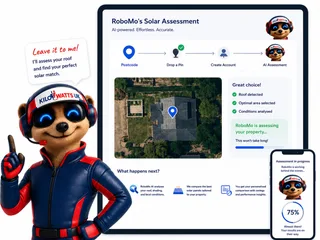
Use Robo
Mo™ to assess your property, compare available technologies and connect with trusted UK installers, suppliers and manufacturers.
Simply enter your postcode, drop a pin on your roof, create your free account and let Robo
Mo™ analyse your property to find the best solar panels for your home.

#### You don't have to think
Robo
Mo™'s AI analyses your roof and does all the hard work.

#### Accurate & tailored
AI-powered assessment based on your roof, location, and conditions.

#### Best options, maximum savings
Compare top solar panels for the best performance and value.

#### Simple, fast & effortless
Provide a few details, sit back and watch your results unfold.

STEP 1
#### Choose Home, Business or Industrial
Enter your postcode to start your assessment.
- Home
- Business
- Industrial
It's fast, free and effortless.
STEP 2

#### Drop a pin on your roof
STEP 3

#### Create your free account
STEP 4

#### Sit back and watch Robo
Mo™ work
Robo
Mo™ analyses your roof and builds your personalised solar comparison.
 ## Flower Turbines
Design your wind energy system.
Instantly forecast generation.
Choose a location, configure your Flower Turbines and instantly see estimated annual generation using location-specific wind data. No account required.

#### Real location data
Generation forecasts based on the location you select.

#### Build your own layout
Configure Flower Turbines to suit your available space.

#### Instant generation forecasts
See estimated annual generation and energy production instantly.

#### No commitment required
Explore different configurations before deciding whether to request a quotation.


STEP 1
#### Enter your postcode
Start designing your wind energy system in seconds.
No account required. Start designing today.
STEP 2

#### Choose a location
STEP 3

#### Build your layout
STEP 4

#### Instant generation forecasts
Compare different turbine layouts and see annual generation forecasts instantly.
STEP 5

#### No commitment required
Explore different configurations before deciding whether to request a quotation.
Are you an installer, distributor or renewable energy business?
Kilowatts UK is actively expanding the Flower Turbines partner network across the United Kingdom. Contact us to discuss installation, reseller and project partnership opportunities.
[Become A Flower Turbines Partner](mailto:dcoleman@flowerturbines.com?subject=Flower%20Turbines%20Partnership%20Enquiry)
## Related articles
[  ### £9,000 Heat Pump Grant: What It Means for UK Homeowners
Learn about the £9,000 heat pump grant announcement and what it means for UK homeowners. Find out if you're eligible, how it works, and what to consider when c…
](/resources/9000-heat-pump-grant-what-it-means-for-uk-homeowners/ "£9,000 Heat Pump Grant: What It Means for UK Homeowners")
[  ### What Does MCS Certification Mean for UK Solar Installations?
Discover how Microgeneration Certification Scheme (MCS) certification affects your solar installation in the UK. Learn about the benefits, what it covers, and…
](/resources/what-does-mcs-certification-mean-for-uk-solar-installations/ "What Does MCS Certification Mean for UK Solar Installations?")
[  ### Flower Turbines UKPN approval: what it means for UK grid connection
Discover what Flower Turbines' UK Power Networks approval means for small wind buyers in the UK, and how it affects their projects. Learn about the importance…
](/resources/flower-turbines-ukpn-approval-what-it-means-for-uk-grid-connection/ "Flower Turbines UKPN approval: what it means for UK grid connection")
[  ### Government Solar Panel Scheme 2026: A Guide to UK Support Routes
Learn about the government solar panel scheme in 2026 and discover the various support routes available for UK homeowners, including ECO4, Great British Insula…
](/resources/government-solar-panel-scheme-2026-a-guide-to-uk-support-routes/ "Government Solar Panel Scheme 2026: A Guide to UK Support Routes")
FAQ
## Need Help? Robo
Mo's Got Answers
Can I have a wind turbine in my garden in the UK? +Yes, you can sometimes install a wind turbine in a UK garden, but it depends on planning rules, site suitability, safety, neighbour impact and the quality of the wind resource. Garden turbines are most realistic for detached rural, coastal or upland homes with open land and clean airflow. They are much less suitable for small urban or sheltered suburban gardens, where buildings, fences, trees and rooflines create turbulence and reduce output.
Do I need planning permission for a garden wind turbine? +You may need planning permission, depending on where you live, the turbine type, its height, rotor size, distance from boundaries and whether your property is in a protected or sensitive area. Some small domestic turbines may qualify as permitted development, but only if every condition is met. Listed buildings, conservation areas, National Parks, National Landscapes, Article 4 Directions, local policies, leasehold restrictions and covenants can all affect what is allowed, so check with your local planning authority before buying equipment.
Are domestic wind turbines covered by permitted development rights? +In some cases, yes. In England, certain small freestanding domestic wind turbines can fall under permitted development rights if they meet strict limits on height, rotor size, location, number of turbines, blade clearance, boundary distances and recognised standards. A commonly referenced freestanding domestic limit in England is 11.1 metres to blade tip, but you should not rely on that figure alone because rules vary by nation, property type and local circumstances.
Is a roof-mounted wind turbine a good idea? +Roof-mounted wind turbines are usually less attractive technically than freestanding turbines. Roofs often create turbulent airflow, and the turbine can transmit vibration and noise into the building. Although small roof-mounted units may look convenient, they often produce limited electricity compared with expectations. Where there is enough land, a freestanding turbine on a properly designed mast is usually the more serious option.
What type of garden is best for a wind turbine? +The best gardens are open, exposed and spacious, with few nearby buildings, trees, hedges or other obstructions. Rural detached homes, coastal homes, upland properties, farms, smallholdings and houses with adjoining open land are more likely to be suitable. The turbine should be positioned where the rotor sits in clean, steady wind and where there is enough space for the mast, foundation, cabling, installation access and long-term maintenance.
Are wind turbines suitable for suburban or urban gardens? +Usually not. Dense housing, mature trees, fences, sheds and nearby rooflines create turbulent, low-quality wind that can make a small turbine underperform. A turbine may spin in gusty air but still generate very little useful electricity. For most suburban homes, solar panels, battery storage, insulation and demand reduction are usually more predictable and cost-effective starting points.
How much wind speed do I need for a garden turbine to be worthwhile? +As a broad screening guide, small domestic wind becomes more interesting where the average wind speed at hub height is around 5 metres per second or higher. Sites around 6 metres per second or more are stronger candidates. Sites below about 4 to 4.5 metres per second at hub height are often difficult to justify financially. The key measurement is wind speed where the centre of the rotor will operate, not how windy the garden feels at ground level.
Why does turbulence matter so much for small wind turbines? +Turbulence reduces generation, increases noise and places more mechanical stress on the turbine. Buildings, trees, fences, hedges and slopes disturb the wind, especially downwind of the obstruction. A turbine in turbulent air may wear faster and generate far less electricity than its brochure rating suggests. Clean, steady wind at hub height is one of the most important requirements for a successful garden turbine.
How much does a domestic wind turbine cost in the UK? +Costs vary widely. Very small roof-mounted turbines may cost around £2,000 to £6,000 installed, although output is often limited. Small freestanding turbines of around 1 k
W to 2 k
W may cost around £7,000 to £15,000 installed. Larger freestanding domestic turbines around 5 k
W to 6 k
W may cost around £20,000 to £40,000, while 10 k
W domestic or farm-scale systems can cost £40,000 to £70,000 or more. The turbine itself is only part of the cost; mast, foundation, cabling, inverter, grid connection, surveys, planning and servicing can all add significantly.
What should be included in a wind turbine quote? +A good quote should include the turbine model, mast or tower, foundation, electrical equipment, inverter, cabling, trenching, grid connection work, certification, planning support, lifting equipment, commissioning and maintenance terms. It should also show expected annual generation in k
Wh, not just the turbine’s rated power in k
W. Rated power can be misleading because actual output depends heavily on wind speed, mast height and site conditions.
Can I get paid for exporting wind-generated electricity? +You may be able to receive export payments through the Smart Export Guarantee if the installation, metering and certification meet the supplier’s requirements. The Feed-in Tariff is closed to new applicants. In most cases, electricity used directly in the home is worth more than exported electricity, so the financial case is stronger where you can use more generation on site, such as with a heat pump, EV charger, workshop or other flexible electrical loads.
Are there grants for domestic garden wind turbines? +There is no universal UK grant that simply pays for every domestic garden wind turbine. Support schemes can change and may depend on location, technology, installer certification and the wider installation package. Export payments through the Smart Export Guarantee may be available if the system qualifies, but they are not the same as an upfront grant. Always ask the installer to confirm current grant eligibility, VAT treatment and export requirements in writing before relying on them in a payback calculation.
Do I need a grid connection application for a domestic wind turbine? +Most grid-connected domestic turbines need to comply with Engineering Recommendation G98 or G99. G98 is usually used for small type-tested generation up to 16 amps per phase, which is around 3.68 k
W on a typical single-phase supply. Larger systems, multiple generators or more complex installations may need G99 approval before connection. Your installer should confirm the correct route with the distribution network operator before installation.
Can I use a wind turbine with solar panels or a battery? +Yes, a wind turbine can be combined with solar panels or battery storage if the system is designed correctly. Wind and solar can complement each other because wind output is often stronger in winter, while solar output is stronger in summer and daylight hours. A battery can help store surplus generation, but it will not solve a poor wind site. If the turbine does not produce much energy, adding a battery will not make the project viable.
Can I use a garden wind turbine off-grid? +Yes, but off-grid wind systems need careful design. They usually require batteries, charge controllers, safe isolation, diversion loads and protection systems so the turbine has somewhere safe to send energy when the batteries are full. Off-grid wind should not be treated as simply adding a turbine to a battery. The system must be designed for charging, braking, overload protection, high-wind conditions and safe maintenance.
Is a wind turbine better than solar panels? +Not for most homes. Solar panels are usually easier to install, easier to predict, lower maintenance and less likely to cause planning or neighbour issues. Wind can be valuable on genuinely exposed sites with strong winter wind and enough space for a proper mast. For many UK households, solar PV and energy efficiency are more practical first choices, with wind considered only where the site is clearly suitable.
Are garden wind turbines noisy? +They can be. Wind turbines may produce aerodynamic blade noise and mechanical noise from moving parts. Noise can be more noticeable at night when background noise is lower. Poor siting, turbulence, worn bearings, blade damage or vibration can make noise worse. Choosing a quality turbine, using a suitable mast, maintaining the system and placing it well away from neighbours and bedrooms can reduce the risk.
Can neighbours object to a garden wind turbine? +Yes. Neighbour concerns can affect planning and the practical success of the project. Issues may include noise, visual impact, shadow flicker, safety, vibration and proximity to boundaries or homes. Speaking to neighbours early can help identify concerns, but neighbour agreement does not replace planning permission or permitted development rules.
Do small wind turbines cause shadow flicker? +They can in some situations, although shadow flicker is usually a bigger concern for larger turbines. It happens when low sun passes through rotating blades and creates a moving shadow through windows or across occupied areas. The risk depends on turbine position, sun path, blade size, distance to neighbouring properties and local topography. Planning authorities may consider shadow flicker where a turbine could affect nearby homes.
Do small wind turbines affect wildlife? +They can, depending on the location. Bats are legally protected in the UK, and turbines near hedgerows, woodland edges, ponds, tree lines or known bat routes may raise ecological concerns. Birds, nesting sites and protected habitats may also be relevant, especially in sensitive rural or coastal areas. A planning authority may request ecological information before deciding whether a turbine is acceptable.
What safety issues should be considered before installing a turbine? +Safety considerations include mast design, foundation strength, braking and overspeed protection, safe isolation, cable protection, lightning risk, corrosion resistance, public access, livestock, children and maintenance access. The installer should explain how the turbine will shut down in high winds, how it will be serviced, how the mast can be lowered or accessed, and what checks are needed after storms or unusual noise.
How do I know whether a wind turbine will generate enough electricity? +Ask for an estimate of annual generation in k
Wh based on the assumed average wind speed at hub height. The estimate should explain how the wind speed was assessed and should account for nearby obstacles and turbulence. For larger domestic systems, an anemometer survey at or near the proposed hub height can reduce the risk of overestimating output. Be cautious of quotes that focus mainly on rated power rather than realistic annual generation.
Do I need a wind survey before installing a domestic turbine? +Not always, but a wind survey can be worthwhile where the investment is significant or the site is complex. Wind maps and desktop estimates are useful for early screening, but they do not prove what the wind is like at the proposed hub height in your garden. An anemometer survey at or close to hub height over several months, ideally longer for higher-cost projects, can reduce the risk of installing a turbine that underperforms.
What are the ongoing maintenance requirements? +Small wind turbines are mechanical systems and need periodic inspection and servicing. Maintenance may include checking blades, bearings, bolts, mast components, braking systems, yaw mechanisms, electrical connections and safety controls. Servicing is especially important on exposed or coastal sites. Before installing, check who will maintain the turbine, how easy it is to access, what the service schedule costs and whether spare parts will remain available.
How long does a domestic wind turbine last? +A well-specified and well-maintained domestic wind turbine can last many years, but lifespan depends on product quality, wind exposure, turbulence, corrosion, maintenance and spare-part availability. Coastal and upland sites can be harsh environments, so corrosion protection, storm resilience and servicing access matter. Before buying, check the warranty, expected service intervals, availability of replacement parts and whether the installer can support the model over its life.
How do I choose a domestic wind turbine installer? +Choose an installer who assesses the site before recommending a turbine. A credible installer should explain the expected annual output in k
Wh, the assumed wind speed at hub height, the planning route, mast and foundation design, grid connection requirements, noise considerations, certification, servicing schedule and warranty support. Be cautious if a proposal relies mainly on rated power, ignores nearby obstacles or avoids discussion of maintenance and planning risk.
When should I decide not to install a garden wind turbine? +You should consider walking away if the site is sheltered, the turbine would sit close to buildings or trees, planning is uncertain, neighbours are likely to be significantly affected, servicing access is poor, or the payback relies on optimistic generation figures. A well-evidenced decision not to proceed can save more money than installing a poorly performing turbine.