# Can Solar Pay for Itself in Your Commercial Property?

[ ](https://www.linkedin.com/in/david-martyn-coleman/ "Linked
In profile for David Coleman")[David Coleman](/authors/david-coleman/ "Author profile for David Coleman")Founder & Renewable Energy Author, kilowatts.uk
# Can Solar Pay for Itself in Your Commercial Property?
**Published:** 2026-07-18 16:57:29
**Updated:** 2026-07-23 08:58:04
Discover how solar power can benefit your business and learn about the factors that affect payback. Find out why self-consumption matters more than export.
[ Preferred on Google](https://www.google.com/preferences/source?q=https://kilowatts.uk)
## Can solar pay for itself in the UK?
Yes, solar can pay for itself in the UK when the value of bill savings, export income and tax treatment recover the installed cost within the working life of the system. For businesses, the strongest driver is usually daytime self-consumption: electricity used on site is normally worth more than electricity exported to the grid.
For a good commercial site with steady daytime electricity use, [commercial solar](/services/commercial/renewable-energy/commercial-solar-panel-installation/compare/) payback is often around 4 to 8 years. For more difficult sites, payback can move towards 7 to 12 years or longer. The difference usually comes down to roof condition, usable demand, grid approval, finance costs, electricity tariffs, maintenance, inverter replacement and the site’s long-term plans.
A solar PV system may generate for 25 to 30 years or more, but it should not be treated as “free electricity” after installation. A dependable business case needs realistic assumptions for output, degradation, maintenance, insurance, export, tax and future electricity use.
## Short summary for businesses.
a paragraph here
- Commercial solar pays for itself mainly by reducing imported electricity.
- The best sites use a high share of solar generation during daylight hours.
- Export income can help, but export rates are usually lower than import rates.
- A strong UK commercial payback is often around 4 to 8 years.
- More complex sites may see 7 to 12 years or longer.
- Half-hourly electricity data is essential for a reliable estimate.
- Roof condition, grid connection and switchgear can materially change costs.
- Batteries can improve some projects, but they are not automatically worth adding.
- Finance can make a project cashflow positive even if it increases total lifetime cost.
- Tax treatment should be checked with an accountant before it is included in the model.
For most businesses, monthly electricity bills are not enough. A reliable payback calculation needs half-hourly consumption data, tariff details, a roof and electrical survey, DNO grid connection checks, and sensible allowances for maintenance and inverter replacement.
## How commercial solar pays for itself.
Solar PV panels convert daylight into electricity. In a [commercial solar panel installation](https://kilowatts.uk/services/commercial/renewable-energy/commercial-solar-panel-installation/ "commercial solar panel installation"), that electricity is normally used by the building first. Any surplus may be exported to the grid if the system, metering and connection agreement allow it.
- The financial return usually comes from three areas:
- Avoided grid electricity purchases.
- Export income for unused generation.
- Tax or accounting treatment of the solar asset.
The most important point is simple: one kilowatt hour used on site is usually worth more than one kilowatt hour exported. If a business pays 25p per k
Wh for imported electricity, every self-used solar k
Wh can avoid roughly that unit cost. If exported electricity earns only 5p to 8p per k
Wh, export still has value but is much less powerful. Payback is the point at which cumulative savings and income recover the initial cost. It is not the same as total profit. After payback, the system may continue producing savings, but those savings still depend on panel degradation, inverter life, maintenance, monitoring, insurance and the future use of the building.
## What a typical UK payback looks like.
For strong UK commercial sites, a payback period of around 4 to 8 years is often realistic. These are usually buildings with:
- Consistent daytime electricity demand.
- A sound roof with enough usable space.
- Simple installation access.
- Limited shading.
- Suitable electrical infrastructure.
- A workable DNO connection route.
- Long-term site occupation.
For weaker sites, payback can be closer to 7 to 12 years or more. This is more likely where the site is closed at weekends, uses most electricity in the evening, exports much of the solar generation, needs electrical upgrades, has a fragile or asbestos-containing roof, or faces DNO export restrictions. A well-sited UK commercial solar system often generates around 800 to 1,000 k
Wh per k
Wp per year. Southern England sites can sometimes exceed 1,000 k
Wh per k
Wp per year, while northern locations, shading, poor orientation and low roof pitch can reduce output. As a broad guide, a 100 k
Wp system might generate roughly 80,000 to 100,000 k
Wh per year. The real figure should be modelled from the actual roof, orientation, shading, local irradiance and inverter design.
## A simple commercial solar example.
Consider a 100 k
Wp commercial solar system generating around 90,000 k
Wh per year.
If the business uses 80% of that electricity on site, it self-consumes about 72,000 k
Wh and exports about 18,000 k
Wh.
If imported electricity costs 25p per k
Wh, the self-used solar electricity avoids about £18,000 of annual grid purchases. If exported electricity earns 6p per k
Wh, the exported portion adds about £1,080.
- That gives a simple gross annual benefit of about £19,080 before:
- Maintenance.
- Monitoring.
- Finance costs.
- Tax treatment.
- Insurance.
- Panel degradation.
- Inverter replacement.
- Export metering or administration costs.
- Any future roof removal and reinstatement costs.
- A practical comparison shows the difference:
- Cold store or food manufacturer: likely to have steady daytime and weekend demand, so self-consumption may be high.
- Office with weekday daytime use: often a reasonable match, but weekend export may reduce the return.
- Distribution warehouse with low electrical demand: may have a large roof but limited load, so a smaller system may give a better payback than filling the roof.
- School or leisure centre: can work well, but holidays, operating hours and heating or ventilation loads need careful modelling.
For a medium commercial system, installed costs are often around £700 to £1,200 per k
Wp, although roof type, access, switchgear, grid works, monitoring and project complexity can move this range. In this example, strong self-consumption makes the business case attractive. If the same system exported most of its output, the payback would be much weaker because most generation would be valued at the lower export rate rather than the higher avoided import rate. The right system size is not always the largest possible system. It is the size that produces useful electricity at the right times, within roof, grid and financial constraints.
## Why self-consumption matters more than export.
Self-consumption is the share of solar generation used by the building at the time it is generated. For most commercial projects, it is the main cashflow driver.
A strong match usually comes from a daytime baseload. Suitable sites can include refrigeration facilities, cold stores, manufacturers, offices, hotels, leisure centres, farms, schools and warehouses. The building type alone is not enough, however. The actual load profile matters more than the label.
For example, a warehouse with electric forklifts, refrigeration, office areas and EV charging may use significant daytime electricity. A similar-sized warehouse used only for storage may have low demand and export much of its solar output. The roof area may look identical, but the payback can be very different. Export still has value, but it should be modelled cautiously. Export prices vary by supplier, contract structure, system size and market conditions. Export terms may also depend on metering, DNO approval and whether export limitation is required. A proposal that relies heavily on optimistic export income should be tested carefully.
## Costs that affect whether solar pays for itself.
Commercial solar costs are usually discussed in pounds per k
Wp, but the headline price is only part of the decision.
- As broad UK market ranges:
- Small commercial systems of around 10 to 30 k
Wp often cost about £900 to £1,500 per k
Wp.
- Medium systems of around 30 to 250 k
Wp often cost about £700 to £1,200 per k
Wp.
- Larger rooftop systems above around 250 k
Wp can fall to about £600 to £900 per k
Wp.
- Common cost variables include:
- Roof access and working at height requirements.
- Structural checks and any roof strengthening.
- Scaffolding, edge protection and fragile roof precautions.
- Roof covering type and roof warranty conditions.
- Asbestos surveys or specialist roof controls where relevant.
- DNO application work and possible export limitation.
- Switchgear, metering and electrical upgrades.
- Cable routes and inverter locations.
- Monitoring, maintenance and inverter replacement.
- Insurance requirements and fire safety documentation.
- Planning constraints, especially for sensitive sites.
These are indicative ranges, not guarantees. A simple trapezoidal metal roof with good access is very different from a fragile roof with rooflights, asbestos risk, poor edge protection and old electrical switchgear. The cheapest quote is not always the lowest lifetime cost. A low price may exclude access, structural checks, fire safety documentation, monitoring, grid application work, roof warranty requirements or electrical upgrades. Battery storage can materially increase upfront cost. [Commercial solar battery storage](https://kilowatts.uk/services/commercial/renewable-energy/commercial-solar-battery-storage/ "commercial solar battery storage") can improve self-consumption where solar output and site demand do not align, but it does not automatically improve payback. If a business already uses most of its solar generation during daylight hours, a solar-only system may be the stronger financial choice.
## Cashflow is not the same as payback.
A project can have an acceptable long-term payback but still create cashflow pressure if it is bought outright. Conversely, a financed system can be cashflow positive if annual savings exceed annual repayments, even though finance costs reduce lifetime savings.
Upfront purchase usually gives the strongest long-term return if the business has the capital and wants to own the asset. Finance, lease and power purchase agreement models can reduce the initial cash requirement, but they change ownership, risk and savings allocation.
- ### Hire purchase
The business pays over time and may own the system after the final payment, depending on the agreement.
- ### Lease finance
The business spreads payments over time, preserving capital but adding finance cost.
- ### Upfront purchase
The business pays for the system and usually keeps the greatest lifetime benefit, subject to maintenance and ownership responsibilities.
- ### Power purchase agreement
A third party usually owns the panels and sells generated electricity to the site under contract.
For commercial buyers, the question is not only “what is the payback?” It is also “what happens to monthly cashflow?” A seasonal business is a good example. A site may save strongly in summer but have lower savings in winter. If finance repayments are fixed every month, the annual payback may look acceptable while winter cashflow still feels tight. The model should therefore show monthly or seasonal cashflow, not just a single annual average.
## UK government support, tax and policy points.
There is generally no universal national grant that makes standard commercial rooftop solar free in the UK. Local authority grants sometimes exist, but they are local, time-limited and subject to eligibility rules. Some public sector schemes may support solar where it forms part of wider decarbonisation, but ordinary commercial buyers should not assume grant funding will be available.
UK policy still matters. Planning rules, grid connection reform, business rates treatment, tax allowances and public sector procurement can all affect confidence and project economics. The British Energy Security Strategy referred to an ambition of up to 70 GW of solar by 2035, but national ambition does not replace site-specific financial modelling.
Solar PV is generally treated as plant and machinery for tax purposes. The Annual Investment Allowance or full expensing may be relevant in some cases, depending on ownership, company status, timing and the specific structure of the transaction. Business rates treatment can also matter and may differ across the UK. Businesses should ask their accountant to check tax, VAT, ownership and capital allowance treatment before relying on those assumptions in a payback model. This is particularly important for leased systems, landlord-and-tenant arrangements, PPAs and group-company structures.
## Roof and grid constraints can make or break the case.
A commercial solar proposal is only as good as the building it sits on. Roof area, orientation, pitch and shading all affect output. South-facing roofs often maximise annual generation, while east-west layouts can spread generation more evenly across the day and may better suit some business loads.
Roof condition is a common deal-breaker. It is often poor practice to install solar on a roof that may need replacement soon, because removing and reinstating panels can add avoidable cost. Roof warranties should also be checked, as some require approved mounting systems, approved contractors or specific fixing methods.
Grid connection is just as important. Many commercial systems need DNO involvement before installation. Larger or three-phase systems usually require G99 approval, and the DNO may restrict export, require export limitation or identify reinforcement works. Grid limits do not always stop a project. They may lead to a smaller system, an export-limited design, a phased approach or a battery-backed design. However, reinforcement costs and delays can materially weaken the financial case, so they should be identified early.
## What data is needed for a reliable payback estimate.
A proper commercial solar assessment should start with the site’s actual electricity use, not with a generic roof size. Half-hourly data for at least 12 months is usually the best basis because it shows when electricity is being used and how closely demand matches solar generation.
- Useful information includes:
- Site address and MPAN details.
- Half-hourly consumption data for at least 12 months.
- Current import tariff and any export tariff.
- Standing charges and capacity charges.
- Maximum demand and available supply capacity.
- Roof plans, roof age and roof covering type.
- Structural information and asbestos register where relevant.
- Main supply capacity and switchgear details.
- Operating hours, weekend use and seasonal shutdowns.
- Planned EV charging, heat pumps or equipment changes.
- Lease terms, landlord consent requirements and roof access rights.
- Insurance requirements and any fire safety conditions.
Without this data, a payback estimate may rely on assumptions that are too optimistic. A desktop quote can be useful at an early stage, but it should not be treated as a final technical design. A credible proposal should make the assumptions visible. It should show expected generation, self-consumption, export, import price, export price, degradation, maintenance, inverter replacement and finance costs. If those numbers are hidden, the buyer cannot properly judge whether solar will pay for itself.
## When commercial solar is likely to be suitable.
Commercial solar is usually strongest where the building has daytime electricity demand, long-term occupancy, a sound roof and a clear route through grid approval. It also helps if the business expects electricity use to remain stable or rise through EV charging, electrified processes, heat pumps or site expansion.
Solar may be suitable for owner-occupiers, landlords, tenants and public sector buildings, but the legal structure matters.
- A tenant may need:
- Landlord consent.
- A licence for alterations.
- Agreement on roof access.
- Insurance approval.
- Clarity on export income.
- End-of-lease removal or transfer terms.
A landlord may need a way to share costs and benefits with occupiers. If the landlord pays for the system but the tenant receives the bill savings, the commercial arrangement needs to reflect that. Solar may be less suitable where the business plans to move soon, the roof needs replacement, daytime demand is very low, export is heavily constrained, or finance costs exceed expected savings. It may also be unsuitable where planning restrictions, listed building status or conservation constraints prevent a workable design.
## Installer-level checks that are easy to overlook.
A good commercial solar design is not just a panel layout. It should consider roof structure, safe access, cable routes, inverter locations, switchgear condition, metering, monitoring, fire access and future maintenance.
Inverter location is a practical example. Inverters need ventilation, access and appropriate cable routes. Placing them in a hot, cramped or inaccessible area can shorten equipment life and make maintenance harder.
- Solar arrays should also avoid blocking:
- Roof hatches.
- Smoke vents.
- Gutters and drainage routes.
- Fire access paths.
- Plant maintenance routes.
- Rooflights and fragile areas.
- Areas needed for future roof repairs.
Insurers may ask for layout information, fire plans, isolator details, clearances and maintenance arrangements. Commercial projects also need proper attention to construction safety, rooflights, fragile roof work and CDM duties. These issues can affect cost and programme, so they should be addressed before the project is priced as if it were a simple installation.
## Batteries can help, but they are not automatic.
Battery storage can store excess solar electricity for use later in the day. It can also help with peak shaving on some half-hourly tariffs. For sites that export during the day and import in the evening, batteries may improve the overall case.
However, batteries add cost, complexity and degradation risk. Commercial batteries may need fire safety assessment, suitable location, ventilation, access arrangements and sometimes separate DNO consideration. They also tend to have shorter typical lifespans than panels.
A sensible approach is to model the solar-only system first, then test whether adding a battery improves cashflow. The battery should be justified by the data.
- A battery may be worth testing where:
- The site exports a large share of daytime solar generation.
- The site imports at expensive evening or peak rates.
- Demand charges or peak capacity costs are significant.
- EV charging creates new load outside solar hours.
- The site needs better control over demand peaks.
- A battery may add little value where:
- Daytime self-consumption is already high.
- Export income is reasonable.
- Peak charges are low.
- The battery would cycle infrequently.
- The added capital cost pushes payback too far out.
## Common mistakes that weaken solar payback.
Many weak solar business cases fail because the assumptions are too simple. The most common mistake is assuming 100% self-consumption without checking half-hourly demand.
- Other common mistakes include:
- Ignoring inverter replacement.
- Ignoring maintenance and monitoring.
- Ignoring finance costs.
- Assuming export will always be available.
- Assuming export rates will remain favourable.
- Oversizing the system so most extra generation is exported.
- Ignoring roof strengthening or roof replacement costs.
- Forgetting the cost of removing panels for future roof works.
- Using unrealistic future electricity price increases.
- Treating a desktop estimate as a final design.
- Failing to check landlord consent, insurance or planning constraints.
A larger system is not always better. Once the building’s useful daytime demand is covered, additional panels may produce electricity that is mostly exported at a lower value. In some cases, a smaller system with higher self-consumption gives a faster and more reliable payback. Businesses should also be cautious of proposals that show only the best-case result. A good model should include a sensitivity check, such as lower electricity prices, lower site demand, reduced export rates or higher maintenance costs.
## How to decide if solar will pay for itself for your site.
The practical decision is to compare the installed cost and financing structure with the site’s expected annual savings over the system life. Start with the load profile, then size the system around useful self-consumption, roof constraints and DNO limits.
- A sensible decision process is to:
- Gather half-hourly electricity data and tariff details.
- Check roof condition, ownership and lease constraints.
- Confirm likely planning and DNO requirements.
- Model solar generation against actual site demand.
- Compare upfront purchase, finance, lease and PPA options.
- Include maintenance, monitoring, inverter replacement and tax assumptions.
- Stress-test the model against lower electricity prices and lower site consumption.
- Check insurance, fire safety and access requirements.
- Confirm who owns the system and who receives the savings.
- Review whether future EV charging, heat pumps or expansion will change demand.
For larger factories, warehouses and process-led sites, it can also be useful to [compare industrial solar options](/services/industrial/renewable-energy/industrial-solar-panel-installation/compare/) against commercial-scale proposals, especially where roof area, consumption and grid constraints are substantial. If the site has strong daytime use, a sound roof and a workable grid connection, commercial solar can pay for itself and continue producing savings long after payback. If those conditions are weak, the right answer may be a smaller system, a different finance structure, battery modelling, roof works first, or no installation until the site is better suited.
### Ready to compare your options?
Get tailored comparisons and connect with trusted installers in under a minute.
[ Book a Survey ](https://kilowatts.uk/booking/?kwrf=8SA53&kwpid=6&kwlid=9)[ Compare Solar](/services/residential/renewable-energy/residential-solar-panel-installation/compare/)
Tags: [Renewable energy uk](/tags/renewable-energy-uk/ "Renewable energy uk")[Solar panels uk](/tags/solar-panels-uk/ "Solar panels uk")[Home battery](/tags/home-battery/ "Home battery")[Solar storage](/tags/solar-storage/ "Solar storage")[Panel efficiency](/tags/panel-efficiency/ "Panel efficiency")[Inverter sizing](/tags/inverter-sizing/ "Inverter sizing")[Export tariff](/tags/export-tariff/ "Export tariff")[Uk solar grants](/tags/uk-solar-grants/ "Uk solar grants")[Installation cost](/tags/installation-cost/ "Installation cost")[Payback period](/tags/payback-period/ "Payback period")
[ Preferred on Google](https://www.google.com/preferences/source?q=https://kilowatts.uk)
## Plan, Compare & Buy Renewable Energy Solutions
AI does the thinking.
You get the perfect solar match.
Use Robo
Mo™ to assess your property, compare available technologies and connect with trusted UK installers, suppliers and manufacturers.
Simply enter your postcode, drop a pin on your roof, create your free account and let Robo
Mo™ analyse your property to find the best solar panels for your home.

#### You don't have to think
Robo
Mo™'s AI analyses your roof and does all the hard work.

#### Accurate & tailored
AI-powered assessment based on your roof, location, and conditions.

#### Best options, maximum savings
Compare top solar panels for the best performance and value.

#### Simple, fast & effortless
Provide a few details, sit back and watch your results unfold.
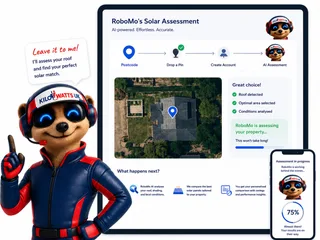
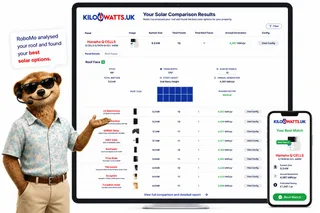
STEP 1
#### Choose Home, Business or Industrial
Enter your postcode to start your assessment.
- Home
- Business
- Industrial
It's fast, free and effortless.
STEP 2

#### Drop a pin on your roof
STEP 3

#### Create your free account
STEP 4

#### Sit back and watch Robo
Mo™ work
Robo
Mo™ analyses your roof and builds your personalised solar comparison.
 ## Flower Turbines
Design your wind energy system.
Instantly forecast generation.
Choose a location, configure your Flower Turbines and instantly see estimated annual generation using location-specific wind data. No account required.

#### Real location data
Generation forecasts based on the location you select.

#### Build your own layout
Configure Flower Turbines to suit your available space.

#### Instant generation forecasts
See estimated annual generation and energy production instantly.

#### No commitment required
Explore different configurations before deciding whether to request a quotation.
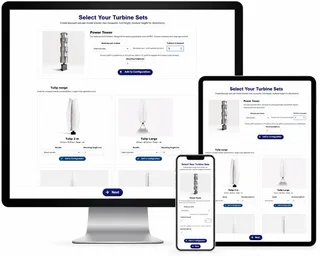
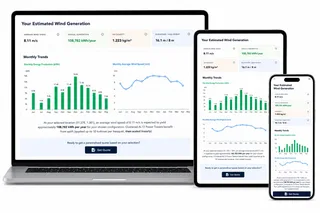
STEP 1
#### Enter your postcode
Start designing your wind energy system in seconds.
No account required. Start designing today.
STEP 2

#### Choose a location
STEP 3

#### Build your layout
STEP 4

#### Instant generation forecasts
Compare different turbine layouts and see annual generation forecasts instantly.
STEP 5

#### No commitment required
Explore different configurations before deciding whether to request a quotation.
Are you an installer, distributor or renewable energy business?
Kilowatts UK is actively expanding the Flower Turbines partner network across the United Kingdom. Contact us to discuss installation, reseller and project partnership opportunities.
[Become A Flower Turbines Partner](mailto:dcoleman@flowerturbines.com?subject=Flower%20Turbines%20Partnership%20Enquiry)
FAQ
## Need Help? Robo
Mo's Got Answers
Can solar panels pay for themselves in the UK? +Yes. Solar panels can pay for themselves in the UK when the value of electricity bill savings, export income and any applicable tax benefits recover the installation cost within the working life of the system. For commercial sites, the strongest return usually comes from using solar electricity on site during the day, because avoided imported electricity is normally worth more than exported electricity.
What is a typical commercial solar payback period in the UK? +A strong commercial solar project in the UK often pays back in around 4 to 8 years. More complex sites may take around 7 to 12 years or longer, especially if the roof needs work, the site exports a lot of electricity, grid approval is restricted, finance costs are high or electrical upgrades are needed. The real payback should always be modelled using the site’s actual electricity use and project costs.
Why does self-consumption matter so much for solar payback? +Self-consumption is the share of solar electricity used by the building at the time it is generated. It matters because each self-used unit can reduce imported electricity at the site’s normal import rate, while exported electricity usually earns a lower rate. A business paying 25p per k
Wh for imported power may save close to that amount for each solar k
Wh used on site, whereas exported electricity may only earn a much lower export price.
Is exporting solar electricity to the grid enough to make solar worthwhile? +Export income can help, but it is usually not the main reason commercial solar pays for itself. Export rates are commonly lower than import rates, so a system that exports most of its generation will usually have a weaker payback than a system matched to daytime demand. Export also depends on metering, supplier terms, DNO approval and whether export limitation is required.
What information is needed to calculate solar payback accurately? +A reliable solar payback estimate usually needs at least 12 months of half-hourly electricity consumption data, current tariff details, export tariff assumptions, roof information, operating hours, supply capacity, switchgear details and expected future changes such as EV charging, heat pumps or site expansion. Without this data, the estimate may rely on assumptions that are too optimistic.
How much electricity does a commercial solar system generate in the UK? +A well-sited UK commercial solar system often generates around 800 to 1,000 k
Wh per k
Wp per year. Southern locations, good orientation and limited shading can improve output, while northern locations, shading, poor roof orientation and unsuitable pitch can reduce it. As a broad example, a 100 k
Wp system might generate roughly 80,000 to 100,000 k
Wh per year, but the final figure should be modelled for the actual site.
What costs affect whether commercial solar pays for itself? +The main costs include the installed solar PV system, roof access, structural checks, scaffolding or edge protection, mounting system, electrical works, switchgear upgrades, DNO application work, metering, monitoring, maintenance and future inverter replacement. Roof condition, asbestos risk, insurance requirements, fire safety documentation and planning constraints can also affect the total cost and the payback period.
Is the biggest possible solar system always the best option? +No. The best system size is usually the one that produces useful electricity at the right times, within the limits of the roof, grid connection and financial model. Oversizing a system can reduce payback if the extra generation is mostly exported at a lower value. In some cases, a smaller system with higher self-consumption gives a faster and more reliable return.
Do commercial solar panels need battery storage to pay for themselves? +Not always. Batteries can improve some projects by storing excess daytime solar electricity for later use or by helping reduce peak demand charges. However, they add cost, complexity and degradation risk. A sensible approach is to model the solar-only system first, then test whether a battery improves cashflow and payback based on the site’s half-hourly demand data.
Can solar be cashflow positive if it is financed? +Yes, a financed solar project can be cashflow positive if the annual or monthly savings are greater than the finance repayments. However, finance usually increases the total lifetime cost compared with buying the system outright. Businesses should review both payback and cashflow, especially where savings are seasonal but repayments are fixed throughout the year.
Are there government grants for commercial solar in the UK? +There is generally no universal national grant that makes standard commercial rooftop solar free for UK businesses. Local authority grants and public sector schemes may be available in some areas or sectors, but they are usually time-limited and subject to eligibility rules. Businesses should not rely on grant funding unless it has been confirmed for their specific project.
How does tax affect commercial solar payback? +Solar PV may be treated as plant and machinery for tax purposes, so capital allowances such as the Annual Investment Allowance or full expensing may be relevant in some cases. The correct treatment depends on ownership, company status, timing, finance structure and the type of agreement used. Businesses should check tax, VAT, capital allowance and business rates treatment with their accountant before including tax benefits in the payback model.
Can roof condition affect solar payback? +Yes. Roof condition can make or break a solar project. Installing panels on a roof that may need replacement soon can lead to extra removal and reinstatement costs later. Roof warranties, structural capacity, rooflights, fragile roof areas, asbestos risk, access routes and drainage must also be checked before installation costs and savings can be assessed properly.
Does the grid connection affect whether solar pays for itself? +Yes. Many commercial solar systems need DNO approval, and larger or three-phase systems may require a formal grid application. The DNO may allow full export, restrict export, require export limitation or identify reinforcement works. Grid limits do not always stop a project, but they can change the system size, cost, timeline and financial return.
Which businesses are best suited to commercial solar? +Commercial solar is usually strongest for businesses with steady daytime electricity use, long-term site occupation, a sound roof and a workable grid connection. Good candidates can include manufacturers, cold stores, offices, hotels, leisure centres, farms, schools and warehouses with meaningful daytime demand. The building type is less important than the actual electricity load profile.
When might solar not pay for itself? +Solar may not pay for itself within an acceptable period if the site has low daytime electricity demand, heavy shading, poor roof condition, high installation complexity, expensive electrical upgrades, restricted export, short remaining lease length or plans to move soon. It may also be unsuitable where planning, insurance, landlord consent or roof warranty issues prevent a practical installation.
What common mistakes make solar payback look better than it really is? +Common mistakes include assuming 100% self-consumption, ignoring export restrictions, using unrealistic electricity price increases, omitting maintenance and inverter replacement, overlooking finance costs, failing to check roof condition, and treating a desktop estimate as a final design. A credible solar proposal should show its assumptions clearly and stress-test the result against less favourable conditions.
How long do commercial solar panels last? +Commercial solar panels can often generate electricity for 25 to 30 years or more, although output gradually reduces over time. Inverters usually have a shorter working life than panels and may need replacement during the system’s lifetime. Long-term savings should therefore include degradation, maintenance, monitoring, insurance and equipment replacement rather than assuming the system is cost-free after installation.