# Commercial solar for care homes in the UK

[ ](https://www.linkedin.com/in/david-martyn-coleman/ "Linked
In profile for David Coleman")[David Coleman](/authors/david-coleman/ "Author profile for David Coleman")Founder & Renewable Energy Author, kilowatts.uk
# Commercial solar for care homes in the UK
**Published:** 2026-07-18 18:44:28
**Updated:** 2026-07-25 05:36:18
Find out commercial solar for care homes in the UK, including costs, what affects price, and how to choose an installer.
[ Preferred on Google](https://www.google.com/preferences/source?q=https://kilowatts.uk)
## [Commercial solar for care homes](/services/commercial/renewable-energy/commercial-solar-panel-installation/compare/) in the UK
Commercial solar panels for care homes in the UK can be a strong investment where the site has consistent daytime electricity use, suitable roof space, manageable grid connection requirements and a long enough occupancy plan to benefit from the savings. Care homes are often well matched to solar PV because they operate every day and use electricity for lighting, kitchens, laundry, lifts, ventilation, pumps, medical equipment, offices and, increasingly, EV charging.
Solar will not usually make a care home fully energy independent. In most cases, a commercial solar PV system reduces grid imports during daylight hours, with surplus electricity exported or stored if battery storage is included. The commercial case depends less on the number of panels alone and more on how much generated electricity is used on site at the time it is produced.
A sensible care home solar proposal should assess roof condition, structural loading, shading, fire safety, electrical capacity, DNO approval, resident disruption, insurance requirements and future energy plans. The cheapest quote is rarely the best comparison point unless every installer has allowed for the same surveys, access, grid work, monitoring and operational constraints. \*\*Author note:\*\* This guide has been prepared by Kilowatts UK’s commercial renewable-energy content team, drawing on UK solar PV procurement, electrical compliance, DNO connection and building-suitability considerations for commercial premises. It is intended to help care home owners, operators, estates teams and finance directors ask better questions before commissioning a site-specific design. It is not a substitute for a structural survey, electrical design, planning advice, insurance review or tax advice.
## Why care homes are often good solar sites
Care homes differ from many commercial buildings because they use power seven days a week. There is usually a steady daytime base load from kitchens, laundry, lighting, ventilation, office equipment, refrigeration and care-related systems. That improves the chance that solar generation is consumed on site rather than exported at a lower value.
Homes with larger laundry facilities, electric cooking, air conditioning, heat pumps or [EV charging plans](https://kilowatts.uk/services/commercial/electric-vehicle-infrastructure/commercial-ev-charger-installation/ "commercial ev charger installation") may be particularly suitable. East-west roof layouts can also work well because they spread generation more evenly through the day, rather than concentrating output around midday.
Solar still produces electricity in cloudy UK weather because solar panels use daylight, not heat. Output is lower in winter and on dark days, so design assumptions should be realistic. A commercial solar panel system that looks excellent in summer may only make a modest contribution in December, especially for sites with higher evening and winter demand. For care home operators, the main attraction is usually a combination of:
- Lower imported electricity consumption.
- Better control over long-term energy costs.
- Reduced carbon emissions for ESG and sustainability reporting.
- Potential support for future electrification, such as EV charging or heat pumps.
- A visible investment in lower-carbon operations for residents, families, commissioners and staff.
## What a care home solar system includes
A [commercial solar PV system](https://kilowatts.uk/services/commercial/renewable-energy/commercial-solar-panel-installation/ "commercial solar panel installation") for a care home normally includes roof-mounted or ground-mounted panels, mounting equipment, inverters, cabling, isolators, metering, monitoring and grid connection equipment. Larger sites often have a three-phase electrical supply, and the design must account for load balancing, protection settings and the capacity of the existing distribution boards.
The panels convert daylight into direct current electricity. Inverters convert that electricity into alternating current for use in the building. The care home uses solar generation first where demand is present, reducing imported electricity from the grid. Surplus power may be exported under an export tariff, restricted by export limitation equipment, or stored in a battery if the system includes one.
[Batteries are optional](https://kilowatts.uk/services/commercial/renewable-energy/commercial-solar-battery-storage/ "commercial solar battery storage"). They can increase self-consumption, help with evening demand, support peak tariff management and contribute to resilience planning. However, they are not always financially justified where the care home already uses most of the solar electricity during the day. Backup-capable solar and battery systems need specialist design because a standard grid-connected solar PV system shuts down during a power cut for safety reasons. If resilience is a key requirement, the installer should explain exactly which circuits can be supported, for how long, under what conditions and whether additional switchgear is required.
## How much commercial solar costs for care homes
Typical UK commercial solar costs are often around £700 to £1,200 per [k
Wp](/blog/what-is-kwp-in-solar-panel "What is kwp in solar panel?") installed, excluding VAT. Smaller systems usually cost more per k
Wp than larger systems because design, access, electrical work and project management are spread across fewer panels.
Indicative commercial solar panel installation costs for care homes may be:
- A 30 k
Wp system: roughly £25,000 to £45,000 excluding VAT.
- A 50 k
Wp system: roughly £40,000 to £70,000 excluding VAT.
- A 100 k
Wp system: roughly £75,000 to £120,000 excluding VAT.
- Full design and generation modelling.
- Scaffolding, edge protection and safe access.
- Structural assessment or structural engineer input.
Those ranges are only a starting point. Real care home solar projects can move above or below them depending on the building and the electrical connection. Cost is affected by roof access, scaffolding, roof type, structural work, asbestos management, monitoring, grid applications, export limitation, inverter location, fire stopping, cable routes and any upgrades needed to the main distribution board. VAT can also be complex for care homes. Some energy-saving materials installed in residential accommodation may qualify for temporary VAT relief in certain circumstances, but care homes can fall into specific VAT categories depending on the nature of the accommodation and care provided. Operators should not rely on a generic VAT assumption without professional advice. When comparing care home solar quotes, check whether the price includes: Asbestos-related checks or exclusions. DNO application and export arrangements. Monitoring hardware and software. Fire stopping and labelling. Commissioning, handover documents and maintenance guidance. Any provisional sums for electrical upgrades.
## What affects payback and savings
Payback for UK care home solar is often around 4 to 8 years, but the actual result depends on site-specific data. The most important factor is how much solar electricity the home uses directly, because avoided imported electricity is usually worth more than exported electricity.
A 50 k
Wp system may generate roughly 42,500 to 55,000 k
Wh per year in the UK. A 100 k
Wp system may generate roughly 85,000 to 110,000 k
Wh per year. Annual output depends on location, orientation, pitch, shading, inverter design and maintenance.
Self-consumption for care homes may be around 50% to 90%, depending on demand and system size. A smaller system on a high-load site may use nearly all generation on site, while an oversized system on a lower-load site may export more. Export still has value, but the Smart Export Guarantee is usually secondary to bill savings. The main financial factors are: Daytime electricity unit rate. Amount of solar generation used on site. Export tariff and export metering arrangements. Installed system cost and finance structure. Roof and electrical upgrade requirements. DNO requirements and any grid reinforcement costs. Care homes on fixed contracts, flexible purchasing arrangements or half-hourly tariffs may see different savings from the same solar system. The proposal should compare solar generation against the tariff structure, not just the annual electricity bill. For stronger financial modelling, ask for savings projections using: Planned future loads such as EV charging or heat pumps. Maintenance costs and inverter replacement assumptions. Whether the property is owned, leased or part of a wider care group estate. At least 12 months of electricity consumption data. Half-hourly data where available. Current and expected future import rates. A clearly stated export tariff assumption. Conservative generation estimates. Degradation assumptions over the system life. A sensitivity analysis showing what happens if prices, export rates or self-consumption change.
## Government support, export payments and tax treatment
UK government support for solar changes over time. Current support is generally more about export payments, tax treatment and planning policy than direct grants for private care home operators. Public sector or charity-linked care facilities may have different routes, but most private care homes should not assume grant funding is available.
The Smart Export Guarantee allows eligible sites to be paid for exported solar electricity. Rates vary by supplier, and some suppliers require MCS certification or an equivalent recognised installation standard. Commercial sites may also need half-hourly metering and an export MPAN before export payments are fully operational.
Companies may be able to use capital allowances for solar investment. The Annual Investment Allowance or full expensing may be relevant in some cases, depending on the ownership structure and accounting position. This should be checked with an accountant before final investment approval. Care home operators should also confirm how a solar PV asset will be treated within their wider financial and operational structure, especially where:
- The care home property and operating company are separate entities.
- The building is leased.
- Energy costs are recharged internally.
- The operator is part of a multi-site group.
- The care home is run by a charity, CIC or public-sector body.
- Finance, leasing or power purchase agreement options are being considered.
## Roof, planning and grid connection checks
Roof suitability is one of the first practical questions. Many care homes are made up of original buildings, later extensions, plant rooms, flat roofs, pitched roofs and mixed roof coverings. A desktop estimate can be useful, but it should not replace a [proper survey](https://kilowatts.uk/booking/?kwrf=8SA53&kwpid=6&kwlid=9).
A good early assessment should check:
Roof age and condition. Structural loading capacity. Shading from trees, chimneys, parapets and nearby buildings. Asbestos information. Safe access for installation and maintenance. Roof warranty implications. [Planning rules](https://kilowatts.uk/resources/do-i-need-planning-permission-for-solar-panels-in-the-uk/ "do i need planning permission for solar panels in the uk") vary across England, Scotland, Wales and Northern Ireland. Many rooftop commercial solar installations in England may fall under permitted development if they meet the relevant conditions, but listed buildings, conservation areas, National Parks, Areas of Outstanding Natural Beauty and World Heritage Sites need particular care. Ground-mounted solar normally requires more planning consideration than rooftop solar. Grid connection is another major issue. Smaller systems may fall under G98 rules, while larger commercial systems usually require G99 approval. The Distribution Network Operator may approve the system, require export limitation, request further studies, or identify upgrade work. This can affect project timescale, cost and viable system size. For care homes, grid and electrical checks should be treated as core design items, not late-stage administration. The installer should confirm: Space for inverters, isolators and cable routes. Existing lightning protection and whether it needs review. Location of plant rooms, ventilation equipment and roof access hatches. Whether a roof replacement or refurbishment is likely during the solar system’s life. Whether the existing supply is single-phase or three-phase. The agreed supply capacity. Whether the proposed system needs G98 or G99 approval. Whether export limitation is required. Whether an export MPAN is needed. Whether the main distribution board has sufficient capacity. Whether shutdowns will be required for connection works. How critical circuits will be protected during installation and commissioning.
## Fire safety and operational disruption
Fire safety is especially important in care homes because residents may be vulnerable and evacuation can be complex. Solar PV does not remove the need for a conventional fire risk assessment, and the fire strategy should be reviewed when a system is added.
Design should consider fire service access routes, safe inverter locations, cable routing, isolation, labelling and fire-rated penetrations. DC cable runs should be planned carefully, and unnecessary internal routing should be avoided where practical. Insurers may also have specific requirements for competence, installation standards, isolators, [inspection and maintenance records](https://kilowatts.uk/services/commercial/general-electrical-work/commercial-electrical-inspections/ "commercial electrical inspections").
Installation in an occupied care home needs more planning than a normal commercial roof. Resident safety, safeguarding, infection control, deliveries, ambulance access, staff parking, noise and planned shutdowns all matter. The final electrical connection may require a shutdown, so this must be coordinated with critical systems such as nurse call equipment, refrigeration, lifts, fire alarms and medical equipment. A good project plan should include:
- Site-specific RAMS.
- Working-at-height controls.
- Resident and visitor segregation.
- Contractor sign-in and safeguarding arrangements.
- Delivery and storage locations.
- Noise and disruption controls.
Care home operators should also notify their insurer before installation. Some insurers may ask for details of installer competence, system design, isolation arrangements, maintenance schedules and fire safety measures before confirming cover. Agreed working hours. Emergency access arrangements. Shutdown planning and advance notice. Commissioning and handover procedures.
## When solar may not be suitable
Solar is not right for every care home. A site with a poor roof, major shading, uncertain ownership or disproportionate grid costs may struggle to justify the investment. Buildings due for roof replacement or redevelopment should normally deal with those works before installing panels.
Solar may be less suitable where:
The roof is heavily shaded for much of the day. The roof condition is poor or near replacement. The operator has only a short lease without landlord consent. Daytime electricity demand is low. Grid connection costs are too high. Planning constraints prevent a practical design. In these cases, it may still be worth reviewing future options. For example, a planned roof refurbishment can be a good opportunity to design solar-ready roof coverings, cable routes and inverter locations. If solar is not viable immediately, a care home may still reduce energy costs through LED lighting, controls, heating optimisation, voltage management, power factor correction, improved maintenance or better tariff procurement. These measures can sometimes improve the case for solar later by creating clearer load profiles and freeing electrical capacity for future projects. The site is likely to be redeveloped soon. The roof structure cannot take the additional load without expensive strengthening. Insurance conditions make the proposed design impractical. Resident disruption would be unacceptable during the proposed programme.
## Choosing an installer for a care home project
Care home solar procurement should focus on competence, evidence and scope clarity. The right installer should understand commercial PV, occupied sites, DNO applications, three-phase electrical systems, roof constraints and the operational realities of care environments.
Ask for a proposal that explains:
System size and estimated annual generation. Expected self-consumption and export assumptions. Roof layout and access requirements. Structural survey requirements. DNO application route and likely timescale. Fire safety and isolation approach. Be cautious with quotes that look complete but exclude scaffolding, structural checks, asbestos considerations, grid applications, monitoring, export setup or electrical upgrades. These items can materially change the final cost and programme. For multi-site care groups, it can be efficient to standardise surveys, data collection and procurement. Even so, each care home still needs its own roof, planning and grid assessment because two apparently similar buildings can have very different constraints. When shortlisting commercial solar panel installers for care homes, ask for evidence of: Monitoring and maintenance arrangements. Inverter replacement assumptions. Exclusions and provisional sums. Relevant installation standards and certification. How the contractor will manage safeguarding and resident disruption. How handover information will be provided to the estates or management team. Commercial solar PV experience, not only domestic installations. Electrical competence and suitable accreditations. DNO application experience. Insurance cover for the proposed works. Working-at-height competence. Familiarity with occupied and sensitive sites. Clear maintenance and monitoring support. References or case studies from comparable commercial buildings.
## What information to gather before asking for quotes
The quality of a solar quote depends heavily on the information provided at the start. Monthly bills can indicate annual usage, but half-hourly data is much better for sizing because it shows when electricity is being used.
Before requesting proposals, gather:
12 months of electricity bills. Half-hourly consumption data where available. MPAN details and supply capacity. Roof plans, roof age and roof warranty information. Asbestos records. Structural information if available. This information helps installers avoid guesswork and gives the care home a better basis for comparing offers. A well-prepared request for quotation should also state whether the care home wants: Details of future EV charging, heat pumps or laundry upgrades. Landlord consent position if the property is leased. Insurance requirements. Listed building or planning constraint information. Site access restrictions and preferred working hours. Known electrical issues or planned upgrades. Details of standby generators or UPS systems if present. Any corporate carbon, ESG or net zero targets. A lowest-capital-cost design. A fastest-payback design. A design that maximises carbon reduction. A system sized around future EV charging or heat pump demand. Battery storage included from the start. A solar-ready design with batteries considered later. A multi-site survey and rollout plan.
## Making a decision
Commercial solar for care homes works best when the design is based on real electricity data, a proper roof survey and a realistic view of grid, planning, safety and operational constraints. The strongest projects usually combine high daytime demand, suitable unshaded roof space, good self-consumption and clear long-term occupancy.
Do not judge the project only by the number of panels or the lowest headline price. A well-specified system should reduce electricity imports, support carbon reporting, provide clear monitoring data and fit safely into the day-to-day operation of the home.
Before approving a care home solar PV project, decision-makers should be comfortable that: The savings model uses realistic import, export and self-consumption assumptions. The roof and structure have been properly considered. DNO requirements are understood. Planning constraints have been checked. Fire safety, insurance and maintenance requirements are covered. Installation disruption can be managed safely around residents and staff. For many UK care homes, solar panels can be a practical way to reduce exposure to electricity prices and demonstrate long-term investment in lower-carbon care. The best results come from careful sizing, competent installation and an honest assessment of the building before contracts are signed. The proposal is clear on inclusions, exclusions and future costs.
Tags: [Renewable energy uk](/tags/renewable-energy-uk/ "Renewable energy uk")[Home battery](/tags/home-battery/ "Home battery")[Solar panels uk](/tags/solar-panels-uk/ "Solar panels uk")[Uk solar grants](/tags/uk-solar-grants/ "Uk solar grants")[Panel efficiency](/tags/panel-efficiency/ "Panel efficiency")[Inverter sizing](/tags/inverter-sizing/ "Inverter sizing")[Export tariff](/tags/export-tariff/ "Export tariff")[Installation cost](/tags/installation-cost/ "Installation cost")[Solar storage](/tags/solar-storage/ "Solar storage")[Battery storage](/tags/battery-storage/ "Battery storage")
[ Preferred on Google](https://www.google.com/preferences/source?q=https://kilowatts.uk)
## Plan, Compare & Buy Renewable Energy Solutions
AI does the thinking.
You get the perfect solar match.
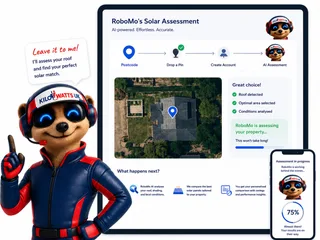
Use Robo
Mo™ to assess your property, compare available technologies and connect with trusted UK installers, suppliers and manufacturers.
Simply enter your postcode, drop a pin on your roof, create your free account and let Robo
Mo™ analyse your property to find the best solar panels for your home.

#### You don't have to think
Robo
Mo™'s AI analyses your roof and does all the hard work.

#### Accurate & tailored
AI-powered assessment based on your roof, location, and conditions.

#### Best options, maximum savings
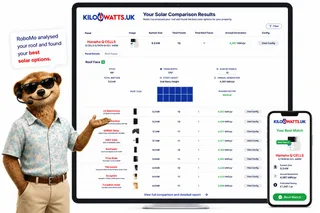
Compare top solar panels for the best performance and value.

#### Simple, fast & effortless
Provide a few details, sit back and watch your results unfold.
STEP 1
#### Choose Home, Business or Industrial
Enter your postcode to start your assessment.
- Home
- Business
- Industrial
It's fast, free and effortless.
STEP 2
#### Drop a pin on your roof
STEP 3

#### Create your free account
STEP 4

#### Sit back and watch Robo
Mo™ work
Robo
Mo™ analyses your roof and builds your personalised solar comparison.
 ## Flower Turbines
Design your wind energy system.
Instantly forecast generation.
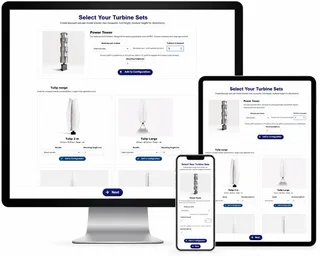
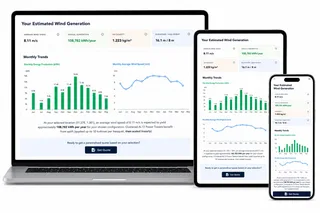
Choose a location, configure your Flower Turbines and instantly see estimated annual generation using location-specific wind data. No account required.

#### Real location data
Generation forecasts based on the location you select.
#### Build your own layout
Configure Flower Turbines to suit your available space.

#### Instant generation forecasts
See estimated annual generation and energy production instantly.

#### No commitment required
Explore different configurations before deciding whether to request a quotation.
STEP 1
#### Enter your postcode
Start designing your wind energy system in seconds.
No account required. Start designing today.
STEP 2

#### Choose a location
STEP 3

#### Build your layout
STEP 4

#### Instant generation forecasts
Compare different turbine layouts and see annual generation forecasts instantly.
STEP 5

#### No commitment required
Explore different configurations before deciding whether to request a quotation.
Are you an installer, distributor or renewable energy business?
Kilowatts UK is actively expanding the Flower Turbines partner network across the United Kingdom. Contact us to discuss installation, reseller and project partnership opportunities.
[Become A Flower Turbines Partner](mailto:dcoleman@flowerturbines.com?subject=Flower%20Turbines%20Partnership%20Enquiry)
## Related articles
[  ### Commercial solar for warehouses in the UK
Find out commercial solar for warehouses in the UK, including costs, what affects price, and how to choose an installer.
](/resources/commercial-solar-for-warehouses-in-the-uk/ "Commercial solar for warehouses in the UK")
[  ### Commercial solar for offices in the UK
Find out commercial solar for offices in the UK, including costs, what affects price, and how to choose an installer.
](/resources/commercial-solar-for-offices-in-the-uk/ "Commercial solar for offices in the UK")
[ 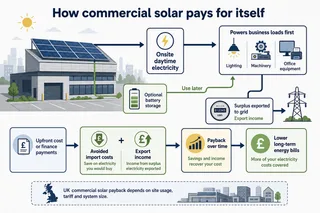 ### Can Solar Pay for Itself in Your Commercial Property?
Discover how solar power can benefit your business and learn about the factors that affect payback. Find out why self-consumption matters more than export.
](/resources/can-solar-pay-for-itself-in-your-commercial-property/ "Can Solar Pay for Itself in Your Commercial Property?")
[ 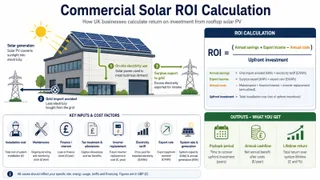 ### Commercial solar ROI explained in the UK
Understand commercial solar roi in the UK, with clear explanations, examples, and practical next steps.
](/resources/commercial-solar-roi-explained-in-the-uk/ "Commercial solar ROI explained in the UK")
FAQ
## Need Help? Robo
Mo's Got Answers
Are solar panels suitable for care homes in the UK? +Solar panels can be well suited to care homes because they use electricity throughout the day, seven days a week. Daytime demand from lighting, kitchens, laundry, ventilation, lifts, refrigeration, offices, care equipment and EV charging can help the building use more of the solar electricity on site. Suitability still depends on roof condition, shading, structural capacity, grid connection, planning constraints, fire safety and how long the operator expects to occupy the property.
Will solar panels make a care home energy independent? +Usually not. Most care home solar PV systems reduce grid electricity use during daylight hours rather than replacing the grid completely. The site will still need grid power at night, during periods of low generation and when demand exceeds solar output. Battery storage can increase self-consumption and provide some resilience, but backup-capable systems need specific design and should not be assumed as standard.
How much do commercial solar panels cost for a care home? +Commercial solar for UK care homes often costs around £700 to £1,200 per k
Wp installed, excluding VAT, although site conditions can move costs outside this range. As a guide, a 30 k
Wp system may cost roughly £25,000 to £45,000 excluding VAT, a 50 k
Wp system may cost around £40,000 to £70,000, and a 100 k
Wp system may cost around £75,000 to £120,000. Final pricing depends on access, scaffolding, roof type, structural checks, asbestos issues, electrical upgrades, DNO requirements, monitoring and fire safety measures.
What is the typical payback period for solar panels on a care home? +A typical payback period for care home solar in the UK may be around 4 to 8 years, but this varies by site. The strongest factor is how much of the solar electricity is used directly in the building, because electricity avoided from the grid is usually worth more than exported electricity. Payback is also affected by installation cost, import tariff, export tariff, finance costs, future energy use, maintenance and any roof or electrical upgrades needed.
How much electricity can a care home solar system generate? +A 50 k
Wp commercial solar PV system may generate roughly 42,500 to 55,000 k
Wh per year in the UK, while a 100 k
Wp system may generate around 85,000 to 110,000 k
Wh per year. Actual generation depends on location, roof orientation, pitch, shading, panel layout, inverter design and maintenance. Output is higher in spring and summer and lower in winter, so savings estimates should be based on realistic annual and seasonal modelling.
Do care homes need battery storage with solar panels? +Battery storage is optional and is not always needed. It can help a care home use more solar electricity in the evening, reduce peak-rate imports, support future EV charging strategies and contribute to resilience planning. However, if the care home already uses most solar generation during the day, a battery may not improve the financial case enough to justify the extra cost. Backup power during outages requires a specially designed battery and switching arrangement, as standard grid-connected solar systems shut down during a power cut for safety.
Can a care home sell unused solar electricity back to the grid? +Yes, eligible care homes may be able to export surplus solar electricity and receive payments through an export tariff such as the Smart Export Guarantee. Export rates vary by supplier and are usually lower than the value of using solar electricity on site. Commercial sites may need suitable metering, an export MPAN and confirmation that the installation meets the requirements of the export supplier.
Do care homes need planning permission for solar panels? +Many rooftop commercial solar installations may be permitted development in England if they meet the relevant conditions, but this is not guaranteed. Listed buildings, conservation areas, National Parks, Areas of Outstanding Natural Beauty, World Heritage Sites and ground-mounted solar installations require particular care. Planning rules also differ across England, Scotland, Wales and Northern Ireland, so site-specific checks should be made before installation.
What roof checks are needed before installing solar panels on a care home? +A care home roof should be checked for condition, age, structural capacity, shading, asbestos risk, safe access, roof warranty implications and likely future refurbishment. Many care homes have mixed roof areas, extensions, plant rooms and different roof coverings, so a desktop estimate is not enough for final approval. A structural assessment is particularly important because solar panels, mounting equipment, ballast and wind loading can add demands to the roof.
What is DNO approval and why does it matter for care home solar? +DNO approval is permission from the local Distribution Network Operator to connect the solar PV system to the electricity network. Smaller systems may fall under G98 rules, while larger commercial systems usually require G99 approval. The DNO may approve the system, require export limitation, request studies or identify reinforcement work. This can affect cost, timescale and the maximum practical system size.
Is solar PV safe for care homes? +Solar PV can be installed safely, but care homes need careful attention to fire safety, electrical design and resident protection. The design should consider inverter locations, DC cable routes, isolators, fire-rated penetrations, labelling, access for the fire service and insurer requirements. Installation should be planned around safeguarding, infection control, noise, deliveries, emergency access and any electrical shutdowns that could affect lifts, alarms, nurse call systems, refrigeration or medical equipment.
Will installation disrupt residents and staff? +Some disruption is likely, but it can usually be managed with proper planning. Most work takes place on the roof and in electrical areas, but care homes must plan for scaffolding, contractor access, deliveries, noise, temporary exclusion zones and possible electrical shutdowns. A good installer should provide site-specific risk assessments and method statements, agree working hours, maintain emergency access and coordinate any shutdowns with the care home management team.
What information should a care home provide before asking for solar quotes? +A care home should provide 12 months of electricity bills, half-hourly consumption data where available, MPAN details, supply capacity, roof plans, roof age, asbestos records, structural information, site access restrictions and any known planning constraints. It is also useful to provide details of future EV charging, heat pumps, laundry upgrades, standby generators, UPS systems, landlord consent, insurance requirements and carbon targets. Better information leads to more accurate system sizing and more comparable quotes.
How should a care home compare solar quotes? +Care homes should compare the full scope, not just the headline price or number of panels. A reliable quote should explain system size, expected generation, self-consumption, export assumptions, roof layout, access requirements, structural checks, DNO route, fire safety measures, monitoring, maintenance, exclusions and provisional sums. Quotes that exclude scaffolding, asbestos considerations, grid applications, monitoring, export setup or electrical upgrades may appear cheaper but cost more later.
Can leased care homes install solar panels? +Yes, but landlord consent is usually required if the care home operator does not own the building. The lease should be checked for rules on alterations, roof access, maintenance responsibilities, insurance, ownership of the solar asset and what happens if the lease ends. Solar is generally easier to justify where the operator has a long enough occupancy plan to benefit from the savings.
Are grants available for care home solar panels? +Direct grants for private care home solar projects are not always available and should not be assumed. Support may instead come through export payments, tax treatment or finance options. Public sector, charity-linked or community care facilities may have different funding routes. Operators should check current schemes, speak to their accountant about capital allowances and avoid basing the business case on uncertain grant funding.
What maintenance do care home solar panels need? +Commercial solar PV systems are relatively low maintenance, but they still need monitoring, periodic inspections, electrical testing, cleaning where required and checks after faults or extreme weather. Inverters may need replacement during the life of the system. Care homes should keep maintenance and inspection records, especially because insurers may request evidence that the system is being managed properly.
When might solar panels not be suitable for a care home? +Solar may not be suitable if the roof is in poor condition, heavily shaded, structurally limited or due for replacement. It may also be difficult where the site has a short lease, no landlord consent, high grid connection costs, major planning constraints, low daytime electricity demand or insurance conditions that make the design impractical. In some cases, it is better to complete roof refurbishment, electrical upgrades or energy efficiency improvements before installing solar.