


Break Even on Solar Panels: How Long Does It Take?
Published: 2026-06-29 10:42:26
Updated: 2026-07-26 18:16:09
The exact solar break even UK figure depends mainly on the installation cost, how much electricity the panels generate.
How long does it take to break even on solar panels?
In the UK, solar panels often break even in around 7 to 15 years. The exact solar break even UK figure depends mainly on the installation cost, how much electricity the panels generate, how much solar electricity you use at home, your import unit rate, your export tariff, and whether you add a battery.
Break even is the point where your total bill savings and export payments equal what you paid for the system. After that point, the ongoing savings are usually treated as net financial benefit, although inverter replacement, maintenance, tariff changes, equipment performance, and finance costs still matter.
A few terms are useful before comparing quotes:
- kWh means kilowatt hour. This is one unit of electricity on your bill.
- kWp means kilowatt peak. This is the rated size of a solar panel system under standard test conditions.
- Import electricity is power you buy from the grid.
- Export electricity is surplus solar power sent back to the grid.
- Self-consumption means the share of your solar generation you use in the home instead of exporting.
- An inverter converts solar panel electricity into usable household electricity.
The most useful answer is not one national average. A realistic payback estimate should model your roof, your electricity use, your tariff, and the quoted system design. Two homes with the same size solar array can have very different payback periods if one uses most of the solar power during the day and the other exports most of it at a low rate.
The basic solar break-even formula.
The simple payback formula is:
Break-even period equals net upfront cost divided by annual financial benefit.
Annual financial benefit has two main parts. The first is the value of solar electricity used in the home, because this reduces the amount bought from the grid. The second is export income from surplus electricity sent to the grid under an export tariff such as the Smart Export Guarantee. For example, if a system costs £6,500 and produces £650 per year in combined bill savings and export income, the simple payback is 10 years. This simple calculation is useful, but it is not the full investment picture. It does not automatically include finance interest, lost interest on cash savings, inflation, panel degradation, inverter replacement, battery degradation, repair costs, or future tariff changes. Those factors can be added to a more detailed model, but simple payback remains a helpful first filter when comparing quotes. For a practical calculation, separate the electricity you use on site from the electricity you export. A unit of solar used in your home is usually worth more than a unit exported, because import electricity rates are normally higher than export rates. This is why self-consumption has such a strong effect on payback.
A worked UK example.
Consider a solar system costing £6,500 and generating 3,800 kWh per year. If the home uses 45% of that solar electricity directly, it uses 1,710 kWh on site and exports 2,090 kWh.
At an import rate of 25p per kWh, the avoided grid electricity is worth £427.50 per year. At an export rate of 12p per kWh, the exported electricity is worth £250.80 per year. The total annual benefit is £678.30, giving a simple break-even period of about 9.6 years.
If the export tariff falls to 5p per kWh while the other assumptions stay the same, export income drops to £104.50 and the total annual benefit becomes £532. The simple break-even period becomes about 12.2 years. If the same system reaches 70% self-consumption with a 12p export rate, the home uses 2,660 kWh of solar and exports 1,140 kWh. The annual benefit becomes £801.80, giving a simple break-even period of about 8.1 years. These examples show why payback is rarely about panel output alone. The same generation figure can produce a very different financial result depending on when electricity is used and what tariff applies to exported power.
What typically shortens solar payback?
The fastest payback periods usually come from a combination of good generation, sensible installation cost, and high use of solar electricity in the property. A south-facing roof helps, but it is not the only route to a good result. East-west systems can be useful where they better match morning and evening demand.
- Lower installation cost.
- Higher electricity import price.
- Higher export tariff.
- Higher daytime electricity use.
- Little or no roof shading.
- Efficient system design.
Homes with electric vehicles can improve self-consumption if charging is scheduled during sunny hours. Heat pumps can also use some solar generation, particularly in spring and autumn, although the strongest heat demand is in winter when solar output is lower. Households that can run appliances during daylight hours may also improve the return. Dishwashers, washing machines, immersion heaters, and smart EV chargers can all help if they are used safely and sensibly. The aim is not to use more electricity overall, but to move flexible use into sunny periods where practical. A larger system can reduce cost per kWp, but the biggest system is not always the best financial choice. If extra panels mainly increase low-value export rather than useful on-site consumption, payback may not improve as much as expected. Suitable roof access and electrical condition. Clear DNO approval or notification route. No major roof repairs needed before installation.
What usually lengthens the break-even period?
Solar payback becomes slower when the system costs more, generates less, or exports too much electricity at a weak tariff. Some of the biggest issues are practical rather than theoretical. Roof condition, scaffolding, cable routes, consumer unit work, shading, and grid export limits can all affect the final outcome.
Heavy shading from chimneys, trees, dormers, or nearby buildings. Roof repairs needed before installation. Low daytime electricity use. Low export tariff. Small roof area with high fixed installation costs. Complex scaffolding or roof access.
A cheap quote is not always better if it omits necessary items or relies on a weak design. For example, a shaded string of panels may underperform unless the design accounts for the shading pattern. Optimisers or microinverters can help in some cases, but they add cost and are not always needed. Roof type also matters. Slate roofs, fragile tiles, complex roof shapes, rooflights, valleys, dormers, and awkward access can increase labour time. If the roof is nearing replacement, it is usually better to deal with that before panels are installed, because removing and refitting panels later adds cost. Old or unsuitable consumer unit. Finance interest that exceeds expected savings. Battery added mainly for backup rather than financial return. Export limits that restrict how much surplus power can be paid for.
How much do UK solar panels cost?
A small 2 to 3 kWp domestic system may cost around £4,000 to £6,000. A typical 3.5 to 4.5 kWp system may cost around £5,000 to £8,000. A larger 5 to 6 kWp system may cost around £7,000 to £11,000. A domestic battery often adds around £3,000 to £7,000 depending on usable capacity, inverter type, brand, and installation complexity.
Those ranges are useful for early planning, but the final quote depends on the property. A proper quote should make clear what is included and what could change. Common cost items include:
- Solar panels.
- Inverter or hybrid inverter.
- Mounting system.
- Roof fixings and weatherproofing.
- Scaffolding or safe access equipment.
- DC and AC cabling.
Optional extras can also affect payback. These may include bird protection, panel-level optimisation, a battery, backup power equipment, an EV charger, hot water diverter, or more detailed monitoring. For residential solar in Great Britain, qualifying energy-saving materials can benefit from 0% VAT until 31 March 2027. Batteries can also qualify in many domestic circumstances, although rules depend on the installation and location. VAT rules can change, so the current position should be checked at the time of quote. The Smart Export Guarantee is not an upfront grant. It is a payment for exported electricity. Most households pay privately, although some homes may be eligible for support through schemes such as ECO4 or local authority programmes. Eligibility normally depends on household circumstances, property type, energy performance, and local criteria. Be cautious of sales claims that present solar as “free” without clearly explaining ownership, eligibility, finance, or long-term responsibilities. Isolators and protection devices. Generation meter or monitoring equipment. Consumer unit work if required. Earthing and bonding checks. DNO application or notification. MCS paperwork where applicable. Labour, commissioning, and handover documents.
What happens during a solar installation?
The installation process is usually straightforward for a suitable house, but the details matter because they affect cost, safety, performance, and future export payments.
A typical domestic solar process looks like this:
Initial consultation: The installer reviews your electricity use, roof type, goals, and whether you want solar only or solar with battery storage. Desktop design: The roof is assessed using satellite imagery, mapping tools, and basic information about orientation, pitch, and shading. Survey: A site survey checks roof condition, loft access, cable routes, meter position, consumer unit, earthing, and practical access for scaffolding. Quote and specification: You receive a proposed system size, panel layout, inverter choice, expected generation, expected savings, and installation scope. DNO check: The installer decides whether the system can be notified under G98 after installation or needs G99 approval before installation. Installation booking: Scaffolding, materials, and electrician time are scheduled. Many straightforward domestic installations are completed in one to three days once scaffolding is in place. More complex roofs, batteries, consumer unit upgrades, long cable routes, or DNO requirements can extend the timeline. Good installers will not treat the survey as a formality. They should check whether the roof can safely take the system, whether any tiles are likely to break, where cables will run, where the inverter and battery can be installed, and whether the household electrical system needs remedial work before solar is connected. Roof installation — Mounting rails and panels are fixed to the roof using an appropriate mounting system. Electrical installation — The inverter, isolators, cabling, monitoring equipment, and any battery are installed and connected. Commissioning — The system is tested to confirm it operates safely and as designed. Handover — You should receive warranties, manuals, schematics, MCS certificate where applicable, DNO paperwork, and monitoring access.
Does adding a battery make break even faster?
A battery can increase annual savings by storing surplus solar for evening use, but it does not automatically shorten payback. The reason is simple. The battery adds a large upfront cost, so the extra annual saving must be high enough to justify it.
Using the supplied example, a £6,500 solar system with a £4,500 battery costs £11,000 in total. If annual generation is 3,800 kWh and self-consumption rises to 75%, the home uses 2,850 kWh and exports 950 kWh. At 25p import and 12p export, the annual benefit is £826.50, giving a simple break-even period of about 13.3 years.
That is a higher annual benefit than solar alone, but a longer payback than the base solar example because the upfront cost is much higher. This does not mean batteries are a bad choice. It means the reason for buying one should be clear.
Financial case
Works best where evening use is high, import rates are high, export rates are low, and the battery is sensibly sized.Tariff strategy
Can improve value where time-of-use tariffs allow cheap overnight charging, but tariff rules and restrictions must be checked.Specification risk
Usable capacity, round-trip losses, warranty terms, installation location, and degradation all affect the real return.Resilience expectation
A standard battery does not automatically provide whole-home backup during a power cut.
Usable capacity is the amount of stored electricity the battery can actually deliver. Round-trip loss means some energy is lost when electricity is stored and then released again. Degradation means the battery will normally hold less energy as it ages. Battery location also matters. Some batteries are unsuitable for loft installation, and the installer should consider access, temperature, manufacturer limits, fire safety guidance, and relevant electrical standards. A battery sized only to look impressive on a quote may not deliver the best return.
Roof, location, and design make a real difference.
UK solar output is commonly around 750 to 1,100 kWh per kWp per year. A well-sited 4 kWp system often produces roughly 3,200 to 4,200 kWh per year. Southern England usually generates more than northern Scotland for the same system, but local shading and roof design can matter just as much as region.
South-facing roofs usually generate the most annual output, but south-east, south-west, and east-west roofs can still be financially sensible. East-west arrays often produce less at midday but can better align with morning and evening household demand. North-facing roofs are usually less favourable, especially if steep or shaded.
Pitch also affects output. Around 30 to 40 degrees is often close to ideal in the UK, but flatter and steeper roofs can still work. Flat roof systems need spacing between rows to avoid self-shading, and ballasted systems add roof loading considerations. Shading should be treated carefully. Even partial shade from a chimney, dormer, tree, aerial, or neighbouring building can reduce output, especially if it falls across panels during strong daylight hours. A good design should explain how shading has been modelled and whether optimisers, microinverters, or a different panel layout would help. The inverter should be specified properly. It is common for the inverter to be slightly smaller than the panel array, and a small amount of clipping on peak summer days can be normal. Clipping means the panels could produce more than the inverter can convert at that moment, so a small amount of potential generation is lost. Undersizing too aggressively can lose useful generation. Inverters also may need replacement before the panels, so long-term ROI should not assume every component lasts equally long.
Export tariffs and self-consumption are often decisive.
The financial value of solar depends heavily on what happens to each unit of electricity generated. If you use the electricity at home, it reduces grid imports. If you export it, the value depends on the export tariff.
Export tariffs vary significantly between suppliers. Some pay only a few pence per kWh, while better tariffs can be above 10p per kWh. Some require a smart meter, some require import supply from the same company, and some apply conditions around batteries or specific tariffs.
Self-consumption is the share of solar generation used directly in the home. Without a battery, many UK households use around 25% to 50% of solar output on site. Households occupied during the day, homes with flexible appliances, EV charging, or well-timed hot water use may use more. The standing charge usually remains even after installing solar, so solar does not normally remove the electricity bill completely. It reduces imported units and may add export income, but the grid connection remains valuable for night-time use, winter demand, and periods of low generation. Seasonality is also important. Solar panels produce much more in spring and summer than in winter. A system may cover a large share of daytime use in June but much less in December. This is one reason annual estimates are more useful than looking at a single sunny day.
What are the environmental benefits of solar panels?
The financial break-even point is not the same as the environmental payback point. Financial break even measures money. Environmental payback considers the energy and carbon used to manufacture, transport, install, and eventually recycle the system.
Solar panels generate electricity without burning gas or coal at the point of use. In the UK, this can reduce the carbon emissions linked to household electricity, especially when solar generation replaces grid electricity during daylight hours. The exact carbon saving depends on system output, the carbon intensity of the grid, how much solar is used on site, and what happens to exported electricity.
As a rough illustration, a well-sited 4 kWp system producing around 3,800 kWh per year could avoid a meaningful amount of carbon each year compared with buying all electricity from the grid. The precise figure changes as the UK grid becomes cleaner, so any carbon saving should be treated as an estimate rather than a fixed guarantee. Solar panels also help reduce demand on the grid during sunny periods and can support a lower-carbon home when combined with efficient appliances, an EV, or a heat pump. However, the best environmental result still comes from reducing waste first. Insulation, draught-proofing, efficient heating controls, and sensible electricity use can all improve the value of solar because the home needs less imported energy overall. Panels typically have long service lives, often supported by performance warranties of 25 years or more, although product warranties and workmanship warranties are separate and should be checked. At the end of life, solar equipment should be handled through appropriate electrical waste and recycling routes.
What should a solar payback calculator include?
A useful solar calculator should not simply multiply system size by a generic output figure. It should model generation, self-consumption, import savings, export income, and installation cost separately. For commercial-intent decisions, it should also let you compare solar only against solar plus battery.
Postcode or region. Roof orientation. Roof pitch. Usable roof area. Shading level. Annual electricity consumption.
The most useful outputs are estimated annual generation, solar used in the home, export volume, annual bill saving, export income, total annual benefit, simple payback, and a longer-term net benefit estimate. Sensitivity testing is also valuable because export tariffs, import prices, and household electricity use can change. If a calculator gives a very precise answer without showing assumptions, treat it cautiously. A payback estimate should be specific enough to guide a decision but honest enough to show uncertainty. Daytime occupancy pattern. Current import unit rate. Expected export tariff. Estimated system size. Installation cost. Battery cost if included. Financing cost if relevant. Expected years in the property. Inverter replacement allowance. Panel degradation assumption. Maintenance or inspection allowance. Export limit if applicable.
How to compare installer quotes for payback.
When comparing solar quotes, do not only compare the headline price. A lower price can be attractive, but only if the design, certification, components, and scope are sound. The best-value quote is usually the one with a realistic generation estimate, clear assumptions, and a specification that fits the property.
Scope of works: Check whether scaffolding, bird protection, monitoring, electrical upgrades, and DNO paperwork are included. Installation process: Ask how long installation is expected to take and whether roof, electrical, or access issues could add cost. Generation estimate: Ask how roof orientation, pitch, shading, and local conditions were modelled. Self-consumption assumption: Make sure the quote does not assume you will use more solar electricity than your routine allows. Export assumption: Check the tariff used in the payback calculation and whether you are eligible for it. Battery sizing: Ask why the proposed usable capacity suits your load profile.
MCS certification is commonly needed for export payments. Grid connection also matters. Smaller domestic systems often use G98 notification after installation, while larger systems or higher export capacity may need G99 approval before installation. The common single-phase export threshold is 3.68 kW per phase, and export limitation can affect income where a system produces a lot of surplus electricity. A credible quote should explain both savings and limitations. Be wary of quotes that guarantee unrealistic bill reductions, ignore shading, assume all solar electricity will be used at home, or use an export tariff you may not be able to access. Equipment specification — Compare panel output, inverter type, battery capacity, warranties, monitoring, and manufacturer support. Handover documents — Expect MCS certification, DNO paperwork, warranties, manuals, schematics, and commissioning records where applicable.
When solar may not be financially suitable.
Solar is not right for every property. If the roof is heavily shaded, needs imminent replacement, or has very limited usable area, payback may be poor. Leasehold properties, flats, listed buildings, conservation areas, and homes with complex permissions can also require additional checks before installation.
It may also be unsuitable if you plan to move before reaching payback and cannot reasonably value the system in a sale. Solar may improve a property’s appeal and energy performance in some cases, but a guaranteed resale uplift should not be assumed. Buyers may ask for ownership evidence, warranties, MCS documents, and building records.
Finance needs careful attention. If monthly repayments are higher than the average bill reduction and export income, the system may not be cashflow-positive even if it eventually pays back. Interest, early repayment charges, and finance terms that outlast key warranties can materially change the result. Solar may also be a lower priority if the home has urgent efficiency problems. For example, a poorly insulated property with high heating demand may benefit from insulation, draught reduction, heating controls, or ventilation improvements before or alongside solar. The right sequence depends on the property and budget.
The practical answer for UK homeowners.
For many UK homes, a realistic solar break-even estimate sits between 7 and 15 years. A good roof, fair installation price, strong export tariff, and high daytime use can bring it towards the shorter end. Shading, low self-consumption, expensive roof or electrical work, weak export rates, batteries, and finance costs can move it towards the longer end.
Solar panels can also reduce the carbon footprint of household electricity, although the exact environmental benefit depends on system output, the UK grid mix, and how the electricity is used or exported. For many homeowners, the decision is therefore a mix of bill savings, long-term energy resilience, property suitability, and sustainability.
The best next step is to calculate payback using your own roof, usage, tariffs, and quote rather than relying on a national average. Look for a design that explains generation, self-consumption, export assumptions, equipment choices, installation process, and any practical costs. Solar can be a strong long-term investment, but the right answer depends on the property and how the system will actually be used. To get property-specific figures, you can book a free home energy survey.
Plan, Compare & Buy Renewable Energy Solutions
AI does the thinking.
You get the perfect solar match.
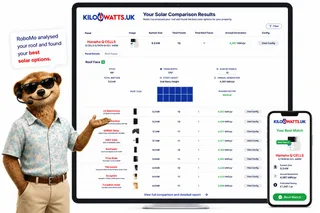
Use RoboMo™ to assess your property, compare available technologies and connect with trusted UK installers, suppliers and manufacturers.
Simply enter your postcode, drop a pin on your roof, create your free account and let RoboMo™ analyse your property to find the best solar panels for your home.

You don't have to think
RoboMo™'s AI analyses your roof and does all the hard work.

Accurate & tailored
AI-powered assessment based on your roof, location, and conditions.

Best options, maximum savings
Compare top solar panels for the best performance and value.

Simple, fast & effortless
Provide a few details, sit back and watch your results unfold.
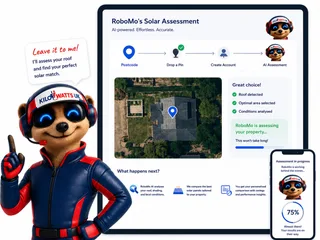
STEP 1
Choose Home, Business or Industrial
Enter your postcode to start your assessment.
STEP 2

Drop a pin on your roof
STEP 3

Create your free account
STEP 4

Sit back and watch RoboMo™ work
RoboMo™ analyses your roof and builds your personalised solar comparison.

Step 1
Enter your postcode
Start designing your wind energy system in seconds.
Are you an installer, distributor or renewable energy business?
Kilowatts UK is expanding the Flower Turbines partner network across the UK.
Become A Flower Turbines PartnerKilowatts UK is an authorised representative
Flower Turbines
Compact vertical-axis turbines built for real UK sites, not just open farmland.
They start in light wind, sit in a small footprint, and are bird-safe by design. Cluster them as a bouquet and the group performs better together than the same turbines standing alone. Enter your postcode for a location-based generation estimate. Figures use area weather data and will differ if buildings, trees or hills sit in the way.
Starts in light UK wind
Built to generate in typical UK wind, not only open farmland.
Small rooftop or ground footprint
Compact towers for roofs, yards and tight sites.
Bird-safe slow rotation
Slow vertical-axis spin, bird-safe by design.
Bouquet clusters raise output
Grouped turbines outperform the same units standing alone.
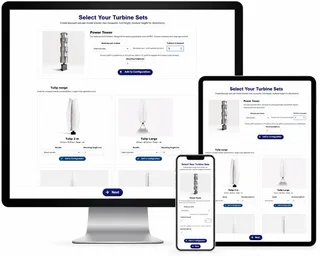
STEP 2

Choose a location
STEP 3

Place your cluster
Tap the map where you want the turbine cluster to go.
STEP 4

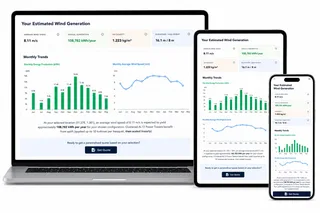
Instant generation forecasts
Compare different turbine layouts and see annual generation forecasts instantly.
STEP 5

No commitment required
Explore different configurations before deciding whether to request a quotation.
Related articles

Mo's Mission Nominations
FAQ
Need Help? RoboMo's Got Answers
How long does it usually take to break even on solar panels in the UK?
Most UK solar panel systems break even in around 7 to 15 years. The exact payback period depends on the installation cost, annual generation, how much solar electricity you use at home, your import electricity rate, your export tariff, and whether you add battery storage or finance.
What does solar panel break even mean?
Break even is the point where your total electricity bill savings and export payments equal the upfront cost of the system. After that point, the system is generally producing net financial benefit, although future maintenance, inverter replacement, tariff changes, finance costs, and equipment performance should still be considered.
How do you calculate solar panel payback?
A simple payback calculation divides the net upfront cost by the annual financial benefit. The annual benefit is made up of electricity bill savings from solar power used in the home plus export income from surplus electricity sent to the grid. For example, a £6,500 system that saves and earns £650 per year has a simple payback of about 10 years.
Why does self-consumption matter so much?
Self-consumption is the share of solar electricity you use at home instead of exporting. It matters because each unit used in the home usually replaces more expensive grid electricity, while exported electricity is often paid at a lower rate. A household that uses more solar power during the day will normally break even faster than one that exports most of its generation.
Do export tariffs affect solar payback?
Yes. Export tariffs can make a significant difference to solar payback, especially if you export a large share of your generation. Some tariffs pay only a few pence per kWh, while others pay more than 10p per kWh. Eligibility can depend on your supplier, smart meter, import tariff, battery setup, and whether your system has the right certification.
Does adding a battery make solar panels pay back faster?
Not always. A battery can increase savings by storing surplus solar electricity for evening use, but it also adds a substantial upfront cost. It may improve the financial case where evening electricity use is high, export rates are low, import rates are high, or time-of-use tariffs are used well. However, solar plus battery can have a longer simple payback than solar panels alone.
How much does a domestic solar panel system cost in the UK?
A small 2 to 3 kWp system may cost around £4,000 to £6,000, while a typical 3.5 to 4.5 kWp system may cost around £5,000 to £8,000. Larger 5 to 6 kWp systems may cost around £7,000 to £11,000. A domestic battery often adds around £3,000 to £7,000 depending on capacity, inverter type, brand, and installation complexity.
What can shorten the break-even period for solar panels?
Solar payback is usually faster when installation costs are competitive, the roof is unshaded, generation is strong, electricity import prices are high, export tariffs are good, and the household uses plenty of electricity during daylight hours. EV charging, hot water diversion, daytime appliance use, and sensible battery sizing can also improve self-consumption.
What can make solar panels take longer to pay back?
Payback can be slower if the roof is shaded, complex, small, or in poor condition, or if the installation needs extra scaffolding, roof repairs, consumer unit work, or long cable routes. Low daytime electricity use, weak export rates, expensive finance, oversized batteries, and export limits can also lengthen the break-even period.
How much electricity do solar panels generate in the UK?
UK solar output is commonly around 750 to 1,100 kWh per kWp per year. A well-sited 4 kWp system often produces roughly 3,200 to 4,200 kWh annually. Actual output depends on location, roof orientation, pitch, shading, panel layout, and inverter design.
Is a south-facing roof essential for good solar payback?
No. South-facing roofs often generate the most annual electricity, but south-east, south-west, and east-west roofs can still be financially worthwhile. East-west systems can be useful because they produce more power in the morning and evening, which may better match household demand.
Will solar panels remove my electricity bill completely?
Usually not. Solar panels reduce the amount of electricity you import from the grid and may earn export payments, but you will still normally pay standing charges and buy electricity at night, during winter, and during periods of low generation. A battery can reduce imports further, but it does not usually remove the need for a grid connection.
How long does solar panel installation take?
Many straightforward domestic solar installations are completed in one to three days once scaffolding is in place. More complex roofs, battery installations, electrical upgrades, difficult cable routes, or grid approval requirements can extend the timeline.
What paperwork should I receive after installation?
You should receive relevant warranties, manuals, electrical certificates, commissioning records, system schematics, monitoring details, DNO paperwork, and an MCS certificate where applicable. MCS certification is commonly required to access Smart Export Guarantee export payments.
Do solar panels need DNO approval?
Some smaller domestic systems can be installed under G98 rules and notified to the Distribution Network Operator after installation. Larger systems or systems with higher export capacity may need G99 approval before installation. Your installer should confirm which route applies and whether any export limit could affect income.
Are solar panels worth it if I plan to move house?
It depends how long you expect to stay and whether the system is likely to add value or appeal to buyers. If you move before reaching payback, you may not personally recover the full financial benefit. Buyers may also want proof of ownership, warranties, MCS certification, DNO paperwork, and installation records.
Are solar panels suitable for every home?
No. Solar may be unsuitable or less financially attractive if the roof is heavily shaded, needs replacement, has very limited usable space, or has complex access issues. Flats, leasehold properties, listed buildings, conservation areas, and homes with unusual permissions may need additional checks before installation.
What should I check when comparing solar quotes?
Compare more than the headline price. Check the generation estimate, self-consumption assumptions, export tariff used, panel and inverter specification, battery sizing, warranties, scaffolding, bird protection, monitoring, electrical upgrades, DNO paperwork, MCS certification, and whether the quote explains shading and roof condition properly.
Are solar panels environmentally beneficial?
Yes, solar panels can reduce the carbon emissions linked to household electricity by generating power without burning fossil fuels at the point of use. The exact carbon saving depends on system output, the carbon intensity of the grid, self-consumption, and exported electricity. Environmental payback is separate from financial payback.
What should a solar payback calculator include?
A useful calculator should include roof orientation, pitch, shading, location, system size, annual electricity use, daytime occupancy, import tariff, export tariff, installation cost, battery cost, finance costs, inverter replacement allowance, panel degradation, and expected years in the property. It should show assumptions rather than giving a precise result without context.