


UK Solar Panel Guide: Are 800W Panels Better Than Standard Ones?
Published: 2026-06-29 12:41:03
Updated: 2026-07-18 09:46:02
Find out whether 800W solar panels are suitable for your UK home. Discover how panel wattage affects system design, installation cost, and payback period.
Are 800W solar panels better than standard panels?
800W solar panels are not automatically better than standard panels for UK homes. They produce more power per panel, but much of that rating usually comes from being physically larger. The better choice depends on roof space, panel efficiency, shading, lifting access, inverter compatibility, roof structure, DNO connection rules, warranty support, and the total installed system design.
For many domestic roofs, standard panels around 400W to 460W remain more practical because they are easier to fit around chimneys, dormers, roof windows, vents, hips and roof edges. On large commercial roofs, agricultural buildings, ground-mounted systems or very simple domestic roof planes, 800W panels can make sense if the installation is designed properly.
A useful short answer is this.
- 800W panels can reduce the number of modules needed.
- Standard panels often fit typical UK roofs more flexibly.
- Total annual generation matters more than the wattage of one panel.
- Inverter, mounting, roof structure and DNO checks are essential with large panels.
- UK planning, Building Regulations and grid-connection requirements still apply.
- A simple decision route looks like this:
- ```text
- Start with the roof
- ↓
- Is there a large, clear, safely accessible area?
- ↓
- Check panel dimensions, weight and mounting zones
- ↓
- Check inverter, optimiser or microinverter compatibility
- ↓
- Check DNO route, export limits and certification
- ↓
- Compare annual kWh, self-consumption, warranty and installed cost
- ↓
- Choose the best whole-system design, not the highest panel wattage
- ```
The most important comparison is not one 800W panel versus one standard panel. It is whether the final installed system gives the best annual kWh, self-consumption, reliability and value on your actual property. If you are weighing up different domestic specifications, you can compare home solar panel options before choosing a quote.
What an 800W solar panel rating really means.
A solar panel’s watt rating is its peak output under Standard Test Conditions. Those test conditions use strong light, controlled cell temperature and ideal laboratory circumstances. A UK roof will not hold those conditions for most of the day, so an 800W panel will not produce 800W continuously.
Many products advertised as “800W solar panels” also need checking carefully. Sometimes the advert refers to one large-format panel. Sometimes it means two 400W panels sold together as an 800W kit. Sometimes it refers to a small solar kit that includes panels, an inverter, cables or battery equipment.
This distinction matters because a single 800W module is a very different design challenge from two standard domestic panels. The single large module may have different dimensions, weight, current rating and mounting requirements. The kit may simply be a normal small array described by its combined capacity. In UK domestic work, a standard panel is commonly around 400W to 460W, with some newer residential panels around 500W to 550W. Panels in the 600W to 800W range are often large-format products aimed at commercial, industrial or utility-scale projects. For a deeper example of this type of module, see this guide to JA Solar Jumbo 800W specs and performance.
- When comparing quotes, make sure the installer states:
- the physical number of panels;
- the wattage of each panel;
- the total system size in kWp;
- the estimated annual generation in kWh;
- the inverter model and rating;
- whether the system is being installed under MCS or an equivalent competent certification route;
- whether G98 notification or G99 application is required.
Why higher wattage does not always mean higher efficiency.
A common misconception is that an 800W panel is twice as efficient as a 400W panel. In practice, an 800W panel is often much larger. If it is roughly twice the physical size, its efficiency may be similar rather than dramatically better.
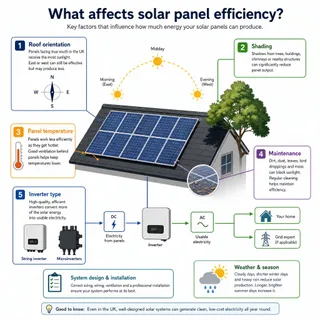
Efficiency describes how well a panel converts available light into electricity for a given area. Wattage describes the rated output of the whole panel. If two panels have similar efficiency, the larger one will have a higher wattage because it has more solar cell area. For more context, read about what affects solar panel efficiency in the UK.
That is why installers look beyond the headline wattage. A practical comparison includes the total array size in kWp, the usable roof area, annual generation in kWh, self-consumed electricity, shading behaviour, and the installed cost per useful unit of energy. On a large, clear roof, fewer high-wattage modules can be tidy and efficient to install. On a broken-up domestic roof, smaller standard panels may let the designer use awkward spaces better and achieve a larger total system. For example, two panel options can have similar efficiency but very different practical outcomes:
- A large 800W panel may suit a wide, unshaded commercial roof with easy access.
- Two smaller 400W panels may suit a domestic roof because they can be split around a skylight or chimney.
- The better option is the one that produces more useful annual electricity from the available roof, not simply the one with the highest individual panel rating.
How 800W and standard panels compare on a UK roof.
The physical size of the panel is often the deciding factor. Standard domestic panels are commonly around 1.7m² to 2.2m² and often weigh around 20kg to 25kg. Large 800W panels are often around 3m² or more and can weigh around 35kg to 45kg, depending on the manufacturer.
Those differences affect real installation work. A large panel can be harder to carry through scaffolding, manoeuvre around roof edges, control in wind and position safely on the rails. Larger panels also need careful attention to manufacturer clamp zones, rail spans and wind uplift calculations.
Standard panels usually offer more layout flexibility. They can often be placed in smaller groups across different roof faces, rotated between portrait and landscape where the mounting system allows, and fitted around common obstacles. This is why standard panels remain common on UK homes. Large 800W panels can reduce the number of modules needed for the same array size. That may reduce some clamps, connectors and roof hooks on a simple roof. However, fewer modules do not always mean a cheaper or easier domestic installation if access, wind loading, roof fit or electrical compatibility becomes more difficult. A good installer should not design from wattage alone. They should assess:
- roof orientation and pitch;
- usable roof dimensions;
- shading from chimneys, trees, parapets and neighbouring buildings;
- roof condition and structural suitability;
- safe access and lifting route;
- wind exposure and mounting system requirements;
- inverter and grid-connection limits;
- the customer’s electricity usage pattern.
Example comparison for a 4kWp system.
A 4kWp system could be made from around 9 or 10 standard 430W panels, or from 5 panels rated at 800W if those large panels physically fit. On paper, both options can have a similar headline system size.
If the panels have similar efficiency, orientation and shading, annual generation may also be similar. UK solar generation is commonly estimated at around 750kWh to 1,100kWh per kWp per year depending on location, pitch, orientation and shading. A 4kWp array is therefore judged by expected annual kWh, not simply by the number printed on each module. You can also read more about how much electricity solar panels generate in the UK.
The standard-panel layout may perform better if it allows more of the available roof to be used. The 800W layout may be attractive if the roof is a large, clear rectangle with safe lifting access and compatible electrical design. This is where a proper roof layout drawing matters. A quote that simply says “800W panels” without dimensions, total kWp, estimated annual generation, inverter details and grid-connection assumptions is not enough to make a reliable decision.
- A like-for-like comparison should include:
- total installed kWp;
- estimated annual kWh;
- panel efficiency;
- panel dimensions and weight;
- inverter make, model and rating;
- whether optimisers or microinverters are included;
- assumed shading losses;
- whether a battery is included;
- whether export limitation is included;
- DNO process and certification route.
Where 800W solar panels can make sense.
800W panels are usually most convincing where the project has space, access and a simple layout. They are more likely to suit larger roofs than typical small domestic pitched roofs.
- Commercial roofs with large clear roof areas.
- Agricultural buildings with simple roof planes.
- Ground-mounted solar arrays.
- Flat roofs with proper ballast and wind-load design.
- Large homes with wide unshaded roof sections.
On these projects, reducing the number of modules can be useful. It may simplify layout, reduce some balance-of-system components and speed up installation where handling is safe and the roof structure is suitable. Businesses with suitable roof space can compare commercial solar options to assess different system designs. Even then, the design still needs checking. Larger modules can have higher current ratings, different voltage characteristics and stricter mounting requirements. The installer must confirm that the inverter, optimisers or microinverters are compatible before the specification is accepted. For commercial and larger domestic projects, the DNO position is especially important. The installer should confirm whether the connection falls under G98 or G99, whether prior approval is needed, and whether export limitation is required. The Energy Networks Association provides guidance on connecting generation to the electricity network, including G98 and G99 connection processes.
Where standard panels are usually better.
Standard panels are often the safer choice for typical UK homes because domestic roofs are rarely perfect rectangles. Terraced homes, semi-detached properties and older roofs often include obstructions, different roof faces or limited working access.
Handling
Standard panels are usually easier to lift, store and position safely on scaffold.Roof fit
Smaller panels can work around chimneys, skylights, vents and dormers more easily.Replacement
Common panel sizes may be easier to source if one module needs replacing later.Shading control
Smaller modules can sometimes limit how much capacity is affected by a shaded area.Layout flexibility
More panels can sometimes make it easier to use multiple roof faces efficiently.Lower handling risk
Smaller modules are generally less awkward in wind and tight access areas.Installer familiarity
UK domestic installers are generally more used to standard residential panel formats.
Standard panels do mean more individual modules for the same system size. That can mean more clamps, more connectors and more roof fixings. However, on many homes, the extra flexibility is worth more than the reduction in module count offered by very large panels. Standard panels may also make future maintenance simpler. If a panel needs replacing years later, a common domestic format may be easier to match than a less common large-format module. Exact like-for-like replacements are never guaranteed, so warranty terms, supplier support and manufacturer track record still matter.
Cost and payback considerations.
Panel wattage is only one part of solar cost. In a UK domestic installation, the installed price is also shaped by scaffolding, labour, mounting equipment, inverter choice, electrical work, certification, design, DNO paperwork and business overheads.
A typical UK domestic solar PV system without a battery is often around £5,000 to £8,000. A typical system with a battery is often around £8,000 to £13,000 or more. These ranges can vary significantly with system size, roof complexity, battery capacity, access, specification and regional labour costs, so they should not be treated as fixed prices.
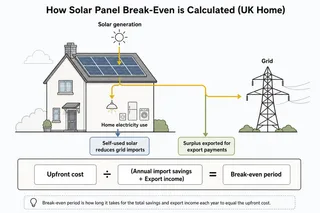
Standard domestic panels are often easier to source and price competitively in the UK. Large 800W panels may be more limited in domestic supply routes, especially if they are mainly stocked for commercial installers. That does not make them unsuitable, but it means availability and replacement support should be checked. Payback is affected more by annual generation, self-consumption and tariffs than by panel wattage alone. Exported electricity under the Smart Export Guarantee is paid according to the supplier tariff. Self-consumed solar often has a higher value because it offsets imported electricity. A battery, EV charging schedule or hot water diverter can sometimes change the economics more than the choice between standard and 800W panels. If battery storage is part of the design, compare it with the wider residential solar battery storage specification rather than judging the panels alone. For official policy context, the UK Government’s Department for Energy Security and Net Zero is responsible for national energy policy, and Ofgem provides consumer information on the Smart Export Guarantee. SEG rates vary by supplier, so homeowners should check current tariffs before relying on export income in a payback calculation. A quote should show how the installer has estimated payback. Useful details include:
- expected annual generation in kWh;
- assumed self-consumption percentage;
- import tariff assumption;
- export tariff assumption;
- battery size and usable capacity, if included;
- inverter replacement assumptions, if any;
- warranty periods for panels, inverter, battery and workmanship.
Electrical and inverter compatibility.
Large panels can have higher current ratings than standard domestic modules. That matters because every inverter, optimiser and microinverter has input limits. The installer needs to check maximum input current, voltage range, string length and temperature-related voltage limits.
A solar array can be larger than the inverter rating, which is known as DC oversizing. Some clipping during peak conditions can be acceptable in UK design, but excessive oversizing can waste generation or breach manufacturer limits.
Microinverter compatibility should also be checked carefully. Some microinverters are designed to handle standard panels or two-panel arrangements rather than one very high-current module. Optimisers can help with shading, mixed orientations and panel-level monitoring, but they add cost and extra roof electronics. For grid connection, the installer must deal with the DNO process. Smaller systems may fall under G98, while larger inverter capacities usually need G99 application or approval. Some properties may also have export limits, and export limitation equipment may be needed if the array is larger than the agreed export capacity. This is not just paperwork. If the inverter is too large for a simple notification route, the DNO may need to assess the local network before the system is connected. In some cases, the DNO may approve the installation with conditions, require export limitation, or set a lower export capacity than the installed solar array could theoretically produce.
- Before accepting an 800W-panel design, ask the installer to confirm:
- the inverter’s maximum input current per MPPT;
- the panel’s short-circuit current and operating current;
- the panel’s open-circuit voltage and temperature-adjusted voltage;
- the proposed string length;
- whether the design complies with the inverter manufacturer’s limits;
- whether the system is G98 or G99;
- whether export limitation is required;
- whether the DNO process is included in the quote.
Planning, roof structure and installation risks.
Domestic solar is often permitted development in the UK if the relevant conditions are met, but rules vary by nation, property type and local authority. Listed buildings, conservation areas, flats, leasehold homes and shared roofs can need extra consent or approval. This guide explains when you may need planning permission for solar panels in the UK.
For official planning context, homeowners in England can review the UK Government’s permitted development rights for householders technical guidance. Scotland, Wales and Northern Ireland have their own planning rules, so homeowners should check the relevant devolved guidance or speak to their local planning authority where there is any doubt.
Building Regulations still apply. The roof must be able to carry the added dead load and resist wind uplift. Larger panels can increase design sensitivity because they create bigger surfaces for wind forces and may have stricter mounting zones. The relevant checks can include structural loading, electrical safety, fire safety considerations, roof weatherproofing and safe cable routing. In England, Government-approved Building Regulations guidance includes Approved Document A for structure and Approved Document P for electrical safety in dwellings. The exact compliance route should be confirmed by the installer. Good installers will check practical details before recommending large modules. These include rafter condition, tile type, roof covering condition, cable routes, consumer unit suitability, inverter location, isolator positions, monitoring signal and safe scaffold access. Handling is not a minor issue. Large panels behave like sails in the wind and are harder to control on a roof. Poor handling can cause microcracks, which may not be obvious at installation but can affect long-term performance. Large-format modules also put more emphasis on the mounting manufacturer’s instructions. Clamp zones, rail spacing and roof fixings must be compatible with the panel, roof type and site exposure. If the mounting design is weak, the issue is not just performance; it can become a safety, warranty and weatherproofing risk.
Questions to ask before choosing 800W panels.
Before accepting a quote based on 800W panels, ask for enough detail to compare the whole system rather than the panel headline.
- Is the 800W rating for one physical panel or a combined kit.
- What are the panel dimensions and weight.
- What is the panel efficiency.
- What is the total system size in kWp.
- What is the estimated annual generation in kWh.
- Has the installer provided a roof layout drawing.
- Is the inverter compatible with the panel voltage and current.
- Is the DNO process included.
- Is the system G98 or G99.
- Is export limitation required.
- Does the design meet relevant Building Regulations requirements.
- Are planning constraints, conservation rules or listed-building issues relevant.
- What mounting system is being used.
- Are the manufacturer’s clamp zones and wind-load requirements satisfied.
- What happens if one large panel needs replacing in future.
A strong quote should also state the mounting system, scaffolding arrangements, workmanship warranty, certification route, assumed roof orientation, pitch, shading and whether a battery or export limitation is included. If you want a professional view on whether large-format panels suit your property, you can book a free home energy survey.
Verdict.
800W solar panels can be better for some projects, but they are not automatically better than standard panels. They are most suitable where there is a large, clear roof or ground-mounted area, safe lifting access, suitable structure and confirmed electrical compatibility.
For many UK homes, standard panels are still the more practical option. They fit varied roof shapes better, are easier to handle, are widely available and can often deliver an equal or better total system design.
The right comparison is the installed system, not the individual panel. Choose the design that gives the best usable generation, sensible cost, reliable equipment, safe installation, compliant grid connection and clear long-term support for your property.
Ready to compare your options?
Get tailored comparisons and connect with trusted installers in under a minute.
Plan, Compare & Buy Renewable Energy Solutions
AI does the thinking.
You get the perfect solar match.
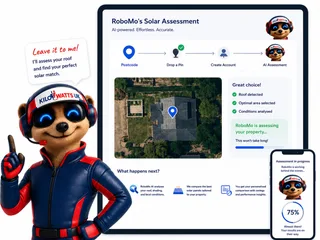
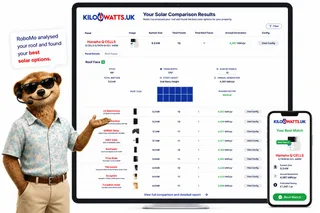
Use RoboMo™ to assess your property, compare available technologies and connect with trusted UK installers, suppliers and manufacturers.
Simply enter your postcode, drop a pin on your roof, create your free account and let RoboMo™ analyse your property to find the best solar panels for your home.

You don't have to think
RoboMo™'s AI analyses your roof and does all the hard work.

Accurate & tailored
AI-powered assessment based on your roof, location, and conditions.

Best options, maximum savings
Compare top solar panels for the best performance and value.

Simple, fast & effortless
Provide a few details, sit back and watch your results unfold.
STEP 1
Choose Home, Business or Industrial
Enter your postcode to start your assessment.
STEP 2

Drop a pin on your roof
STEP 3

Create your free account
STEP 4

Sit back and watch RoboMo™ work
RoboMo™ analyses your roof and builds your personalised solar comparison.

Step 1
Enter your postcode
Start designing your wind energy system in seconds.
Are you an installer, distributor or renewable energy business?
Kilowatts UK is expanding the Flower Turbines partner network across the UK.
Become A Flower Turbines PartnerKilowatts UK is an authorised representative
Flower Turbines
Compact vertical-axis turbines built for real UK sites, not just open farmland.
They start in light wind, sit in a small footprint, and are bird-safe by design. Cluster them as a bouquet and the group performs better together than the same turbines standing alone. Enter your postcode for a location-based generation estimate. Figures use area weather data and will differ if buildings, trees or hills sit in the way.
Starts in light UK wind
Built to generate in typical UK wind, not only open farmland.
Small rooftop or ground footprint
Compact towers for roofs, yards and tight sites.
Bird-safe slow rotation
Slow vertical-axis spin, bird-safe by design.
Bouquet clusters raise output
Grouped turbines outperform the same units standing alone.


STEP 2

Choose a location
STEP 3

Place your cluster
Tap the map where you want the turbine cluster to go.
STEP 4

Instant generation forecasts
Compare different turbine layouts and see annual generation forecasts instantly.
STEP 5

No commitment required
Explore different configurations before deciding whether to request a quotation.
Related articles
Mo's Mission Nominations
FAQ
Need Help? RoboMo's Got Answers
Are 800W solar panels better than standard panels for UK homes?
Not usually. An 800W solar panel can be useful on large, simple, unshaded roofs, commercial buildings, farms and ground-mounted systems, but standard 400W to 460W panels are often more practical for typical UK homes. The best option depends on the whole system design, including roof layout, shading, panel dimensions, inverter compatibility, DNO requirements, installation cost and expected annual generation, not just the wattage of each individual panel.
Does an 800W solar panel always produce 800 watts?
No. The 800W rating is normally the panel’s peak DC output under Standard Test Conditions in a laboratory. UK roofs rarely match those ideal conditions for long, so real-world output changes throughout the day with sunlight, temperature, roof angle, orientation, shading and system design. The panel may sometimes get close to its rating in strong sun, but it will often generate less during normal British weather.
Is one 800W solar panel the same as two 400W panels?
Not always. Some products advertised as “800W solar panels” are actually kits made from two smaller panels, such as two 400W modules. A true 800W module is one large panel with its own datasheet, dimensions, voltage, current, efficiency rating and warranty. Always check the manufacturer’s datasheet and the quote to confirm whether the 800W figure refers to one physical module or the combined output of a kit.
Are 800W solar panels more efficient than standard panels?
Not necessarily. Higher wattage does not automatically mean higher efficiency. An 800W panel may produce more power because it is physically much larger, not because it converts sunlight more efficiently. A fair comparison should look at panel efficiency, watts per square metre, usable roof area and the expected annual kWh from the complete system.
How big and heavy is an 800W solar panel?
A true 800W solar panel is usually much larger and heavier than a standard domestic panel. Standard UK domestic panels are often around 20kg to 25kg, while large 800W modules can be around 35kg to 45kg and may cover around 3m² or more. This can make lifting, handling, scaffolding, roof access and safe installation more difficult, especially on pitched domestic roofs or properties with restricted access.
Can 800W solar panels fit on a normal house roof?
Sometimes, but they are often less flexible than standard panels. Many UK roofs have chimneys, dormers, roof windows, vents, hips, valleys, roof edges and shaded areas. Standard-sized panels can usually be arranged around these features more easily. A smaller number of very large panels may leave awkward gaps and could reduce the total solar capacity that can be fitted.
Do 800W solar panels need a special inverter?
They may need careful inverter matching. Large-format panels often have higher current ratings than standard domestic panels, so the installer must check the inverter’s maximum input current, voltage range, MPPT limits and string design. Some microinverters and optimisers may not be compatible with every high-wattage panel, so the electrical design should be confirmed against the panel and inverter datasheets before installation.
Do 800W solar panels need DNO approval in the UK?
The DNO requirement depends on the inverter’s AC output and the overall system design, not simply the wattage of one panel. In the UK, systems up to 3.68kW AC per phase are commonly handled under G98 notification after installation. Larger systems usually need G99 approval before connection. Your installer should confirm the correct DNO route, export limit and paperwork before work begins.
Are 800W solar panels cheaper to install?
Not automatically. Fewer panels may reduce some components, such as clamps, connectors or module-level electronics, but large panels can be harder to handle and may need more careful mounting, access planning and design work. The best comparison is the installed cost per kWp and expected annual kWh, rather than the price or wattage of each individual panel.
Do 800W solar panels improve solar payback?
Not by themselves. Payback depends more on installed cost, annual generation, self-consumption, import tariff, export tariff, battery use and maintenance assumptions than on individual panel wattage. An 800W panel layout may have good payback on a large, clear roof, but standard panels may perform better financially on a typical home if they allow more usable capacity to fit safely and efficiently.
When do 800W solar panels make sense?
800W panels can make sense on large, simple, unshaded roofs where there is plenty of space and good access. They are often more suitable for commercial roofs, agricultural buildings, workshops, ground-mounted arrays and some flat roof systems. They can also be useful where reducing the number of modules and connections is a genuine design advantage and the roof structure, mounting system, inverter and DNO position are all suitable.
When are standard solar panels usually better?
Standard domestic solar panels are usually better for smaller or more complicated roofs. They are easier to arrange around chimneys, dormers, roof windows, vents and shaded areas, and they are generally easier to lift, install, source and replace. For many homes, standard panels offer the best balance of performance, flexibility, cost, availability and practicality.
Are 800W solar panels suitable for shaded roofs?
They are not usually the best choice if the roof is heavily shaded or broken into small usable areas. Shading can reduce output, and large panels may be harder to position away from chimneys, trees, dormers or neighbouring buildings. Standard panels, optimisers or microinverters may give the installer more flexibility, but the right solution depends on a proper shade assessment and electrical design.
Do 800W solar panels need extra roof structure checks?
They should be assessed carefully. Solar installations must account for added weight, wind uplift, fixing points and the condition of the roof covering and structure. Large 800W panels can place more emphasis on correct clamp zones, rail spacing and wind-load design because they are bigger and heavier than standard domestic modules. A competent installer should check that the roof and mounting system are suitable before recommending them.
Do 800W solar panels need planning permission in the UK?
Panel wattage does not decide whether planning permission is needed. Many domestic solar installations are permitted development if the relevant rules are met, but listed buildings, conservation areas, flats, leasehold properties, shared roofs and unusual installations can need extra consent. Rules also vary across England, Scotland, Wales and Northern Ireland, so homeowners should check local requirements where there is any doubt.
Are 800W solar panels harder to maintain or replace?
They can be. Large-format panels may be less common in domestic supply chains, and exact replacements may be harder to source years later than standard residential formats. Their size and weight can also make removal and replacement more awkward. This does not make them unsuitable, but warranty terms, manufacturer support, installer aftercare and future availability should be considered before choosing them.
How should I compare 800W panels with standard solar panels?
Compare complete system designs, not individual panel wattages. Look at total kWp, estimated annual generation, installed cost per kWp, expected self-consumption, likely export, inverter compatibility, DNO requirements, roof fit, panel dimensions, panel weight, mounting design, warranty cover and future replacement options. A good quote should clearly show why the chosen panel size suits your roof, electricity use and budget.