


Solar Panel Efficiency: Debunking Common Myths
Published: 2026-07-25 15:58:18
Updated: 2026-07-31 17:16:27
Discover what affects solar panel efficiency, from roof orientation to maintenance, and learn how to maximise your energy output with our expert guide.
Solar Panel Efficiency Myths UK Homeowners Should Ignore
Solar panel efficiency is the percentage of incoming sunlight a panel converts into electricity. It matters, but it is only one part of real-world solar performance. In the UK, annual generation is shaped by panel technology, roof direction, roof pitch, shading, inverter design, installation quality, local daylight, maintenance and how much of the electricity you use at home. That distinction is where many myths start. A high-efficiency panel on a shaded, awkward roof can underperform a well-designed system using standard modern panels. Likewise, a larger array with slightly lower-efficiency modules may produce more electricity over a year than a smaller array of premium panels. If you are new to PV, it helps to first understand how solar works. Most current domestic solar panels quoted for UK homes are in the high-teens to low-twenties for efficiency, with many monocrystalline modules sitting around 18% to 23%. Some products sit outside that range, and datasheets change over time, so the figure should be checked on the specific module being quoted rather than assumed from the brand name.
| Myth | Reality for UK homes |
|---|---|
| Solar panels need hot sun | They need light, not heat, and still generate in cloudy conditions at lower output |
| Higher wattage always means higher efficiency | Wattage depends on panel size as well as efficiency |
| Batteries make panels more efficient | Batteries improve how generation is used, not how sunlight is converted |
| Premium panels always pay back faster | They may help on tight roofs, but value depends on total cost and annual kWh |
| All panels age the same way | Degradation rates and performance warranties vary by product |
Efficiency Is Not the Same as Annual Output
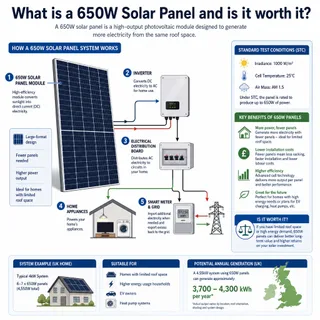
Panel efficiency is measured under Standard Test Conditions, usually abbreviated to STC. These use a controlled irradiance of 1,000 W/m2, a cell temperature of 25°C and a defined light spectrum. STC is useful because it lets different panels be compared on a consistent basis, but it is not a prediction of what every panel will produce on a British roof in January, April or August.
Annual output is the figure that matters most for bills. It is usually expressed in kilowatt-hours, or kWh, and depends on the system size in kWp, the amount of daylight reaching the array, shading, inverter losses, cable losses, panel temperature and the way the system is configured. A larger system using slightly less efficient panels can generate more electricity than a smaller system using premium modules because it has more total panel area installed. For a fuller output-focused explanation, see how much electricity panels generate.
This is why solar quotes should be judged on predicted annual generation, roof layout, equipment selection and assumptions, not just the headline efficiency percentage. A quote that says “23% efficient panel” but gives no credible annual kWh estimate is less useful than a quote that explains the roof, shading, inverter and expected output clearly.
The UK Factors That Change Solar Performance
The UK has enough daylight for solar panels to work, but generation varies by location and roof conditions. Southern England generally receives more solar irradiance than Scotland, but the difference between regions is only one part of the picture. A lightly shaded, well-orientated roof in a cooler northern location can still perform sensibly, while a heavily shaded roof in a sunnier area can disappoint. Cloud cover reduces output, but it does not stop solar generation. Panels can use diffuse light, which is important in typical UK weather. Cooler conditions can also help because solar panel output usually falls as cell temperature rises above the STC test temperature. That does not mean winter produces more energy overall, because days are shorter and the sun is lower, but it does explain why panels do not need heat to work.
| Factor | Typical effect in UK conditions | What to check before installation |
|---|---|---|
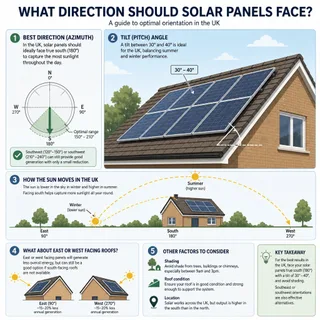
| Roof orientation | South-facing roofs usually give the highest annual yield | Whether east, west or split arrays suit your usage pattern |
| Roof pitch | Around 30 to 40 degrees is often strong for UK latitude | Whether the existing roof angle causes meaningful losses |
| Shading | Chimneys, trees and nearby buildings can reduce output significantly | Whether shade affects one panel, one string or the whole array |
| Location | Solar irradiance varies across the UK | Whether the quote uses realistic local generation assumptions |
| Temperature | Cooler weather can reduce heat-related losses | Whether panels have good airflow underneath |
| Inverter design | Affects how much DC panel output becomes usable AC electricity | Whether string design and MPPT ranges are correctly matched |
| Maintenance | Dirt, moss, leaves and bird droppings can reduce generation | Whether the roof pitch and local conditions encourage soiling |
Myth: Solar Panels Need Hot, Direct Sunshine
Solar panels need daylight, not hot weather. They produce most when sunlight is strong and direct, but they still generate electricity in overcast conditions because diffuse light reaches the panels through cloud. Output is lower than on a clear summer day, but it does not fall to zero simply because the sky is grey.
This myth is especially common in the UK because people associate solar panels with hotter countries. In practice, the UK’s cooler climate can be helpful for module efficiency, while the main winter limitations are shorter days, a lower sun angle and more frequent cloud. For more detail, read winter solar performance.
The realistic way to think about this is seasonal rather than daily. A solar PV system will usually generate much more in spring and summer than in midwinter, but the annual total is what should be modelled in a quote.
Myth: Higher Wattage Always Means Higher Efficiency
Panel wattage and panel efficiency are related, but they are not the same. A physically larger panel may have a higher wattage simply because it has more surface area. A smaller premium panel may be more efficient per square metre even if its wattage looks lower on the datasheet.
For homeowners, the practical question is how much system capacity can fit on the usable roof area and how much annual generation that layout is expected to produce. If two panels are similar in size, a higher wattage often suggests better output potential. If they are different sizes, comparing wattage alone can mislead.
System size
The combined rated capacity of all panels, usually shown in kWp.Panel wattage
The rated power output of the module under Standard Test Conditions.Panel efficiency
The percentage of incoming sunlight converted into electricity under test conditions.Annual generation
The expected kWh the system produces over a typical year at that property.
A good quote should name the panel model, show the number of panels, state the system size and explain the expected annual kWh. Without those details, a high wattage figure is not enough to judge value.
Myth: Batteries Improve Panel Efficiency
A battery does not make solar panels convert more sunlight into electricity. It changes what happens to the electricity after it has been generated. Instead of exporting surplus electricity immediately, a battery can store some of it for later use in the home.
That can improve self-consumption and reduce grid imports, especially for households that are out during the day but use more electricity in the evening. It can also help make better use of a larger solar array. However, it should not be described as improving panel efficiency because the panel’s conversion process has not changed.
Battery value depends on household usage patterns, battery size, tariff structure, installation cost, backup requirements and whether the system is designed to work well with the inverter. It should be assessed as part of the overall energy strategy rather than treated as a magic efficiency upgrade.
Myth: Premium Panels Always Pay Back Faster
Higher-efficiency panels can be worth paying for, but not in every case. They are most useful where roof space is limited, where the roof has awkward usable areas, or where the household has high demand and wants to fit as much generation as possible into a constrained footprint. If a roof has plenty of unshaded space, a well-priced modern panel with slightly lower efficiency may deliver better value than a premium module. The difference between two good panels can be less important than the difference between a good and poor roof layout, or between a realistic and unrealistic generation estimate.
| Situation | Higher-efficiency panels may help | They may be less important when |
|---|---|---|
| Limited roof space | More capacity can fit into the available area | There is enough unshaded roof for the desired system size |
| Complex roof layout | Smaller high-output arrays may fit awkward spaces better | Simple roof planes allow standard panels to be arranged efficiently |
| High household demand | Extra generation can support daytime use or battery charging | Electricity use is low and export value is the main consideration |
| Premium specification | Stronger degradation terms may be part of the package | The performance gain is small compared with the added cost |
| Visual preferences | Fewer panels may create a cleaner layout | Appearance is secondary to installed cost and output |
Roof Design and Shading Matter More Than Most Datasheets
For many UK homes, roof design has a bigger effect on real-world performance than the difference between two decent modern panels. A south-facing roof usually gives the strongest annual yield. East- and west-facing roofs often produce less overall, but they can still be valuable because they generate earlier or later in the day, which may suit household demand. If orientation is a key concern, compare the effect of best roof direction before judging panels on efficiency alone.
North-facing pitched roofs are usually less attractive for standard domestic PV, although some properties may have other usable roof planes, garages, outbuildings or flat-roof options. Complex roofs with dormers, valleys, chimneys and multiple small areas need careful design because awkward panel placement can reduce performance and increase installation complexity.
Shading deserves particular attention. In a traditional string inverter system, shade on one panel can reduce output from other panels on the same string. Power optimisers or microinverters can help manage partial shading, but they add cost and should be specified for a clear design reason rather than treated as an automatic upgrade.
- Nearby trees and whether they will grow into the solar path.
- Chimneys, flues, aerials and roof features that cast moving shadows.
- Neighbouring buildings that affect low winter sun.
- Dormers, valleys and roof shape limitations.
- Whether shaded panels should be avoided, optimised or placed on a separate string.
- Whether the roof condition is good enough to justify installing panels now.
Shading analysis is not just a desktop exercise. Installers may use digital modelling, satellite imagery or shade assessment tools to estimate losses, but the assumptions should still make sense when compared with what you can see around the property.
Panel Technology, Temperature and Degradation
Most domestic UK systems now use monocrystalline panels, especially where roof space is limited. These typically offer higher efficiency than older or lower-cost polycrystalline panels, although exact performance depends on the specific model, cell technology and module size.
Higher efficiency is most valuable when usable roof area is tight. If you can only fit a small number of panels, a higher-efficiency module may increase the total kWp on the roof. If you have a large, simple, unshaded roof, the value of paying more for marginally higher efficiency needs to be weighed against total installed cost and predicted annual output.
Temperature also matters. Solar panels usually have a negative temperature coefficient, meaning output falls slightly as cell temperature rises above the standard test condition. UK weather is generally cooler than many high-sun countries, but panels on dark roofs can still get hot in summer. Good mounting, airflow beneath the panels and sensible inverter placement all help the system perform reliably. Degradation is another long-term factor. Panels gradually lose output over time, and many manufacturer datasheets describe annual degradation assumptions and a retained-output level after a set period, often 25 years or longer. Some warranties may refer to around 80% to 85% retained output after 25 years, while newer premium products may claim stronger figures. The exact terms vary, so read the product warranty and performance warranty rather than assuming all panels are identical. For more on long-term performance, read about how long panels last.
Installation Quality and Inverter Design
A solar PV system is only as good as its design and installation. Efficient panels can underperform if string sizing is wrong, cable routes are poorly considered, connectors are badly installed, roof mounting is unsuitable or the inverter is placed somewhere that becomes excessively hot.
Modern inverters can be highly efficient, but they still need to be correctly matched to the array. The DC voltage from the panels must sit within the inverter’s operating range, including the MPPT range used to track the panels’ best power point. If the system is poorly matched, it may not harvest energy as well as it should.
Inverter location also matters. Loft installations are common, but lofts can become hot in summer and may be awkward for access. Inverters often have a shorter service life than solar panels, so a sensible design considers ventilation, monitoring, safe isolation, replacement access and future maintenance. Grid connection should also be understood. Many small single-phase domestic systems are designed around the G98 limit of 16 A per phase, often described as around 3.68 kW per phase for export. Larger systems, or systems that do not fit G98 conditions, may require Distribution Network Operator assessment under G99 before connection. Export limitation can be used in some designs, but it should be explained clearly because it may cap export in certain conditions. Installation paperwork and standards can also matter, so it is worth understanding MCS certification when assessing a solar proposal.
Maintenance and Monitoring in Real UK Conditions
Solar panels are relatively low-maintenance, but they are not immune to performance loss. UK rainfall often provides enough natural cleaning for pitched arrays at a sensible tilt, but bird droppings, moss, leaves, dust and debris can still build up, particularly on low-pitch roofs, under trees or near nesting birds.
Heavy soiling can reduce output, and in some cases the losses can be noticeable. Cleaning should be approached carefully because walking on roofs, using unsuitable tools or damaging panel coatings can create more problems than it solves. If cleaning is needed, safe access and suitable methods matter.
Monitoring is one of the simplest ways to spot underperformance. A sudden drop in generation may indicate inverter faults, isolation issues or communication problems. A gradual reduction may point towards shading from growing trees, soiling, panel degradation or a monitoring issue rather than a genuine panel-efficiency problem.
- Compare generation with seasonal expectations rather than daily weather alone.
- Check inverter or monitoring alerts when output changes unexpectedly.
- Look for new shading from trees, scaffolding or nearby construction.
- Inspect visible debris where safe to do so from ground level.
- Keep handover documents, warranties and commissioning certificates accessible.
- Ask the installer what monitoring support is included after installation.
Periodic inspection can be worthwhile, particularly for older systems, complex roofs or commercial arrays. The aim is not to over-service a simple system, but to catch avoidable faults before they quietly reduce generation for months.
How to Judge a Solar Quote for Efficiency
A strong solar quote should make the design assumptions clear. It should show the proposed system size, panel model, inverter model, expected annual generation, roof orientation, roof pitch, shading assumptions and whether any battery storage or export limitation is included.
Be cautious about quotes that focus only on best-case savings or headline panel efficiency. Real projects involve compromises, especially where there is shading, limited roof space, older roofing, difficult access or grid export considerations. A good installer should explain these limits rather than hide them.
Predicted generation: The quote should show an annual kWh estimate based on your roof, location, orientation and shading. Panel specification: The panel model, rated wattage, efficiency and warranty terms should be named clearly. Roof suitability: The installer should consider roof condition, structure, orientation, pitch and available space. Shading treatment: The design should explain whether shade is avoided, accepted or managed with optimisers or microinverters. Inverter specification: The inverter should be matched to the array and installed in a suitable, accessible location. Battery assumptions: Any battery proposal should show how it changes self-consumption rather than panel efficiency. If you are comparing options, use the efficiency figure as one part of the decision, not the whole decision. The best-performing solar installation is usually the one where the roof survey, electrical design and usage assumptions have been handled properly. You can also compare home solar options when you are ready to look at system choices more practically. Export assumptions — The quote should explain whether export is unrestricted, limited or subject to DNO approval. Warranty and degradation — Product warranties, workmanship cover and long-term output assumptions should be clear. Monitoring — The proposal should explain how generation will be monitored and who helps if performance looks wrong. Paperwork — The installer should explain MCS documentation, electrical certification and DNO notification or approval where relevant.
UK Standards and Source Notes Behind the Claims
Solar PV performance claims should be grounded in recognised standards, consumer guidance and realistic modelling. Homeowners do not need to read technical documents in full, but a trustworthy quote should be consistent with the way these bodies and standards describe solar PV.
The key point is that lab ratings, installation standards, grid rules and export arrangements are separate issues. A panel datasheet tells you about module performance under test conditions. MCS and electrical standards relate to installation quality and documentation. DNO processes govern connection to the local network. Export payments depend on supplier tariffs and eligibility rules.
MCS
The Microgeneration Certification Scheme provides UK standards and installer/product certification routes commonly used for domestic solar PV quality assurance.Energy Saving Trust
Consumer-facing UK solar guidance is a useful benchmark for understanding generation, usage and savings assumptions.Manufacturer datasheets
These should state module efficiency, rated output, temperature coefficient, product warranty and performance warranty assumptions.Standard Test Conditions
Panel wattage and efficiency are measured under defined laboratory conditions, commonly 1,000 W/m2 irradiance and 25°C cell temperature.Ofgem and Smart Export Guarantee
Ofgem oversees SEG obligations for eligible suppliers, while individual suppliers set export tariffs and eligibility terms.Energy Networks Association and DNOs
G98 and G99 connection processes are used by network operators to manage small-scale generation connections.
These source notes do not replace a site-specific survey. They are a sanity check: if a quote conflicts with basic PV principles, ignores DNO requirements or treats a battery as an efficiency upgrade, ask for the assumptions in writing. PVGIS and UK climate data — Solar yield estimates should use credible irradiance and location assumptions rather than generic best-case figures.
The Practical Bottom Line
Solar panel efficiency in the UK is shaped by both the panel itself and the conditions around it. Panel technology matters, but so do roof orientation, pitch, shading, inverter selection, installation workmanship, maintenance and how electricity is used in the building.
Higher-efficiency panels are most likely to be worth paying for where roof space is limited, the roof layout is awkward, the household has high electricity demand, or the warranty and degradation terms justify the upgrade. They are less automatically compelling where there is plenty of unshaded roof space and a well-priced standard modern panel can deliver the desired annual generation.
The main myths are straightforward to dismiss: solar panels do work in cloudy UK weather, cold conditions do not stop generation, higher wattage is not always the same as higher efficiency, and batteries do not improve the panel’s conversion efficiency. The real gains come from good roof design, honest modelling, suitable equipment and a quote that explains expected annual kWh rather than chasing a single percentage on a datasheet.
Plan, Compare & Buy Renewable Energy Solutions
AI does the thinking.
You get the perfect solar match.
Use RoboMo™ to assess your property, compare available technologies and connect with trusted UK installers, suppliers and manufacturers.
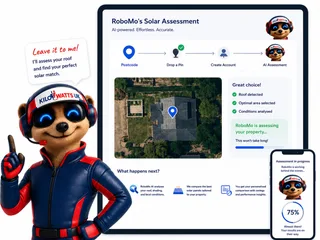
Simply enter your postcode, drop a pin on your roof, create your free account and let RoboMo™ analyse your property to find the best solar panels for your home.

You don't have to think
RoboMo™'s AI analyses your roof and does all the hard work.

Accurate & tailored
AI-powered assessment based on your roof, location, and conditions.

Best options, maximum savings
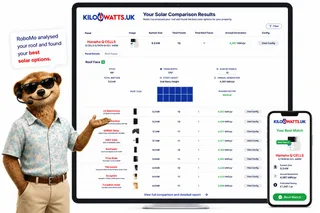
Compare top solar panels for the best performance and value.

Simple, fast & effortless
Provide a few details, sit back and watch your results unfold.
STEP 1
Choose Home, Business or Industrial
Enter your postcode to start your assessment.
STEP 2

Drop a pin on your roof
STEP 3

Create your free account
STEP 4

Sit back and watch RoboMo™ work
RoboMo™ analyses your roof and builds your personalised solar comparison.

Kilowatts UK is an authorised representative
Flower Turbines
Compact vertical-axis turbines built for real UK sites, not just open farmland.
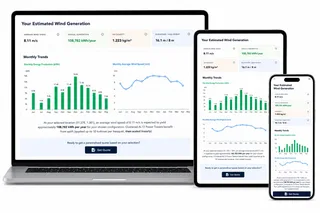
They start in light wind, sit in a small footprint, and are bird-safe by design. Cluster them as a bouquet and the group performs better together than the same turbines standing alone. Enter your postcode for a location-based generation estimate. Figures use area weather data and will differ if buildings, trees or hills sit in the way.
Starts in light UK wind
Built to generate in typical UK wind, not only open farmland.
Small rooftop or ground footprint
Compact towers for roofs, yards and tight sites.
Bird-safe slow rotation
Slow vertical-axis spin, bird-safe by design.
Bouquet clusters raise output
Grouped turbines outperform the same units standing alone.

Step 1
Enter your postcode
Start designing your wind energy system in seconds.
STEP 2

Choose a location
STEP 3

Place your cluster
Tap the map where you want the turbine cluster to go.
STEP 4

Instant generation forecasts
Compare different turbine layouts and see annual generation forecasts instantly.
STEP 5

No commitment required
Explore different configurations before deciding whether to request a quotation.
Related articles
Mo's Mission Nominations
FAQ
Need Help? RoboMo's Got Answers
How Do Solar Panels Work?
As a leading UK renewable energy expert, I'm delighted to share my insights on what impacts solar panel efficiency. With over [X] years of experience in the industry, I've compiled a comprehensive guide to help homeowners maximise their energy output and reduce their reliance on traditional fossil fuels. ### Factors Affecting Solar Panel Efficiency Higher-efficiency panels do offer better performance, but other factors like roof orientation, shading, and maintenance can also impact output. Roof tilt is particularly important, as a south-facing slope can increase energy generation by up to 20%. Shading from trees or buildings can significantly reduce efficiency, with a single tree blocking up to 30% of the panel's surface area. ### Maintenance and Cleaning Regular cleaning is essential for maintaining solar panel efficiency. Dirt, leaves, and debris can reduce output by up to 25%. A simple hose-down or using a soft-bristled brush can make a significant difference. It's also important to inspect your panels regularly for any signs of wear or damage. ### Inverter Type The type of inverter used can also impact solar panel efficiency. String inverters are the most common, but microinverters can provide greater flexibility and better performance in shaded areas. **Take Control of Your Energy Generation** To ensure you're getting the most out of your solar panel system, consider the following: * **Schedule regular maintenance**: Clean your panels every 6-12 months to maintain optimal efficiency. * **Monitor your energy output**: Keep track of your energy generation and identify any potential issues early on. * **Consult a professional**: If you notice any decreases in performance or experience any issues with your system, consult a qualified solar panel installer for assistance.
Take the Next Step
Book a free home energy survey to get started on your path to renewable energy independence.