


What Funding is Available for EPC Upgrades in 2026
Published: 2026-07-19 09:26:45
Updated: 2026-08-01 05:54:06
The main options for rental property energy efficiency funding are ECO4, ECO Flex, the Great British Insulation Scheme, the Boiler Upgrade Scheme.
What funding can landlords use for EPC upgrades in 2026
Landlords looking for EPC upgrade grants in 2026 have several possible funding routes, but most are targeted rather than universal. The main options for rental property energy efficiency funding are ECO4, ECO Flex, the Great British Insulation Scheme, the Boiler Upgrade Scheme, local authority retrofit schemes, devolved government schemes, VAT relief on energy-saving materials, and green finance from lenders. For a wider overview of upcoming support routes, see this guide to the Warm Homes Plan.
The right route depends on the property, the tenant and the proposed works. Key factors include:
- the current EPC rating and recommendation report
- whether the property is in England, Wales, Scotland or Northern Ireland
- whether the tenant receives qualifying benefits or meets local vulnerability criteria
- the council tax band and local authority area
- the existing heating system and fuel type
- whether the work is insulation, low-carbon heating, solar PV, ventilation or a wider retrofit package
In practice, the strongest funding prospects are usually for EPC D, E, F or G private rented homes occupied by low-income, vulnerable or fuel-poor tenants. Off-gas properties and poorly insulated homes are often more likely to qualify than modern, well-insulated homes. A landlord with an EPC C property and higher-income tenants may struggle to access grants, although 0% VAT on eligible installed measures and green borrowing may still reduce costs. A short summary is that most landlord EPC upgrade grants are not general buy-to-let refurbishment grants. The main timing issue for 2026 is that ECO4 and the Great British Insulation Scheme are scheduled to run until 31 March 2026 unless extended, amended or replaced. Landlords should check current government, Ofgem, local authority and installer guidance before committing, because scheme rules, delivery partners and funding windows can change during the year. whether the landlord can provide consent, evidence and access before installation Most schemes depend on tenant need, property inefficiency or a specific technology. Landlord permission and tenant access are usually required. Funding may be partial rather than fully funded. Work should normally not start before approval. Installers often need scheme-specific accreditation. Building Regulations, planning constraints and ventilation requirements still apply. A post-works EPC is usually needed to confirm the rating improvement.
ECO4 and ECO Flex for inefficient rental homes
ECO4 is one of the main EPC grants for landlords with inefficient homes and eligible tenants. It operates in Great Britain, not Northern Ireland, and is funded through larger energy suppliers. Private rented sector properties can qualify in some cases, but eligibility is usually driven by the tenant’s circumstances rather than the landlord’s income or portfolio size.
ECO4 commonly supports insulation, heating improvements, heating controls and low-carbon heating as part of a whole-house retrofit approach. The strongest candidates are usually EPC D to G homes where the fabric and heating system are poor. It is not designed to fund cosmetic refurbishment, routine maintenance or upgrades to homes that already perform well.
ECO Flex is the local-authority flexible eligibility route within ECO. Councils can set local eligibility criteria within national rules, which may help households that are not on qualifying benefits but are still low-income, vulnerable, affected by health conditions or facing high energy costs. ECO Flex still depends on the council participating and an installer or energy supplier being willing to fund the package. For landlords, the practical barriers are usually evidence, consent and access. Installers may need: a valid EPC or retrofit assessment proof of occupancy tenant benefit, income or vulnerability evidence landlord consent forms tenant signatures pre-installation photographs ECO-funded work should normally follow TrustMark and PAS 2035 processes. That can add paperwork and survey time, but it also helps control quality, ventilation risk and measure suitability. Landlords should be cautious of any installer promising instant approval without proper eligibility checks. ECO4 is most useful where a landlord is prepared to coordinate properly with the tenant and allow a whole-house assessment. It is less useful where the tenant is not eligible, the property is already EPC C or above, or the landlord needs urgent works completed before funding approval. details of the existing heating system and insulation post-installation evidence and certificates
Great British Insulation Scheme for single insulation measures
The Great British Insulation Scheme, often shortened to GBIS, is another important landlord insulation grant route in Great Britain. It is also scheduled to run until 31 March 2026 unless changed. Compared with ECO4, GBIS is usually more focused on a single insulation measure rather than a deep whole-house retrofit package.
Eligible measures can include loft insulation, cavity wall insulation, solid wall insulation, underfloor insulation, room-in-roof insulation and some roof insulation measures. Heating controls may be included in some circumstances, but landlords should not treat GBIS as a full heating replacement grant.
Eligibility can depend on EPC rating and council tax band, with England often using council tax bands A to D and Wales and Scotland often using bands A to E. Low-income eligibility routes may also apply. Private rented properties can qualify in some cases, but tenant eligibility, property suitability and landlord consent are still central. GBIS is most useful where the property has an obvious missing insulation measure. For example, a rental home with little loft insulation or an uninsulated cavity wall is more likely to be suitable than a property where the main EPC weakness is an old heating system, poor glazing or lack of solar PV. Landlords should be careful with suitability surveys. Cavity wall insulation needs a proper wall inspection, and exposed, narrow, dirty or rubble-filled cavities may be unsuitable. Loft insulation should not block ventilation at the eaves, and tanks, pipes, downlights and loft hatches may need additional work. Poorly specified insulation can create damp and condensation problems, especially when ventilation is ignored. Building Regulations also matter. Insulation upgrades may need to meet relevant thermal standards, and ventilation must be considered under Approved Document F where work affects airtightness or moisture risk. If electrical work is needed, such as changes around downlights or heating controls, Part P electrical safety requirements may apply. Landlords should use competent installers and keep completion documents for compliance, insurance and future EPC assessments.
Boiler Upgrade Scheme for heat pumps and low-carbon heating
The Boiler Upgrade Scheme applies in England and Wales and can be used by property owners, including private landlords. It provides £7,500 towards an air source heat pump, £7,500 towards a ground source heat pump, and £5,000 towards an eligible biomass boiler in qualifying rural off-gas properties. It is scheduled to run until 2028. Landlords comparing eligibility and subsidy levels can read more about the BUS grant.
The installer normally applies for the grant, and the value is deducted from the installation cost. The installer must be MCS certified, the property needs a valid EPC, and the heating system must meet the scheme rules. Landlords should not install first and assume they can claim later.
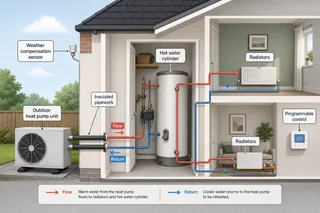
BUS is most relevant when replacing oil, LPG, coal, direct electric heating or an old inefficient system. It may be less compelling for a rental property with a modern mains gas boiler and relatively low heat demand, particularly if the tenant’s bills would not improve. Heat pumps can improve comfort and reduce carbon emissions, but they do not automatically guarantee a large EPC improvement. EPC methodology is partly based on running cost, and real-world performance depends on insulation, radiator sizing, flow temperature, hot water design, controls and tenant use. Poor design can lead to high bills and complaints, so landlords should treat the design stage as essential rather than optional. Typical air source heat pump installation costs before the grant are about £8,000 to £15,000. Ground source heat pumps are typically about £18,000 to £35,000 before the grant. Extra costs can include larger radiators, a hot water cylinder, pipework changes, electrical checks, external unit siting, noise considerations and making good after installation. A landlord considering BUS should ask for:
- a room-by-room heat-loss calculation
- a clear emitter and radiator schedule
- proposed flow temperatures
- hot water cylinder details
- controls and tenant handover information
- confirmation of MCS certification
In rental properties, simple controls and clear written instructions matter because the tenant will operate the system day to day. Landlords should also consider whether the property needs fabric improvements first. Installing a heat pump in a draughty, poorly insulated home can reduce performance and increase the risk of tenant dissatisfaction. planning and permitted development checks expected disruption and access requirements
Local authority and devolved schemes across the UK
Local authority schemes can be valuable for private rented sector EPC improvements, but they vary heavily by area. Some councils run retrofit programmes for specific postcodes, off-gas villages, low-income households or properties below a certain EPC rating. Private landlords may be included where tenants qualify, although landlord contributions and declarations are common.
In England, Warm Homes: Local Grant is expected to support low-income households in energy-inefficient homes, with a focus on EPC D to G homes and off-gas properties. Measures may include insulation, low-carbon heating, solar PV, heating controls and ventilation, but the details depend on the local authority delivering the scheme.
Wales has Welsh Government Warm Homes support, including schemes aimed at fuel poverty. Private rented homes may be eligible in some cases, but landlord permission is normally required and tenant circumstances are central. BUS also applies in Wales for qualifying heat pump and biomass boiler installations. Scotland has separate rules and funding routes, so Scottish landlords should not assume England and Wales MEES or grant criteria apply in the same way. Home Energy Scotland is the usual starting point for advice on grants and loans, and rural or island support may be relevant where schemes are open. Northern Ireland does not use ECO4 or GBIS in the same way as Great Britain. Landlords there need to check Northern Ireland-specific housing and energy-efficiency schemes. Support for private rented EPC upgrades may be more limited and can change by budget and department. For social landlords, the Warm Homes: Social Housing Fund is a separate route. It is aimed at councils, housing associations and registered providers rather than standard private buy-to-let landlords. Because local authority funding changes regularly, landlords should check the council website, the official Simple Energy Advice service where applicable, and any named delivery partner before giving tenant data or signing documents. Avoid assuming that a scheme is available simply because a similar grant operated in another council area.
VAT relief, green finance and tax treatment
Not all support for landlord EPC upgrades is a grant. VAT relief can reduce the cost of energy-saving materials in residential properties, including rented homes. The 0% VAT rate for eligible installed energy-saving materials is scheduled to run until 31 March 2027, before returning to 5% unless extended.
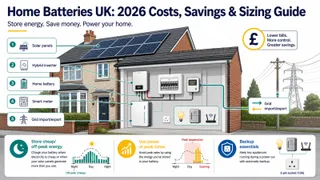
Relevant measures can include insulation, solar panels, heat pumps, biomass boilers, micro-CHP, draught stripping, heating controls and battery storage. Battery storage was added to the relief from 2024. The key point is that the relief normally applies to supply and installation by a contractor, not simply to materials bought separately by a landlord. If solar PV is part of the upgrade plan, this overview of solar support routes explains the main UK options.
Green mortgages, buy-to-let further advances and retrofit loans can help where grant eligibility is weak. Some lenders reward efficient properties or offer finance for improvements, but this is borrowing rather than free funding. Suitability depends on lender criteria, property value, rental cover, interest rates and the landlord’s wider portfolio position. Tax treatment also matters. Some repair costs may be deductible from rental income, while capital improvements are treated differently. Replacing a failed item with a modern equivalent may not be treated the same as adding a new system or significantly improving the property. Landlords should keep VAT invoices, grant paperwork, EPCs, installer certificates, MCS certificates, Building Regulations notices, warranties and photographs, and should take property-tax advice before assuming a measure is fully deductible. Good record-keeping also helps with future sales, remortgages, tenancy checks and EPC reassessments. If an EPC assessor cannot see evidence for insulation, heating controls or renewable systems, the assessment may rely on default assumptions that understate the property’s actual performance.
Which EPC measures are most likely to help
The cheapest route to a better EPC depends on the existing property, not just the recommendation list on the EPC certificate. EPC assessors use standard assumptions, and missing evidence can reduce the recognised performance of previous works. A post-works EPC is the only way to confirm the new rating.
In many rental homes, basic fabric measures come first because they reduce heat loss and can make later heating upgrades work better. Loft insulation, cavity wall insulation, draught-proofing, heating controls and low-energy lighting are often lower-cost improvements. Solid wall insulation, room-in-roof insulation, floor insulation, heat pumps and solar PV can have larger effects but need more careful design and higher budgets.
Typical UK cost ranges vary widely by property. An EPC assessment often costs about £60 to £120 for a typical rental property. Loft insulation top-up is often about £800 to £1,500, cavity wall insulation about £1,500 to £3,000, and suspended floor insulation about £2,000 to £6,000. Internal solid wall insulation can be about £7,000 to £15,000 for a typical house, while external solid wall insulation can be about £10,000 to £25,000. Solar PV can also improve EPC ratings, especially where the roof is suitable. A 3 kWp to 4 kWp solar PV system usually costs about £5,000 to £9,000 and often generates about 2,500 to 3,800 kWh per year in the UK. Roof condition, shading, orientation, scaffolding, structural checks and DNO requirements all affect suitability. Battery storage can help with energy use but adds cost, often about £3,000 to £8,000. Landlords can compare solar options before deciding whether PV is the right EPC measure for a specific property. Double glazing is often requested by tenants, but it is rarely the cheapest first EPC measure compared with insulation or heating controls. It may still make sense where windows are failing, draughty or due for replacement as part of planned maintenance. Landlords should also separate EPC improvement from actual comfort and running-cost improvement. The EPC score is important for compliance and valuation, but the best retrofit plan should also reduce heat loss, avoid damp, keep controls simple and fit the tenant’s day-to-day use of the home.
How to choose the right funding route
The best route is usually found by starting with the property and tenant, then matching the scheme. A landlord should avoid choosing a measure purely because funding is advertised. The funded measure still has to be technically suitable, compliant and useful for the tenant.
ECO4
Best for inefficient EPC D to G homes with low-income or vulnerable tenants where a wider package of measures is needed.VAT relief
Best as a broad cost reduction where eligible installed energy-saving materials are being fitted.Devolved schemes
Best where the property is in Wales, Scotland or Northern Ireland and local national rules differ from England.Boiler Upgrade Scheme
Best for landlords replacing fossil, direct electric or inefficient heating with a properly designed heat pump.Local authority schemes
Best where the property is in a participating council area and matches local priorities such as off-gas homes, fuel poverty or EPC D to G properties.Great British Insulation Scheme
Best for rental properties with a clear missing insulation measure and suitable council tax band or tenant eligibility.
Before applying, landlords should gather the current EPC, tenancy details, landlord consent, tenant consent, proof of tenant eligibility where relevant, council tax band, heating system details, photos of existing insulation and any leasehold or planning constraints. Flats may need freeholder or management company consent, and listed buildings or conservation areas may restrict external wall insulation, solar panels or visible heat pump equipment. Landlords should also think about sequencing. Adding insulation without ventilation can increase condensation risk. Installing a heat pump before dealing with heat loss can lead to poor performance. Fitting solar PV on a roof near the end of its life can create avoidable future costs. A simple whole-house plan helps avoid doing works in the wrong order. For Building Regulations, the exact requirements depend on the measure. Insulation may trigger thermal and ventilation standards. Heating work may need competent-person certification or Building Control sign-off. Electrical alterations may fall under Part P. Solar PV and batteries should be installed to relevant electrical and safety standards, with DNO notification or approval where required. Landlords should ask installers what certificates will be provided before agreeing to the work. Green finance — Best where grants are unavailable but the landlord can justify borrowing for long-term property improvement.
Common mistakes landlords should avoid
The biggest mistake is assuming that a grant is available simply because the property is rented or because the landlord wants to reach EPC C. Most schemes are targeted at tenant need, inefficient properties or specific technologies. A grant application can fail after survey if the property, tenant or proposed measure does not fit the rules.
Another common mistake is starting work too early. Many schemes require approval before installation, and funded work often needs specific installer accreditation, evidence photos, paperwork and post-installation checks. A cheap private quote may not meet the requirements for ECO, BUS or other funded routes.
Landlords should also avoid treating the EPC recommendation report as a design specification. It is a useful guide, but it may not identify damp defects, ventilation issues, unsuitable cavities, electrical constraints, radiator sizing, roof condition, planning restrictions or tenant disruption. These details determine whether the upgrade will work in the real property. For England and Wales, most privately rented homes currently need to be EPC E or above unless a valid exemption applies under the Minimum Energy Efficiency Standards. The previous proposal for mandatory EPC C by 2025 or 2028 was dropped, but future tightening remains a policy risk. Landlords planning EPC upgrades in 2026 should check current legislation and consider whether doing slightly more now avoids repeated disruption later. Other common errors include: relying on old EPC data without checking whether evidence is missing ignoring ventilation when improving insulation or airtightness installing low-carbon heating without a proper heat-loss calculation assuming solar PV is suitable without checking roof condition and shading failing to obtain tenant consent and access dates in writing forgetting leasehold, freeholder or management company permissions choosing an installer before checking scheme accreditation not keeping certificates and invoices for the next EPC assessment
Practical next steps for landlords in 2026
Start with a current EPC and a basic property condition check. If the EPC is old, based on assumptions or missing evidence for previous works, a new assessment may change the starting point. Evidence for insulation, heating systems, solar PV and controls should be kept because it can affect how the EPC assessor records the property.
Next, screen for funding in this order: tenant-based schemes such as ECO4 or local authority routes, insulation support through GBIS, technology-specific support through BUS, devolved schemes where relevant, VAT relief, then green finance. This order helps avoid overlooking grant support before taking on borrowing.
Get installer advice that is specific to the property. For insulation, that means checking damp, ventilation, wall type and access. For heat pumps, it means a room-by-room heat-loss calculation and emitter design. For solar PV, it means roof condition, shading, structure, inverter location, export arrangements and DNO requirements. If you want help comparing realistic upgrade options, you can also book a free survey. Finally, build in time for surveys, tenant communication, consent forms, grant approval, installation and post-works evidence. Grant-funded retrofit is often slower than a normal private job, but the extra process can reduce the risk of unsuitable measures. The right outcome is not just a better EPC certificate, but a rental home that is warmer, easier to run and compliant for the long term.
Plan, Compare & Buy Renewable Energy Solutions
AI does the thinking.
You get the perfect solar match.
Use RoboMo™ to assess your property, compare available technologies and connect with trusted UK installers, suppliers and manufacturers.
Simply enter your postcode, drop a pin on your roof, create your free account and let RoboMo™ analyse your property to find the best solar panels for your home.

You don't have to think
RoboMo™'s AI analyses your roof and does all the hard work.

Accurate & tailored
AI-powered assessment based on your roof, location, and conditions.

Best options, maximum savings
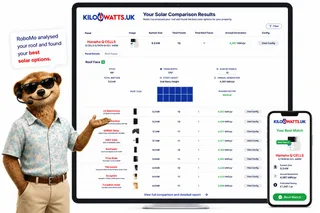
Compare top solar panels for the best performance and value.

Simple, fast & effortless
Provide a few details, sit back and watch your results unfold.
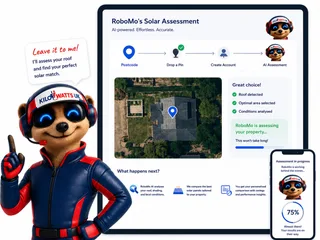
STEP 1
Choose Home, Business or Industrial
Enter your postcode to start your assessment.
STEP 2

Drop a pin on your roof
STEP 3

Create your free account
STEP 4

Sit back and watch RoboMo™ work
RoboMo™ analyses your roof and builds your personalised solar comparison.

Kilowatts UK is an authorised representative
Flower Turbines
Compact vertical-axis turbines built for real UK sites, not just open farmland.
They start in light wind, sit in a small footprint, and are bird-safe by design. Cluster them as a bouquet and the group performs better together than the same turbines standing alone. Enter your postcode for a location-based generation estimate. Figures use area weather data and will differ if buildings, trees or hills sit in the way.
Starts in light UK wind
Built to generate in typical UK wind, not only open farmland.
Small rooftop or ground footprint
Compact towers for roofs, yards and tight sites.
Bird-safe slow rotation
Slow vertical-axis spin, bird-safe by design.
Bouquet clusters raise output
Grouped turbines outperform the same units standing alone.

Step 1
Enter your postcode
Start designing your wind energy system in seconds.

STEP 2

Choose a location
STEP 3

Place your cluster
Tap the map where you want the turbine cluster to go.
STEP 4

Instant generation forecasts
Compare different turbine layouts and see annual generation forecasts instantly.
STEP 5

No commitment required
Explore different configurations before deciding whether to request a quotation.
Related articles


Mo's Mission Nominations
FAQ
Need Help? RoboMo's Got Answers
Can landlords get grants for EPC upgrades in 2026?
Yes, landlords may be able to access funding for EPC upgrades in 2026, but most schemes are targeted rather than universal. Eligibility usually depends on the property’s EPC rating, the tenant’s income or vulnerability, the location of the property, the existing heating system and the type of improvement proposed. The strongest prospects are typically for EPC D, E, F or G rented homes occupied by low-income, vulnerable or fuel-poor tenants.
Are EPC upgrade grants available for all buy-to-let properties?
No, most landlord EPC funding is not a general buy-to-let refurbishment grant. A property that is already EPC C or above, has higher-income tenants or only needs cosmetic improvements is less likely to qualify. Landlords in this position may still benefit from 0% VAT on eligible installed energy-saving materials, green finance, or funding for specific technologies such as heat pumps where the scheme rules are met.
Can private landlords use ECO4?
Private landlords can use ECO4 in some cases, but eligibility is usually driven by the tenant’s circumstances and the property’s inefficiency. ECO4 is most relevant for EPC D to G homes where tenants receive qualifying benefits or meet local vulnerability or fuel-poverty criteria. Landlord consent, tenant cooperation, evidence checks and a suitable whole-house retrofit assessment are normally required before any funded work can go ahead.
What is ECO Flex and how can it help rental properties?
ECO Flex is the local authority flexible eligibility route within ECO. It can help households that do not receive standard qualifying benefits but are still considered low-income, vulnerable, affected by health conditions or facing high energy costs. For landlords, ECO Flex depends on the council participating, the tenant meeting local criteria, the property being suitable and an approved installer or supplier being able to fund the work.
Can landlords use the Great British Insulation Scheme?
Yes, private rented properties can qualify for the Great British Insulation Scheme in some cases. It is usually aimed at single insulation measures such as loft insulation, cavity wall insulation, solid wall insulation, underfloor insulation or room-in-roof insulation. Eligibility can depend on EPC rating, council tax band, tenant circumstances and technical suitability, and landlord consent is normally required.
Can landlords use the Boiler Upgrade Scheme?
Yes, landlords in England and Wales can use the Boiler Upgrade Scheme if the property and installation meet the rules. The scheme provides £7,500 towards an eligible air source or ground source heat pump and £5,000 towards an eligible biomass boiler in qualifying rural off-gas properties. The installer normally applies for the grant and must be MCS certified, so landlords should not install first and try to claim afterwards.
Does a heat pump always improve a rental property’s EPC rating?
No, a heat pump does not automatically guarantee a large EPC improvement. EPC results depend on the property, the heating fuel being replaced, insulation levels, hot water setup and system design. A heat pump should be specified using a room-by-room heat-loss calculation, suitable radiator or emitter sizing and clear controls so that the tenant can run it efficiently.
Are there local council grants for landlord EPC improvements?
Some local authorities offer retrofit funding that can include private rented homes, but availability varies heavily by area. Schemes may focus on EPC D to G homes, off-gas properties, low-income households, fuel poverty or specific postcodes. Landlords should check their council’s current scheme rules and confirm whether landlord contributions, tenant eligibility evidence or local declarations are required.
Do EPC upgrade grants work the same in England, Wales, Scotland and Northern Ireland?
No, rules and funding routes differ across the UK. ECO4 and the Great British Insulation Scheme operate in Great Britain but not Northern Ireland in the same way. The Boiler Upgrade Scheme applies in England and Wales. Scotland has separate advice and funding routes, often starting with Home Energy Scotland, while Northern Ireland landlords need to check Northern Ireland-specific energy-efficiency support.
Can landlords get 0% VAT on EPC improvement works?
Landlords may benefit from 0% VAT on eligible installed energy-saving materials in residential properties, including rented homes. Eligible measures can include insulation, solar panels, heat pumps, biomass boilers, draught stripping, heating controls and battery storage. The relief normally applies when a contractor supplies and installs the measure, not when a landlord simply buys materials separately.
What EPC rating do rental properties need in 2026?
In England and Wales, most privately rented homes currently need to be EPC E or above unless a valid exemption applies under the Minimum Energy Efficiency Standards. Earlier proposals for mandatory EPC C by 2025 or 2028 were dropped, but future tightening remains possible. Landlords should check the latest rules before planning works and may still choose to aim above the legal minimum to reduce future disruption.
Which improvements are most likely to raise an EPC rating?
The best EPC improvements depend on the property, but common measures include loft insulation, cavity wall insulation, heating controls, low-energy lighting, floor insulation, solid wall insulation, solar PV and heating upgrades. Basic fabric improvements are often the best starting point because they reduce heat loss and can make later heating upgrades work better. A post-works EPC is the only reliable way to confirm the final rating.
Should landlords start work before grant approval?
No, landlords should usually wait for written approval before starting grant-funded work. Many schemes require approved installers, pre-installation evidence, tenant eligibility checks, landlord consent forms and post-installation paperwork. Starting too early can make the work ineligible for funding even if the measure itself would otherwise have qualified.
What evidence do landlords need for EPC grant applications?
Landlords may need a current EPC, tenancy details, proof of occupancy, tenant consent, landlord consent, evidence of tenant benefits or income where relevant, council tax band information, photographs of existing insulation or heating systems, and details of the proposed work. Flats, leasehold properties, listed buildings and homes in conservation areas may also need freeholder, management company or planning checks.
Can a landlord apply for funding without the tenant’s involvement?
Usually not. Many schemes are based on the tenant’s circumstances, so tenant consent, access and evidence are often essential. Installers or councils may need the tenant to provide benefit, income or vulnerability information and to allow surveys, installation visits and post-installation checks. Landlords should arrange consent and access in writing before progressing an application.
What mistakes should landlords avoid when upgrading EPC ratings?
Landlords should avoid assuming a grant is available automatically, starting work before approval, choosing measures only from an EPC recommendation list without a proper survey, ignoring ventilation, and using installers who do not hold the required scheme accreditation. They should also keep invoices, certificates, warranties, Building Regulations documents, MCS certificates and photographs, as missing evidence can affect future EPC assessments.