


£9,000 Heat Pump Grant: What It Means for UK Homeowners
Published: 2026-06-28 20:37:04
Updated: 2026-07-26 17:33:51
The main national heat pump grant in England and Wales is the Boiler Upgrade Scheme.
What the £9,000 heat pump announcement means
Thousands of homes may be eligible for up to £9,000 off a heat pump, but the headline figure should not be read as a guaranteed UK-wide grant for every household. The main national heat pump grant in England and Wales is the Boiler Upgrade Scheme, which provides £7,500 towards an eligible air source or ground source heat pump. A £9,000 discount usually depends on the exact GOV.UK announcement, local top-up, devolved support, supplier offer, or eligibility uplift.
This guide is for UK homeowners, landlords, and property buyers who have seen the £9,000 heat pump headline and want to understand whether it is relevant to their property before requesting quotes or paying a deposit. Its purpose is to explain how the funding may fit with existing schemes, what checks matter, and how to avoid choosing an installation based on the grant amount alone.
“Eligible” does not mean every home can claim £9,000. You need to check:
- Which scheme the announcement refers to.
- Where the property is located.
- Whether you own, rent, or manage the property.
- What heating system is being replaced.
- Whether the installer is approved for the scheme.
- Whether the heat pump and design meet the funding rules.
In most cases, the discount is applied to the installed price rather than paid to the homeowner as cash. The customer normally pays the remaining balance after the grant or discount has been deducted.
Short summary for homeowners
The £9,000 headline should be treated as a scheme-specific maximum, not a standard entitlement. For many owner-occupiers in England and Wales, the relevant national grant remains the Boiler Upgrade Scheme.
A heat pump can be a good option where the property has manageable heat loss, enough space for the equipment, a suitable hot water arrangement, and a heating system designed to run efficiently at lower temperatures. It is often most attractive when replacing oil, LPG, coal, old storage heating, or direct electric heating. Running cost savings compared with mains gas depend more heavily on electricity tariffs, system efficiency, radiator sizing, insulation, and how the home is used.
Before making decisions from a headline figure, confirm: The property is in the scheme area. The home and heating system are eligible. The installer is allowed to apply for the funding. The quoted price shows the grant deduction clearly. The design includes room-by-room heat loss calculations. The controls are suitable for heat pump operation. A heat pump grant can reduce the upfront cost, but it does not replace the need for a proper survey and design. Any electrical, planning, leasehold, or landlord permissions have been checked.
How the Boiler Upgrade Scheme fits in
The Boiler Upgrade Scheme applies in England and Wales and is administered by Ofgem. It provides £7,500 towards eligible air source heat pumps and £7,500 towards eligible ground source heat pumps, including shared ground loop systems. It also provides £5,000 towards biomass boilers in limited rural circumstances.
Scotland has separate support through Home Energy Scotland, and Northern Ireland has different domestic energy support arrangements. A GOV.UK news item does not automatically mean the same offer is available in every UK nation.
For Boiler Upgrade Scheme projects, the installer normally applies for the grant on behalf of the customer. The homeowner must agree to the application and confirm consent with Ofgem. The discount should then be shown clearly in the quotation, contract, and final paperwork. Installers and products normally need to meet scheme standards, including relevant MCS requirements. MCS stands for Microgeneration Certification Scheme and is the quality assurance framework commonly used for small-scale renewable installations in the UK. Most new-build homes are excluded, although self-build properties can be eligible if they meet the rules. Landlords can apply for eligible rental properties, but tenants cannot usually apply directly without the property owner.
Who may be eligible for up to £9,000 off
The exact answer depends on the GOV.UK announcement and the scheme it refers to. A £9,000 amount may come from a top-up to the Boiler Upgrade Scheme, a local authority programme, a devolved-government scheme, a supplier-led offer, or a specific uplift for certain households.
Eligibility can depend on:
- Location.
- Property ownership.
- Existing heating fuel.
- Household income.
- Property type.
- Scheme budget.
The existing heating system matters. Heat pump funding commonly focuses on replacing fossil fuel systems such as gas, oil, LPG, coal, or direct electric heating. It generally does not fund the replacement of an existing low-carbon heating system. If you rent your home, the landlord normally needs to lead the process. If you own a leasehold flat or maisonette, you may also need freeholder consent, building management approval, or planning advice before an installation can go ahead. You should check the live scheme rules before relying on any published figure, because eligibility, budgets, deadlines, and grant levels can change. Installer participation. Whether funding is first-come, first-served. Whether the property has previously received related public funding. Whether the installation replaces a fossil fuel or high-carbon heating system.
What £9,000 off does and does not cover
A £9,000 discount can make a heat pump more affordable, but it does not necessarily make the installation free. The final customer contribution depends on the property, system design, equipment, labour, access, electrical work, hot water requirements, and any radiator or pipework upgrades.
The installed cost depends less on the heat pump unit alone and more on the whole heating system design. A quote may include the outdoor unit, cylinder, controls, radiator upgrades, pipework changes, electrical work, flushing, commissioning, and any making good.
Some technical terms are worth understanding before comparing quotes: Flow temperature means the temperature of the water leaving the heat pump and travelling around the heating system. Emitters are the parts that release heat into rooms, such as radiators or underfloor heating. Commissioning means setting up, testing, and recording the system so it operates as designed. Heat loss is the amount of heat a room or property loses in cold weather. The grant or discount amount. The remaining customer contribution. A low headline price is not always a good result if important work has been removed from the specification. A heat pump connected to undersized radiators, restrictive pipework, or poorly configured controls can cost more to run and feel less comfortable. Good quotations should make clear: If the quote simply says “heat pump installation less grant” without showing how the system has been designed, it is not detailed enough for an informed decision. The heat pump model and capacity. The proposed flow temperature. The radiator and pipework upgrades. The hot water cylinder arrangement. The controls and commissioning approach. Any exclusions, assumptions, or optional extras.
The property checks that matter most
A good heat pump design starts with heat loss, not the size of the old boiler. Many UK boilers are oversized, so using the boiler rating as a guide can lead to a heat pump that is too large, inefficient, noisy, or poorly matched to the radiators. The installer should calculate room-by-room heat loss and check whether each radiator can deliver enough heat at the proposed low flow temperature. Some radiators may need to be larger. Some homes with microbore pipework may need more careful hydraulic design, and in some cases pipework upgrades. Heat pumps usually work best with steady, lower-temperature operation. They can work with radiators, underfloor heating, or a mixture of both, but the system must be designed around the home’s heat demand rather than treated as a simple boiler swap. Insulation is also important, even where it is not a grant requirement. The Boiler Upgrade Scheme insulation requirement was changed in 2024, but an EPC or energy survey can still be useful for identifying heat loss issues. Loft insulation, suitable cavity wall insulation, draught-proofing, and sensible ventilation improvements can reduce the heat pump size needed and improve comfort. Outdoor unit location also matters. The installer should consider airflow, access, defrost water, noise, neighbours, boundaries, and planning rules. A suitable position is not just a place where the unit fits; it must allow the heat pump to operate properly.
Heat pump controls and remote control
Heat pump controls are often misunderstood. A heat pump should not always be controlled like a gas boiler with short, aggressive heating bursts. Frequent on-off cycling can reduce efficiency, especially where the system volume is low or the flow temperature has been set too high.
Weather compensation is a key feature. It adjusts the heating flow temperature according to outdoor conditions, so the system runs warmer in cold weather and cooler in milder weather. This can improve efficiency and comfort when commissioned correctly.
Smart controls and app-based remote control can be useful, but they do not fix poor design. Some smart thermostats designed for homes are not ideal for heat pumps. Compatibility matters, especially where the heat pump needs modulation, weather compensation, hot water scheduling, and legionella cycle control. Large overnight temperature setbacks may also be counterproductive in some homes because the heat pump then has to work harder in the morning. A smaller setback or steadier heating pattern may perform better, although the best approach depends on the building, tariff, occupancy, and comfort expectations. A good handover should explain how to use the controls, what settings have been applied, and what not to change without advice. Many poor heat pump experiences come from systems that were technically installed but not properly explained.
Running costs and performance
Heat pump efficiency is usually described using COP or SCOP.
COP means Coefficient of Performance. It is the efficiency of the heat pump at a specific test condition. For example, a COP of 3 means the heat pump produces about 3 kWh of heat for every 1 kWh of electricity used at that moment.
SCOP means Seasonal Coefficient of Performance. It is a broader estimate of efficiency across a heating season. A SCOP of 3 means 1 kWh of electricity produces about 3 kWh of heat on average over the season. Well-designed UK air source heat pump systems commonly achieve seasonal performance in a range that depends on property heat loss, flow temperature, weather, hot water use, and commissioning quality. Ground source heat pumps can be higher in some cases, but only when the ground loop and heating system are properly designed. The flow temperature has a major effect. Lower flow temperatures usually mean better efficiency, which is why radiator sizing, pipework, and commissioning matter so much. Heat pumps are usually much cheaper to run than direct electric heating and can be attractive compared with oil, LPG, or old storage heating. Savings versus mains gas are less certain because UK electricity is usually more expensive per kWh than gas. A heat pump needs a high enough seasonal efficiency, and preferably a suitable electricity tariff, to compete strongly with gas boiler running costs. Solar panels can offset some daytime electricity use, and battery storage can help shift electricity consumption, but neither should be assumed to make a poor heat pump design economical. The heating system must work properly first. Running costs should be assessed using the household’s actual energy use, not only generic averages. A larger home, high hot water demand, high flow temperatures, or poor insulation can all increase electricity consumption.
When a heat pump may not be suitable
Heat pumps can work in many UK homes, including older homes, but they are not right for every situation. The main barriers are usually design constraints, permissions, upfront cost, and user expectations.
A heat pump may be difficult where there is no practical outdoor unit location, where planning or leasehold consent is unlikely, or where noise-sensitive boundaries make siting difficult. Flats and maisonettes can be more complex than houses because external wall space, freeholder consent, and shared services may all matter.
Some homes need electrical supply checks before installation. The installer may need to notify the Distribution Network Operator, often shortened to DNO. The DNO is the company responsible for the local electricity network, not necessarily the company that sends your energy bill. Some properties may need a residential fuse box upgrade or other electrical work. This is not always a problem, but it should be identified early rather than after a deposit has been paid. Heat pumps may also be less suitable for households that expect instant high-temperature heating from short bursts, or for short-term occupants who cannot justify the remaining upfront cost. Major damp, ventilation, structural, or insulation problems should be assessed before committing to a new heating system. A heat pump may still be possible in a challenging property, but the quote should explain the compromises clearly. If several important issues are unresolved, it may be better to improve the property first and revisit the heating system afterwards.
Questions to ask before accepting a grant-funded quote
A grant-funded quote should still be judged like any other heating specification. The funding reduces the price, but it does not guarantee that the design is right.
Ask the installer:
Controls
Will weather compensation be enabled and are the controls designed for heat pump operation.Hot water
Where will the cylinder go and is it sized for the household.Flow temperature
What design flow temperature is being proposed and how does it affect radiator sizing.Noise and siting
Has the outdoor unit location been assessed for airflow, neighbours, and defrost drainage.Heat loss calculation
Has a room-by-room heat loss survey been completed rather than using the old boiler size.Radiators and pipework
Which emitters or pipe runs need upgrading and which can stay.
If an installer cannot explain these points clearly, the grant amount should not be the deciding factor. A slightly cheaper installation can become expensive if it runs inefficiently or needs remedial work later. You should also be cautious of pressure selling. A genuine grant deadline or limited scheme budget may exist, but that does not remove your need to check eligibility, compare specifications, and understand the remaining customer contribution. Electrical supply — Is a fuse upgrade, DNO notification, or additional electrical work needed. Commissioning — What settings will be recorded and explained at handover. Grant process — Who applies for the funding and when is the grant deducted from the quote. Handover — Will the installer explain normal operation, tariffs, controls, and maintenance.
Practical next steps
First, identify the exact GOV.UK scheme or announcement being referred to and check whether the £9,000 amount applies to your area and property. Then compare it with the Boiler Upgrade Scheme rules if the home is in England or Wales, or the relevant devolved support if it is in Scotland or Northern Ireland.
Next, book a free home energy survey rather than a quick like-for-like boiler quote. The best proposals will show the funding deduction, the remaining balance, the system design assumptions, and the work needed to make the home perform well.
If you are comparing heat pumps with home solar panel options, battery storage, or future electricity tariffs, consider the whole household energy pattern rather than each technology in isolation. A good result depends on the property, the heating design, the controls, and how the home is actually used. The safest approach is to treat the £9,000 figure as a prompt to investigate, not as a reason to rush. Confirm the scheme, check the property, insist on a proper heat loss design, and make sure the final quote shows exactly what is included.
Plan, Compare & Buy Renewable Energy Solutions
AI does the thinking.
You get the perfect solar match.
Use RoboMo™ to assess your property, compare available technologies and connect with trusted UK installers, suppliers and manufacturers.
Simply enter your postcode, drop a pin on your roof, create your free account and let RoboMo™ analyse your property to find the best solar panels for your home.

You don't have to think
RoboMo™'s AI analyses your roof and does all the hard work.

Accurate & tailored
AI-powered assessment based on your roof, location, and conditions.

Best options, maximum savings
Compare top solar panels for the best performance and value.

Simple, fast & effortless
Provide a few details, sit back and watch your results unfold.
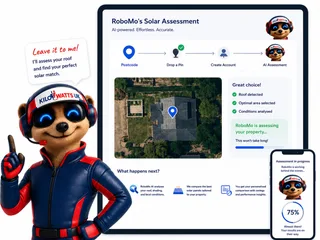

STEP 1
Choose Home, Business or Industrial
Enter your postcode to start your assessment.
STEP 2

Drop a pin on your roof
STEP 3

Create your free account
STEP 4

Sit back and watch RoboMo™ work
RoboMo™ analyses your roof and builds your personalised solar comparison.

Kilowatts UK is an authorised representative
Flower Turbines
Compact vertical-axis turbines built for real UK sites, not just open farmland.
They start in light wind, sit in a small footprint, and are bird-safe by design. Cluster them as a bouquet and the group performs better together than the same turbines standing alone. Enter your postcode for a location-based generation estimate. Figures use area weather data and will differ if buildings, trees or hills sit in the way.
Starts in light UK wind
Built to generate in typical UK wind, not only open farmland.
Small rooftop or ground footprint
Compact towers for roofs, yards and tight sites.
Bird-safe slow rotation
Slow vertical-axis spin, bird-safe by design.
Bouquet clusters raise output
Grouped turbines outperform the same units standing alone.

Step 1
Enter your postcode
Start designing your wind energy system in seconds.

STEP 2

Choose a location
STEP 3

Place your cluster
Tap the map where you want the turbine cluster to go.
STEP 4

Instant generation forecasts
Compare different turbine layouts and see annual generation forecasts instantly.
STEP 5

No commitment required
Explore different configurations before deciding whether to request a quotation.
Related articles
Mo's Mission Nominations
FAQ
Need Help? RoboMo's Got Answers
Is the £9,000 heat pump grant available to every UK household?
No. The £9,000 figure should be treated as a scheme-specific maximum rather than a guaranteed UK-wide grant. In England and Wales, the main national heat pump grant is the Boiler Upgrade Scheme, which usually provides £7,500 towards an eligible air source or ground source heat pump. A £9,000 discount may depend on a specific GOV.UK announcement, local top-up, devolved scheme, supplier offer, or eligibility uplift.
What is the Boiler Upgrade Scheme?
The Boiler Upgrade Scheme is a grant scheme for eligible properties in England and Wales. It provides £7,500 towards eligible air source heat pumps and ground source heat pumps, including some shared ground loop systems. It also provides £5,000 towards biomass boilers in limited rural circumstances. Scotland and Northern Ireland have separate energy support arrangements, so homeowners outside England and Wales should check the relevant local scheme.
Do I receive the heat pump grant as cash?
Usually, no. In most cases, the grant or discount is deducted from the installed price by the installer rather than paid directly to the homeowner. The customer normally pays the remaining balance after the grant has been applied. The quotation, contract, and final paperwork should clearly show the total installed cost, the grant deduction, and the customer contribution.
Who applies for the heat pump grant?
For the Boiler Upgrade Scheme, the installer normally applies for the grant on behalf of the customer. The homeowner must agree to the application and confirm consent with Ofgem. You should check that the installer is approved for the scheme and that the proposed heat pump installation meets the funding rules before paying a deposit.
Can landlords apply for heat pump funding?
Yes, landlords may be able to apply for eligible rental properties, provided the property and installation meet the scheme rules. Tenants usually cannot apply directly without the property owner. If the property is leasehold, additional permissions may be needed from the freeholder, managing agent, or building management company.
Are new-build homes eligible for heat pump grants?
Most new-build homes are excluded from the Boiler Upgrade Scheme, although self-build homes can be eligible if they meet the rules. Eligibility should always be checked against the live scheme guidance, because grant rules, budgets, and deadlines can change.
What does a heat pump grant cover?
A heat pump grant reduces the cost of an eligible installation, but it does not necessarily cover the full cost. A complete heat pump installation may include the outdoor unit, hot water cylinder, controls, radiator upgrades, pipework changes, electrical work, system flushing, commissioning, and handover. A quote should make clear what is included, what is excluded, and what the customer must still pay.
Why is a heat loss calculation important?
A heat pump should be designed around the property’s heat loss, not the size of the old boiler. Many boilers are oversized, so using the boiler rating can lead to a heat pump that is too large or poorly matched to the home. A proper survey should include room-by-room heat loss calculations and checks to confirm whether existing radiators and pipework can deliver enough heat at lower flow temperatures.
Will I need new radiators for a heat pump?
Possibly. Heat pumps usually work most efficiently at lower flow temperatures than gas or oil boilers, so some existing radiators may need to be replaced with larger ones. This does not mean every radiator must always be changed, but the installer should assess each room and explain which emitters can stay and which need upgrading.
Can a heat pump work in an older UK home?
Yes, heat pumps can work in many older UK homes if they are designed correctly. The key issues are heat loss, insulation, radiator sizing, pipework, controls, and outdoor unit location. Improving loft insulation, draught-proofing, suitable wall insulation, and ventilation can reduce heat demand and help the system run more efficiently.
Are heat pumps cheaper to run than gas boilers?
Not always. Heat pumps are usually much cheaper to run than direct electric heating and can be attractive when replacing oil, LPG, coal, or old storage heating. Savings compared with mains gas are less certain because electricity usually costs more per kWh than gas. Running costs depend on the heat pump’s seasonal efficiency, the electricity tariff, insulation, radiator sizing, hot water use, and how the heating controls are set.
What do COP and SCOP mean?
COP means Coefficient of Performance and describes heat pump efficiency at a specific operating condition. For example, a COP of 3 means the heat pump produces about 3 kWh of heat for every 1 kWh of electricity used at that moment. SCOP means Seasonal Coefficient of Performance and gives a broader estimate of efficiency over a heating season.
Do heat pumps need special controls?
Heat pumps perform best with controls designed for steady, lower-temperature operation. Weather compensation is especially important because it adjusts the heating flow temperature according to outdoor conditions. Some smart thermostats are not ideal for heat pumps, so compatibility should be checked before installation. A good installer should explain the controls, hot water schedule, weather compensation settings, and any settings that should not be changed without advice.
Will I need electrical work before installing a heat pump?
Some properties need electrical checks or upgrades before a heat pump can be installed. The installer may need to notify the Distribution Network Operator, known as the DNO, which manages the local electricity network. In some cases, a fuse upgrade, consumer unit work, or additional electrical wiring may be needed. These checks should happen early in the process.
Where can an outdoor heat pump unit be installed?
The outdoor unit needs a location with suitable airflow, access for maintenance, safe defrost water drainage, and acceptable noise levels for neighbours and boundaries. It is not enough for the unit simply to fit physically. The installer should assess the site, consider planning rules, and confirm that the location allows the heat pump to operate properly.
Can flats and maisonettes get heat pumps?
Sometimes, but they can be more complex than houses. Flats and maisonettes may need freeholder consent, managing agent approval, planning advice, and careful assessment of outdoor unit siting, noise, access, and shared building services. Leasehold restrictions can be a major factor, so permissions should be checked before committing to a quote.
What should I check before accepting a grant-funded heat pump quote?
Check that the quote includes a room-by-room heat loss calculation, proposed flow temperature, radiator and pipework requirements, hot water cylinder details, controls, outdoor unit location, electrical work, commissioning process, grant deduction, and final customer contribution. A grant-funded quote should still be judged on design quality, not just the headline discount.
Can solar panels or a battery improve heat pump running costs?
Solar panels can offset some daytime electricity use, and battery storage can help shift electricity consumption, but they do not fix a poorly designed heat pump system. The heating system should first be designed to run efficiently with suitable flow temperatures, controls, insulation, and emitters. Solar, battery storage, and smart tariffs can then be considered as part of the wider household energy strategy.
Should I rush to secure the £9,000 heat pump discount?
No. A genuine grant deadline or limited budget may exist, but you should still confirm eligibility, check the scheme rules, compare detailed specifications, and understand the remaining cost. The £9,000 headline should be treated as a reason to investigate, not as a reason to accept a rushed or poorly explained installation.