


MCS Certification for Solar Panels: What UK Homeowners Need
Published: 2026-08-09 13:38:39
Updated: 2026-08-12 03:35:32
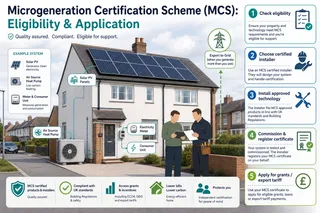
MCS certification is a recognised UK quality framework for small-scale renewable installations, including domestic solar PV.
What MCS certification means when comparing UK solar quotes
MCS certification is a recognised UK quality framework for small-scale renewable installations, including domestic solar PV. For homeowners, MCS matters because it helps show that the installer, design process and eligible products have followed an assessed route. It is also commonly requested for export tariff applications. It does not replace DNO connection paperwork, nor does it guarantee the best price, savings or workmanship on its own.
A good solar quote should make three things clear: who is responsible for the MCS installation, how the system will be connected to the electricity network, and what evidence you will receive after commissioning. If those points are vague, two quotes that look similar on panel count may carry very different risks.
Treat MCS as a due-diligence check, not a badge to accept without question. Verify the legal company name, the scope of certification, the consumer code named in the contract, the DNO route, and the timing of the final certificate before signing.
Why MCS matters to homeowners
MCS stands for Microgeneration Certification Scheme. In solar PV, it covers certified contractors and relevant certified products within a defined scheme. For a homeowner, MCS certification gives a practical way to check whether the business quoting has been assessed against recognised installation and business processes, rather than relying only on a logo in a proposal.
In real projects, MCS often becomes important when paperwork affects money or future plans. Smart Export Guarantee applications commonly ask for an MCS certificate or an accepted equivalent, along with metering and DNO evidence. Some funding, local authority or lender requirements may also specify certification, but eligibility always depends on the exact scheme and should be checked before you rely on it.
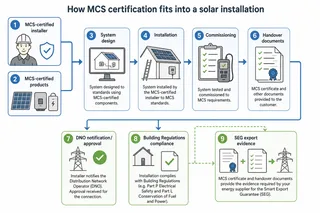
MCS also gives structure to the handover. After a compliant installation, you should expect documents that identify the installed system, confirm commissioning, set out warranties, explain operation and maintenance, and provide the MCS certificate where applicable. If a quote says “MCS included” but does not explain the handover pack, ask for the missing detail before you commit.
What MCS does not prove on its own
MCS certification should not be treated as a substitute for checking the engineering detail in the quote. It does not mean every installer will design the same array, choose the same inverter, allow the same time on site, use the same mounting specification or provide the same aftercare. It also does not guarantee a particular payback period, savings figure or export income.
The biggest misunderstanding is thinking MCS is the only approval involved. A solar PV system also needs appropriate electrical design, safe installation and the correct connection arrangements with the local Distribution Network Operator. Depending on inverter capacity, export level, battery arrangement and whether other generation is already present, the DNO route may be simple notification or a more involved application.
That distinction matters when comparing quotes. One installer may have allowed for a G99 application, export limitation or battery-specific design, while another may have assumed a simpler G98 notification route. Those quotes are not equivalent if the network assumptions, timescale and export arrangements are different.
How to check if a solar installer is MCS certified
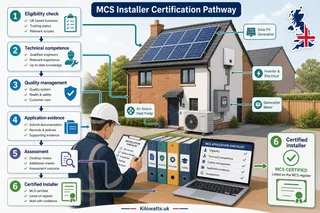
The safest route is to verify the installer through the official MCS installer search rather than relying only on sales material. Check that the legal company name matches the firm on your quote and contract, and check that its certification scope includes solar PV. If the sales company, surveyor and installation company are different businesses, ask which certified legal entity is responsible for the design, installation and final certificate.
You should also ask when the MCS certificate will be issued. It is normally produced after the installation is complete and registered, not before the panels are fitted. A pre-installation quote can state that the work will be completed through an MCS certified installer, but the final certificate depends on the installed system and the completion of the required paperwork.
Useful checks before accepting a quote include:
MCS scope
Check that solar PV is included, rather than assuming a company certified for another technology can certify your solar installation.Consumer code
Ask which consumer code applies to the contract, such as RECC or HIES where applicable, and check that the named route is written into the paperwork.Handover pack
Request a clear list of the documents you will receive after commissioning.Responsibility
Clarify who designs the system, who installs it, who commissions it and who registers the final certificate.Installer status
Confirm the company is currently MCS certified for solar PV and that the name matches the contract.Product evidence
Ask whether the panels and relevant MCS-listed products are suitable for the proposed installation.
Product certification and what it does not cover
For solar PV, homeowners often hear “MCS approved panels” and assume every component in the system is certified in the same way. The reality is more precise. MCS product certification applies to relevant product categories within the scheme, and installers should use eligible products where required for the certified installation.
That does not mean every accessory, cable, isolator, monitoring device or mounting component is individually described by homeowners in the same certification language. Those parts still matter, but they are normally assessed through appropriate electrical design, product suitability, manufacturer instructions and installation standards rather than being checked by the homeowner as a simple MCS product-list exercise.
The practical question to ask is not only “are the panels MCS certified?” A better question is whether the proposed system will be registered as an MCS installation using eligible products and suitable components, with the exact panel, inverter, battery and mounting details identified in the quote and handover paperwork.
How MCS fits with DNO approval and export tariffs
MCS, DNO approval and export tariff paperwork are connected, but they are not the same thing. MCS relates to the installation scheme and recognised standards. The DNO process relates to whether your local electricity network can accept the generator and any export. Export tariff paperwork is handled by the supplier that pays for exported electricity, subject to its own requirements.
For many domestic systems, the DNO route depends on inverter capacity, export level, whether export is limited, and whether batteries or other generation are connected. Installers usually manage this process, but you should still ask what has been assumed in the quote. A system that needs pre-approval can take longer than one that can be notified after installation.
Export payments are separate again. Under the Smart Export Guarantee, participating suppliers set their own tariff terms and evidence requirements. They commonly ask for documents such as an MCS certificate or accepted equivalent, a smart meter capable of recording export, and DNO confirmation. Check the chosen supplier’s requirements before assuming a quote will qualify you for a specific export tariff.
A practical example of two quotes that are not equivalent
A common real-world issue is when two quotes show a similar number of panels but make different assumptions about grid connection. Quote A might assume a smaller inverter and a straightforward post-installation notification. Quote B might include a larger inverter, a battery, export limitation and time for a DNO application before work starts. The headline system size may look close, but the design risk and administrative route are different. This is where MCS alone is not enough to compare value. Both quotes may say the installation will be MCS certified, but only one may have properly allowed for the network process, metering arrangement and export evidence that you will need later. If a cheaper quote avoids these details, ask whether the omission is a genuine design difference or a cost left outside the proposal.
| Quote area | Why it matters | What to ask before signing |
|---|---|---|
| MCS status | Affects recognised installation paperwork and many export or scheme requirements | Is the contracted installer currently certified for solar PV? |
| Legal entity | Sales brands and installation companies are not always the same | Which legal company signs the contract and issues the MCS certificate? |
| DNO process | Export may be limited or require approval before installation | Is this G98 notification, G99 application or an export-limited design? |
| System design | Output depends on roof orientation, shading, inverter sizing and layout | What assumptions are used in the generation estimate? |
| Equipment | Panels, inverters and batteries differ in warranty, compatibility and monitoring | Which exact models are included in the quote? |
| Handover documents | Future support, export applications and property sale enquiries rely on paperwork | What certificates, manuals and warranties will be provided? |
| Consumer protection | Complaints routes depend on the installer and contract | Which consumer code applies and where is it named in the contract? |
| Battery integration | Hybrid and AC-coupled batteries affect design, metering and DNO treatment | Is the battery included in the same application and design scope? |
Consumer protection and complaints routes
MCS certification is linked to consumer protection requirements, but homeowners should still check the exact route that applies to their contract. In domestic solar, installers may be members of a consumer code such as RECC or HIES, depending on the business. The important point is to confirm the named code in the contract, not only in sales literature.
This matters because complaints and dispute routes depend on the legal company you contracted with and the consumer code it belongs to. If one firm sells the system and another installs it, you need to know who is accountable for workmanship, documentation, warranty support and any complaint after handover.
Ask for the position in writing before paying a deposit. A clear installer should be able to explain who holds the MCS certification, which consumer code applies, what deposit protection or insurance-backed warranty arrangements are included where applicable, and how you would raise a complaint if something goes wrong.
What should be in the handover pack
The handover pack is evidence you may need for export payments, future maintenance, warranty claims, property sale enquiries and fault diagnosis. Missing documents can become a problem months or years after installation, especially if you change energy supplier or sell the property.
Ask the installer to list the handover documents before you sign. The exact pack depends on the system, but for a typical domestic solar PV installation you should expect clear evidence of design, commissioning, product details and user guidance.
Key documents usually include the MCS certificate where the system is installed through the MCS process, the electrical certificate, and DNO confirmation showing the relevant notification or approval route. You should also receive model references for panels, inverter, battery and monitoring equipment where included, along with warranty information and basic operation guidance.
MCS certificate
Issued after the completed installation is registered where the system is installed through the MCS process.DNO confirmation
Paperwork showing the relevant notification or approval route for the connected generation.Design information
Key assumptions such as array layout, inverter rating, orientation, shading and estimated generation.Operation guidance
Instructions explaining safe isolation, monitoring, basic fault indicators and maintenance expectations.Electrical certificate
Evidence that the electrical work has been inspected and tested by the responsible installer.Product and warranty details
Model references, manufacturer warranties and workmanship warranty information with clear contact routes.
Common mistakes to avoid
The most common mistake is accepting a quote because it displays an MCS logo without checking the company behind it. Certification should be current, relevant to solar PV, and linked to the legal entity you are contracting with. If a salesperson says another firm will “cover the MCS”, get that arrangement in writing and understand who is accountable.
Another mistake is comparing headline system sizes without checking usable design detail. A 4 kW array, a 5 kW inverter and a 10 kWh battery are different measures, and they do not tell you everything about annual generation, export, self-consumption or backup capability. Battery capacity is measured in kWh, inverter output in kW, and backup operation is not standard unless specifically designed and documented.
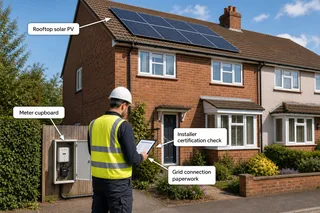
Be cautious if a quote avoids site-specific issues. Roof structure, roof covering, shading, consumer unit condition, cable routes, earthing arrangements, scaffold access and meter position can all change the final design. Common mistakes include:
When MCS may be especially important
MCS is especially important if you want the option to apply for export payments, use a scheme that requires recognised certification, or keep paperwork clean for a future house sale. If you are reviewing available support, check the requirements around solar grants before assuming a certificate will make a project eligible. It is also valuable where you want a defined complaints route and a clearer standard for design and handover.
It may be less central if the project is a specialist off-grid or private-wire arrangement outside typical domestic solar PV, but that is not the norm for most UK homeowners. Even then, the installer should be able to explain what standards apply instead, what paperwork you will receive, and what you may lose by not having an MCS certificate.
Where solar is being installed with a battery, heat pump or EV charger, the interactions become more important. The installer should explain how the inverter and battery will be connected, whether export is controlled, what the DNO will be told, and how the system will be monitored after commissioning.
Check before signing
Before choosing a solar installer, ask for the quote to separate the essentials from the assumptions. You want to know what is fixed, what is provisional, and what depends on survey, scaffold access, meter position or DNO response. This is especially important if one quote is materially cheaper than another.
Use the same checks across every quote so you are comparing like with like. The goal is not to find the most paperwork-heavy proposal. It is to identify the installer that has clearly accounted for certification, design, grid connection, consumer protection and handover.
Check the company name on the quote, contract and MCS listing matches the business you are relying on. Confirm that the installer is currently certified for solar PV and ask how the installer has checked that the panels and relevant products are suitable for an MCS installation. You should also confirm which consumer code is named in the contract and what your chosen Smart Export Guarantee supplier will require.
DNO route
Ask whether the quote assumes G98 notification, G99 application, export limitation or another connection arrangement.MCS scope
Confirm that the installer is currently certified for solar PV and not only for another technology.Consumer code
Confirm whether RECC, HIES or another applicable route is named in the contract.Handover pack
Get the promised document list in writing before paying a deposit.Legal company
Check the company name on the quote, contract and MCS listing matches the business you are relying on.Certificate timing
Confirm that the MCS certificate will be issued after completion and registration, and ask what could delay it.
Practical next steps before you choose an installer
Before you sign, gather recent electricity bills, note your typical daytime use, and consider planned changes such as an EV, heat pump, battery or home working. These details affect the right system size, inverter choice, battery value and export assumptions. A good installer should explain how the proposed design fits your property and usage, rather than offering a generic package.
Keep the decision grounded in evidence rather than badges alone. MCS certification is a useful filter, but the stronger quote is the one that combines proper certification with a realistic survey, transparent equipment schedule, clear DNO process, named consumer protection and complete handover documents.
If a quote is unclear, ask for clarification before signing rather than trying to resolve it after installation. It is far easier to confirm the legal entity, DNO route, product details and certificate process at quotation stage than to correct missing paperwork once the system is already on the roof.
Plan, Compare & Buy Renewable Energy Solutions
AI does the thinking.
You get the perfect solar match.
Use RoboMo™ to assess your property, compare available technologies and connect with trusted UK installers, suppliers and manufacturers.
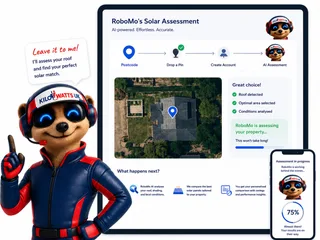
Simply enter your postcode, drop a pin on your roof, create your free account and let RoboMo™ analyse your property to find the best solar panels for your home.

You don't have to think
RoboMo™'s AI analyses your roof and does all the hard work.

Accurate & tailored
AI-powered assessment based on your roof, location, and conditions.

Best options, maximum savings
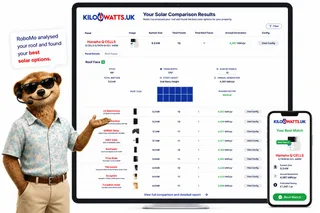
Compare top solar panels for the best performance and value.

Simple, fast & effortless
Provide a few details, sit back and watch your results unfold.
STEP 1
Choose Home, Business or Industrial
Enter your postcode to start your assessment.
STEP 2

Drop a pin on your roof
STEP 3

Create your free account
STEP 4

Sit back and watch RoboMo™ work
RoboMo™ analyses your roof and builds your personalised solar comparison.

Kilowatts UK is an authorised representative
Flower Turbines
Compact vertical-axis turbines built for real UK sites, not just open farmland.
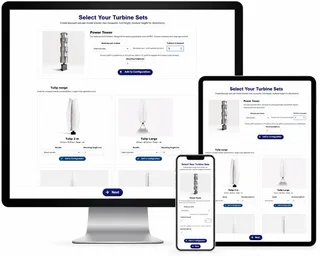
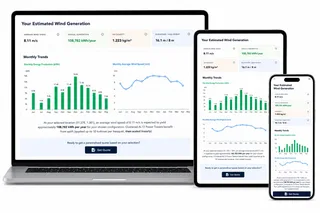
They start in light wind, sit in a small footprint, and are bird-safe by design. Cluster them as a bouquet and the group performs better together than the same turbines standing alone. Enter your postcode for a location-based generation estimate. Figures use area weather data and will differ if buildings, trees or hills sit in the way.
Starts in light UK wind
Built to generate in typical UK wind, not only open farmland.
Small rooftop or ground footprint
Compact towers for roofs, yards and tight sites.
Bird-safe slow rotation
Slow vertical-axis spin, bird-safe by design.
Bouquet clusters raise output
Grouped turbines outperform the same units standing alone.
Step 1
Enter your postcode
Start designing your wind energy system in seconds.
STEP 2

Choose a location
STEP 3

Place your cluster
Tap the map where you want the turbine cluster to go.
STEP 4

Instant generation forecasts
Compare different turbine layouts and see annual generation forecasts instantly.
STEP 5

No commitment required
Explore different configurations before deciding whether to request a quotation.
Related articles
Solar panels
Mo's Mission Nominations
FAQ
Need Help? RoboMo's Got Answers
What does MCS certification mean for a UK solar panel installation?
MCS is a recognised UK quality scheme for small-scale renewable installations, including domestic solar PV. It shows the installer and relevant products have followed an assessed route. It is useful evidence for many export tariff applications, but it is not a guarantee of savings, workmanship or the best quote.
How can I check if my solar installer is MCS certified?
Use the official MCS installer search and check the legal company name against your quote and contract. Make sure the certification is current and includes solar PV, not just another technology. If a sales company and installation company are different, ask which certified business will issue the final certificate.
Will I receive an MCS certificate before the panels are installed?
No, the MCS certificate is normally issued after the installation has been completed and registered. A quote can state that the work will be carried out through an MCS certified installer, but the final certificate depends on the completed system and paperwork. Ask when you should expect to receive it after commissioning.
Is MCS the same as DNO approval?
No, MCS and DNO paperwork are separate. MCS relates to the installation scheme, while the Distribution Network Operator process relates to connecting generation to the local electricity network. Your installer should explain whether the system needs simple notification, prior approval or export limitation.
Do I need MCS certification to get paid for exported solar electricity?
Many Smart Export Guarantee suppliers commonly ask for an MCS certificate or an accepted equivalent, but each supplier sets its own evidence requirements. You may also need DNO confirmation and a meter that can record export. Check the chosen supplier’s terms before assuming a quote will qualify you for a specific tariff.
Are MCS certified solar panels the only thing I need to check?
No, the whole proposed system matters, not just the panel label. Ask whether the installation will be registered through the MCS process using eligible products and suitable components. The quote should identify the panel, inverter, battery if included, mounting approach and key design assumptions.
What should be included in the solar handover pack?
You should expect the MCS certificate where applicable, electrical certificate, DNO confirmation, product details, warranties and basic operating guidance. The pack should also record important design information such as inverter rating, array layout and estimated generation. Keep these documents for export applications, maintenance, warranty claims and future property sale enquiries.
What should I ask before accepting a solar quote that says “MCS included”?
Ask which legal company holds the MCS certification and which company signs the contract. Check which consumer code applies, what DNO route has been assumed and when the final certificate will be issued. Also ask for a written list of the documents you will receive after commissioning.