


How many solar panels does a UK home need
Published: 2026-02-04 23:42:20
Updated: 2026-02-05 00:41:58
Find out how many solar panels your UK home needs based on roof size, energy usage, and budget. Typical systems need 8–13 panels costing £6,000–£15,000
Summary
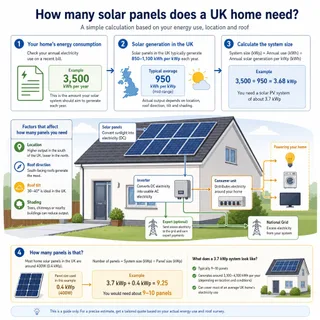
Most UK homes need between 8 and 13 solar panels to cover a significant portion of their electricity usage. The exact number depends on your roof space, energy consumption, and whether you have a battery. A typical 4kW system costs £6,000 to £8,000 installed and pays for itself in 7 to 10 years through reduced bills and export payments.
What determines how many panels you need
The following points summarise the most important takeaways:
Shading
Even partial shading on one panel can reduce entire system output if using string inverters.Roof pitch
The ideal angle is 30 to 40 degrees; 39 degrees is considered optimal for year-round UK performance.Panel wattage
Higher wattage panels (400W+) reduce the total number needed but may cost more per unit.Roof orientation
South-facing is optimal; east or west-facing reduces output by approximately 15%.Energy consumption
Higher usage requires larger systems; adding an electric vehicle increases demand by roughly 2,000 kWh annually.
Typical system sizes for UK homes
The following points summarise the most important takeaways:
Large household or high usage
12 to 16 panels (5–6 kWp) generating 4,500–6,000 kWh annually.Small household (1–2 people)
8 to 10 panels (3–3.5 kWp) generating 2,500–3,000 kWh annually.Medium household (3–4 people)
10 to 12 panels (4 kWp) generating 3,400–4,200 kWh annually.
Roof space and structural requirements
The following points summarise the most important takeaways:
Spacing
Panels need approximately 3 cm between them and 30 cm clearance from roof edges.Obstructions
Dormer windows, chimneys, and vents significantly reduce usable area and may require complex layouts.Physical space
Approximately 1.5 to 2.2 m² per panel; a 4kW system needs roughly 16 to 20 m² of clear roof space.Weight loading
Roofs must support an additional 20 to 25 kg per panel; older roofs may need reinforcement or replacement first.
Costs and payback
The following points summarise the most important takeaways:
Cost per kW
Approximately £1,600 to £1,900 installed.System cost
£6,000 to £8,000 for a typical 4kW system including installation but excluding battery storage.Annual savings
£400 to £600 on electricity bills depending on usage patterns and system size.Payback period
Typically 7 to 10 years; shorter if electricity prices rise or you use more of what you generate.SEG export income
£100 to £200 annually depending on supplier rates (3p to 15p per kWh) and excess generation.
Planning and regulatory considerations
The following points summarise the most important takeaways:
Flat roofs
Installations up to 0.6m height are now permitted without planning permission as of November 2023.DNO approval
Systems over 3.68 kW require approval from your local Distribution Network Operator before installation.Building regulations
Require structural assessment of roof load-bearing capacity and electrical compliance with BS 7671.Permitted development
Most residential roof installations do not require planning permission.Listed buildings and conservation areas
Additional restrictions apply; visual impact assessments may be needed.
Who should consider solar panels
The following points summarise the most important takeaways:
- Homeowners with unshaded south, east, or west-facing roofs in good structural condition.
- Those planning to stay in the property long enough to realise payback.
- Households with high daytime electricity usage or plans to add battery storage.
- Properties with at least 8 to 10 m² of usable roof space.
Who should reconsider
The following points summarise the most important takeaways:
- Properties with heavily shaded roofs from trees or adjacent buildings.
- North-facing roofs without substantial system oversizing to compensate.
- Homes with roofs requiring replacement within 5 to 10 years.
- Renters without landlord permission or leaseholders with restrictive covenants.
- Those seeking immediate financial returns; benefits accrue over the medium to long term.
Technology and equipment choices
The following points summarise the most important takeaways:
Panel lifespan
25 to 30 years with performance warranties guaranteeing 80 to 85% output after 25 years.String inverters
Cheaper option but suffer from the "weakest link" problem where one shaded panel reduces output of the entire string.Inverter lifespan
10 to 15 years for string inverters; replacement costs £500 to £1,500.Annual degradation
Panels lose 0.4 to 0.8% efficiency per year.Microinverters or power optimisers
Add £100 to £150 per panel but can increase efficiency by 5 to 25% in partially shaded conditions.
Installer selection and certification
The following points summarise the most important takeaways:
DNO applications
Systems over 3.68 kW require approval that can take several weeks; this should be handled before installation.Quote comparison
Ensure scaffolding, VAT, and monitoring equipment are included in pricing.MCS certification
Required for Smart Export Guarantee eligibility; uncertified installations cannot access export payments.Installer assessment
Check that generation estimates match your specific roof orientation, pitch, and location.
Future-proofing your system
The following points summarise the most important takeaways:
Heat pumps
Increase electricity demand significantly; consider larger systems or battery storage.Battery storage
Allows you to store excess generation for evening use; adds £2,000 to £6,000 to system cost but improves self-consumption.Electric vehicles
Add approximately 2,000 kWh to annual consumption; size your system accordingly if you plan to buy one.Home working patterns
Increased daytime occupancy improves the economics of solar by using more generation on-site.
Frequently asked questions
A typical 3-bedroom UK home needs 10 to 12 panels (4 kWp) to cover most of its electricity usage, assuming average consumption of 2,900 to 3,100 kWh per year. Yes, though it is often more cost-effective to size correctly initially. Adding panels later may require a new inverter, additional DNO approval, and matching panel specifications that may no longer be available. Yes. Panels generate electricity from daylight, not just direct sunlight. Output drops to 10 to 25% of rated capacity during heavy cloud cover but generation continues. Yes. The Smart Export Guarantee (SEG) replaced the Feed-in Tariff in 2020. Energy suppliers pay 3p to 15p per kWh for exported electricity, though you must have an MCS-certified installation to qualify. Panels typically last 25 to 30 years with warranties guaranteeing 80 to 85% output after 25 years. They can function for 40 years or more at reduced efficiency. The inverter will need replacement after 10 to 15 years.
- How many solar panels does a UK home need for a 3-bedroom house?
- Can I add more panels later if my energy needs increase?
- Do solar panels work on cloudy UK days?
- Will I still receive an export payment for surplus electricity?
- How long do solar panels last in the UK climate?
Next steps
To get an accurate assessment of how many solar panels your specific home needs, use the solar calculator to estimate generation and payback based on your roof characteristics and location. You can also find MCS-certified installers in your area through our directory. If you are considering battery storage, explore our battery storage guides to understand how storage affects system sizing and economics. For information on available support, check our grants and funding section, though note that most residential solar installations now proceed without government subsidies. [cta: solar]
Ready to compare your options?
Get tailored comparisons and connect with trusted installers in under a minute.
Plan, Compare & Buy Renewable Energy Solutions
AI does the thinking.
You get the perfect solar match.
Use RoboMo™ to assess your property, compare available technologies and connect with trusted UK installers, suppliers and manufacturers.
Simply enter your postcode, drop a pin on your roof, create your free account and let RoboMo™ analyse your property to find the best solar panels for your home.

You don't have to think
RoboMo™'s AI analyses your roof and does all the hard work.

Accurate & tailored
AI-powered assessment based on your roof, location, and conditions.

Best options, maximum savings
Compare top solar panels for the best performance and value.

Simple, fast & effortless
Provide a few details, sit back and watch your results unfold.
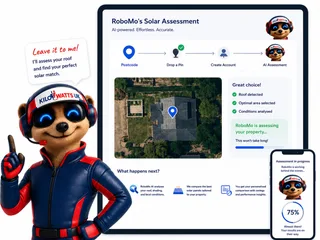
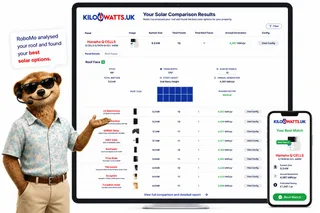
STEP 1
Choose Home, Business or Industrial
Enter your postcode to start your assessment.
STEP 2
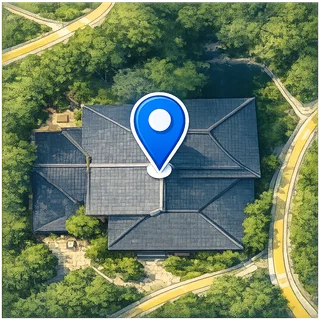
Drop a pin on your roof
STEP 3

Create your free account
STEP 4

Sit back and watch RoboMo™ work
RoboMo™ analyses your roof and builds your personalised solar comparison.
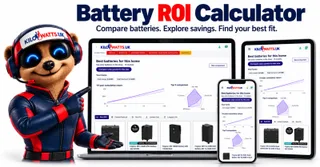
BATTERY ROI TOOL
See what a battery saves on your bill
Enter the day rate, off-peak rate and export rate. The calculator ranks batteries in the Kilowatts shop over 10 years.
Home batteries also suit offices and small commercial sites. Industrial batteries are listed on their own calculator.

Step 1
Enter your postcode
Start designing your wind energy system in seconds.
Are you an installer, distributor or renewable energy business?
Kilowatts UK is expanding the Flower Turbines partner network across the UK.
Become A Flower Turbines PartnerKilowatts UK is an authorised representative
Flower Turbines
Compact vertical-axis turbines built for real UK sites, not just open farmland.
They start in light wind, sit in a small footprint, and are bird-safe by design. Cluster them as a bouquet and the group performs better together than the same turbines standing alone. Enter your postcode for a location-based generation estimate. Figures use area weather data and will differ if buildings, trees or hills sit in the way.
Starts in light UK wind
Built to generate in typical UK wind, not only open farmland.
Small rooftop or ground footprint
Compact towers for roofs, yards and tight sites.
Bird-safe slow rotation
Slow vertical-axis spin, bird-safe by design.
Bouquet clusters raise output
Grouped turbines outperform the same units standing alone.
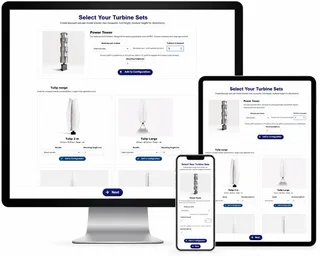
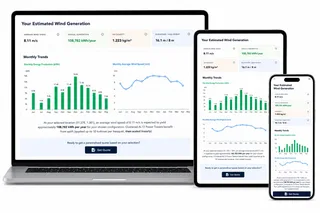
STEP 2

Choose a location
STEP 3
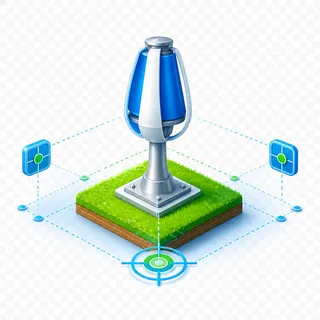
Place your cluster
Tap the map where you want the turbine cluster to go.
STEP 4

Instant generation forecasts
Compare different turbine layouts and see annual generation forecasts instantly.
STEP 5

No commitment required
Explore different configurations before deciding whether to request a quotation.
Related articles

Mo's Mission Nominations
FAQ
Need Help? RoboMo's Got Answers
How many solar panels does a typical UK home need?
Most UK homes need between 8 and 13 solar panels to cover a significant portion of their electricity usage. A typical 3-bedroom house requires 10 to 12 panels (4 kWp) assuming average consumption of 2,900 to 3,100 kWh per year. The exact number depends on your roof space, energy consumption, and whether you have a battery.
What factors determine how many solar panels I need?
Several factors influence system sizing: your energy consumption (higher usage requires larger systems), roof orientation (south-facing is optimal; east or west-facing reduces output by approximately 15%), roof pitch (30 to 40 degrees is ideal), shading from trees or buildings, and panel wattage (higher wattage panels reduce the total number needed).
How much roof space do I need for solar panels?
You need approximately 1.5 to 2.2 m² per panel. A typical 4kW system requires roughly 16 to 20 m² of clear roof space. Panels need approximately 3 cm between them and 30 cm clearance from roof edges. Dormer windows, chimneys, and vents can significantly reduce usable area.
How much does a solar panel system cost in the UK?
A typical 4kW system costs £6,000 to £8,000 including installation but excluding battery storage. This works out to approximately £1,600 to £1,900 per kW installed. Battery storage adds £2,000 to £6,000 to the system cost.
What is the payback period for solar panels?
Solar panels typically pay for themselves in 7 to 10 years through reduced electricity bills and export payments. Annual savings on electricity bills range from £400 to £600, plus £100 to £200 from SEG export income depending on your supplier rates.
Do I need planning permission for solar panels?
Most residential roof installations fall under permitted development rights and do not require planning permission. However, listed buildings, conservation areas, and flats have additional restrictions. Flat roof installations up to 0.6m height are now permitted without planning permission as of November 2023.
What is DNO approval and when do I need it?
DNO (Distribution Network Operator) approval is required for systems over 3.68 kW before installation. This process can take several weeks and should be handled by your installer before work begins.
Do solar panels work on cloudy UK days?
Yes. Panels generate electricity from daylight, not just direct sunlight. During heavy cloud cover, output drops to 10 to 25% of rated capacity but generation continues. Cooler UK temperatures actually improve panel efficiency compared to hotter climates.
Will I get paid for excess electricity I export?
Yes. The Smart Export Guarantee (SEG) replaced the Feed-in Tariff in 2020. Energy suppliers pay between 3p and 15p per kWh for exported electricity. You must have an MCS-certified installation to qualify for these payments.
How long do solar panels last?
Panels typically last 25 to 30 years with performance warranties guaranteeing 80 to 85% output after 25 years. They can function for 40 years or more at reduced efficiency. The inverter will need replacement after 10 to 15 years at a cost of £500 to £1,500.
Can I add more panels later if my energy needs increase?
Yes, though it is often more cost-effective to size correctly initially. Adding panels later may require a new inverter, additional DNO approval, and matching panel specifications that may no longer be available.
Who is not suitable for solar panels?
Solar panels may not be suitable if you have a heavily shaded roof, a north-facing roof without substantial system oversizing, a roof requiring replacement within 5 to 10 years, or if you are renting without landlord permission. They are also unsuitable for those seeking immediate financial returns.
What is MCS certification and why does it matter?
MCS (Microgeneration Certification Scheme) is the government-backed quality standard for installers and equipment. It is required for Smart Export Guarantee eligibility. Uncertified installations cannot access export payments.
Should I choose string inverters or microinverters?
String inverters are cheaper but suffer from the "weakest link" problem where one shaded panel reduces output of the entire string. Microinverters or power optimisers add £100 to £150 per panel but can increase efficiency by 5 to 25% in partially shaded conditions.
How do I future-proof my solar system?
Consider sizing your system for future needs if you plan to buy an electric vehicle (adds approximately 2,000 kWh annually) or install a heat pump (significantly increases electricity demand). Battery storage allows you to store excess generation for evening use and improves self-consumption.