


JA Solar Jumbo 800W specs and performance explained in the UK
Published: 2026-04-07 11:19:11
Updated: 2026-04-07 13:40:58
Understand ja solar jumbo 800w in the UK, with clear explanations, examples, and practical next steps.
JA Solar Jumbo 800W specs and performance explained in the UK
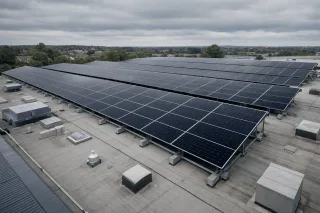
The ja solar jumbo 800w is a large-format solar panel designed for high output per panel. It is primarily aimed at commercial and utility-scale systems rather than typical UK homes. In the UK market, this specific panel is not commonly available through standard installer supply chains.
What the JA Solar Jumbo 800W actually is
The ja solar jumbo 800w refers to a very large solar panel rated at around 800 watts under standard test conditions.
Weight
Typically between 35kg and 45kg.Efficiency
Around 21% to 23% depending on model.Power rating
Around 800W under standard test conditions.Physical size
Usually over 2.2 metres long.Cell technology
Typically N-type TOPCon or advanced PERC.
It achieves this output mainly through increased physical size rather than fundamentally different efficiency. This type of panel is significantly larger than what is normally installed on UK residential roofs.
Availability in the UK market
This is an important distinction for UK readers.
Commercial focus
Mainly supplied for large-scale or export projects.MCS considerations
Not all versions are certified for UK domestic installs.Limited availability
Not widely stocked by UK residential installers.Not commonly offered
Most UK quotes will not include 800W panels.Not sold via Kilowatts
This panel is not currently available through our installer network.
If you are comparing options, it is more realistic to explore panels that are actively used in UK installs via solar panel installation comparisons.
Key differences vs standard UK panels
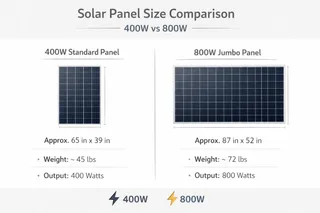
The main difference is scale, not just output.
Weight
Heavier and harder to handle on-site.Panel size
Much larger than standard 350W to 450W panels.Panel count
Fewer panels needed for the same system size.Layout flexibility
Reduced flexibility on complex roofs.Electrical behaviour
Higher current affects system design.
For most UK homes, smaller panels allow better use of available roof space.
Electrical specifications and design impact
These panels require more careful system design.
Cable sizing
May require thicker DC cables.String design
Needs careful planning to avoid exceeding limits.Voltage range
Typically around 45V to 55V open-circuit.Current levels
Often above 18A, higher than standard panels.Inverter limits
Not all inverters support high current modules.
Many UK systems use equipment designed around standard panels, which limits compatibility. You can explore how systems are typically configured via solar resources and guides.
UK performance and expected output
Performance depends on installation conditions rather than panel size alone.
Best orientation
South-facing roofs with minimal shading.Annual generation
Around 650 to 800 kWh per panel in the UK.Cloud performance
Modern panels still generate under diffuse light.Lower performance
North-facing or shaded roofs reduce output.Temperature losses
Output decreases slightly in higher temperatures.

Panel wattage does not change how UK sunlight behaves, only how much area is used to capture it.
Installation challenges in the UK
Larger panels introduce practical constraints.
Access
Difficult to transport on tight residential streets.Fixings
Fewer panels but greater stress per mounting point.Handling
Often requires multiple installers per panel.Wind uplift
Larger surface area increases wind forces.Roof structure
Higher loads per panel must be considered.
Installers may require specialist equipment depending on the property. Choosing experienced installers through local electrical companies is important for non-standard systems.
Cost considerations in the UK
Costs vary depending on scale and project type.
Supply chain
Limited availability can affect pricing.Cost per watt
Lower in large commercial systems.Labour impact
Increased handling time can offset savings.Cost per panel
Higher due to size and output.Residential installs
Often more expensive due to complexity.
Most UK homeowners will achieve better value using standard panel formats.
Suitability for UK installations
These panels are designed for specific use cases.
Suitable for
Ground-mounted systems with open space.Not ideal for
Complex layouts with dormers or multiple orientations.Best suited for
Commercial rooftops and agricultural buildings.Less suitable for
Standard pitched residential roofs.Limited compatibility
Some inverter systems cannot support them.
System design should focus on total output and efficiency of the full system rather than individual panel size.
Common misconceptions
There are several misconceptions around high-wattage panels.
Bigger panels work everywhere
Roof shape and structure limit suitability.More watts means more savings
Savings depend on usable generation, not panel size alone.All panels are interchangeable
Electrical compatibility must be checked.Fewer panels means cheaper installs
Labour and logistics can increase costs.Higher wattage equals better performance
Total system design matters more.
Installer-level practical notes
These are considerations typically handled during system design.
MPPT limits
Inverter current limits must be checked carefully.Risk management
Larger panels increase installation risk.Mounting systems
Rail spacing must suit panel size and load.Logistics planning
Delivery and handling require planning.String calculations
Voltage and current must be balanced correctly.
UK regulations and compliance
System compliance is more important than panel size.
DNO limits
Export limits still apply regardless of panel size.SEG payments
Based on system compliance, not panel wattage.Planning rules
Oversized panels may raise visual considerations.MCS certification
Required for Smart Export Guarantee eligibility.Installer responsibility
Full compliance must be documented.
Practical alternatives for UK homeowners
If you are researching the ja solar jumbo 800w, you are likely comparing high-output options.
Standard panels
400W to 450W panels are the UK norm.Battery integration
Improves self-consumption of generated energy.System optimisation
Layout and orientation have greater impact than panel size.Installer-led design
Most systems are designed around available roof space.Higher efficiency panels
Offer similar output per area with easier installation.
You can explore realistic system options including batteries via home battery storage solutions.
Quick summary
The ja solar jumbo 800w is a large, high-output panel designed mainly for commercial use. It is not commonly available or recommended for typical UK residential installations. Most UK systems achieve better results using standard panel sizes with optimised layouts.
Ready to compare your options?
Get tailored comparisons and connect with trusted installers in under a minute.
Plan, Compare & Buy Renewable Energy Solutions
AI does the thinking.
You get the perfect solar match.
Use RoboMo™ to assess your property, compare available technologies and connect with trusted UK installers, suppliers and manufacturers.
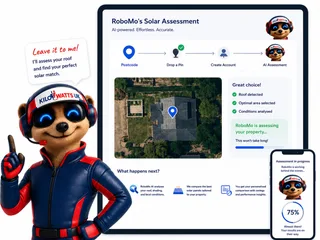
Simply enter your postcode, drop a pin on your roof, create your free account and let RoboMo™ analyse your property to find the best solar panels for your home.

You don't have to think
RoboMo™'s AI analyses your roof and does all the hard work.

Accurate & tailored
AI-powered assessment based on your roof, location, and conditions.

Best options, maximum savings
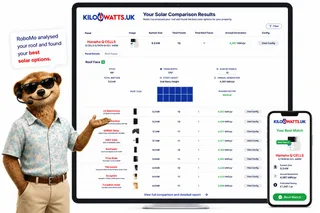
Compare top solar panels for the best performance and value.

Simple, fast & effortless
Provide a few details, sit back and watch your results unfold.
STEP 1
Choose Home, Business or Industrial
Enter your postcode to start your assessment.
STEP 2

Drop a pin on your roof
STEP 3

Create your free account
STEP 4

Sit back and watch RoboMo™ work
RoboMo™ analyses your roof and builds your personalised solar comparison.

Step 1
Enter your postcode
Start designing your wind energy system in seconds.
Are you an installer, distributor or renewable energy business?
Kilowatts UK is expanding the Flower Turbines partner network across the UK.
Become A Flower Turbines PartnerKilowatts UK is an authorised representative
Flower Turbines
Compact vertical-axis turbines built for real UK sites, not just open farmland.
They start in light wind, sit in a small footprint, and are bird-safe by design. Cluster them as a bouquet and the group performs better together than the same turbines standing alone. Enter your postcode for a location-based generation estimate. Figures use area weather data and will differ if buildings, trees or hills sit in the way.
Starts in light UK wind
Built to generate in typical UK wind, not only open farmland.
Small rooftop or ground footprint
Compact towers for roofs, yards and tight sites.
Bird-safe slow rotation
Slow vertical-axis spin, bird-safe by design.
Bouquet clusters raise output
Grouped turbines outperform the same units standing alone.


STEP 2

Choose a location
STEP 3

Place your cluster
Tap the map where you want the turbine cluster to go.
STEP 4

Instant generation forecasts
Compare different turbine layouts and see annual generation forecasts instantly.
STEP 5

No commitment required
Explore different configurations before deciding whether to request a quotation.
Related articles



Mo's Mission Nominations
FAQ
Need Help? RoboMo's Got Answers
Can I buy an 800W solar panel in the UK?
Not easily. They are not commonly stocked or installed for residential systems.
Why are 800W panels not used on houses?
They are too large, heavy, and incompatible with many residential system designs.
Are 800W panels better than 400W panels?
Not necessarily. Total system design and roof layout matter more than individual panel size.
What is the best panel wattage for UK homes?
Typically between 400W and 500W for optimal performance and flexibility.
Should I wait for 800W panels to become available?
No. Current panel technology already delivers excellent performance when properly installed.