


What is a home battery and how does it work for UK homes
Published: 2026-04-05 04:25:15
Updated: 2026-08-26 14:19:29
A home battery is a rechargeable electricity storage system. It lets a property use electricity later instead of using it at once or exporting it straight.
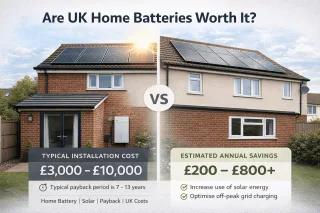
What is a home battery and how does it work
What is a home battery and how does it work in the UK? A home battery stores electricity so it can be used later in your property.
What a home battery is and what it does
A home battery is a rechargeable electricity storage system. It lets a property use electricity later instead of using it at once or exporting it straight away. In a UK home, it is often paired with solar panels, but it can also be charged from the grid on a suitable time-of-use tariff. It does not generate electricity; it shifts electricity from one time to another. For a broader primer, see this home battery storage guide.
The main factors are usable battery capacity, inverter output, tariff structure, solar generation, household demand, installation quality and whether backup power is required. A battery can be useful, but only when there is a real mismatch between when electricity is available and when the home needs it.
In practice, a battery stores surplus solar electricity during brighter periods and releases it later for appliances, lighting, cooking or general household use. It may also charge from the grid during cheaper tariff periods and discharge when grid electricity is more expensive. The result depends on the property, the equipment and how electricity is used day to day.
How a home battery works in a normal UK home
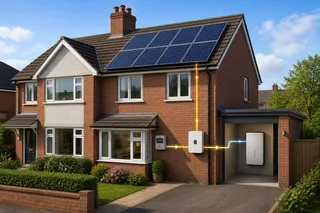
A battery system sits between the electricity source, the property’s electrical loads and the grid. Electricity may come from solar panels, from the grid, or from both. The battery charges when the system is set to store available electricity, then discharges when the home would otherwise import from the grid.
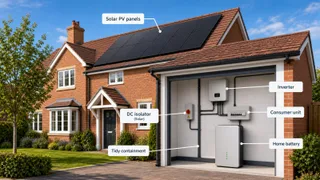
Most household appliances use alternating current, while batteries store direct current. An inverter is needed to convert electricity between the battery and the home’s circuits. Some systems use a hybrid inverter that manages both solar PV and battery storage. Others use a separate AC-coupled battery inverter that can be added to an existing solar installation.
The system also relies on metering, sensors and control settings. Current clamps or meters measure import, export and household demand. Software settings then decide when the battery should charge or discharge. If these parts are installed in the wrong place or set up poorly, the battery can behave in a confusing way, such as charging from the grid when the homeowner expected it to store only solar energy.
The main parts of a home battery system
A domestic battery installation is more than a storage box on the wall. The equipment has to store energy safely, convert it into usable electricity, communicate with the property’s metering and protect the wider electrical installation. A proper survey should look at the consumer unit, earthing arrangement, cable routes, mounting position, internet connection and any existing solar inverter.
The exact components vary by manufacturer and design, but most home battery systems include the same core functions. Capacity determines how much energy can be stored, while inverter output determines how much power can be delivered at any moment.
The inverter rating matters as much as the battery capacity. A battery may have enough stored energy for several hours of light use, but it will not necessarily run several high-demand appliances at once. Electric showers, ovens, immersion heaters, heat pumps and EV chargers need careful consideration because they can exceed what a domestic battery inverter is designed to supply.
Does a home battery need solar panels?
A home battery does not have to be installed with solar panels, but solar often makes the purpose easier to understand. With solar PV, the battery can store daytime generation that would otherwise be exported, then release it later when the home needs electricity. Without solar, the battery needs a clear tariff strategy to make sense, so it is worth checking whether a battery without solar fits your usage pattern.
A grid-charged battery can work where there is a suitable time-of-use tariff and the household can charge during lower-cost periods. Tariff terms can change, and the saving depends on the difference between import prices, export arrangements, battery efficiency, usage pattern and installation cost. Ofgem-regulated suppliers set tariff terms differently, so homeowners should check current tariff details rather than relying on old assumptions.
The strongest design is often not simply “battery or no battery”, but how storage fits into the wider property. A household with solar PV, a heat pump, EV charging, evening cooking demand or regular daytime occupancy will use a battery differently from a low-use home where most electricity is already consumed when solar is being generated.
AC-coupled and DC-coupled batteries compared
The two common design routes are AC-coupled and DC-coupled storage. AC-coupled batteries connect on the home’s alternating current side and are often used for retrofits. DC-coupled batteries usually work through a hybrid inverter and are often specified when solar and storage are installed together. Neither route is automatically better for every property. The right design depends on whether solar PV already exists, the age and compatibility of the inverter, available space, metering layout, export settings, monitoring requirements and whether future expansion is likely.
Overview
Retrofit jobs need more checking than they first appear to. The installer must confirm how the existing PV inverter is connected, where metering clamps can be placed, whether the consumer unit has capacity for the required work, and whether the battery system can correctly measure import and export. If storage is being added later, review what is involved when a battery is added to existing solar.
How much electricity can a home battery store?
Battery capacity is measured in kilowatt-hours, or kWh. This is the amount of energy a battery can store and later deliver, allowing for the system’s usable capacity. It is different from kilowatts, or kW, which describe how much power the battery or inverter can supply at one moment.
Usable capacity is often lower than the headline or nominal capacity because battery systems reserve some charge to protect battery health. Round-trip efficiency is also below perfect, so some energy is lost when electricity is stored and later discharged. The exact usable capacity, power output and efficiency should be checked in the manufacturer’s datasheet rather than assumed from the product name.
The best size is not always the largest battery that fits on the wall. A well-sized system is matched to the home’s solar generation, evening demand, tariff strategy, backup expectations and available installation budget. If you are comparing capacities, start with what size battery suits the home rather than the biggest number on the datasheet. Oversizing can leave expensive capacity unused, especially during periods when there is not enough surplus solar to fill the battery regularly.
Simple examples of how a battery behaves
A useful way to understand a battery is to picture the daily pattern rather than focus only on the product specification. In a solar-led home, the battery may sit partly empty in the morning, charge when solar generation exceeds household demand, then discharge through the evening as lights, cooking appliances, television, broadband and small appliances are used.
In a tariff-led home without solar, the battery may be scheduled to charge during a cheaper overnight period and discharge later. That can reduce exposure to more expensive periods, but only if the tariff spread, losses, standing arrangements, usage pattern and installation cost make sense. Savings should be tested against current tariff terms and actual consumption data, not against a generic brochure example.
These examples are simplified. Real homes are affected by weather, season, occupancy, appliance timing, export rates, smart meter data quality and the way the battery control settings are configured.
Will a home battery power the house in a power cut?
A standard grid-connected home battery does not necessarily keep the house running during a power cut. Many systems shut down unless they have specific backup or emergency power supply equipment, because they must not energise the local network when engineers may be working on it. This is one of the most common areas of confusion, so read more on a battery in a power cut.
Backup needs to be designed deliberately. Some systems provide power to a dedicated socket or essential-load circuit. Others can be configured for wider backup with additional hardware and wiring. Whole-home backup is a more demanding design than keeping broadband, lighting, refrigeration and selected sockets running.
The duration is not fixed. It depends on battery size, state of charge at the moment of the outage, inverter output and which appliances are connected. A battery asked to run heavy electrical loads will empty much faster than one supplying only essential low-power circuits, and some appliances may exceed the backup output altogether.
Safety, standards and UK compliance
Home batteries should be treated as electrical energy systems, not DIY appliances. Installation work must be designed and carried out by competent professionals because it can affect the consumer unit, protective devices, earthing, isolation, metering, solar PV equipment and the local electricity network connection.
Relevant UK considerations can include BS 7671 electrical installation requirements, manufacturer installation instructions, DNO notification or approval, and the G98 or G99 connection route depending on the proposed inverter arrangement. The installer should confirm the correct route for the specific equipment and export settings rather than assuming every installation is the same.
Where solar PV is included, homeowners should also ask how the installation relates to MCS guidance and consumer documentation where relevant. MCS, Energy Saving Trust, Ofgem information, DNO guidance and manufacturer datasheets are useful authority sources to check, but the final design still needs to be based on the property rather than a generic rule of thumb.
Location, clearances and fire-safe installation
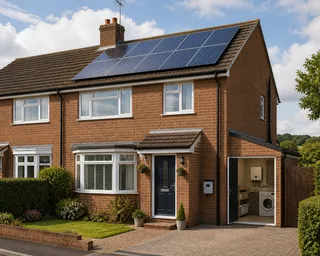
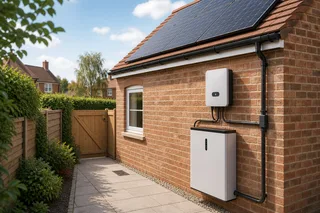
The installation location is a practical and safety decision. Batteries are commonly considered for garages, utility areas, external walls or other service spaces, but the right position depends on the product’s rating, manufacturer instructions, access requirements, cable routes and environmental conditions.
Fire safety is about sensible design. The installer should follow manufacturer clearances, temperature limits, ventilation requirements where stated, fixing requirements and rules for keeping the equipment accessible for isolation and maintenance. A neat-looking position is not always the best position if it creates difficult cable runs, poor access or unsuitable environmental conditions.
Homeowners should be cautious about unusually cheap or informal installations. A battery may look like a plug-in product, but incorrect protection, isolation, metering or network connection work can create safety, performance and compliance problems.
Battery chemistry, degradation and warranty terms
Most modern domestic battery systems use lithium-ion technology, with lithium iron phosphate and nickel manganese cobalt being common chemistry families in the market. The chemistry is only one part of the decision, because the enclosure, battery management system, inverter compatibility, installation environment and warranty terms all affect long-term performance.
All batteries degrade with use and age. That does not mean they suddenly stop working, but their usable capacity can reduce over time. Heat, very heavy cycling, operating outside manufacturer conditions or unsuitable installation locations can affect battery life and may also affect warranty cover.
Warranty documents should be read carefully before purchase. A long warranty headline is less useful if the conditions, throughput limits or retained-capacity terms do not match how the homeowner expects to use the system. Battery lifespan also depends on usage and conditions, so review how long batteries last before relying on a headline warranty period.
Manufacturer datasheets are important here. They should state usable capacity, power output, operating limits, enclosure rating, compatible inverters where applicable and warranty conditions.
What affects whether a home battery is worth considering?
A home battery is most useful when there is a genuine time-shifting opportunity. That could be surplus solar generation in the day, cheaper off-peak electricity at night, or a household that uses most of its electricity in the evening. Without that mismatch between availability and demand, storage has less work to do.
The economics should be treated carefully. Installed cost varies with brand, capacity, inverter choice, installation complexity and whether the battery is fitted with new solar or retrofitted later. Payback should not be assumed because it depends on import tariffs, export rates, solar generation, battery degradation, control settings and household behaviour. A realistic assessment should calculate the payback from current tariff details and actual usage rather than a generic estimate.
A practical assessment should look beyond the battery brochure. In many homes, the quote changes because of consumer unit work, cable routes, wall construction, outdoor rating, internet connection, monitoring requirements or the DNO process. These are normal design issues, not minor details.
Common mistakes to avoid before choosing a battery
The biggest mistake is treating battery capacity as the only specification that matters. Capacity tells you how much energy can be stored, but inverter output determines how quickly it can be delivered. Monitoring, tariff control, installation location and compatibility can have just as much effect on the result.
Another common assumption is that a battery makes solar panels produce more electricity. It does not. It stores some electricity that would otherwise be exported or unused by the home at that time. The solar array, roof orientation, shading, season and inverter performance still determine how much generation is available.
Compatibility with existing solar equipment also needs checking before a system is chosen. The same applies to warranty conditions, installation environment, monitoring app and control settings. A battery that cannot be scheduled properly for the chosen tariff, or one that cannot read import and export accurately, may underperform even if the hardware specification looks strong.
What an installer should check on site
A proper battery survey starts with how the home actually uses electricity. Recent bills, half-hourly smart meter data where available, solar generation history and planned changes such as an EV charger or heat pump all help shape the design. Guesswork can lead to a battery that is either too small to be useful or too large to work hard enough.
The physical installation matters as much as the energy model. The battery needs a suitable mounting location, manufacturer-required clearances, safe access, cable routes and appropriate protection from weather if installed outside. The installer also needs to consider the consumer unit, earthing, isolation, metering positions and network connection requirements.
DNO requirements may apply because battery inverters can affect import and export to the local network. The installer should confirm the correct notification or approval route for the proposed equipment and settings, including whether G98 or G99 processes are relevant. This is particularly important where solar PV, battery storage, export limits or larger inverter capacities are involved.
Buyer checklist before you commit
Before choosing a battery, ask for a design that explains how the system will work in your specific home. A useful quote should not only name a battery model. It should explain the assumptions behind the design and the limits of the system.
The aim is to compare real designs, not just headline storage capacity. Two systems with similar kWh figures can behave very differently if the inverter output, backup design, installation location, monitoring and tariff controls are different.
The quote should also explain monitoring and controls, including how the system measures import, export, solar generation and tariff schedules. Ask what DNO notification or approval process applies to the proposed system, and make sure any savings estimate uses current tariff details and realistic household behaviour. If a quote does not explain these points clearly, it is worth asking for more detail before proceeding. A well-designed battery should match the home’s usage pattern, not just look attractive on a comparison sheet.
How to decide your next step
Start by identifying the problem the battery is meant to solve. If the aim is to use more solar power in the evening, the key question is how much surplus solar you normally export. If the aim is tariff shifting, the key question is whether the charging schedule and tariff terms still leave a useful saving after losses and costs.
If backup is the priority, be specific about which circuits or appliances matter. Asking for “the whole house” can lead to a very different design from asking for lights, broadband, a fridge and selected sockets. A good installer should explain the difference before quoting.
Before committing, ask for a written design that states usable capacity, inverter output, coupling type, backup capability if any, installation location, monitoring method, DNO route and savings assumptions. That gives you something practical to compare and reduces the chance of buying a battery that looks impressive on paper but does not match the way your home uses electricity. If the battery is part of a wider solar project, you can also compare home solar options before choosing an installer.
Plan, Compare & Buy Renewable Energy Solutions
AI does the thinking.
You get the perfect solar match.
Use RoboMo™ to assess your property, compare available technologies and connect with trusted UK installers, suppliers and manufacturers.
Simply enter your postcode, drop a pin on your roof, create your free account and let RoboMo™ analyse your property to find the best solar panels for your home.

You don't have to think
RoboMo™'s AI analyses your roof and does all the hard work.

Accurate & tailored
AI-powered assessment based on your roof, location, and conditions.

Best options, maximum savings
Compare top solar panels for the best performance and value.

Simple, fast & effortless
Provide a few details, sit back and watch your results unfold.
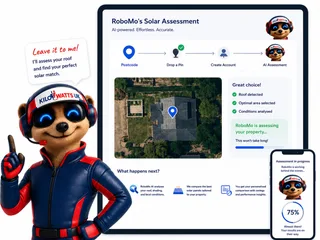
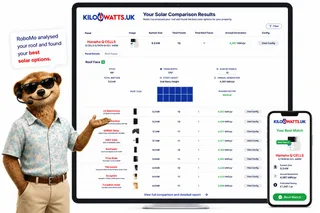
STEP 1
Choose Home, Business or Industrial
Enter your postcode to start your assessment.
STEP 2

Drop a pin on your roof
STEP 3

Create your free account
STEP 4

Sit back and watch RoboMo™ work
RoboMo™ analyses your roof and builds your personalised solar comparison.

Step 1
Enter your postcode
Start designing your wind energy system in seconds.
Are you an installer, distributor or renewable energy business?
Kilowatts UK is expanding the Flower Turbines partner network across the UK.
Become A Flower Turbines PartnerKilowatts UK is an authorised representative
Flower Turbines
Compact vertical-axis turbines built for real UK sites, not just open farmland.
They start in light wind, sit in a small footprint, and are bird-safe by design. Cluster them as a bouquet and the group performs better together than the same turbines standing alone. Enter your postcode for a location-based generation estimate. Figures use area weather data and will differ if buildings, trees or hills sit in the way.
Starts in light UK wind
Built to generate in typical UK wind, not only open farmland.
Small rooftop or ground footprint
Compact towers for roofs, yards and tight sites.
Bird-safe slow rotation
Slow vertical-axis spin, bird-safe by design.
Bouquet clusters raise output
Grouped turbines outperform the same units standing alone.
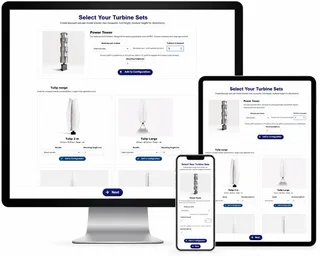
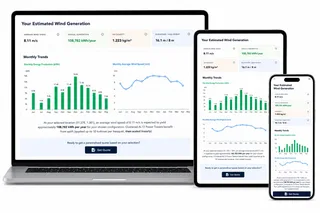
STEP 2

Choose a location
STEP 3

Place your cluster
Tap the map where you want the turbine cluster to go.
STEP 4

Instant generation forecasts
Compare different turbine layouts and see annual generation forecasts instantly.
STEP 5

No commitment required
Explore different configurations before deciding whether to request a quotation.
Related articles
Mo's Mission Nominations
FAQ
Need Help? RoboMo's Got Answers
How does a home battery store electricity?
A home battery stores electrical energy chemically when it charges. It then converts that stored energy back into electricity when the home needs it. The inverter is the part that helps convert electricity between the battery and normal household circuits.
Can a home battery work without solar panels in the UK?
Yes, a home battery can charge from the grid, usually with a suitable time-of-use tariff. This can make sense if the battery charges during cheaper periods and discharges when electricity is more expensive. The benefit depends on your tariff, usage pattern, battery losses and installation cost.
How long does a home battery last?
Many domestic battery systems are designed to last for around 10 to 15 years, but the actual lifespan depends on the product, usage and conditions. Batteries usually lose capacity gradually over time rather than suddenly stopping. Check the manufacturer’s warranty and usable capacity figures before comparing systems.
Do home batteries work during power cuts?
Not all home batteries provide backup power during a power cut. Many standard grid-connected systems shut down unless specific backup equipment and wiring have been installed. If backup is important, ask whether the system can supply a dedicated socket, essential circuits or a wider part of the home.
Is a home battery worth it in the UK?
It depends on how and when your home uses electricity. Batteries tend to be more useful where there is spare solar generation, high evening demand or a suitable off-peak tariff. A proper assessment should use your actual consumption, tariff details and expected solar generation rather than a generic saving claim.
What size home battery do I need?
Battery size is measured in kilowatt-hours, or kWh, which shows how much energy it can store. The right size depends on your solar generation, evening use, tariff strategy and whether you want backup power. Bigger is not always better, because unused capacity can add cost without improving savings.
What is the difference between AC-coupled and DC-coupled batteries?
An AC-coupled battery connects on the home’s alternating current side and is often used when adding storage to an existing solar system. A DC-coupled battery usually works through a hybrid inverter and is often chosen when solar panels and a battery are installed together. The best option depends on the existing equipment, metering layout, compatibility and future plans.
Where can a home battery be installed safely?
Common locations include garages, utility areas, external walls and other service spaces, but the right position depends on the product and the property. The installer should follow the manufacturer’s rules for clearances, temperature limits, mounting, access and isolation. Home batteries should be installed by competent professionals because they affect the electrical installation and may require the correct DNO notification or approval route.