


How long do solar panels last in the UK?
Published: 2026-02-26 09:45:18
Updated: 2026-04-08 00:51:31
How long solar panels last in the UK depends on the warranty, the yearly drop in output, and when the inverter needs replacing.

How long do solar panels last in the UK?
Most modern solar panels installed in the UK are expected to last around 25 to 30 years. Many systems keep producing electricity beyond 30 years, but at a lower output than when new. The 25 year figure is usually tied to the performance warranty, not a switch-off date. If you are comparing system types and sizes, the solar PV comparison flow can help you line up assumptions consistently. [cta: solar]
What “lasting” means for solar panels
Solar panel lifespan usually means the period the panels keep producing useful electricity at an acceptable level. Panels tend to degrade gradually rather than failing suddenly. A panel can still be working even if it produces less than its original rating. Performance is different from reliability, because output can be lower while the panel is still functional.
Typical UK lifespan and warranties
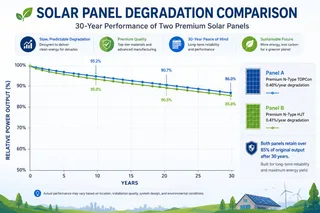
Most modern UK installations are designed around a 20 to 30 year service life. Manufacturers commonly provide a 25 year performance warranty for the panels. Performance warranties often guarantee roughly 80 to 87 percent of original output at year 25. Typical annual degradation is commonly around 0.3 to 0.5 percent per year in UK conditions. After 25 years, a 400W panel may still be roughly in the 340W to 360W range under standard test conditions.
Which parts wear out first
The inverter usually has a shorter lifespan than the panels. String inverter: Often replaced after around 10 to 15 years in UK conditions. Hybrid inverter: Often replaced after around 10 to 15 years depending on loading and battery use. Microinverters: Can last longer in some cases, but lifespan varies by manufacturer and installation environment. Battery storage: Commonly lasts around 10 to 15 years depending on cycle count and operating conditions. Balance of system parts: Switches, isolators, monitoring hardware, and connectors can fail before panels do.
What affects solar panel lifespan in the UK
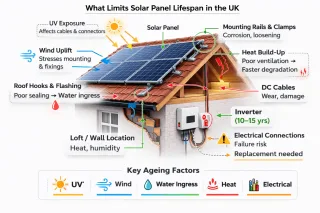
Roof condition: A roof that needs major work within 10 to 15 years may require panel removal and reinstallation. Coastal exposure: Salt air can accelerate corrosion if fixings and clamps are low quality or mismatched metals are used. Wind exposure: Uplift and vibration in exposed areas can stress mounting and fixings over time. Heat and ventilation: Poor airflow under panels can increase heat and accelerate degradation. Shading patterns: Heavy shading can create uneven electrical stress and reduce long-term performance. Installation quality: Poor cable routing and poor terminations can cause faults long before panels age out.
Installer-level details that change long-term outcomes
Cable management: UV exposed DC cabling and loose clips can degrade insulation and create faults. Roof hook sealing: Incorrect flashing or disturbed tiles can cause water ingress that becomes visible years later. Clamp torque: Over-tightening or under-tightening clamps can contribute to damage and movement. Roof load and fixing design: Rail layout, hook spacing, and wind zone design must match the roof and location. Component environment: Inverters in hot lofts or poorly ventilated cupboards can fail earlier than expected. Isolator quality: Some DC isolators have historically been a weak point and may require replacement.
UK weather and damage risk
The UK climate is moderate and often favourable for long component life compared with hotter regions. High winds are a more common UK stressor than heavy snow. Hail damage is uncommon, and panels are typically tested to withstand hail impacts within standard test regimes. Physical damage is more often caused by poor handling, roof work, or debris impact than normal rainfall.
Roof types and long-term maintenance planning
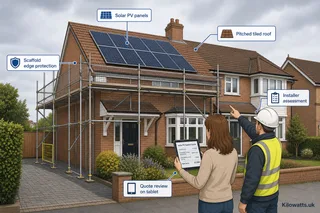
Pitched tiled roofs: Commonly suitable for long lifespans when the roof is in good condition. Flat roofs: Waterproofing details matter, and mounting methods must remain watertight over decades. Re-roofing: Panel removal and refit may be needed if the roof covering is replaced during the system life. Access and scaffolding: Future access for inverter replacement or roof work affects lifetime cost planning. If you are also upgrading storage, the home battery storage installation information is useful for understanding battery replacement timelines.
Performance over time and how to spot issues
Gradual year-on-year decline is normal and matches expected degradation. Sudden drops in generation often point to inverter issues, a disconnected string, shading changes, or a fault. Comparing generation data across the same months year-to-year helps separate weather variation from equipment problems. Monitoring platforms can become obsolete even while panels continue working.
Regulations and compliance that relate to longevity
Most UK domestic systems are installed under permitted development rules. Panels on pitched roofs should not protrude more than 200mm beyond the roof plane under common permitted development limits. MCS standards are widely used for installation quality, warranties, and grid-connection processes. DNO notification and export limits do not change physical lifespan, but they affect how the system is commissioned and documented. For broader context on UK solar performance assumptions, the solar panel efficiency guide links lifespan to real-world output.
Misconceptions UK homeowners often have
Panels must be replaced after 10 years: Most panels keep working well beyond 10 years and degrade gradually. Panels stop working after 25 years: 25 years usually reflects the warranty period, not an end date. UK weather ruins panels quickly: The UK climate is generally mild and not inherently harsh on panels. Cleaning is always required: In many UK locations rainfall keeps panels reasonably clean, unless there is heavy soiling from trees or birds.
Who longevity assumptions fit and who should think twice
Long-term homeowners: A 25 to 30 year panel life aligns with long-term energy planning. Homes needing roof work soon: Re-roofing within 10 to 15 years can add cost and disruption. Very shaded roofs: Output may be low even if the panels last physically. Battery-heavy usage: Batteries may need replacement earlier, changing whole-system lifetime economics. If you are planning other electrical upgrades alongside solar, the UK electrician and installer directory is relevant for bundling works like consumer unit upgrades and compliance checks.
Typical UK costs and what changes them
Domestic solar PV system cost can vary widely by size, equipment choice, scaffolding needs, and roof complexity. Typical UK residential systems are commonly in the 3kW to 6kW range. Whole-system lifespan costs are often driven more by inverter and battery replacement than by panel replacement. Access costs, roof works, and monitoring subscriptions can affect lifetime spend.
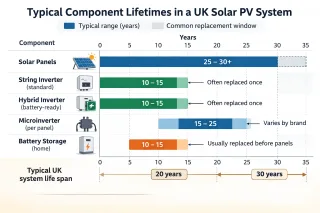
Component lifetime comparison chart
This section focuses on practical implementation without editorial quotes, keeping the message factual and instructional.
Ready to compare your options?
Get tailored comparisons and connect with trusted installers in under a minute.
Plan, Compare & Buy Renewable Energy Solutions
AI does the thinking.
You get the perfect solar match.
Use RoboMo™ to assess your property, compare available technologies and connect with trusted UK installers, suppliers and manufacturers.
Simply enter your postcode, drop a pin on your roof, create your free account and let RoboMo™ analyse your property to find the best solar panels for your home.

You don't have to think
RoboMo™'s AI analyses your roof and does all the hard work.

Accurate & tailored
AI-powered assessment based on your roof, location, and conditions.

Best options, maximum savings
Compare top solar panels for the best performance and value.

Simple, fast & effortless
Provide a few details, sit back and watch your results unfold.
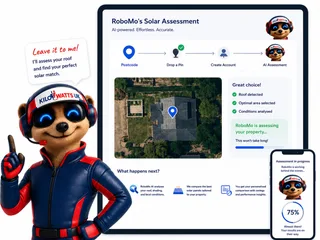
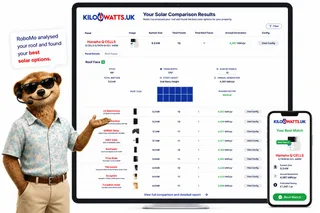
STEP 1
Choose Home, Business or Industrial
Enter your postcode to start your assessment.
STEP 2
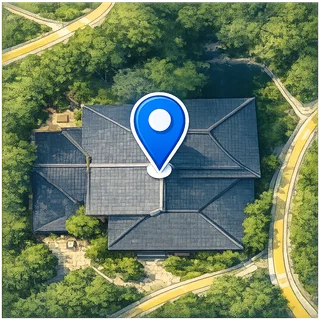
Drop a pin on your roof
STEP 3

Create your free account
STEP 4

Sit back and watch RoboMo™ work
RoboMo™ analyses your roof and builds your personalised solar comparison.
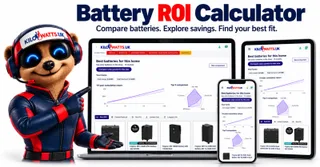
BATTERY ROI TOOL
See what a battery saves on your bill
Enter the day rate, off-peak rate and export rate. The calculator ranks batteries in the Kilowatts shop over 10 years.
Home batteries also suit offices and small commercial sites. Industrial batteries are listed on their own calculator.

Step 1
Enter your postcode
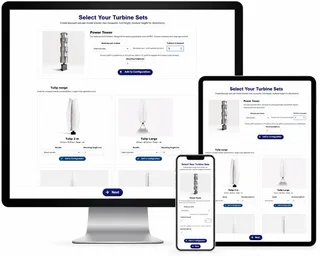
Start designing your wind energy system in seconds.
Are you an installer, distributor or renewable energy business?
Kilowatts UK is expanding the Flower Turbines partner network across the UK.
Become A Flower Turbines PartnerKilowatts UK is an authorised representative
Flower Turbines
Compact vertical-axis turbines built for real UK sites, not just open farmland.
They start in light wind, sit in a small footprint, and are bird-safe by design. Cluster them as a bouquet and the group performs better together than the same turbines standing alone. Enter your postcode for a location-based generation estimate. Figures use area weather data and will differ if buildings, trees or hills sit in the way.
Starts in light UK wind
Built to generate in typical UK wind, not only open farmland.
Small rooftop or ground footprint
Compact towers for roofs, yards and tight sites.
Bird-safe slow rotation
Slow vertical-axis spin, bird-safe by design.
Bouquet clusters raise output
Grouped turbines outperform the same units standing alone.
STEP 2

Choose a location
STEP 3
Place your cluster
Tap the map where you want the turbine cluster to go.
STEP 4

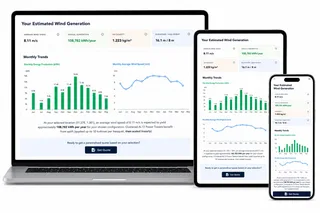
Instant generation forecasts
Compare different turbine layouts and see annual generation forecasts instantly.
STEP 5

No commitment required
Explore different configurations before deciding whether to request a quotation.
Related articles

Mo's Mission Nominations
FAQ
Need Help? RoboMo's Got Answers
How long do solar panels last in the UK?
Most modern solar panels installed in the UK are expected to last around 25 to 30 years, with many systems continuing to generate electricity beyond 30 years at reduced output.
Do solar panels stop working after 25 years?
No, 25 years usually refers to the performance warranty period, not a switch-off date, and panels typically degrade gradually rather than failing suddenly.
What parts of a solar system wear out before the panels?
Inverters and battery storage commonly have shorter lifespans, often around 10 to 15 years, while switches, isolators and monitoring equipment may also require replacement before the panels do.
What affects solar panel lifespan in the UK?
Installation quality, roof condition, wind exposure, coastal corrosion risk, heat build-up under panels and poor cable management can all influence how long a system performs reliably.
How can I tell if my solar panels are degrading or faulty?
A gradual year-on-year decline in output is normal, but sudden drops in generation may indicate inverter issues, wiring faults, shading changes or other system problems that need investigation.