


MCS Certification for UK Solar Installations
Published: 2026-08-07 17:40:09
Updated: 2026-08-09 23:29:34
To become an MCS certified installer in the UK, a contracting business normally applies to an MCS-approved certification body.
MCS installer certification: UK eligibility and how to apply
To become an MCS certified installer in the UK, a contracting business normally applies to an MCS-approved certification body, chooses the technology scope it wants to install, proves competence and passes assessment against the current MCS contractor and technology standards. The key factors are business control, technical competence, compliant customer processes, installation evidence, suitable products and ongoing record keeping.
MCS is not a badge for an individual engineer. Certification is usually held by the installation business for defined scopes, such as solar PV or heat pumps. Individual qualifications, experience and supervision still matter, but the assessor will also look at how the business surveys, designs, quotes, installs, commissions, handles complaints and hands over each job.
Start with the current MCS Contractor Standard, the relevant technology-specific MIS standard, the MCS installer certification guidance, the approved certification body list and the MCS product database on the official MCS website. Requirements can change, so do not rely on old templates, forum advice or another installer’s application pack.
What MCS certification means for an installer
MCS certification shows that a business has been assessed for the design, installation and handover of eligible small-scale low-carbon technologies against the MCS scheme requirements. It is a structured certification process, not a one-off training course. The business must show that it can deliver repeatable, documented and auditable installations.
Assessment covers both office systems and technical work. A technically competent installer can still struggle if surveys, calculations, customer paperwork or handover records are incomplete. Equally, a well-written procedure is not enough if the technical evidence does not show that the system was designed and installed correctly.
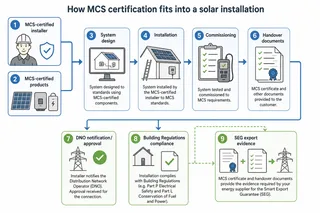
MCS certification does not guarantee a customer’s bill saving, payback period, planning outcome, grid export permission or eligibility for every grant or tariff. Those depend on the property, scheme rules, DNO position, usage profile, system design and products used. Certification is an important part of the evidence chain, but it does not replace proper design or honest customer advice. For a customer-facing overview, see our guide to MCS in UK solar.
Who is eligible to apply
Eligibility is based on whether the business can meet the current MCS requirements for the technology scope it is applying for. A new business is not automatically excluded, but it must still demonstrate competence, control and suitable processes. An established electrical, heating or renewables contractor may already have some of the evidence, but often needs to improve documentation before assessment.
The applicant must normally be the contracting business responsible for the installation work. If subcontractors are used, the certification body will still expect clear responsibility for competence, supervision, quality control and customer handover. Passing responsibility to a subcontractor without evidence of control is a common weakness.
For solar PV, assessment will usually focus on electrical competence, safe installation practice, roof and mounting considerations, design assumptions, product selection, commissioning results and customer documentation. Installers building their first PV scope may also find the solar installation basics useful when mapping the customer journey from survey to handover. For heat pumps, the emphasis is likely to include heat-loss calculation, system sizing, emitter suitability, hydraulic design, controls, commissioning and user handover.
Standards and official sources to check before applying
A sound MCS application should be built around current official requirements rather than generic quality paperwork. The main documents and sources to check are the MCS Contractor Standard, the relevant MIS technology standard, the MCS installer certification guidance, the list of approved certification bodies, the MCS product database and any consumer code requirements that apply under current scheme rules.
The MCS Contractor Standard sets the main requirements for how certified contractors operate. The technology-specific MIS standards set requirements for particular technologies, such as solar PV or heat pumps. The MCS product database helps confirm whether products are recognised within the scheme where product certification is relevant.
You should also check the certification body’s own application guidance. Certification bodies assess against the MCS framework, but they may request evidence in slightly different formats. Before paying for training, buying software or building templates, ask your chosen certification body what it expects to see for your scope.
MCS product database
The source used to check recognised products where relevant to the scheme and technology.MCS Contractor Standard
The core scheme document for contractor requirements, including business processes, competence, quality management and customer-facing controls.Consumer code requirements
The customer protection framework that may apply to domestic installation work under current scheme rules.Approved certification body list
The official route for choosing a body that can assess your chosen technology scope.Technology-specific MIS standard
The installation standard for the scope being assessed, such as solar PV or heat pumps.
What the application process normally involves
The usual route is to choose the technology scope, contact an MCS-approved certification body, submit business and technical evidence, complete assessment and close out any findings. The process is closer to an audit of your business than a form-filling exercise. Assessors want to see that compliant work will happen repeatedly, not only on the job selected for review.
There is no single safe timescale or cost to quote because it depends on the certification body, technology scope, readiness of your evidence, availability of suitable installations for assessment and how quickly any nonconformities are closed. Ask for a written fee schedule and current process guide from the certification body before committing. Fees may include application, assessment, scope additions and ongoing surveillance, depending on the body’s current structure.
Most applications follow a practical sequence.
Choose the scope
Decide whether you are applying for solar PV, heat pumps or another MCS technology, because each scope needs its own technical evidence.Close out findings
If nonconformities are raised, provide corrective evidence rather than a vague promise to improve.Complete assessment
Expect review of business systems and technical evidence, with site or installation evidence assessed as required by the current process.Prepare the office evidence
Put your business procedures, competence records, customer paperwork, complaints process and record control in order.Select a certification body
Use an MCS-approved certification body that assesses your chosen scope and ask for its current application pack.Prepare the technical evidence
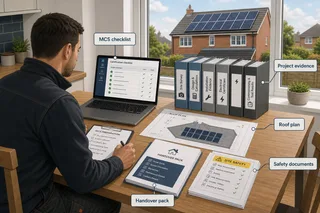
Assemble completed job files, calculations, commissioning records, product information and handover documents.
After approval, keep records in order because surveillance and renewal checks are part of remaining certified. Possible outcomes include certification being granted, certification being delayed until nonconformities are closed, or the application needing further evidence before a decision can be made. Treat findings as a quality improvement process. A rushed close-out with weak evidence may cause problems later at surveillance.
Evidence to prepare before you apply
A strong application starts with organised evidence that shows how your business controls work from enquiry to handover. Installers often focus on technical certificates but underestimate the need for consistent files, version-controlled templates and clear customer documents. If the assessor cannot follow how a job was surveyed, designed, installed, checked and handed over, the file is unlikely to be strong.
Your evidence should match how the business actually operates. Generic procedures copied from another installer can create problems if staff do not follow them on site. The aim is not to produce paperwork for its own sake; it is to prove that the business can deliver safe, consistent and compliant installations.
General business evidence commonly includes business identity, current insurance documents, competence records and written quality procedures. Customer paperwork also matters, including quotations, contracts, cancellation information where relevant, complaints processes and handover templates. Record control should show how job files are stored, how templates are updated and how product information and manufacturer instructions are retained. Where electrical competence is central to the scope, our guide to choosing a qualified electrician explains the customer-side checks that often shape trust and expectations.
Record control
A clear method for storing job files, updating templates and keeping traceable records.Business identity
Company or sole trader details, trading name, responsible people and scope of work.Competence records
Qualifications, experience, training, supervision arrangements and responsibilities for staff or subcontractors.Customer paperwork
Quotations, contracts, cancellation information where relevant, complaints process and handover templates.Insurance evidence
Current insurance documents appropriate to the work being offered.Quality procedures
Written processes for survey, design, quotation, installation, commissioning, handover, complaints and corrective action.
For a solar PV application, the technical evidence should normally explain the design assumptions and the installation choices. That means the file should show how the system size, layout, mounting approach, electrical design, product selection, commissioning and handover were controlled. The assessor should not need to guess why a particular inverter, array layout or cable route was chosen. For a heat pump application, the technical file should show how the heat demand was assessed and how the system was designed around the building. Weak files often miss the link between heat-loss calculations, emitter sizing, flow temperatures, controls, commissioning and customer explanation. A heat pump that works on paper but is poorly matched to the property can still lead to complaints.
Solar PV and heat pump evidence in practice
Solar PV and heat pump scopes are often pursued by the same renewables business, but they are not the same assessment. Shared office systems may help, but the technical design evidence is different. Applying for both scopes at the same time can be sensible if your team and records are ready, but it can also multiply the work if documentation is thin. The practical test is whether a competent reviewer can understand the installation without speaking to the installer who completed it. If the design calculation, survey notes, product choices and commissioning records are all held in someone’s head, the business is not ready. MCS assessment relies on evidence.
| Readiness area | Solar PV evidence to check | Heat pump evidence to check |
|---|---|---|
| Survey and design | Roof condition, shading considerations, layout assumptions and electrical design basis | Heat-loss calculation, hot water requirement, emitter suitability and system sizing |
| Product selection | Modules, inverter, mounting system and compatibility with installation requirements | Heat pump unit, cylinders, emitters, controls and manufacturer installation requirements |
| Installation records | Mounting, cabling, isolation, labelling, testing and commissioning information | Pipework, hydraulics, controls, condensate or drainage where relevant, and commissioning settings |
| Customer handover | System operation, safety information, certificates, warranties and maintenance guidance | Controls explanation, running guidance, maintenance information and expected operating behaviour |
| Quality control | Completed checklists, photographs where useful, and clear responsibility for sign-off | Completed checklists, commissioning results and clear responsibility for sign-off |
Overview
This comparison is useful before you apply because it shows whether your evidence is genuinely technology-specific. A business may have strong electrical records but weak heat-loss documentation, or good heat pump calculations but incomplete customer handover packs.
Common reasons MCS applications slow down
Applications usually slow down because the business is competent on site but cannot evidence its process clearly. Certification bodies assess the system as well as the finished installation. Missing templates, inconsistent job files, unclear subcontractor arrangements and incomplete customer paperwork can all delay approval.
Another common issue is applying for too many scopes at once. A company may want to offer solar PV, battery storage and heat pumps, but each technology has different design, competence and evidence requirements. Starting with the scope you can evidence properly is often more effective than applying broadly and then struggling to close gaps.
Customer protection also needs close attention. Quotations, contracts, cancellation rights where applicable, complaints handling and handover information must be clear and consistent. If the sales paperwork promises one thing and the design file shows another, the assessor is likely to question whether the business has adequate control.
Unclear scope
The business applies for technologies it cannot yet evidence properly.Weak job files
Survey notes, calculations, commissioning sheets or handover records are missing.Generic procedures
The quality manual does not match how staff actually work.Product uncertainty
Equipment evidence is incomplete or not checked against current scheme requirements where relevant.Customer paperwork gaps
Quotes, contracts, complaints information and handover packs are inconsistent.Poor subcontractor control
Responsibility for competence, supervision and sign-off is unclear.
Slow corrective action can also cause delays if nonconformities are answered with promises rather than documented evidence. These issues are usually fixable, but they are easier to resolve before assessment. A short internal file review can save weeks of back-and-forth later.
Ongoing surveillance and keeping certification
MCS certification is not finished once the certificate is issued. Certified businesses must maintain their systems, keep current records and remain ready for surveillance or renewal checks under the scheme and certification body requirements. The exact process and timing should be confirmed with your certification body.
Ongoing control matters because renewables businesses change quickly. Staff leave, subcontractors vary, product ranges change, standards are updated and templates become outdated. If the quality system is only prepared for the initial assessment, it can become unreliable within a few months.
A practical maintenance routine should include regular job file reviews, template updates, product checks and competence reviews. When standards change, update the procedure and tell the people using it. If a complaint or defect reveals a weakness, record the corrective action and make sure the same issue cannot repeat unnoticed.
How to judge whether your business is ready
Readiness is less about company size and more about control. A small installer with clear procedures, competent people and complete records may be better prepared than a larger contractor with inconsistent files. The useful question is whether another competent person could review your paperwork and understand exactly what was surveyed, designed, installed, tested and handed over.
Before applying, compare your current process with the evidence the certification body is likely to request. If you already produce consistent design packs, commissioning records and customer handovers, you may be close. If most decisions are held in one person’s head, build the system first.
Design control
Your calculations, assumptions and product choices are recorded clearly enough for review.Record control
Files are saved as work is completed, not recreated just before assessment.Product control
Products and manufacturer instructions are checked before installation and retained in the job file.Customer control
Quotes, contracts, complaints information and handover packs are consistent and understandable.Installation control
Site work follows documented procedures and completed checklists are kept.Technical competence
You can identify who is competent for each scope and show qualifications, experience, supervision and training records.
Mistakes, complaints and nonconformities should also be recorded and used to improve the system. This readiness review is valuable even if you delay certification. It reduces the risk of customer disputes, failed assessments and missed scheme opportunities.
Why MCS matters for customers, grants and export payments
Customers often ask for MCS because it can be part of the evidence required for certain grants, export arrangements, finance products, warranties or consumer protection processes. The exact requirement depends on the scheme rules in force at the time. Installers should never promise eligibility without checking the current rules for the specific customer and technology. For wider context, customers can compare solar grant options and current solar support routes before making assumptions.
For solar PV customers, MCS certification is commonly relevant when discussing export payments or evidence that the system has been installed to recognised standards. For heat pump customers, it may be relevant to grant eligibility where the scheme requires it. In both cases, the customer should be told clearly what certification does and does not prove.
MCS does not remove the need for other checks. A solar PV system may still need appropriate electrical design, roof suitability review and DNO considerations. A heat pump still needs proper heat-loss assessment and customer guidance. Certification supports good practice, but it is not a shortcut around project-specific design.
Practical next steps for UK installers
Start by choosing the technology scope that is commercially important and realistic for your current competence. Then read the current MCS Contractor Standard, the relevant MIS technology standard and the official MCS installer guidance. Contact an approved certification body and ask for its current application process, evidence list, fee schedule and assessment approach.
Next, review one or two recent jobs as if you were the assessor. Check whether the file explains the survey, design, products, installation, commissioning, customer paperwork and handover. If it does not, fix the process before booking assessment. The aim is to make every future job easier to evidence, not to polish one file for the application.
Installers should also check training needs, insurance, consumer code obligations, product selection, subcontractor control and record storage. Customers choosing an installer should ask whether the business is MCS certified for the specific technology being installed, not just whether it “does renewables”. They should also ask how the system has been designed, what will be included in the handover pack and whether MCS certification is required for any scheme they intend to use. Homeowners comparing next steps can compare home solar options, while business customers can review commercial solar options before requesting installer quotes.
Plan, Compare & Buy Renewable Energy Solutions
AI does the thinking.
You get the perfect solar match.
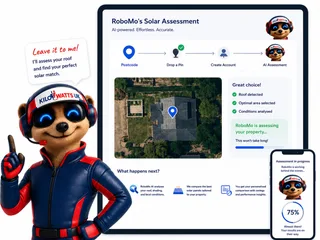
Use RoboMo™ to assess your property, compare available technologies and connect with trusted UK installers, suppliers and manufacturers.
Simply enter your postcode, drop a pin on your roof, create your free account and let RoboMo™ analyse your property to find the best solar panels for your home.

You don't have to think
RoboMo™'s AI analyses your roof and does all the hard work.

Accurate & tailored
AI-powered assessment based on your roof, location, and conditions.

Best options, maximum savings
Compare top solar panels for the best performance and value.

Simple, fast & effortless
Provide a few details, sit back and watch your results unfold.

STEP 1
Choose Home, Business or Industrial
Enter your postcode to start your assessment.
STEP 2

Drop a pin on your roof
STEP 3

Create your free account
STEP 4

Sit back and watch RoboMo™ work
RoboMo™ analyses your roof and builds your personalised solar comparison.

Step 1
Enter your postcode
Start designing your wind energy system in seconds.
Are you an installer, distributor or renewable energy business?
Kilowatts UK is expanding the Flower Turbines partner network across the UK.
Become A Flower Turbines PartnerKilowatts UK is an authorised representative
Flower Turbines
Compact vertical-axis turbines built for real UK sites, not just open farmland.
They start in light wind, sit in a small footprint, and are bird-safe by design. Cluster them as a bouquet and the group performs better together than the same turbines standing alone. Enter your postcode for a location-based generation estimate. Figures use area weather data and will differ if buildings, trees or hills sit in the way.
Starts in light UK wind
Built to generate in typical UK wind, not only open farmland.
Small rooftop or ground footprint
Compact towers for roofs, yards and tight sites.
Bird-safe slow rotation
Slow vertical-axis spin, bird-safe by design.
Bouquet clusters raise output
Grouped turbines outperform the same units standing alone.


STEP 2

Choose a location
STEP 3

Place your cluster
Tap the map where you want the turbine cluster to go.
STEP 4

Instant generation forecasts
Compare different turbine layouts and see annual generation forecasts instantly.
STEP 5

No commitment required
Explore different configurations before deciding whether to request a quotation.
Related articles

Mo's Mission Nominations
FAQ
Need Help? RoboMo's Got Answers
What is an MCS certified installer?
An MCS certified installer is a business that has been assessed against MCS requirements for specific technologies, such as solar PV or heat pumps. It is not simply a personal badge for one engineer. The certification covers the company’s processes, competence, installation quality, customer paperwork and ongoing records.
How can I check whether an installer is MCS certified?
Use the official MCS website to search for the installer and check the technology scope they are certified for. Make sure the trading name and company details match the business quoting for your work. If in doubt, ask the installer and their certification body to confirm the current status before you sign.
Does using an MCS installer guarantee savings or grant eligibility?
No. MCS certification is important, but it does not guarantee energy bill savings, export payments, planning approval or eligibility for every grant or scheme. Those depend on the property, system design, products, usage, DNO position and the current rules of any scheme. Always ask for written assumptions behind any savings or payback estimate.
What paperwork should I expect from an MCS installer?
You should expect clear survey information, a written quote, contract documents, design details, product information, commissioning records and handover guidance. For domestic work, there should also be a complaints process and relevant consumer protection information. Keep all documents because they may be needed for warranties, future maintenance, property sale enquiries or scheme applications.
Can an installer use subcontractors and still be MCS certified?
Yes, subcontractors may be used, but the certified business should still control competence, supervision, quality and customer handover. As a customer, you should know which company is responsible for the contract and aftercare. Ask who will design, install, commission and sign off the system.
Is MCS certification the same as being a qualified electrician or heating engineer?
No. Individual qualifications and experience matter, but MCS certification applies to the installation business and its approved technology scopes. A solar PV installer may need strong electrical competence, while a heat pump installer needs suitable heating design and commissioning competence. You can ask what qualifications, supervision and experience apply to the people working on your installation.
Why does MCS matter when buying solar panels or a heat pump?
MCS certification gives you a recognised route for checking that the installer has been assessed against relevant standards. It can also be required by some grants, tariffs, finance products or customer protection arrangements, depending on their current rules. It should be treated as a minimum check, not a substitute for a good survey, clear design and honest advice.
What should I ask an MCS installer before accepting a quote?
Ask which MCS technology scope they hold, what products they plan to use and what assumptions sit behind the design. Ask whether DNO notification or approval, planning issues or building constraints could affect the project. You should also ask what happens if there is a fault, complaint or warranty claim after installation.