


Solar panel installation in Dover
Published: 2026-10-06 00:58:32
Updated: 2026-10-05 17:59:41
Solar panel installation in Dover is settled by brittle tiles, harbour scaffold, salt-air fixings and UK Power Networks, not by postcode. Survey first.
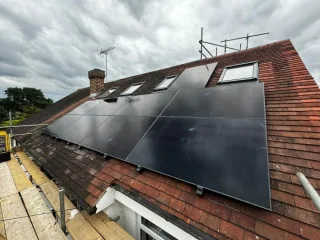
Solar panel installation in Dover
Solar panel installation in Dover from Kilowatts.uk in Broadstairs. Costs, roofs, planning and what to do next then compare a local system.
Solar panel installation in Dover
South-east England is among the better-irradiated parts of the UK, but a shaded Dover roof will underperform a clear inland one. An open sea view does not override a failing covering or unsafe scaffold. Designers often start from a UK-wide specific-yield band of roughly 800 to 1,100 kWh a year per kilowatt-peak for a largely unshaded array. That band is a national starting point, not a measurement from Dover roofs and not a promise for your house. Shade, orientation, pitch, soiling and system losses move the result. A quote should show a model of the named roof, not recycle the band as your annual output.
Dover, for this search, means the town and nearby coastal and cliff-edge streets in Dover district, not the whole of Kent. Victorian and later housing, harbour streets and exposed headlands sit side by side. A drone photo of tiles is not a design. The practical next step is a surveyed proposal for solar panel installation in Dover, based on the roof, the consumer unit and the network connection you actually have.
What a Dover roof survey actually checks
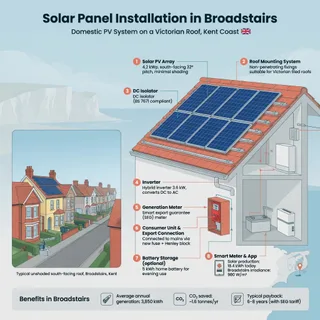
In practice the survey decides whether the job is straightforward or whether scope will change before anyone orders panels. Installers look at rafter or beam spacing, underlay, tile or slate condition, ridges and verges, and whether the covering can be lifted and rebedded without widespread breakage. On older Dover roofs, brittle tiles and hidden timber decay often turn a simple array into a roofing job as well as an electrical one. A visual pass from the street will not show nail sickness, slipped underlay or decayed rafter ends.
Weight is only half the structural question. Wind uplift on an exposed elevation can govern clamp spacing and where the array may sit, even when the roof looks large enough. Cable routes, inverter location, heat and noise, and space for isolators beside the consumer unit are settled at survey, not after the scaffold is up. Older consumer units sometimes need work before a generator can be connected. That is a site finding, not a product fault. It should appear in the quote as its own line, not as a surprise variation.
Access often dominates the programme on narrow streets, steep chalk plots and cliff-side paths. Scaffold, pavement arrangements and how materials reach the roof can matter as much as panel count. Harbour and town-centre streets may need the highway authority’s agreement for pavement scaffold. In Kent that is a separate question from planning consent. Generation and export are not the same figure. A roof sized only to spare tiles will export more, and self-consume less, if nobody is home in the day. Reading how many panels a home needs is useful background, but it does not replace a layout drawn for this roof.
Coastal exposure, salt air and cliff sites
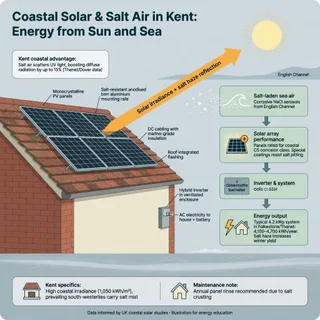
Coastal Dover is not automatically a poor place for photovoltaics. Modules generate in bright cloud as well as clear sun, at lower output. Salt does not stop that process. It does attack fixings, flashings and cable entries over decades, which is why an exposed Channel aspect is specified differently from a sheltered inland Kent roof. A clear horizon can also mean higher wind speeds acting on the same brackets for the life of the array. If you want the mechanism in plain terms, see how solar panels work.
Corrosion-resistant brackets, correct torque and sealed penetrations are design choices, not optional extras, where salt-laden air and uplift act together. The schedule should be calculated for the site wind exposure and the actual covering, whether that is tile, slate, felt or membrane, rather than copied from an inland kit. Mild-steel hardware with a coat of paint is a poor substitute on a sea-front or headland elevation. The roof covering still has to accept the fixing method. A clear view of the sky does not override a failing covering or unsafe access.
The idea that the cliffs get more sun, so any cliff house is ideal, is the wrong way round. Exposure, scaffold, planning constraints and roof condition can outweigh irradiance. Houses set back from the most open elevations, with standard tile or slate and a largely unshaded pitch, are the straightforward cases. Bird soiling and salt film reduce output if they are left to build up. Cleaning should follow the module maker’s guidance, usually fresh water without abrasives. It is maintenance, not a reason to rule solar out. Neighbouring chimneys and trees matter just as much: one shaded panel can pull down a whole string if the design ignores it.
Planning, heritage and the network connection
Many domestic roof-mounted systems in England can be permitted development when the relevant conditions are met. That is a set of conditions, not a Dover-wide permission, and it is not a guarantee for a given address. Listed buildings follow a different consent path. Conservation areas and other designations can restrict where equipment sits, especially if it would face a highway or affect a protected setting. Dover district includes conservation areas and listed buildings. Whether your house is covered is a records check on the Dover District Council planning and heritage map, not a guess from how old the brickwork looks. Scaffold should not be booked until that check, and any required consent, is clear. Grid connection is a separate step from planning. The distribution network operator for Dover is UK Power Networks. Smaller schemes are often connect-and-notify, commonly under the G98 route where the inverter stays within the usual single-phase notification limit. Larger plant, or a proposal the network needs to study, follows an application, commonly under G99. An approved export limit can cap what may leave the property even when the roof could hold more modules. Those thresholds and forms change with the equipment and with the current UK Power Networks and ENA process, so they should be confirmed for the inverter and export limit actually proposed. A change of inverter, a hybrid battery arrangement, or a different export limit can be treated as a different proposal.
Overview
East–west roofs are often still workable if morning and evening use is high, though annual yield per kilowatt-peak is usually lower than a clear south pitch. A battery is optional. It can shift surplus into the evening. It does not make an unsuitable roof suitable, and it does not replace a proper connection design or an export limit the network has required. Wider context on solar panel installation in Kent still has to be narrowed to this address.
What makes the install certifiable and export-eligible
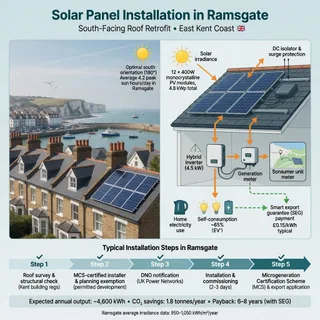
Installing panels and being able to evidence a compliant, export-eligible system are not the same thing. For a typical owner-occupier job, buyers should expect three separate trails: product and installer certification, an electrical notification under the Building Regulations, and a network notification or application. Missing any one of them is a common reason a finished roof still cannot be paid for exported electricity, or still lacks the paperwork a buyer or insurer later asks for.
The Microgeneration Certification Scheme is the usual UK route for small-scale solar. An MCS-certified installer, using products that will actually be listed on the certificate, is what most Smart Export Guarantee suppliers look for. Some suppliers may accept an equivalent scheme. That is a supplier rule to check, not something to assume from a sales conversation. MCS is a certification and paperwork standard. It is not, by itself, proof that a cliff-edge scaffold is safe or that decayed timbers have been repaired.
The Smart Export Guarantee is the framework, overseen by Ofgem, under which licensed suppliers must offer a tariff for eligible exported electricity. There is no single national rate. Income exists only at the tariff you are actually offered and accept, and only for electricity you export rather than use. Rates, metering requirements and eligibility can change. A quote that prints a payback from an assumed export price is not a design. Ask which supplier tariff, if any, has been used, and treat that figure as illustrative until you hold an offer. In England, the new circuit and related electrical work for solar is generally notifiable building work, commonly discussed under Part P of the Building Regulations. A registered competent person can certify the work and notify building control. If the installer is not on a relevant competent-person scheme, a building-control application may be needed instead. Ask who will notify, which scheme they are on, and what certificate you will receive when the job is complete. Do not treat a verbal assurance as the notification.
What changes a Dover quote
Installed prices for Dover should not be invented from a national table, and payback should not be inferred from a postcode. The useful question is which local conditions move labour, access and electrical scope before a surveyor has stood on the roof. Those drivers explain why two similar-looking terraces can produce very different proposals. A pound figure from a blog is not a quotation. If you are weighing kit types before a visit, compare home solar options only as a shortlist, not as a price for this house.
Scaffold and material handling are often the first cost driver. Narrow harbour streets, pavement licences, steep chalk plots, long carries and cliff-side paths can dominate the programme even when the panel count is modest. Specialist access is a finding, not a line to hide inside a panel price. If the only way onto the roof is unsafe, the correct outcome is to stop, not to discount the array.
Roof repairs are the second. Brittle tiles, failed nails, tired underlay and decayed timbers are common once the covering is lifted. A survey allowance is not a fixed roofing price. The quote should say what was seen, what was assumed, and what stops the job or becomes extra work if the structure is worse than the survey could prove from outside. Who pays for broken tiles and for timber repairs should be written down before the scaffold goes up. That allocation is contractual, not a national rule. The electrical and network end is the third. A consumer-unit upgrade, new tails, extra ways, isolators, generation metering and cable routes through a solid or congested house all add scope. If UK Power Networks caps export, the design may need a smaller inverter, fewer modules, or approved export limitation so the roof can still serve daytime use without exceeding the agreed export. That equipment and the application time are part of the job. Marine-spec fixings, and any heritage-driven change to layout or appearance, are further reasons a coastal quote will not match an inland kit price. None of these drivers produces a reliable payback until usage, a modelled generation figure and a real export tariff are known. Do not assume a grant will close the gap. Check any current official scheme yourself rather than treating a sales mention as eligibility.
Who a Dover install suits, and when to stop
The search fits owner-occupiers with a sound, largely unshaded roof, safe scaffold access, and enough daytime electricity use to justify the fixed costs of scaffold, electrical work and connection. People who can wait for a survey, rather than a price from a postcode, are the right audience. Renters, and anyone who does not control the roof, cannot commission a standard owner-occupier install without the owner’s agreement and a clear arrangement for certification and access.
It is a poor fit where the roof is failing, heavily shaded for much of the day, or structurally doubtful, and where a very small usable area will not carry those fixed costs. Flats, harbour buildings with shared roofs, and homes with no space for an inverter and isolators need an individual feasibility check, not a standard terrace design. A cliff-top or sea-front house is not excluded, but it is not a sheltered-roof job. Off-grid design is a different project from the grid-connected system this query usually means.
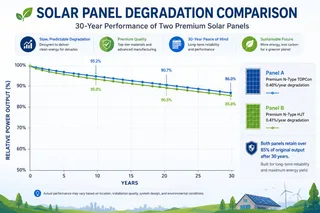
Module makers commonly state performance warranties of around 25 years, with product warranties often shorter. That is a warranty period, not a measured Dover lifespan in salt air and high wind. Inverter replacement during the system life is a normal maintenance expectation, not evidence that the panels have failed. Export income remains unknown until a supplier offers a tariff against metered export. A competent installer will say what would make them decline the roof, rather than forcing a layout onto a covering that should be repaired or replaced first.
What to measure before you request a survey
Before you ask an installer to visit, note the roof covering, roughly which way the slopes face, and what shades them between late morning and mid-afternoon. Chimneys, neighbouring houses, trees and, on some plots, the lie of the cliffs matter more than a small change in tilt. A phone photo of the consumer unit, the meter cupboard and the street access helps a surveyor see whether the electrical end or the scaffold will set the programme. If you already know the house is listed, or sits in a conservation area, say so. If you do not know, the installer should check the Dover District Council map before work is booked, not after the deposit is paid. When those notes are ready, book a free home survey rather than pricing the job from a postcode.
The answers that change a Dover quote are usually about credentials, marine design and what happens when the roof is opened, not about panel brand. A competent proposal names the assumptions on shade, export and roof condition, states whether the network step is a notification or an application, and says what would stop the job. If those points are missing, the price is not yet a design.
Take those answers in writing. They are the difference between a surveyed Dover install and a generic south-facing sketch with a postcode on it.
Plan, Compare & Buy Renewable Energy Solutions
AI does the thinking.
You get the perfect solar match.
Use RoboMo™ to assess your property, compare available technologies and connect with trusted UK installers, suppliers and manufacturers.
Simply enter your postcode, drop a pin on your roof, create your free account and let RoboMo™ analyse your property to find the best solar panels for your home.

You don't have to think
RoboMo™'s AI analyses your roof and does all the hard work.

Accurate & tailored
AI-powered assessment based on your roof, location, and conditions.

Best options, maximum savings
Compare top solar panels for the best performance and value.

Simple, fast & effortless
Provide a few details, sit back and watch your results unfold.
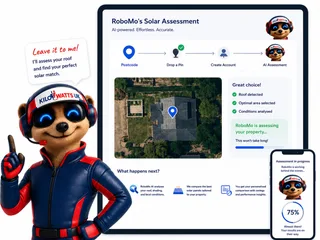
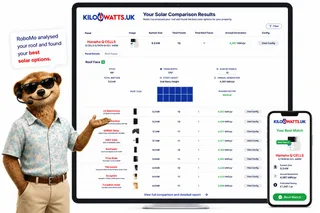
STEP 1
Choose Home, Business or Industrial
Enter your postcode to start your assessment.
STEP 2
Drop a pin on your roof
STEP 3

Create your free account
STEP 4

Sit back and watch RoboMo™ work
RoboMo™ analyses your roof and builds your personalised solar comparison.

Step 1
Enter your postcode
Start designing your wind energy system in seconds.
Are you an installer, distributor or renewable energy business?
Kilowatts UK is expanding the Flower Turbines partner network across the UK.
Become A Flower Turbines PartnerKilowatts UK is an authorised representative
Flower Turbines
Compact vertical-axis turbines built for real UK sites, not just open farmland.
They start in light wind, sit in a small footprint, and are bird-safe by design. Cluster them as a bouquet and the group performs better together than the same turbines standing alone. Enter your postcode for a location-based generation estimate. Figures use area weather data and will differ if buildings, trees or hills sit in the way.
Starts in light UK wind
Built to generate in typical UK wind, not only open farmland.
Small rooftop or ground footprint
Compact towers for roofs, yards and tight sites.
Bird-safe slow rotation
Slow vertical-axis spin, bird-safe by design.
Bouquet clusters raise output
Grouped turbines outperform the same units standing alone.


STEP 2

Choose a location
STEP 3

Place your cluster
Tap the map where you want the turbine cluster to go.
STEP 4

Instant generation forecasts
Compare different turbine layouts and see annual generation forecasts instantly.
STEP 5

No commitment required
Explore different configurations before deciding whether to request a quotation.
Related articles
FAQ
Need Help? RoboMo's Got Answers
Is solar panel installation in Dover different from an inland Kent job?
The panels and inverter are ordinary grid-connected kit. What changes the job is the site: salt air, Channel wind, cliff and chalk-plot access, older brittle tiles, and heritage designations. A clear sea view does not override a failing covering or unsafe scaffold. Design should be for this roof and elevation, not copied from an inland kit.
How much electricity will panels on a Dover roof generate?
Designers often start from a UK-wide band of roughly 800 to 1,100 kWh a year per kilowatt-peak for a largely unshaded array. That is a national starting point, not a measurement from Dover roofs and not a promise for your house. Shade, orientation, pitch, soiling and system losses all move the result. Ask for a model of the named roof, not a recycled national figure.
Do I need planning permission for roof-mounted solar in Dover?
Many domestic roof-mounted systems in England can be permitted development when the relevant conditions are met. That is not a Dover-wide permission and not a guarantee for a given address. Listed buildings follow a different consent path, and conservation areas can restrict where equipment sits. Check the Dover District Council planning and heritage map for the address before scaffold is booked.
Who handles the grid connection, and can export be limited?
The distribution network operator for Dover is UK Power Networks. Smaller schemes are often connect-and-notify, commonly under G98 where the inverter stays within the usual single-phase notification limit. Larger plant, or a proposal the network needs to study, commonly follows G99. An approved export limit can cap what leaves the property even if the roof could hold more modules. Thresholds and forms change, so confirm them for the inverter and export limit actually proposed.
What paperwork is needed before exported electricity can be paid for?
A finished roof and an export-eligible system are not the same thing. Buyers should expect product and installer certification, an electrical notification under the Building Regulations, and a network notification or application. MCS is the usual route most Smart Export Guarantee suppliers look for; some may accept an equivalent, which is a supplier rule to check. The Smart Export Guarantee has no single national rate, and income depends on the tariff you are offered and on electricity you actually export.
Why can two similar Dover houses get very different quotes?
Installed prices should not be taken from a national table or a postcode. Narrow streets, pavement arrangements, steep chalk plots and cliff-side access can dominate the programme. Brittle tiles, failed nails, tired underlay and decayed timbers can turn the job into roofing as well as electrical work. Consumer-unit upgrades, cable routes, export limitation and corrosion-resistant fixings are further scope. Do not assume a grant will close a gap; check any current official scheme yourself.
Does salt air or a cliff-edge site rule solar out?
Coastal Dover is not automatically a poor place for photovoltaics. Modules still generate in bright cloud, at lower output, and salt does not stop that process. Salt and wind do attack fixings, flashings and cable entries over decades, so brackets, torque and sealed penetrations should be specified for the exposure and the actual covering. Bird soiling and salt film are maintenance issues; cleaning should follow the module maker’s guidance, usually fresh water without abrasives.
Is solar still worth considering on an east–west or partly shaded Dover roof?
East–west roofs are often workable if morning and evening use is high, though annual yield per kilowatt-peak is usually lower than a clear south pitch. Shade from chimneys, trees or neighbouring houses can cut output, and one shaded panel can drag down a whole string if the design ignores it. A battery can shift surplus into the evening, but it does not make an unsuitable, failing or heavily shaded roof suitable, and it does not replace a proper connection design.