


Unlock Commercial Solar for Manufacturing in the UK
Published: 2026-07-18 17:17:34
Updated: 2026-07-26 18:35:42
Suitability depends on the site’s half-hourly demand profile, roof condition, grid connection, installation access, electricity tariff, export value.
Commercial solar for manufacturing in the UK
Commercial solar for manufacturing can be a strong fit in the UK because many factories use large amounts of electricity during daylight hours, when solar PV is generating. Suitability depends on the site’s half-hourly demand profile, roof condition, grid connection, installation access, electricity tariff, export value, ownership structure, and production constraints. The best projects are sized around real site consumption rather than roof area alone.
For a manufacturer, solar PV is not just a sustainability measure. It is a long-life electrical asset that can reduce imported kWh, support carbon reporting, and make part of the site’s energy cost more predictable. It still needs careful design because manufacturing sites bring risks that are less common on simple commercial buildings, including process dust, fragile roofs, shutdown windows, high motor loads, landlord permissions, hygiene rules, fire strategy, and insurer requirements.
A good early summary is this. If your site has a stable daytime baseload, a sound roof, clear electrical capacity, and a practical grid connection, commercial solar is worth comparing. If the roof is near the end of its life, the site is heavily shaded, the lease is short, or electricity demand is mostly at night, the business case may be weaker or may need a smaller system, export limitation, batteries, carports, or a different decarbonisation approach. This guide is written for UK manufacturing businesses assessing rooftop or site-based solar PV. It is intended to help owners, finance directors, operations managers, estates teams, energy managers, and landlords understand what matters before committing to a design, quote, or power purchase agreement.
Author credentials and review basis
This article has been prepared by the Kilowatts UK commercial renewable-energy editorial team for UK business buyers considering solar PV on manufacturing premises. The guidance reflects practical project considerations commonly reviewed during commercial and industrial solar assessments, including half-hourly energy data, Distribution Network Operator applications, roof condition, CDM duties, electrical design, export assumptions, installer documentation, and long-term operation and maintenance.
It is editorial guidance, not a site-specific design, legal opinion, tax recommendation, structural calculation, or grid connection offer. Manufacturers should take project-specific advice from competent solar designers, structural engineers, electrical contractors, planning consultants, insurers, accountants, landlords, and the relevant Distribution Network Operator before making investment decisions.
Why manufacturing sites can suit solar PV
Manufacturing sites often have a better demand match for solar than offices, schools, or many retail premises. Typical daytime loads include compressors, pumps, motors, conveyors, CNC machines, process cooling, refrigeration, ventilation, lighting, extraction, packaging lines, warehouse automation, and office areas. Many of these run during the same hours that PV generation is available.
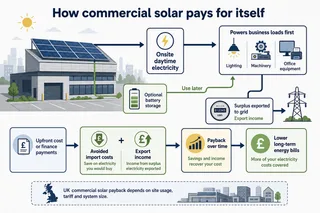
The key concept is self-consumption. This means using the solar electricity on site instead of exporting it to the grid. For manufacturing projects, self-consumption is often the main source of value because avoided imported electricity is usually worth more than exported electricity.
Many manufacturing sites can use a high proportion of their solar generation directly, especially where production runs through the middle of the day or across seven days. Weekday-only factories, sites with summer shutdowns, or businesses with low weekend demand may export more electricity during periods when panels are producing well. Solar works in UK daylight, not only in direct sunshine. Output is higher in spring and summer and lower in winter, but many manufacturers use electricity all year. This makes annual and seasonal modelling important. A single annual electricity figure is not enough to size a system properly. For example, a food manufacturer with refrigeration and daytime processing may have a strong summer match because cooling loads rise when solar output is high. A metal fabricator running a single weekday shift may still have a good daytime baseload, but weekend export could reduce the value of a very large system. A plastics, cold storage, or 24-hour production site may support a larger system because demand continues beyond normal office hours. These are examples of why the production pattern matters as much as the roof size.
Typical costs and generation for UK manufacturing solar
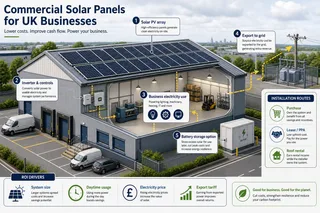
Commercial rooftop solar costs in the UK commonly fall around £700 to £1,200 per kWp, with larger systems often achieving a lower cost per kWp. A 50 kWp system may cost around £40,000 to £65,000, a 100 kWp system around £70,000 to £110,000, a 250 kWp system around £150,000 to £250,000, and a 1 MWp rooftop system around £600,000 to £900,000.
These are broad guide ranges, not a substitute for a surveyed design. Manufacturing sites can move outside these ranges if they need roof strengthening, asbestos management, specialist access, major switchgear work, export limitation, high-voltage integration, upgraded fire safety measures, or complex installation phasing around production.
UK commercial rooftop solar systems commonly generate around 850 to 1,050 kWh per kWp per year. Sites in southern England may generate around 950 to 1,100 kWh per kWp per year, while northern England, Scotland, shaded sites, or less favourable roof orientations may be closer to around 750 to 950 kWh per kWp per year. As rough examples, a 100 kWp system may generate around 85,000 to 105,000 kWh per year, a 250 kWp system around 212,000 to 262,000 kWh per year, and a 1 MWp system around 850,000 to 1,050,000 kWh per year. The useful value of that generation depends on how much is used on site and what electricity costs it displaces. Payback periods vary widely because they depend on installed cost, self-consumption, import tariff, export rate, maintenance cost, finance cost, tax position, degradation, and future electricity prices. Manufacturers should be cautious with proposals that rely on aggressive electricity price inflation, unusually high export values, or assume that all solar generation offsets the full import tariff.
What affects the price of a factory solar installation
The panel count is only one part of the cost. On manufacturing buildings, the expensive or risky items are often found in the roof, electrical infrastructure, grid connection, access plan, and operating environment.
Grid approval
Most commercial systems require a G99 application to the Distribution Network Operator, and export limits or reinforcement can affect size and cost.Roof covering
Standing seam, trapezoidal metal, flat membrane, cement fibre, fragile materials, and asbestos-containing roofs all need different mounting and access approaches.Roof structure
The installer needs to confirm that the roof can take the additional dead load, wind load, snow load, ballast, fixings, and maintenance access requirements.Electrical connection
Main switchgear, transformer capacity, cable routes, metering, protection settings, and existing private networks can all affect design.Operational constraints
Work may need to be scheduled around production hours, hygiene zones, loading movements, shutdown windows, and critical plant.Fire and insurance requirements
Cable management, isolation, access routes, fire stopping, roof compartmentation, and insurer guidance can change the layout.
The lowest quote is not always the lowest-risk option. A proposal that ignores roof warranty conditions, DNO constraints, production disruption, or maintenance access can become expensive later. A finance director may focus on payback and cash flow, while an operations manager may be more concerned about shutdowns and production risk. A landlord may focus on roof warranty and removal obligations, and an insurer may focus on fire strategy and maintenance. A robust solar proposal should address all of these perspectives, not only the headline price per kWp. Site environment — Dust, chemicals, humidity, salt exposure, ammonia, food hygiene requirements, or corrosive atmospheres may require different equipment specifications and maintenance plans. Documentation quality — Proper surveys, structural checks, DNO paperwork, commissioning records, and O&M manuals add value because they reduce operational, insurance, and resale risks.
Sizing solar around manufacturing demand
The right system size is usually not the largest system that can fit on the roof. It is the size that gives the best balance between self-consumption, export, capital cost, roof constraints, grid limits, and future site plans.
A reliable design normally starts with at least 12 months of half-hourly electricity data. This shows when electricity is used throughout the day, week, and year. It also exposes shutdown periods, weekend demand, seasonal production peaks, night shifts, and base loads that are hidden in annual bills.
A manufacturer with a high weekday baseload may be able to use a large amount of solar directly. A site with seven-day production may perform even better because weekend generation is less likely to be exported. A site with a long summer shutdown may need a smaller system or a more conservative export assumption. Installers should model the system using site-specific roof data, orientation, shading, soiling assumptions, inverter losses, cable losses, and degradation. They should also distinguish between DC panel capacity in kWp and AC inverter capacity. DC capacity can be higher than inverter output, and some clipping may be acceptable if it improves the annual generation profile and project economics. Manufacturers should ask for the modelling assumptions in plain English. A good appraisal should show expected annual generation, self-consumed electricity, exported electricity, import savings, export income, maintenance cost, degradation, and sensitivity to electricity price changes. Where possible, the installer should explain how the design performs in a typical summer week, winter week, weekend, and shutdown period.
Roof, structure, and site condition checks
The roof is often the first pass-or-fail item. Commercial solar panels can last 25 to 30 years or more, so putting them on a roof with limited remaining life can create a costly problem. If major roof works are likely in the next few years, it may be better to refurbish before installing solar.
A structural survey is normally required. This should consider the existing roof build-up, purlins, fixings, wind uplift zones, snow load, ballast or fixing loads, rooflights, fragile areas, drainage, and safe access routes. On older industrial buildings, purlins and fixings can be the limiting factor rather than the main steel frame.
Usable roof area is not the same as total roof area. A rough space allowance is 5 to 7 square metres per kWp, so a 100 kWp system may need around 500 to 700 square metres of usable roof area. Rooflights, vents, flues, parapet shading, plant, walkways, fragile zones, drainage routes, and fire access requirements all reduce the practical area. Manufacturing environments can also affect performance. Dust, fumes, process residue, bird nesting, nearby quarries, ports, cement works, food production areas, or busy roads may increase soiling and maintenance needs. Coastal, corrosive, high-humidity, chemical, or ammonia-rich environments may need enhanced material specifications. Roof warranties should be checked before mounting equipment is selected. Some roof systems require approved fixings or installation methods to keep warranties valid. If the building is leased, the landlord may require independent structural review, method statements, reinstatement obligations, and evidence that the solar installation will not reduce the roof’s lifespan. Asbestos is another important issue on older manufacturing sites. If asbestos-containing materials may be present, surveys, risk controls, and specialist handling may be required before any roof work or cable routing is planned.
Grid connection and electrical design
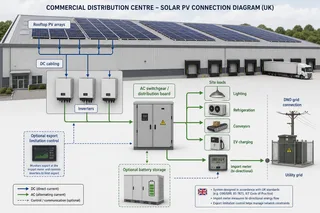
Most manufacturing solar systems need approval from the local Distribution Network Operator before they can be connected. Very small systems may fall under G98, but most commercial factory systems are handled through G99. Larger or more complex projects may require studies, protection settings, witness testing, and commissioning evidence.
DNO approval can affect the system size, export capacity, timescale, and cost. In some cases, the roof can physically fit a large array but the grid connection cannot accept the export without reinforcement. A high daytime manufacturing load can reduce this issue because more generation is consumed on site, but export assumptions still need to be agreed.
Export limitation can sometimes allow a larger installed system where the DNO restricts export. This uses control equipment to prevent export above an agreed level, often designed under G100 principles. It is not a shortcut around grid approval, and it needs proper commissioning and testing. Electrical design should also review main switchgear capacity, transformer capacity, meter arrangements, power factor correction, harmonic issues, backup generators, combined heat and power plant, and sensitive production machinery. Standard grid-tied solar does not keep a factory running during a power cut. Backup operation needs specialist islanding equipment and usually a battery or generator integration strategy. Manufacturing sites with high-voltage supplies, private networks, multiple meters, landlord supplies, tenant supplies, or embedded generation need particular care. The point of connection, metering boundary, export MPAN requirements, protection settings, and operational control responsibilities should be clarified early. Cable routes should be planned around fire compartments, roof penetrations, hygiene zones, vehicle routes, hot works restrictions, and future maintenance access. Inverter locations also matter. Dust, heat, poor ventilation, chemical exposure, and difficult access can reduce reliability or increase maintenance cost.
Planning, compliance, and insurance
Many rooftop solar installations on commercial buildings in England may be possible under permitted development if the conditions are met, but this should be checked rather than assumed. Planning rules differ across England, Scotland, Wales, and Northern Ireland. Listed buildings, conservation areas, Article 4 directions, roof height, visual impact, and equipment siting can all change the position.
Ground-mounted solar and carport solar usually involve more planning and civil engineering work than rooftop systems. Ground-mounted schemes may need assessments for ecology, flood risk, landscape impact, heritage, glare, access, and drainage. Carports can be useful for sites with limited roof space, but the steel structure and foundations usually make them more expensive than rooftop PV.
Commercial installation work also brings CDM duties, risk assessments, method statements, working-at-height controls, lifting plans, and electrical shutdown planning. Manufacturing sites may need weekend work, shutdown-period installation, contamination controls, or temporary arrangements for critical production lines. Insurers should be engaged early. They may ask about competence, fire strategy, cable routes, isolation, maintenance, access zones, and design guidance. Fire service access routes, smoke vents, roof plant, compartment walls, and drainage should all be considered before the layout is finalised. For food, pharmaceutical, aerospace, chemical, and precision manufacturing environments, additional controls may be needed. These can include hygiene segregation, foreign-object controls, dust containment, clean access routes, hot works controls, permit-to-work systems, and coordination with quality management procedures. Compliance is not just a paperwork exercise. It affects how safely the system can be installed, operated, maintained, isolated, and removed at the end of life.
Batteries, EV charging, and process electrification
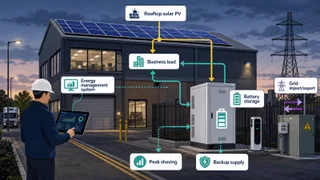
A battery is not automatically required for manufacturing solar. Many factories already have enough daytime demand to use most of the PV output directly, which can make a battery less attractive. Batteries are more likely to help where solar generation exceeds daytime demand, where there are evening loads, or where tariffs reward peak reduction and time shifting.
Battery projects need their own assessment. They add capital cost, space requirements, fire safety considerations, maintenance, operating limits, and warranty conditions. Battery backup for critical loads is possible, but whole-factory backup is usually much more demanding. Large motors, compressors, and process equipment can have high starting currents that must be designed for. For larger facilities, industrial solar battery storage should be assessed as a separate engineering and financial decision, not an automatic add-on.
Solar can also interact well with EV charging and heat electrification. Controlled daytime EV charging can absorb solar generation that might otherwise be exported. Heat pumps, electric boilers, or electrified process heat can increase electricity demand and change the best solar size, but solar does not decarbonise gas use unless the relevant heat process is actually electrified. If production growth, new lines, EV fleets, warehouse automation, refrigeration expansion, or heat electrification are planned, they should be included in the solar model. Designing only around today’s demand can undersize the system for a site that is about to use more electricity. A practical example is a manufacturer planning electric forklifts, staff EV charging, and additional automated warehousing. The existing demand profile may suggest a modest PV system, but the future load could justify a larger system if charging can be controlled during daylight hours. By contrast, an electrified process heat project that runs mainly overnight may not improve solar self-consumption unless load shifting or storage is part of the plan.
Government support, tax, and export income
There is no general UK grant that pays for all commercial solar installations. Support changes over time and can be scheme-specific, competitive, regional, or linked to wider decarbonisation projects. The Industrial Energy Transformation Fund has supported some industrial energy efficiency and decarbonisation projects, but funding windows open and close.
Local authority grants and devolved government schemes may be available in some areas. Tax treatment, full expensing, Annual Investment Allowance, VAT recovery, and business rates should be checked with an accountant or rating adviser because the position depends on the company, site, nation, and timing.
The Smart Export Guarantee can apply to eligible solar installations up to 5 MW, but commercial sites often use negotiated export contracts or power purchase agreements. Export income should be treated carefully because exported electricity is usually worth less than electricity used on site. Government policy and UK politics can influence solar through planning rules, grid connection reform, public sector decarbonisation, business rates, tax treatment, and industrial energy policy. For manufacturing rooftop solar, the practical barriers are often less about land-use debate and more about roof condition, grid capacity, installation disruption, and access to capital. Manufacturers should also consider how solar affects environmental reporting. On-site solar can support Scope 2 electricity reduction narratives where the electricity is consumed by the business, but claims should be accurate and consistent with the company’s reporting method, electricity supply contract, and any export or certificate arrangements. Overstated carbon claims can create reputational risk, especially for manufacturers supplying larger customers with formal sustainability requirements.
Ownership, finance, and PPAs
Manufacturers can buy a solar system outright, use asset finance, enter a power purchase agreement, or consider a roof lease or private wire structure. The right model depends on capital availability, balance sheet treatment, lease length, electricity procurement strategy, and appetite for operational responsibility.
Solar PPA
A third party owns the system and sells electricity to the site under a long-term agreement, often assessed by tariff discount rather than simple payback.Roof lease
A third party uses roof space for generation, which can be more complex where the occupier and building owner are different.Asset finance
The capital cost is spread over time, which can help preserve cash while still allowing the site to benefit from generation.Direct purchase
The manufacturer owns the asset, receives the electricity benefit, and is responsible for maintenance, insurance coordination, and lifecycle costs.
For leased factories, permissions are critical. The tenant may need landlord consent, a licence for alterations, roof access rights, removal obligations, and agreement on what happens at lease expiry. A short remaining lease can make direct investment difficult unless renewal or assignment terms are clear. Manufacturers with fixed electricity supply contracts should also check volume commitments, export arrangements, supplier notification requirements, and whether an export MPAN is needed. Embedded generation can affect energy procurement, so it should not be treated as a standalone building project. Different stakeholders may prefer different finance models. A privately owned manufacturer with available capital may prefer direct purchase because it keeps the full energy benefit. A growing business preserving cash for machinery may prefer asset finance. A landlord and tenant may prefer a PPA if ownership, maintenance, and lease-end responsibilities are clearer than a tenant-funded system. These structures should be compared using like-for-like assumptions, including maintenance, insurance, indexation, buyout rights, and termination provisions.
How to choose a commercial solar installer for a manufacturing site
A manufacturing solar installer should be able to work with energy data, roof constraints, DNO applications, electrical infrastructure, insurers, and production schedules. Domestic-style proposals are rarely enough for a factory project.
A good proposal should clearly state system size, expected annual generation, self-consumption, export assumptions, roof layout, inverter strategy, grid connection assumptions, exclusions, maintenance requirements, and financial assumptions. It should separate import savings from export income and explain whether electricity prices include VAT, Climate Change Levy, and other charges.
Ask how the installer will manage working at height, fragile roof areas, roof warranties, shutdowns, cable routes, fire stopping, inverter placement, monitoring, and handover. Inverter locations matter because heat, dust, poor ventilation, and restricted access can reduce reliability or make maintenance harder. You should also expect clear commissioning documents. These may include electrical test certificates, G99 paperwork, as-built drawings, monitoring setup, emergency procedures, O&M manuals, warranties, datasheets, isolator locations, and maintenance schedules. Site staff should know that DC circuits can remain live in daylight and that solar equipment should be included in planned preventative maintenance. Before appointing an installer, manufacturers should ask for evidence of commercial or industrial experience, appropriate accreditations or memberships, insurance cover, health and safety processes, named project management responsibilities, and examples of work on comparable buildings. References are particularly useful where the previous project involved live manufacturing operations, fragile roofs, high-voltage infrastructure, food hygiene controls, or complex DNO requirements. A strong installer should be willing to discuss risks as well as benefits. Be cautious if a proposal does not request half-hourly data, ignores roof condition, assumes a battery without modelling, promises outage backup from a standard grid-tied system, or gives a payback figure without showing the assumptions behind it.
Stakeholder considerations in a manufacturing solar project
Commercial solar affects more than the energy bill. A successful manufacturing project usually needs input from several people across the business and, in leased buildings, from the property owner.
Finance director
Needs transparent assumptions, tax advice, cash-flow modelling, contract terms, asset ownership clarity, and sensitivity analysis.Operations manager
Needs installation phasing, shutdown planning, safe access, minimal disruption, and clear responsibilities if production is interrupted.Health and safety manager
Needs CDM compliance, working-at-height controls, permits, emergency procedures, fire strategy, and staff awareness.Managing director or owner
Usually wants confidence that the project supports long-term cost control, resilience, customer expectations, and business value.Energy or facilities manager
Needs accurate monitoring, maintenance arrangements, inverter access, spare parts planning, and integration with existing systems.Landlord or property manager
Needs consent documents, roof warranty protection, structural evidence, access rights, and lease-end arrangements.
Including these perspectives early can prevent delays later. Many solar projects stall not because the PV design is poor, but because landlord consent, insurer requirements, production shutdown windows, or switchgear constraints were left too late. Insurer — Needs confidence in equipment quality, installation competence, fire separation, cable management, isolation, and inspection regimes. Customers and supply-chain partners — May value credible carbon reduction evidence, but claims must be accurate and not overstated.
When commercial solar may not be suitable
Commercial solar is not right for every manufacturing site. A weak business case is usually caused by poor demand match, roof problems, grid constraints, ownership issues, or operational risks rather than by solar technology itself.
Solar may be less suitable where the roof is near the end of its life, heavily shaded, structurally limited, or difficult to access safely. It may also be less suitable where the business expects to move soon, has a short lease, uses most electricity at night, cannot tolerate installation disruption, or faces a DNO export limit that prevents a viable system size.
The largest possible system is not always best. Export-heavy systems are more sensitive to export tariffs, grid constraints, and curtailment. A smaller system with high self-consumption can sometimes be more robust than a larger system that relies heavily on export income. Common mistakes include modelling from annual usage only, ignoring roof condition until late in the process, assuming a battery is always needed, assuming solar provides backup during outages, and comparing quotes that use different electricity price escalation, degradation, export, and maintenance assumptions. There are also cases where the right decision is to delay. If roof replacement is due, a major production change is imminent, a lease renewal is uncertain, or the electrical infrastructure is about to be upgraded, waiting a few months and designing around the confirmed position may produce a better long-term outcome.
Practical next steps for manufacturers
Start with the data and the building, not with a panel count. Gather 12 months of half-hourly electricity data, recent electricity bills, roof drawings if available, lease information, planned production changes, and details of any critical electrical infrastructure. This gives installers enough information to produce a meaningful first assessment.
The first site visit should check roof condition, access, rooflights, plant, drainage, shading, switchgear, meter position, cable routes, inverter locations, loading areas, and installation constraints. For manufacturing, it should also cover process risks such as dust, hygiene, hot surfaces, chemicals, vehicle movements, and shutdown windows.
A useful early checklist is:
- 12 months of half-hourly import data
- Recent electricity invoices and tariff details
- Existing supply capacity and meter information
- Any export arrangements or existing generation
- Roof plans, warranties, asbestos information, and maintenance history
- Lease terms, landlord details, and consent requirements
If your site is closer to a heavy industrial facility than a standard commercial building, it may be better to compare industrial solar options so that high-voltage infrastructure, larger loads, DNO constraints, and operational risks are considered from the start. A well-specified commercial solar project can reduce imported electricity for decades, but the best result comes from matching the design to real factory operations. Treat the project as an energy, building, electrical, financial, and operational decision, not just a rooftop installation. Production hours, shutdown periods, and weekend demand Planned growth, EV charging, automation, refrigeration, or electrification Insurance requirements and fire strategy information Known switchgear, transformer, or cable route constraints
Plan, Compare & Buy Renewable Energy Solutions
AI does the thinking.
You get the perfect solar match.
Use RoboMo™ to assess your property, compare available technologies and connect with trusted UK installers, suppliers and manufacturers.
Simply enter your postcode, drop a pin on your roof, create your free account and let RoboMo™ analyse your property to find the best solar panels for your home.

You don't have to think
RoboMo™'s AI analyses your roof and does all the hard work.

Accurate & tailored
AI-powered assessment based on your roof, location, and conditions.

Best options, maximum savings
Compare top solar panels for the best performance and value.

Simple, fast & effortless
Provide a few details, sit back and watch your results unfold.
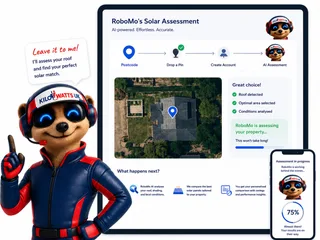

STEP 1
Choose Home, Business or Industrial
Enter your postcode to start your assessment.
STEP 2

Drop a pin on your roof
STEP 3

Create your free account
STEP 4

Sit back and watch RoboMo™ work
RoboMo™ analyses your roof and builds your personalised solar comparison.

Kilowatts UK is an authorised representative
Flower Turbines
Compact vertical-axis turbines built for real UK sites, not just open farmland.
They start in light wind, sit in a small footprint, and are bird-safe by design. Cluster them as a bouquet and the group performs better together than the same turbines standing alone. Enter your postcode for a location-based generation estimate. Figures use area weather data and will differ if buildings, trees or hills sit in the way.
Starts in light UK wind
Built to generate in typical UK wind, not only open farmland.
Small rooftop or ground footprint
Compact towers for roofs, yards and tight sites.
Bird-safe slow rotation
Slow vertical-axis spin, bird-safe by design.
Bouquet clusters raise output
Grouped turbines outperform the same units standing alone.
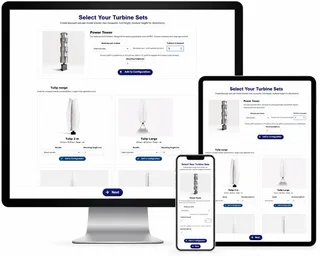
Step 1
Enter your postcode
Start designing your wind energy system in seconds.
STEP 2

Choose a location
STEP 3

Place your cluster
Tap the map where you want the turbine cluster to go.
STEP 4

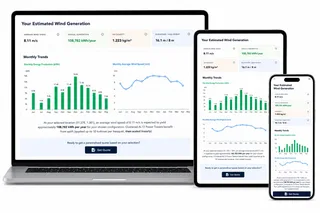
Instant generation forecasts
Compare different turbine layouts and see annual generation forecasts instantly.
STEP 5

No commitment required
Explore different configurations before deciding whether to request a quotation.
Related articles
Mo's Mission Nominations
FAQ
Need Help? RoboMo's Got Answers
Is commercial solar a good fit for manufacturing sites in the UK?
Commercial solar can be a strong fit for UK manufacturers because many factories use electricity during daylight hours, when solar PV is generating. The best results usually come from sites with a stable daytime baseload, a sound roof, suitable electrical infrastructure, and enough long-term occupancy to benefit from the asset. Suitability should be assessed using half-hourly electricity data, roof condition, grid connection options, production schedules, tariff details, and any landlord or insurer requirements.
How much does solar PV cost for a manufacturing business?
UK commercial rooftop solar commonly costs around £700 to £1,200 per kWp, with larger systems often achieving a lower cost per kWp. As broad guide ranges, a 50 kWp system may cost around £40,000 to £65,000, a 100 kWp system around £70,000 to £110,000, a 250 kWp system around £150,000 to £250,000, and a 1 MWp rooftop system around £600,000 to £900,000. Costs can be higher if the project needs roof strengthening, asbestos management, specialist access, switchgear upgrades, export limitation, high-voltage integration, or complex installation phasing around production.
How much electricity can a factory solar system generate?
Commercial rooftop solar in the UK typically generates around 850 to 1,050 kWh per kWp per year, depending on location, orientation, shading, roof pitch, soiling, and system design. A 100 kWp system may generate roughly 85,000 to 105,000 kWh per year, while a 250 kWp system may generate around 212,000 to 262,000 kWh per year. The financial value depends less on the total generation figure and more on how much of that electricity the factory can use on site.
What is self-consumption and why does it matter for manufacturers?
Self-consumption means using solar electricity directly on site instead of exporting it to the grid. It is important because avoided imported electricity is usually worth more than exported electricity. Manufacturers with daytime production, refrigeration, compressors, pumps, motors, conveyors, ventilation, extraction, or warehouse automation often have a good demand match for solar. Sites with low weekend use, long shutdowns, or mainly night-time demand may need a smaller system, export limitation, batteries, or more conservative financial modelling.
How should a solar system be sized for a manufacturing site?
A factory solar system should usually be sized around real electricity demand, not simply the maximum roof area available. A good assessment should use at least 12 months of half-hourly electricity data to identify daytime baseload, weekend demand, seasonal changes, shutdown periods, and future load growth. The design should model expected generation, self-consumed electricity, exported electricity, import savings, export income, degradation, maintenance costs, and sensitivity to changing electricity prices.
Does a factory roof need to be surveyed before installing solar?
Yes. The roof is often one of the main pass-or-fail factors for a manufacturing solar project. A structural survey should check whether the roof can support the additional loads from panels, mounting systems, wind uplift, snow, ballast or fixings, and maintenance access. The survey should also consider rooflights, drainage, fragile areas, roof coverings, purlins, fixings, asbestos risk, safe access, and roof warranty conditions. If the roof is near the end of its life, refurbishment before solar installation may be the better long-term option.
How much roof space is needed for commercial solar panels?
As a rough allowance, commercial solar needs around 5 to 7 square metres of usable roof area per kWp. A 100 kWp system may therefore need around 500 to 700 square metres of practical roof space. Usable space is often much less than total roof area because rooflights, vents, flues, plant, walkways, parapet shading, fragile zones, drainage routes, and fire access requirements can all reduce the available layout.
Do manufacturing solar projects need grid approval?
Most factory solar projects need approval from the local Distribution Network Operator before connection. Very small systems may fall under G98, but most commercial manufacturing systems are handled under G99. The DNO process can affect the permitted system size, export capacity, timescale, protection settings, and cost. If the grid cannot accept the proposed export level, the project may need export limitation, design changes, or reinforcement.
Can export limitation help if the grid connection is restricted?
Export limitation can sometimes allow a larger solar array where the DNO restricts how much electricity can be exported to the grid. The system uses control equipment to prevent export above an agreed limit, often designed in line with G100 principles. It still requires proper DNO agreement, commissioning, and testing. It should not be treated as a way to avoid grid approval.
Will solar panels keep a factory running during a power cut?
Standard grid-tied solar PV does not keep a factory running during a power cut. For safety reasons, it normally shuts down when the grid supply fails. Backup operation requires specialist islanding equipment and usually a properly designed battery, generator integration, or critical-load system. Whole-factory backup can be complex because manufacturing equipment such as motors, compressors, and process machinery may have high starting currents and strict operating requirements.
Is battery storage always needed with manufacturing solar?
No. Many manufacturers already have enough daytime electricity demand to use a high proportion of solar generation directly, which can make a battery less attractive. Batteries may be useful where solar generation exceeds daytime demand, where there are evening or peak-period loads, or where tariffs support time shifting and peak reduction. Battery storage should be assessed separately because it adds cost, space requirements, fire safety considerations, maintenance obligations, and warranty conditions.
Can solar work alongside EV charging or process electrification?
Yes. Solar can work well with controlled daytime EV charging, electric forklifts, warehouse automation, refrigeration expansion, heat pumps, or other electrified loads. Future electricity demand should be included in the solar model, especially if the site is planning new production lines, fleet electrification, or heat electrification. However, solar only helps decarbonise heat where the relevant gas or fuel process is actually converted to electricity.
Do commercial solar panels need planning permission?
Many rooftop solar installations on commercial buildings in England may be possible under permitted development if the conditions are met, but this should always be checked for the specific site. Planning rules differ across England, Scotland, Wales, and Northern Ireland. Listed buildings, conservation areas, Article 4 directions, roof height, visual impact, equipment siting, ground-mounted systems, and solar carports can all change the planning position.
What compliance and insurance issues should manufacturers consider?
Manufacturing solar projects should consider CDM duties, working-at-height controls, risk assessments, method statements, lifting plans, electrical shutdowns, fire strategy, cable routes, isolation, access routes, roof penetrations, and maintenance procedures. Insurers may ask about installer competence, equipment quality, fire separation, cable management, inspection regimes, and emergency isolation. Food, pharmaceutical, aerospace, chemical, and precision manufacturing sites may also need hygiene controls, permit-to-work procedures, dust containment, and foreign-object controls.
Are grants available for commercial solar in the UK?
There is no general UK grant that pays for all commercial solar installations. Support can change over time and may be regional, competitive, sector-specific, or linked to wider decarbonisation work. Manufacturers should check current local authority schemes, devolved government support, and industrial energy programmes. Tax treatment, full expensing, Annual Investment Allowance, VAT recovery, and business rates should be reviewed with an accountant or rating adviser.
Can manufacturers earn money by exporting unused solar electricity?
Yes, but export income should be modelled carefully. Exported electricity is usually worth less than electricity used on site, so the strongest business case normally comes from high self-consumption. Eligible systems up to 5 MW may be able to use Smart Export Guarantee arrangements, but commercial sites may also use negotiated export contracts or power purchase agreements. Proposals should clearly separate import savings from export income.
What finance options are available for factory solar?
Manufacturers can buy a solar system outright, use asset finance, enter a solar power purchase agreement, or consider a roof lease or private wire arrangement. Direct purchase gives the business ownership of the asset and the full electricity benefit, but also the maintenance and lifecycle responsibilities. Asset finance spreads the capital cost over time. A PPA usually means a third party owns the system and sells electricity to the site under a long-term contract. The right option depends on capital availability, lease length, tax position, contract terms, and operational responsibility.
Can a tenant install solar on a leased manufacturing building?
A tenant may be able to install solar, but landlord consent is usually essential. The lease may require a licence for alterations, structural evidence, roof warranty protection, access rights, reinstatement obligations, and agreement on what happens at lease expiry. A short remaining lease can weaken the business case unless renewal, assignment, buyout, or removal terms are clear.
How disruptive is solar installation for a live manufacturing site?
Disruption can often be managed, but it must be planned carefully. Manufacturing sites may need installation work around production hours, hygiene zones, loading movements, electrical shutdown windows, vehicle routes, and critical plant. Cable routes, inverter locations, roof access, lifting operations, and switchgear work should be coordinated with operations and health and safety teams before installation starts.
What should manufacturers ask a commercial solar installer?
Manufacturers should ask for evidence of commercial or industrial solar experience, appropriate accreditations, insurance cover, health and safety processes, DNO application experience, and examples of comparable factory projects. The proposal should clearly show system size, expected generation, self-consumption, export assumptions, roof layout, inverter strategy, grid connection assumptions, financial assumptions, exclusions, maintenance requirements, and commissioning documentation. Be cautious of proposals that do not request half-hourly data, ignore roof condition, promise backup from a standard grid-tied system, or provide payback figures without clear assumptions.
When might commercial solar not be suitable for a manufacturing site?
Solar may be less suitable where the roof is near the end of its life, heavily shaded, structurally limited, or difficult to access safely. It may also be weaker where the business has a short lease, expects to move soon, uses most electricity at night, has long shutdown periods, cannot tolerate installation disruption, or faces grid constraints that prevent a viable system size. In some cases, it is better to delay until roof works, lease renewal, production changes, or electrical upgrades are confirmed.