


Commercial solar for distribution centres in the UK
Published: 2026-07-18 18:38:20
Updated: 2026-07-26 18:20:36
Find out commercial solar for distribution centres in the UK, including costs, what affects price, and how to choose an installer.
Commercial solar for distribution centres in the UK
Commercial solar for distribution centres can be a strong fit in the UK because logistics buildings often combine large roof areas, significant daytime electricity use and exposure to volatile power prices. The business case still depends on practical site factors: roof condition, structural capacity, grid connection limits, lease terms, insurance requirements, electricity tariffs and how much generated electricity can be used on site rather than exported.
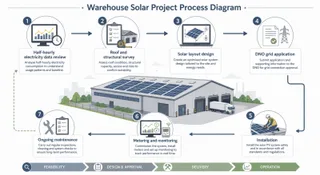
A warehouse, fulfilment centre or logistics hub solar project is not simply a question of how many panels will fit on the roof. A viable design has to work around rooflights, smoke vents, drainage, fire breaks, plant access, cable routes, switchgear capacity, DNO approval and live operational constraints.
For most sites, the best starting point is a feasibility review using half-hourly electricity data, roof drawings, an initial structural review, an electrical survey and a clear view of future loads such as refrigeration, automation, conveyor upgrades, heat pumps or fleet charging.
Why distribution centres are well suited to solar
Distribution centres often have the three things rooftop solar needs most: usable roof space, daytime consumption and a long-term need for electricity. Lighting, conveyors, sortation systems, IT equipment, HVAC, refrigeration, battery charging and office areas can all create demand during solar generation hours.
Refrigerated distribution centres can be particularly suitable because cooling demand often rises during warmer, brighter periods. Automated fulfilment centres and parcel hubs may also have strong daytime baseloads. Ambient warehouses with limited automation and low weekend activity can still work, but the system size needs more care because exported electricity is usually less valuable than electricity used on site.
Solar generation is usually strongest in spring and summer, while warehouse demand may be more stable across the year. Sites operating seven days a week generally absorb more solar electricity than sites with low weekend loads. A site with weekday-only operations may still be suitable, but the financial model should show what happens to weekend generation. In buyer terms, the strongest candidates are usually buildings with:
- high daytime consumption throughout the year;
- a large, uncluttered roof with a good remaining service life;
- a stable lease or long-term ownership position;
- no major roof replacement planned in the near term;
- manageable grid connection requirements;
- an internal team able to coordinate access, safety and shutdown windows.
What size solar system can a distribution centre install?
Typical UK distribution centre systems range from a few hundred kWp to several MWp. Smaller logistics buildings may suit 100 kWp to 500 kWp, medium sites often fall around 500 kWp to 2 MWp, and large fulfilment hubs can support larger arrays if the roof, structure and grid connection allow.
As a rough design guide, commercial roofs often need about 5 to 7 square metres of usable roof area per kWp. A 1 MWp rooftop system may therefore need roughly 5,000 to 7,000 square metres of usable roof space. The available area is usually less than the headline roof size because designers must allow for rooflights, smoke vents, plant, parapet shading, drainage routes, walkways, fire access and maintenance zones.
A simple way to think about sizing is: A desktop estimate is useful at the first stage, but it should not be treated as a final design. The real system size is normally set by a combination of usable roof area, structural capacity, electrical connection capacity, DNO export limits and the site’s demand profile. For example, a site may physically fit 2 MWp of panels but only have enough daytime load and grid capacity to justify 1 MWp. In that situation, the smaller system may produce a stronger return because more electricity is consumed on site and fewer grid or electrical upgrade costs are triggered.
Expected solar generation for UK logistics sites
A well-designed UK commercial solar system commonly generates about 850 to 1,050 kWh per kWp per year, depending on location, orientation, shading and system design. Southern England sites are often nearer the higher end of that range, while Scotland, northern England, shaded roofs or less favourable layouts may be lower.
As broad examples:
These figures are useful for early screening, not a substitute for site-specific modelling. A proper yield estimate should account for local irradiance, roof pitch, orientation, shading, panel layout, inverter sizing, cable losses, soiling, degradation and system availability. South-facing arrays usually maximise annual yield where the roof allows. On flat roofs, east-west layouts can fit more panels into a given area and spread generation more evenly across the day. That can suit distribution centres because it produces more useful morning and afternoon output, although annual yield per panel may be slightly lower than an optimised south-facing layout.
Costs and payback for distribution centre solar
Large UK commercial rooftop solar often costs roughly £600 to £1,000 per kWp installed, excluding site-specific abnormal costs and subject to survey. Very large, simple rooftops can sometimes come in below this range, while smaller or more complex sites may be above it. As broad examples, a 500 kWp system may cost around £300,000 to £500,000, and a 1 MWp system may cost around £600,000 to £900,000.
Simple payback for UK commercial solar is often around 5 to 10 years, but the actual result depends heavily on electricity import price, self-consumption rate, export price, capital cost, finance cost, maintenance and tax treatment. Exported electricity is usually worth less than electricity avoided on site, so annual consumption alone is not enough to size a system properly.
The main cost drivers are usually practical rather than theoretical.
- Roof access and working-at-height requirements.
- Roof type, warranty conditions and fixing method.
- Structural upgrades or roof repairs.
- Cable routes from roof arrays to inverters and switchgear.
- Switchgear capacity, transformer capacity and protection changes.
- DNO application, export limitation and grid reinforcement.
Operation and maintenance also needs to be allowed for. Commercial systems are low maintenance, but not maintenance-free. Annual inspections, monitoring, cleaning where needed, inverter servicing, thermal imaging, insurance compliance checks and occasional remedial works can all affect lifetime performance. A credible proposal should show more than a headline payback. It should include expected annual generation, on-site usage, export assumptions, electricity tariff assumptions, degradation, maintenance allowance, inverter replacement assumptions where relevant, and sensitivity to future power prices. Monitoring, metering, fire safety and insurer requirements. Out-of-hours working or phased installation to avoid operational disruption. Specialist surveys, asbestos management or roof warranty approvals.
Roof and structural checks before installation
The roof is often the biggest constraint on a distribution centre solar project. Trapezoidal metal roofs are common on UK logistics buildings and can often accept rail-mounted systems, subject to structural approval and fixing design. Standing seam roofs may allow non-penetrating clamps. Single-ply membranes and flat roofs often need ballasted, mechanically fixed or hybrid mounting systems agreed with the roof manufacturer.
Typical commercial PV roof loads may be around 10 to 25 kg per square metre. Ballasted flat-roof systems can be higher, sometimes around 20 to 40 kg per square metre or more in localised areas. A structural engineer should review dead load, wind uplift, snow load, roof condition and the existing building structure before the project is committed.
In plain English, this means the engineer is checking both the everyday weight of the system and the forces created by wind and weather. A light roof may still be unsuitable if wind uplift is difficult to control. A strong-looking roof may still need care if fixings, purlins, roof sheets or existing penetrations are in poor condition. Common roof issues that can delay or change a project include widespread corrosion, fragile rooflights, saturated insulation, failing membranes, cut-edge corrosion, congested plant areas and inadequate access routes. If the roof is likely to need major repair or replacement soon, it is normally better to deal with that before installing solar. Removing and reinstalling a large PV system for roof works is expensive and disruptive. Roof warranties also matter. The mounting method should be agreed with the roof manufacturer or warranty provider where applicable. A design that technically works but invalidates the roof warranty can create a major commercial risk for landlords and occupiers.
Electrical design and grid connection
Most distribution centre solar projects need a proper electrical survey before final pricing. Designers need to understand the site’s main switchgear, transformer capacity, spare ways, fault ratings, earthing arrangement, cable routes, protection settings, metering and existing single-line diagram.
Very small three-phase systems may fall under G98, but most distribution centre projects require a G99 application to the Distribution Network Operator. If export needs to be limited, G100-compliant export control may be required. This can allow a site to install a larger behind-the-meter system while restricting how much electricity is sent to the public network.
The key terms are:
[{~b}]DNO
[{/b~}] the Distribution Network Operator responsible for the local electricity network.[{~b}]G98
[{/b~}] the connection route for small-scale generation that meets defined limits.[{~b}]G99
[{/b~}] the connection process for larger generation systems, including most commercial rooftop solar schemes.[{~b}]G100
[{/b~}] export limitation requirements where a site must control the maximum amount of electricity exported to the grid.
DNO approval can affect size, timescale and cost. A large roof does not guarantee a large export connection. In some areas, grid constraints mean the most sensible design is based on high on-site consumption and limited export rather than maximum installed capacity. Electrical integration should be designed by competent commercial electrical specialists. The installation will need to comply with relevant UK electrical standards, including BS 7671, and should be properly tested, certified and documented at handover.
Batteries and EV charging
A battery is not automatically required for commercial solar, but it can be useful where generation exceeds daytime demand, where evening operations are significant, or where EV charging is being added. Batteries can also help with peak shaving or export constraints, depending on tariff structure, control strategy and site load profile.
For distribution centres, battery sizing should be based on half-hourly data rather than rules of thumb. A battery with high energy capacity but a low power rating may not solve short demand peaks. A battery with high power output but limited energy capacity may not shift much surplus solar into the evening.
Fleet electrification changes the calculation. Electric vans, forklifts, yard tractors and future HGV charging can increase site demand, but the timing matters. Daytime managed charging can improve solar use. Overnight charging has limited direct overlap with solar unless storage or scheduling is used. Solar can reduce imports, but it should not be treated as firm capacity in the same way as a grid supply unless the system includes suitable storage, controls and backup design. If charging is mission-critical, the design should consider grid capacity, load management, operational schedules, resilience requirements and whether a phased charging rollout is more realistic than a single large upgrade.
Planning, government support and policy context
Many non-domestic rooftop solar installations in England can use permitted development rights where the relevant conditions are met. Planning permission may still be needed for listed buildings, conservation areas, scheduled monuments, unusual roof designs, ground-mounted arrays or more visually sensitive schemes. Listed building consent may also be required separately from planning permission.
Rules differ across the UK, so planning should be checked for the specific site before committing to a programme.
[{~b}]Wales
[{/b~}] permitted development rights may be available for some non-domestic rooftop solar installations, but conditions and local constraints should be checked with the local planning authority.[{~b}]England
[{/b~}] many commercial rooftop systems may fall under permitted development if conditions are met, but restrictions can apply in sensitive locations and for listed buildings.[{~b}]Scotland
[{/b~}] rooftop solar may be permitted in many cases, but rules differ from England and additional controls can apply in conservation areas, on listed buildings and in other designated settings.[{~b}]Northern Ireland
[{/b~}] planning rules are separate from Great Britain and should be checked against the relevant local planning authority requirements.
Planning is not the only consent issue. Building control, fire strategy, roof warranty consent, landlord consent, lender consent, insurer approval and DNO approval may all be relevant. For leased logistics units, these consents can take as long as the technical design. There is no standard UK-wide upfront grant for ordinary commercial rooftop solar on distribution centres. Support is more commonly found through tax treatment, planning policy, export arrangements and wider decarbonisation policy. VAT on commercial solar installations is normally 20%, although VAT-registered businesses may be able to reclaim input VAT under normal rules. Businesses should take tax advice on the Annual Investment Allowance, full expensing and any applicable treatment for plant and machinery. These rules depend on the legal entity, accounting treatment, timing of expenditure and whether the equipment qualifies. England has business rates exemptions for eligible plant and machinery used in onsite renewable energy generation until 2035. Rules can differ in Scotland, Wales and Northern Ireland, and property-specific advice may be needed because ratings treatment can depend on ownership, occupation and how electricity is used. The Smart Export Guarantee applies to eligible low-carbon generators up to 5 MW, but larger commercial projects often use negotiated export contracts or power purchase agreements rather than relying on standard small-scale tariffs. Political discussion around solar often focuses on grid capacity, planning, land use, domestic manufacturing and energy security. Rooftop solar on distribution centres avoids many land-use concerns because it uses existing built space.
Landlord, tenant and PPA considerations
Many UK distribution centres are leased, which can make ownership and consent as important as the engineering. A tenant may need landlord consent, lender consent, roof warranty approval and a licence for alterations. Lease length has a direct effect on payback and financeability.
For landlords, solar can be installed as a building asset and used to supply power to occupiers through an agreed structure. For tenants, the key issue is whether they will occupy the site long enough to benefit and what happens at lease end. Dilapidations, removal obligations, roof reinstatement and metering arrangements should all be settled before installation.
Power purchase agreements can remove the upfront capital cost for the occupier, but they create long-term contractual commitments. The tariff structure, indexation, change-of-occupier provisions, maintenance responsibilities and end-of-term ownership should be reviewed carefully. Common commercial questions include: Who owns the solar system? Who receives the electricity savings or export income? What happens if the tenant leaves early? Who pays for roof repairs if panels need to be removed? Who is responsible for insurance, maintenance and monitoring? How is electricity measured and billed between landlord and occupier? For multi-let logistics parks, metering and supply structure can be more complex. Private wire arrangements, landlord supply models and tenant PPAs should be reviewed carefully with legal, metering and energy procurement advisers. Can the system remain in place at lease expiry?
Insurance, fire safety and operations
Insurers should be engaged early, not after the system has been designed. Commercial rooftop solar can affect roof fire strategy, access routes, compartmentation, smoke ventilation, cable routing and emergency procedures. Some insurers may refer to guidance such as RISC Authority RC62 when reviewing commercial rooftop PV.
Important design points include suitable distances from roof edges, fire walls, smoke vents and combustible materials where required. DC cabling should be clearly routed and labelled, penetrations should be fire-stopped, and inverter locations should consider heat, ventilation, access, impact risk and fire separation.
For a logistics site, the operational plan is as important as the drawing. Installation may need to be phased around vehicle movements, loading bays, peak trading periods, security rules, refrigeration requirements and restricted roof access. Crane lifts, scaffold, edge protection, compound locations and cable routes should be coordinated with site management before works begin. Facilities teams also need clear handover information. As-built drawings, shutdown procedures, test certificates, DNO acceptance, monitoring access, O&M manuals and warranty documents should be available to the people who will operate and maintain the building. A good handover should make it clear: how to shut the system down safely; who monitors faults and performance; who to call in an emergency; where isolators and inverters are located; what maintenance is required and when; how roof contractors should work near the PV system; what documentation insurers or landlords may request.
How to decide if your site is a strong fit
A good project normally starts with evidence, not assumptions. Twelve months of half-hourly electricity data is usually needed to understand weekdays, weekends, bank holidays, shutdowns and seasonal patterns. Future changes such as automation, refrigeration expansion, heat pumps or EV charging should be modelled before the system is finalised.
Distribution centre solar is usually strongest where the site has large usable roof areas, high daytime demand, a roof with at least 15 to 20 years of remaining service life, confirmed structural capacity, manageable grid connection requirements and clear ownership or lease arrangements.
It may be less suitable where the building is due for redevelopment, the lease is short, the roof is fragile or congested, DNO constraints prevent useful export and on-site demand is low, or insurer requirements cannot be met cost-effectively. A practical early-stage assessment should usually cover: electricity use by half-hour and season; current import tariff, standing charges and export options; roof age, type, warranty and condition; structural capacity and likely mounting approach; DNO connection route and export position; switchgear, transformer and cable route constraints; A competent installer or consultant should be able to explain the trade-offs clearly, including why a smaller system may outperform a larger one financially if it achieves higher self-consumption and avoids expensive grid or roof works. planning and consent requirements for the UK nation and local area; landlord, tenant and insurer requirements; future load growth from refrigeration, automation or charging.
What to ask an installer before committing
The right installer for a distribution centre should understand commercial roofs, DNO processes, insurance requirements and live logistics operations. The cheapest proposal is not always the lowest-risk option if it has missed access, switchgear, roof warranty or export limitation details.
Survey scope: The proposal should explain what has been checked, what is assumed and what still needs confirmation. Demand modelling: The financial case should use half-hourly consumption data, not only annual electricity use. Roof design: The mounting method should suit the roof type, warranty position, drainage, walkways and wind loading. Electrical integration: The installer should review switchgear, transformer capacity, cable losses, protection and metering. Grid connection: The proposal should state whether G99, G100 export limitation or DNO reinforcement may be needed. Fire and insurance: The layout should consider insurer requirements, emergency procedures, labelling and compartmentation.
A robust proposal will also make exclusions clear. Common exclusions include roof repairs, structural strengthening, switchgear upgrades, grid reinforcement, asbestos works, specialist access systems, planning applications, legal agreements and out-of-hours working. Before committing, ask for the assumptions behind the savings forecast. A serious proposal should be transparent about import prices, export prices, self-consumption, panel degradation, maintenance costs, inverter assumptions and whether figures are shown before or after VAT and tax effects. Planning and consent — The installer should flag whether planning, building control, landlord, lender or roof warranty approvals may be needed. Handover and maintenance — The contract should include monitoring, O&M responsibilities, test records and fault response expectations.
Next step for distribution centre solar
For most UK logistics sites, the practical next step is a feasibility assessment using half-hourly electricity data, roof information, an initial structural review and a check of the grid connection position. This will show whether the project should be sized around maximum roof capacity, maximum self-consumption, export limits, future EV charging, or a staged approach.
Commercial solar can be a strong long-term investment for distribution centres, but it works best when the design is led by the building, the load profile and the operational constraints rather than by headline roof area alone.
Plan, Compare & Buy Renewable Energy Solutions
AI does the thinking.
You get the perfect solar match.
Use RoboMo™ to assess your property, compare available technologies and connect with trusted UK installers, suppliers and manufacturers.
Simply enter your postcode, drop a pin on your roof, create your free account and let RoboMo™ analyse your property to find the best solar panels for your home.

You don't have to think
RoboMo™'s AI analyses your roof and does all the hard work.

Accurate & tailored
AI-powered assessment based on your roof, location, and conditions.

Best options, maximum savings
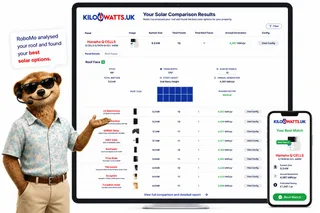
Compare top solar panels for the best performance and value.

Simple, fast & effortless
Provide a few details, sit back and watch your results unfold.
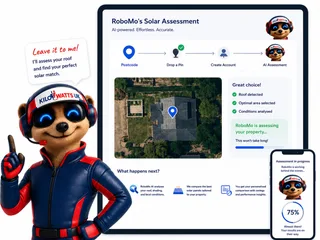
STEP 1
Choose Home, Business or Industrial
Enter your postcode to start your assessment.
STEP 2

Drop a pin on your roof
STEP 3

Create your free account
STEP 4

Sit back and watch RoboMo™ work
RoboMo™ analyses your roof and builds your personalised solar comparison.

Kilowatts UK is an authorised representative
Flower Turbines
Compact vertical-axis turbines built for real UK sites, not just open farmland.
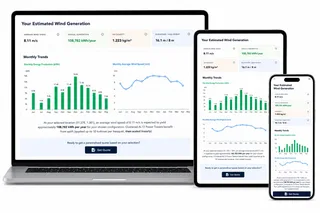
They start in light wind, sit in a small footprint, and are bird-safe by design. Cluster them as a bouquet and the group performs better together than the same turbines standing alone. Enter your postcode for a location-based generation estimate. Figures use area weather data and will differ if buildings, trees or hills sit in the way.
Starts in light UK wind
Built to generate in typical UK wind, not only open farmland.
Small rooftop or ground footprint
Compact towers for roofs, yards and tight sites.
Bird-safe slow rotation
Slow vertical-axis spin, bird-safe by design.
Bouquet clusters raise output
Grouped turbines outperform the same units standing alone.

Step 1
Enter your postcode
Start designing your wind energy system in seconds.
STEP 2

Choose a location
STEP 3

Place your cluster
Tap the map where you want the turbine cluster to go.
STEP 4

Instant generation forecasts
Compare different turbine layouts and see annual generation forecasts instantly.
STEP 5

No commitment required
Explore different configurations before deciding whether to request a quotation.
Related articles
Mo's Mission Nominations
FAQ
Need Help? RoboMo's Got Answers
Are distribution centres suitable for commercial solar panels?
Yes, many UK distribution centres are well suited to rooftop solar because they often have large roof areas and significant daytime electricity use. Lighting, conveyors, sortation equipment, refrigeration, IT systems, HVAC, battery charging and office loads can all use solar power while it is being generated. The best projects are usually on buildings with a sound roof, strong daytime demand, clear lease or ownership arrangements, and manageable grid connection requirements.
How much roof space is needed for solar on a distribution centre?
As a rough guide, commercial rooftop solar usually needs about 5 to 7 square metres of usable roof area per kWp installed. A 1 MWp system may therefore need around 5,000 to 7,000 square metres of usable roof space. The usable area is usually smaller than the total roof area because the design must allow for rooflights, smoke vents, plant, drainage, walkways, access zones, shading and fire safety requirements.
What size solar system can a UK distribution centre install?
Typical systems range from around 100 kWp on smaller logistics buildings to several MWp on large fulfilment centres and warehouse campuses. The final size depends on usable roof area, structural capacity, electricity demand, switchgear capacity, DNO approval, export limits and commercial objectives. A larger system is not always the best option if much of the generation would be exported at a low rate or if it triggers costly grid upgrades.
How much electricity will commercial solar generate for a distribution centre?
A well-designed UK commercial solar system commonly generates around 850 to 1,050 kWh per kWp each year, depending on location, orientation, roof layout, shading and system losses. For example, a 500 kWp system may generate roughly 425,000 to 525,000 kWh annually, while a 1 MWp system may generate around 850,000 to 1,050,000 kWh. A site-specific yield model is needed before making investment decisions.
How much does solar cost for a distribution centre?
Large UK commercial rooftop solar projects often cost roughly £600 to £1,000 per kWp installed, subject to survey and excluding abnormal site-specific costs. A 500 kWp system may cost around £300,000 to £500,000, while a 1 MWp system may cost around £600,000 to £900,000. Costs can rise where roof repairs, structural strengthening, switchgear upgrades, complex access, grid reinforcement or out-of-hours work are required.
What is the typical payback period for distribution centre solar?
Commercial solar payback is often around 5 to 10 years, but this varies significantly by site. The main factors are the installed cost, electricity import price, proportion of solar used on site, export price, maintenance costs, finance costs and tax treatment. Sites with high daytime consumption usually achieve stronger returns because using solar electricity on site is normally worth more than exporting it to the grid.
Does the roof need to be checked before installing solar panels?
Yes, roof condition and structural capacity are critical. A structural engineer should assess the roof’s ability to carry the additional dead load, wind uplift forces and localised loads from the mounting system. The roof should also have a suitable remaining service life, because removing and reinstalling panels for roof repairs can be expensive and disruptive. Roof warranties should be checked before choosing a mounting method.
Will a distribution centre need DNO approval for solar?
Most distribution centre solar projects require approval from the Distribution Network Operator, usually through the G99 connection process. If the site needs to restrict how much power is exported to the grid, G100-compliant export limitation may also be required. DNO requirements can affect system size, timescale and cost, so the grid position should be checked early in the feasibility stage.
Can solar panels power refrigerated warehouses?
Yes, refrigerated distribution centres can be particularly suitable for solar because cooling demand often increases during brighter and warmer periods when solar generation is higher. Solar can help reduce grid imports for refrigeration loads, but it should be sized using half-hourly electricity data. If refrigeration is mission-critical, the design should also consider resilience, backup arrangements, maintenance access and operational risk.
Do distribution centres need battery storage with solar?
Battery storage is not always required, but it can help where solar generation exceeds daytime demand, where the site has evening or overnight loads, where export is limited, or where EV charging is planned. Battery sizing should be based on half-hourly consumption data and the site’s tariff structure. The design needs to consider both power output and energy capacity, as the wrong battery specification may not solve the site’s actual problem.
Can solar support EV fleet charging at a logistics site?
Solar can help reduce the cost and carbon impact of EV charging, especially where vehicles, forklifts, yard equipment or vans can charge during daylight hours. Overnight charging has less direct overlap with solar unless batteries or smart charging schedules are used. For large fleet charging projects, solar should be considered alongside grid capacity, load management, charger phasing, operational schedules and resilience requirements.
Is planning permission needed for commercial solar on distribution centres?
Many non-domestic rooftop solar installations in England may fall under permitted development rights if the relevant conditions are met. Planning permission may still be needed for listed buildings, conservation areas, scheduled monuments, visually sensitive sites, unusual designs or ground-mounted arrays. Rules differ in Scotland, Wales and Northern Ireland, so planning requirements should be checked for the specific site before committing.
What consents are needed for solar on a leased distribution centre?
A leased site may need landlord consent, lender consent, roof warranty approval, insurer approval and a licence for alterations, as well as DNO approval and any planning or building control requirements. The lease should be reviewed to confirm ownership, maintenance responsibility, access rights, electricity savings, export income, end-of-lease treatment, removal obligations and responsibility for roof repairs if panels need to be moved.
Can a distribution centre install solar with no upfront cost?
Some sites may be able to use a power purchase agreement, where a third party funds, owns and operates the solar system and sells the electricity to the occupier or landlord under contract. This can reduce upfront capital cost, but it creates a long-term commitment. The tariff, indexation, maintenance responsibilities, change-of-occupier clauses, end-of-term ownership and lease compatibility should be reviewed carefully.
What insurance and fire safety issues apply to rooftop solar?
Insurers should be involved early because rooftop solar can affect fire strategy, access routes, smoke ventilation, compartmentation, cable routing and emergency procedures. The design should allow suitable access, safe DC cable routes, clear labelling, appropriate inverter locations and compliant penetrations. Facilities teams should receive shutdown procedures, as-built drawings, test certificates, monitoring details and maintenance instructions at handover.
What information is needed for a solar feasibility assessment?
A useful feasibility assessment normally needs at least 12 months of half-hourly electricity data, roof drawings or plans, roof age and condition information, details of the electrical supply and switchgear, current tariff information, lease or ownership details, and any future load plans such as refrigeration upgrades, automation, heat pumps or EV charging. This allows the system to be sized around real demand and practical site constraints rather than roof area alone.
What should a distribution centre ask a solar installer?
Ask how the installer has modelled demand, what roof and structural assumptions have been made, whether DNO approval or export limitation is required, how the system will connect to existing switchgear, and what exclusions apply. The proposal should clearly show generation, self-consumption, export assumptions, savings, maintenance, degradation, warranties, access requirements, fire safety considerations, handover documents and ongoing monitoring arrangements.