


Commercial solar for warehouses in the UK
Published: 2026-07-18 17:25:55
Updated: 2026-07-25 05:37:14
Find out commercial solar for warehouses in the UK, including costs, what affects price, and how to choose an installer.
Key takeaways for warehouse owners and occupiers
| Decision area | Why it matters | What to check early |
|---|---|---|
| Roof condition | Solar panels are a long-term asset, but weak or ageing roofs can make installation uneconomic | Roof age, warranty, waterproofing, asbestos risk, remaining roof life |
| Structural capacity | Many warehouse roofs are lightweight and may have limited spare load capacity | Structural survey, wind uplift, ballast or fixing method |
| Electricity demand | Self-consumed solar usually has the highest value | Half-hourly data, weekday and weekend loads, seasonal demand |
| Grid connection | Export may be limited even where the site has a large import supply | DNO process, G99 requirements, export limits, reinforcement costs |
| Lease position | A tenant may not control the roof or remain long enough to benefit | Landlord consent, roof access, ownership, removal obligations |
| Insurance and fire safety | Warehouses often contain high-value stock and business-critical operations | Insurer requirements, access routes, isolation, O&M records |
| Future site plans | Solar should match how the warehouse will operate over the system life | EV charging, automation, refrigeration, heat pumps, expansion plans |
Why warehouses are often good solar sites
Warehouses can be well suited to solar because they often have large, relatively open roofs and predictable electricity demand. A low-pitch commercial roof can take a high-density layout, especially where an east-west mounting arrangement is appropriate. That can spread generation more evenly through the working day and reduce the sharp midday peak seen on some south-facing arrays.
The fit is strongest where the site consumes power when the system generates. Cold stores, food distribution centres, automated fulfilment buildings, production-linked warehouses, logistics depots, and distribution centres with daytime EV charging can all make good use of solar generation. Ambient storage units with limited equipment, low lighting demand, or mostly night-time activity may still benefit, but the design has to be more conservative.
The main constraint is that a large roof does not automatically mean a large project. Rooflights, smoke vents, plant, access routes, fire breaks, parapet shading, structural limits, and DNO export restrictions can reduce the usable array size substantially. A proper feasibility study is therefore more valuable than a simple satellite image estimate.
Typical system sizes, output, and roof area
UK warehouse solar systems commonly range from around 50 kWp for a smaller trade counter or industrial unit to several MWp for a large distribution centre. Very large logistics sites can exceed 5 MWp if roof area, grid capacity, and demand allow, but the practical size is often set by the weakest part of the project rather than the theoretical roof area. Commercial solar usually needs about 5 to 8 square metres of roof area per kWp. On that basis, a 100 kWp system may need about 500 to 800 square metres, a 500 kWp system may need about 2,500 to 4,000 square metres, and a 1 MWp system may need about 5,000 to 8,000 square metres. These are planning-level figures only because warehouse roofs often lose space to safety zones and obstructions.
| Indicative system size | Approximate roof area needed | Typical annual generation range | Typical warehouse fit |
|---|---|---|---|
| 50 kWp | 250 to 400 m² | 37,500 to 50,000 kWh | Small industrial unit, trade counter, small depot |
| 100 kWp | 500 to 800 m² | 75,000 to 100,000 kWh | Smaller warehouse with good daytime use |
| 250 kWp | 1,250 to 2,000 m² | 187,500 to 250,000 kWh | Medium warehouse, cold store, regional depot |
| 500 kWp | 2,500 to 4,000 m² | 375,000 to 500,000 kWh | Large logistics or distribution building |
| 1 MWp | 5,000 to 8,000 m² | 750,000 to 1,000,000 kWh | Major warehouse or fulfilment centre |
What commercial warehouse solar costs
Typical UK commercial rooftop solar costs are roughly £700 to £1,100 per kWp, depending on scale, roof complexity, access, electrical works, and grid connection requirements. Smaller or more complex systems can sit above that range, while large and straightforward warehouse roofs can be below the upper end. Using that range, a 100 kWp system may cost roughly £70,000 to £110,000 before VAT and site-specific extras. A 500 kWp system may cost roughly £350,000 to £550,000, and a 1 MWp system may cost roughly £700,000 to £1.1 million. These are indicative project ranges, not quotations.
| System size | Indicative cost range before VAT and site-specific extras | Notes |
|---|---|---|
| 100 kWp | £70,000 to £110,000 | Smaller commercial roof; costs can rise if access, roof works or switchgear upgrades are needed |
| 250 kWp | £175,000 to £275,000 | Often suitable for medium warehouses with strong daytime demand |
| 500 kWp | £350,000 to £550,000 | Common scale for larger logistics and distribution sites |
| 1 MWp | £700,000 to £1.1 million | Requires substantial roof area, electrical capacity and grid assessment |
Payback and financial performance
Payback for warehouse solar commonly depends more on self-consumption and electricity price than on export income. Self-consumed solar offsets imported electricity, which is usually more valuable than selling surplus generation to the grid. Export can still help, but it should normally be treated as a supporting income stream rather than the main reason to invest. Payback periods can vary widely. In many projects they are commonly modelled around 4 to 8 years, but outliers are common because electricity tariffs, load profiles, export limits, tax position, finance terms, roof works, and connection costs all change the result. The most useful financial modelling starts with half-hourly meter data. For warehouses with seasonal demand, a full year of data is preferable. That data shows how much solar is likely to be used on site, how much may be exported, whether weekends create surplus generation, and whether batteries or smart charging would improve the outcome.
| Factor | Improves the business case | Weakens the business case |
|---|---|---|
| Self-consumption | High daytime demand that uses solar directly | Low daytime demand and high weekend export |
| Electricity tariff | High import rates, especially during solar generation hours | Low import rates or unusual tariff structures |
| Roof condition | Long remaining roof life and straightforward access | Roof refurbishment, asbestos, warranty disputes |
| Grid position | Low-cost connection with usable export allowance | Export limits, reinforcement costs, long DNO programme |
| Lease certainty | Long lease, landlord agreement or owner occupation | Short lease, break clauses, unclear roof rights |
| Future demand | EV charging, automation, refrigeration or electrification | Planned relocation, redevelopment or downscaling |
Government support, export tariffs, and UK policy
There is no universal UK government grant that pays for standard commercial warehouse solar installations. Support is generally more indirect, through tax treatment, export payment mechanisms, planning rules, business rates policy, and grid reform. Local and regional net zero grants sometimes appear, but they are scheme-specific, eligibility-led, and can close quickly.
The Smart Export Guarantee can apply to eligible generators up to 5 MW, with export rates set by suppliers. Larger projects may use negotiated export arrangements, supplier contracts, or power purchase agreements. For many warehouses, however, the core financial driver remains avoided import cost.
Businesses may be able to use capital allowances for qualifying solar investment, subject to tax rules and professional advice. The Annual Investment Allowance and full expensing may be relevant in some cases, depending on the company and asset eligibility. Business rates treatment also depends on the nation, circumstances, and current rules, so it should be checked rather than assumed. This is where UK solar policy can cause confusion. Domestic solar incentives, public sector decarbonisation schemes, support for solar manufacturing, and commercial rooftop deployment are not the same thing. For a warehouse project, the most practical policy questions are usually whether planning is straightforward, what export terms are available, how tax treatment works, and whether the DNO connection can be secured on acceptable terms.
Roof suitability and structural checks
The roof is often the make-or-break part of a warehouse solar project. Many warehouse roofs were designed to be lightweight, and some have limited spare load capacity. A structural engineer should assess the roof before any final design is agreed.
Ballasted mounting systems avoid some roof penetrations but add more weight. Mechanically fixed systems can be lighter but must be compatible with the roof build-up, structural members, weatherproofing, and roof warranty. Standing seam, trapezoidal metal, single-ply membrane, bituminous, and asbestos-containing roofs all need different design approaches.
A roof with less than 10 to 15 years of remaining life may need refurbishment before solar. Removing and reinstalling panels later for roof replacement can be disruptive and costly. For leased warehouses, roof ownership, repair obligations, access rights, and end-of-lease removal requirements should be checked early. The most commonly overlooked roof issues include rooflights reducing usable space, drainage routes being obstructed, parapets creating shading, and fire access routes cutting into panel density. Wind uplift can also be a critical design factor on large exposed roofs, particularly on coastal or open industrial sites.
Grid connection and electrical design
Most warehouse solar projects need DNO involvement before installation. Larger systems usually follow the G99 connection process, and export capacity is not guaranteed just because the site has a large import supply. The local network may allow full export, limited export, or zero export, depending on conditions.
Export limitation equipment can allow a project to proceed where full export is not permitted, but it must be designed to meet DNO requirements and fail safely. If a DNO offer includes network reinforcement costs, those costs can materially affect the business case and programme.
The site electrical infrastructure also matters. Main switchgear, transformers, protection settings, earthing, metering, cable routes, and power quality all need review. The point of connection should be confirmed before the final layout and inverter arrangement are fixed. Good electrical design is practical as well as compliant. Inverters need ventilation, safe access, protection from water ingress, and protection from vehicle impact. DC cable routes should avoid unnecessary exposure and mechanical damage. Labelling, isolation, firefighter access, and shutdown procedures should be clear enough for the facilities team and emergency responders.
Design process for a warehouse solar project
A warehouse solar project should move from data and feasibility into design, consent, connection, installation, and monitored operation. Skipping the early checks often leads to oversizing, grid delays, roof warranty disputes, or disappointing performance.
A practical process usually includes these stages.
Detailed design
Panel layout, mounting, inverters, cable routes, protection, monitoring, fire access, and metering are specified.Electricity data review
Half-hourly consumption data is used to estimate self-consumption and avoid oversizing.Roof and structure survey
The roof condition, construction, load capacity, access, asbestos risk, and warranty position are checked.Grid connection application
The DNO position is established before the project relies on a particular export level.Installation and commissioning
Works are delivered under appropriate health, safety, electrical, and grid connection requirements.Planning and constraints review
Permitted development, heritage constraints, glint and glare, airports, roads, and neighbouring properties are considered.
In real projects, these stages overlap. For example, the best electrical design may change once the DNO offer arrives, and the best roof layout may change after a structural survey or insurer review. Monitoring and maintenance — Performance is tracked, faults are acted on, and inspections are carried out over the system life.
Planning, compliance, and insurance
Many rooftop commercial solar installations in England may fall under permitted development rights if the relevant conditions are met, but this should not be assumed. Planning rules differ across England, Scotland, Wales, and Northern Ireland. Listed buildings, conservation areas, scheduled monuments, sensitive landscapes, airports, railways, and nearby roads can all introduce additional requirements.
Commercial solar installations must also be designed and installed with relevant electrical, construction, and safety duties in mind. Key references can include the Electricity at Work Regulations 1989, Construction Design and Management Regulations 2015, BS 7671, Engineering Recommendation G98 or G99, the IET Code of Practice for Grid Connected Solar Photovoltaic Systems, Building Regulations, and DNO-specific requirements.
Insurance is particularly important for warehouses because stock type and business continuity risk vary widely. Insurers may ask about inverter locations, DC isolators, fire separation, maintenance records, access routes, and contractor competence. High-value stock, flammable goods, aerosols, packaging, chemicals, timber, and cold storage can increase scrutiny. A fire risk assessment should be updated after installation. It is also sensible to agree maintenance responsibilities, roof access arrangements, and emergency shutdown information before handover rather than treating them as afterthoughts.
Batteries, EV charging, and wider energy planning
Batteries can improve the use of surplus solar generation, support peak shaving, and help warehouses with evening or night-time demand. They are not automatically required. Many warehouses with strong daytime loads can use a large share of solar directly, which is usually simpler and cheaper than storing it first.
Battery economics depend on the load profile, tariff structure, export value, space availability, fire risk assessment, maintenance needs, and any flexibility revenue assumptions. A battery also adds another layer to grid connection design and site safety planning.
EV charging can change the calculation. Depot vans that are parked and charged during the day can increase solar self-consumption, while fleets that are away during daylight may be a weaker match unless charging is scheduled intelligently or supported by storage. HGV charging can be much larger than the solar output at peak times and may require major electrical upgrades. Solar should also be considered alongside LED lighting, heat pumps, refrigeration upgrades, power factor correction, and operational changes. Reducing demand before sizing solar can sometimes lead to a smaller and better-performing system, while future electrification may justify allowing for expansion.
Choosing an installer or project partner
A good warehouse solar installer should be able to deal with commercial roof constraints, DNO applications, electrical integration, monitoring, insurer questions, and ongoing maintenance. The ability to design around a large industrial building is as important as the ability to supply panels.
When comparing proposals, look for clear evidence of site-specific design rather than a generic kWp figure. The proposal should explain roof assumptions, mounting method, inverter locations, cable routes, export assumptions, generation modelling, maintenance requirements, and exclusions.
Useful questions to ask include the following.
Data basis
Has the system been sized using half-hourly consumption data rather than only annual electricity use?Grid basis
Has the DNO process and likely export position been identified?Roof basis
Has a structural survey, roof condition review, and warranty position been allowed for?Commercial basis
Are costs, exclusions, payment terms, warranties, O&M responsibilities, and assumptions clearly separated?Performance basis
Are monitoring, fault alerts, maintenance, degradation, and inverter replacement assumptions clearly stated?Fire and insurance basis
Has the design considered access routes, isolation, labelling, inverter location, and insurer information needs?
The best installer for a warehouse is not always the one offering the largest system. The better choice is usually the one that explains the constraints clearly and designs a system that the roof, grid connection, and business can support. Programme basis — Are DNO timescales, roof access, surveys, installation sequencing, and operational disruption considered?
When warehouse solar may not be suitable
Warehouse solar may not be suitable where the roof is near the end of its life, the structure cannot take the additional load, or the building is due for redevelopment. It may also be a poor fit where the occupier has a short lease with no renewal certainty, or where the landlord and tenant cannot agree ownership, access, and benefit sharing.
A project can also become difficult where DNO reinforcement costs are high, export is heavily restricted, roof access is unsafe, asbestos is present, or shading is extensive. These issues do not always stop a project, but they can change the design, cost, timescale, and expected return.
Operational mismatch is another common issue. If the warehouse has low daytime use, long weekend shutdowns, and limited scope for flexible loads, a large PV system may export too much energy at a lower value. In that case, a smaller system, battery storage, smart EV charging, or no project at all may be the better answer.
What to prepare before requesting quotes
The quality of the quote depends heavily on the quality of the information provided. A short desktop estimate can be useful, but a serious commercial proposal needs enough data to model the project properly and identify hidden constraints.
Before speaking to installers, gather the following.
- Site address and postcode.
- Roof plans and roof construction details.
- Roof age and warranty information.
- Structural information if available.
- Asbestos survey where relevant.
- Half-hourly electricity consumption data.
This information helps avoid unrealistic designs and makes it easier to compare proposals on a like-for-like basis. Electricity tariff and supply details. MPAN and agreed supply capacity. Main switchgear and transformer details where available. Lease or ownership information. Planned roof works or redevelopment. Planned EV charging or electrification. Insurance requirements. Known planning constraints.
Next steps for a warehouse solar project
The right starting point is a feasibility review based on roof suitability, half-hourly electricity use, grid connection prospects, and commercial objectives. For most warehouses, that will quickly show whether the opportunity is strong, marginal, or likely to be blocked by roof, lease, or grid constraints.
If the early checks look positive, move to a more detailed design and financial model before committing to installation. Make sure the proposal explains self-consumption, export, roof works, DNO assumptions, maintenance, warranties, and responsibilities after handover.
Commercial solar for warehouses can work very well in the UK, but the best projects are not based on roof size alone. They are based on a practical match between the building, the electrical load, the grid connection, and the long-term plans for the site.
Plan, Compare & Buy Renewable Energy Solutions
AI does the thinking.
You get the perfect solar match.
Use RoboMo™ to assess your property, compare available technologies and connect with trusted UK installers, suppliers and manufacturers.
Simply enter your postcode, drop a pin on your roof, create your free account and let RoboMo™ analyse your property to find the best solar panels for your home.

You don't have to think
RoboMo™'s AI analyses your roof and does all the hard work.

Accurate & tailored
AI-powered assessment based on your roof, location, and conditions.

Best options, maximum savings
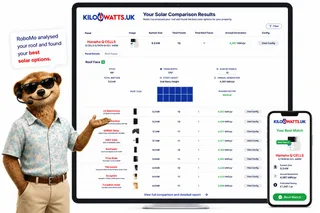
Compare top solar panels for the best performance and value.

Simple, fast & effortless
Provide a few details, sit back and watch your results unfold.
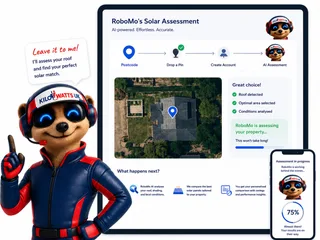
STEP 1
Choose Home, Business or Industrial
Enter your postcode to start your assessment.
STEP 2

Drop a pin on your roof
STEP 3

Create your free account
STEP 4

Sit back and watch RoboMo™ work
RoboMo™ analyses your roof and builds your personalised solar comparison.

Kilowatts UK is an authorised representative
Flower Turbines
Compact vertical-axis turbines built for real UK sites, not just open farmland.
They start in light wind, sit in a small footprint, and are bird-safe by design. Cluster them as a bouquet and the group performs better together than the same turbines standing alone. Enter your postcode for a location-based generation estimate. Figures use area weather data and will differ if buildings, trees or hills sit in the way.
Starts in light UK wind
Built to generate in typical UK wind, not only open farmland.
Small rooftop or ground footprint
Compact towers for roofs, yards and tight sites.
Bird-safe slow rotation
Slow vertical-axis spin, bird-safe by design.
Bouquet clusters raise output
Grouped turbines outperform the same units standing alone.
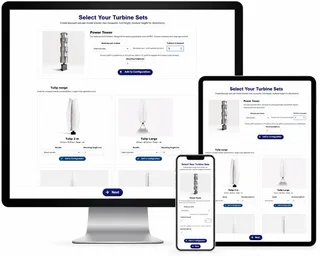
Step 1
Enter your postcode
Start designing your wind energy system in seconds.
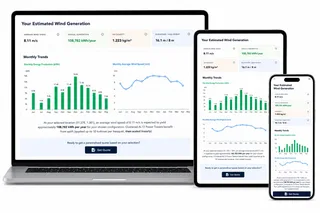
STEP 2

Choose a location
STEP 3

Place your cluster
Tap the map where you want the turbine cluster to go.
STEP 4

Instant generation forecasts
Compare different turbine layouts and see annual generation forecasts instantly.
STEP 5

No commitment required
Explore different configurations before deciding whether to request a quotation.
Related articles
Mo's Mission Nominations
FAQ
Need Help? RoboMo's Got Answers
Are warehouses good sites for commercial solar panels?
Warehouses can be very good sites for commercial solar because they often have large roofs and predictable electricity demand. The best results usually come from sites that use a lot of electricity during daylight hours, such as cold stores, fulfilment centres, logistics depots, warehouses with automation, offices, refrigeration, conveyors, or daytime EV charging. A large roof alone is not enough; the project also needs a suitable roof structure, usable grid connection, strong self-consumption, and clear ownership or lease arrangements.
How much roof space is needed for warehouse solar panels?
As a planning estimate, commercial solar usually needs about 5 to 8 square metres of roof area per kWp. A 100 kWp system may need roughly 500 to 800 square metres, a 500 kWp system may need around 2,500 to 4,000 square metres, and a 1 MWp system may need about 5,000 to 8,000 square metres. The actual usable area can be lower once rooflights, smoke vents, plant, access routes, fire breaks, shading, parapets, and structural limits are taken into account.
How much electricity can a warehouse solar system generate in the UK?
A well-designed UK commercial solar system typically generates about 750 to 1,000 kWh per kWp per year. A 100 kWp system may produce around 75,000 to 100,000 kWh annually, while a 500 kWp system may produce around 375,000 to 500,000 kWh. Output varies by location, roof orientation, pitch, shading, panel layout, system losses, and seasonal weather, with generation usually highest from spring to early autumn and lower in winter.
How much does commercial solar for a warehouse cost?
Typical UK commercial rooftop solar costs are often around £700 to £1,100 per kWp before VAT and site-specific extras. A 100 kWp system may cost roughly £70,000 to £110,000, a 500 kWp system may cost around £350,000 to £550,000, and a 1 MWp system may cost about £700,000 to £1.1 million. Costs can increase if the project needs roof repairs, structural upgrades, asbestos management, complex access, switchgear changes, transformer upgrades, metering work, or DNO reinforcement.
What is the typical payback period for warehouse solar panels?
Many warehouse solar projects are modelled with payback periods of around 4 to 8 years, but the actual result can be shorter or longer. Payback depends mainly on how much solar electricity is used on site, the import electricity price being avoided, export income, installation cost, roof works, grid connection costs, maintenance, tax treatment, and finance terms. The most reliable payback estimate should be based on half-hourly electricity data rather than annual consumption alone.
Why is self-consumption important for warehouse solar?
Self-consumption means using the solar electricity directly on site instead of exporting it to the grid. This is usually the main financial driver because each unit used on site offsets imported electricity, which is normally worth more than the export rate. Warehouses with strong daytime demand usually achieve better returns than sites that export a large share of generation at weekends or during low-demand periods.
Do warehouses need battery storage with solar panels?
Battery storage is not always needed for warehouse solar. If the warehouse already has high daytime demand, much of the solar generation may be used directly, which is simpler and often more cost-effective than storing it. Batteries can be useful where there is surplus daytime generation, evening or night-time demand, peak charges, constrained export, or a need to support EV charging. The case for a battery should be modelled using the site’s load profile, tariff, export value, fire safety requirements, space availability, and maintenance costs.
Can solar panels support EV charging at a warehouse?
Solar panels can support warehouse EV charging, especially where vans, cars, forklifts, or depot vehicles charge during daylight hours. This can increase self-consumption and improve the solar business case. If vehicles are away during the day and charge mainly overnight, the match is weaker unless charging can be scheduled intelligently or supported by battery storage. Large fleet or HGV charging loads may be much bigger than the solar output at peak times and may also require electrical capacity upgrades.
Does a warehouse solar project need DNO approval?
Most commercial warehouse solar projects need involvement from the local Distribution Network Operator, especially larger systems under the G99 process. A large import supply does not automatically mean the site can export a large amount of solar electricity. The DNO may allow full export, limited export, zero export, or require reinforcement. DNO conditions can affect system size, cost, programme, export assumptions, and the overall business case, so they should be checked early.
Can a warehouse install solar with zero export to the grid?
Yes, some warehouse solar systems can be designed with export limitation or zero export controls if the DNO does not allow export or only allows a small export capacity. This can make a project possible where grid capacity is constrained, but the system must be designed to comply with DNO requirements and fail safely. A zero export arrangement usually works best when the warehouse has enough daytime load to use most of the solar generation on site.
What roof checks are needed before installing solar on a warehouse?
The roof should be checked for condition, remaining life, structural capacity, access, waterproofing, wind uplift, rooflights, drainage, shading, asbestos risk, and warranty implications. Many warehouse roofs are lightweight and may have limited spare load capacity, so a structural assessment is important before final design. If the roof has less than about 10 to 15 years of life remaining, refurbishment before installation may be more sensible than removing and reinstalling panels later.
Can solar panels be installed on a leased warehouse?
Solar can be installed on a leased warehouse, but the lease position must be checked early. Key issues include landlord consent, roof ownership, access rights, repair obligations, insurance, responsibility for maintenance, who benefits from the electricity savings, and whether panels must be removed at lease end. A short lease, break clause, or unclear roof rights can weaken the business case unless the landlord and tenant agree a workable arrangement.
Do warehouse solar panels need planning permission?
Many rooftop commercial solar installations may fall under permitted development rights in England if the relevant conditions are met, but planning should not be assumed. Rules differ across England, Scotland, Wales, and Northern Ireland. Listed buildings, conservation areas, airports, railways, roads, heritage settings, sensitive landscapes, and ground-mounted or canopy installations may need additional checks or consent.
Are there grants for commercial warehouse solar in the UK?
There is no universal UK grant that pays for standard commercial warehouse solar installations. Some local, regional, or sector-specific net zero grants may be available from time to time, but they are eligibility-based and can close quickly. Financial support may also come indirectly through tax treatment, export payments, capital allowances, business rates rules, or finance arrangements. Businesses should check current rules and take professional tax advice before relying on any incentive.
Can a warehouse sell surplus solar electricity to the grid?
Yes, eligible commercial solar systems can usually export surplus electricity if the DNO connection allows it and an export arrangement is in place. Smaller eligible generators may use the Smart Export Guarantee up to 5 MW, with rates set by suppliers. Larger or more complex projects may use negotiated export contracts or power purchase agreements. For most warehouses, export income is useful, but the main value usually comes from reducing imported electricity.
What information is needed to get an accurate warehouse solar quote?
Installers will usually need the site address, roof plans, roof construction details, roof age, warranty information, structural information, asbestos survey if relevant, half-hourly electricity data, tariff details, MPAN, agreed supply capacity, switchgear or transformer information, lease or ownership details, planned roof works, future EV charging plans, insurance requirements, and known planning constraints. Better input data leads to more realistic designs and makes it easier to compare quotes.
How should a warehouse solar system be sized?
A warehouse solar system should be sized using the roof constraints, structural capacity, half-hourly electricity consumption, tariff, export limits, and future site plans. The aim is not always to cover the whole roof. In many cases, a smaller system with high self-consumption gives a better return than a larger system that exports too much at a lower value. Future EV charging, refrigeration, electrification, or automation may justify designing for expansion.
What should be compared when choosing a commercial solar installer?
Compare more than the headline price and system size. A strong proposal should explain the roof assumptions, structural requirements, mounting method, inverter locations, cable routes, DNO process, export assumptions, generation estimate, self-consumption estimate, monitoring, maintenance, warranties, exclusions, and programme. For warehouses, experience with commercial roofs, electrical integration, insurer requirements, fire safety, and operations and maintenance is especially important.
When might warehouse solar not be suitable?
Warehouse solar may not be suitable if the roof is near the end of its life, the structure cannot take the load, asbestos or access issues make installation impractical, DNO reinforcement costs are too high, or the site is due for redevelopment. It may also be a poor fit where the occupier has a short lease, low daytime demand, heavy shading, or limited ability to use or export the electricity generated. In these cases, a smaller system, battery storage, smart EV charging, roof refurbishment first, or no installation may be the better option.