


Commercial solar for offices in the UK
Published: 2026-07-18 18:31:43
Updated: 2026-07-25 11:22:20
Find out commercial solar for offices in the UK, including costs, what affects price, and how to choose an installer.
Commercial solar for offices in the UK
Commercial solar for offices means installing photovoltaic panels on an office roof, car park, façade, or nearby land to generate electricity for business use. It can be a strong fit for UK office buildings because much of the electricity demand occurs during daylight hours, but it is not suitable for every site.
The viability of office solar depends on several practical factors:
- Roof condition and remaining roof life.
- Daytime electricity demand.
- Grid connection and DNO requirements.
- Lease terms and landlord consent.
- Metering arrangements.
- Structural capacity and safe access.
For most office projects, the main financial benefit is not export income. It is the reduction in imported grid electricity during working hours. Offices with lighting, IT equipment, lifts, ventilation, cooling, server rooms, catering loads and shared facilities can often use a meaningful share of solar generation on site. The best projects are designed around the building’s actual half-hourly electricity use, not simply the maximum number of panels that can fit on the roof. A design that looks impressive on a plan can perform poorly financially if too much generation is exported at a low rate, if the roof needs early replacement, or if grid connection limits restrict output. Fire, insurance and maintenance requirements. Budget, tax position and expected occupation period.
At a glance: what office decision-makers need to know
Commercial solar for offices is usually most attractive when the building has a good daytime load, a sound roof and a long-term occupation plan. The strongest business cases normally come from using the electricity on site rather than exporting it.
Key points for UK offices:
Typical commercial PV output is often around 850 to 1,100 kWh per kWp per year, depending on location, orientation, shading and design. Installed costs vary widely, but smaller commercial systems are often around £900 to £1,300 per kWp, while larger systems are often around £600 to £1,000 per kWp before VAT and site-specific extras. Payback periods are commonly around 4 to 8 years, but this depends heavily on self-consumption, electricity price, export value and project cost. Most commercial office systems need DNO approval before connection. A structural survey and roof condition review should be completed before committing to installation. Multi-let offices can work, but metering, leases and benefit allocation need to be resolved early. Batteries are optional, not automatic; they should be modelled against actual load data. A credible installer should request half-hourly data, MPAN details, roof information, tariff details and site constraints before finalising a design.
When office solar is a good fit
Office solar is usually most attractive where the building has steady daytime electricity demand, a suitable roof, a long-term occupation plan and a practical route to connect into the electrical infrastructure.
Owner-occupied offices and single-tenant buildings are often simpler than multi-let offices because the organisation paying for the system is more likely to receive the electricity saving directly.
Good candidates often have these features:
- High weekday electricity use.
- A roof with enough remaining service life.
- Limited shading from plant rooms, parapets and neighbouring buildings.
- Safe access for installation and maintenance.
- A three-phase electrical supply.
- Clear ownership or landlord consent.
Office buildings with air conditioning can be particularly well matched because cooling demand is often higher in sunnier months when solar output is stronger. Server rooms, ventilation plant, lifts and other consistent daytime loads can also improve self-consumption. Solar may be less suitable where: A large roof does not automatically make a strong solar project. The building’s electricity profile, structure, access, grid connection and commercial arrangements matter just as much as the available roof area. A long enough occupation period to benefit from the savings. A tariff where avoided import is materially more valuable than export. Good monitoring and facilities management arrangements. The office is due for redevelopment. The roof needs replacement soon. The lease is short or landlord consent is uncertain. Shading is severe. Electricity use is low during daylight hours. The switchboard has limited spare capacity. The roof structure, access route or fire strategy is unsuitable. DNO restrictions would significantly limit usable generation.
Typical system sizes and roof space
UK office solar systems vary widely. A small office might use a system around 10 kWp, while a larger office or business park building may support 250 kWp or more.
As a broad planning guide, 1 kWp of solar capacity usually needs about 4 to 6 square metres of usable roof area.
Indicative examples: 30 kWp may need roughly 120 to 180 square metres. 50 kWp may need roughly 200 to 300 square metres. 100 kWp may need roughly 400 to 600 square metres. 250 kWp may need roughly 1,000 to 1,500 square metres. Plant rooms. Rooflights. These figures are only early-stage guides. Usable area is often reduced by: Flat office roofs are often designed with east-west mounting rather than a simple south-facing arrangement. East-west layouts can increase panel density and spread generation across more of the working day, which can suit office demand better than chasing the highest possible annual yield. South-facing arrays can produce strong annual output, but they may generate a sharper midday peak. East-west arrays may produce slightly less peak output per panel, but the generation curve can align better with office occupancy and electrical demand. Vents and smoke vents. Lift overruns. Parapet shading. Mansafe systems. Maintenance walkways. Fragile roof zones. Drainage routes. Wind uplift zones around roof edges. Fire access and separation requirements.
How commercial office solar works
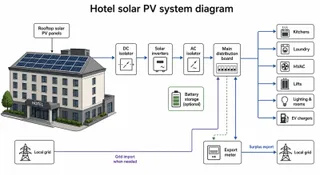
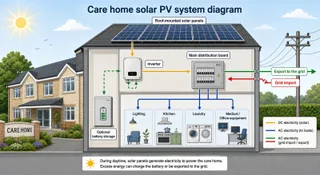
An office solar PV system converts daylight into DC electricity at the panels. Inverters then convert that electricity into AC power for use in the building. The system is normally connected through the building’s electrical infrastructure, with metering and monitoring used to record generation, import, export and system performance.
In simple terms:
- Solar panels generate electricity during daylight.
- Inverters convert the electricity into a form the building can use.
- The office uses solar power first where demand exists at the same time.
- If generation is lower than demand, the office imports the balance from the grid.
- If generation exceeds demand and export is permitted, surplus power can be exported.
- Monitoring helps identify faults, low performance and export levels.
The design needs to consider more than panels and inverters. A robust commercial solar panel installation should include: These technical details are often where weak commercial solar projects fail. A system can use good panels and still perform poorly if the design, installation, monitoring or maintenance planning is inadequate. Cable routes. Switchboard capacity. Isolation points. Fire access. Labelling. Monitoring. Shutdown procedures. Export limitation where needed. Safe roof access for maintenance. Handover documentation. Ongoing inspection arrangements.
Costs for commercial solar on offices
Typical installed costs for smaller UK commercial solar systems are often around £900 to £1,300 per kWp. Larger commercial systems are often around £600 to £1,000 per kWp.
These are broad ranges before VAT and site-specific extras. Real quotes can move outside them where access, structural works, switchgear, roof condition, metering, fire requirements or grid requirements are more complex.
Indicative office solar cost examples: A 30 kWp office system may cost around £27,000 to £39,000 before VAT and site-specific extras. A 50 kWp office system may cost around £45,000 to £65,000 before VAT and site-specific extras. A 100 kWp office system may cost around £70,000 to £110,000 before VAT and site-specific extras. A 250 kWp office system may cost around £150,000 to £250,000 before VAT and site-specific extras. Roof condition: Weak, ageing, fragile or asbestos-containing roofs can require extra assessment or remedial work before installation. Access and safety: Scaffolding, edge protection, lifting equipment, walkways and CDM requirements can materially affect cost. The largest cost differences usually come from practical site issues rather than the panels themselves. A straightforward metal roof with good access and spare switchboard capacity is very different from a high-rise office with restricted crane access, fragile roof areas, complex metering and insurer requirements. Main cost variables include: A credible proposal should separate core system cost from provisional items and assumptions. If a quote looks unusually low, check whether it includes: Commercial buyers should also confirm VAT treatment, tax assumptions and accounting treatment with their accountant rather than relying on a sales proposal. Electrical works — Main switchboard upgrades, metering changes, export controls and cable routes can change the budget. Grid connection — DNO studies, export limits or reinforcement requirements can affect both cost and programme. Fire and insurance requirements — Insurer expectations may influence product choice, layout, isolation, maintenance and documentation. Monitoring — Good monitoring may add cost but is important for long-term performance. Roof warranty requirements — Some roof systems need approved fixing methods to avoid invalidating warranties. Programme constraints — Occupied offices, city-centre access, restricted working hours and tenant disruption can increase complexity. Structural survey. DNO application. Design drawings. Generation modelling. Monitoring platform. Access equipment. Fire and safety documentation. Metering and export controls. Commissioning. Handover pack. Operations and maintenance information.
Expected output and financial return
UK commercial solar output is typically around 850 to 1,100 kWh per kWp per year, depending on location, orientation, shading, equipment and system design. Southern England usually has higher yield than Scotland or northern England, but solar still works across the UK because panels generate from light, not heat.
Indicative annual generation examples:
- A 30 kWp office system may generate about 25,500 to 33,000 kWh per year.
- A 50 kWp office system may generate about 42,500 to 55,000 kWh per year.
- A 100 kWp office system may generate about 85,000 to 110,000 kWh per year.
- A 250 kWp office system may generate about 212,500 to 275,000 kWh per year.
- Installed cost.
- Self-consumption percentage.
Output is strongest from March to September and much lower in December and January. This seasonal pattern should be compared with the office’s electricity use, especially if heating, cooling, hybrid working or occupancy patterns vary during the year. Payback periods for UK office solar are commonly around 4 to 8 years, but this depends heavily on: Exported electricity is normally worth less than electricity avoided on site. A system that uses most generation in the building will usually have stronger economics than one that exports a large share. Solar can reduce imported kWh charges, but it does not usually remove: It may reduce some costs linked to imported electricity volume, but the effect varies by tariff and metering arrangement. For this reason, a financial model should use the office’s actual tariff and half-hourly consumption rather than generic assumptions. Electricity import price. Export rate. DNO export limits. System performance. Maintenance costs. Inverter replacement assumptions. Tax position. Financing costs, if applicable. Standing charges. Night-time import. Winter import. Agreed supply capacity charges. All network charges. All demand-related costs.
Government support, tax, and export payments
Most offices should not assume there is a universal upfront UK government grant for commercial solar. The Feed-in Tariff closed to new applicants in 2019.
The Smart Export Guarantee can pay eligible small-scale generators for exported electricity, but export rates vary by supplier and export income is usually less valuable than using the electricity on site.
SEG points to check: Systems up to 5 MW can be eligible where metering and certification requirements are met. Systems up to 50 kW usually need MCS certification or an equivalent standard for SEG eligibility. Larger systems may need ROO-FIT accreditation. Export payments depend on the supplier’s tariff and eligibility rules. Export must be measured with suitable metering. Businesses may also be able to use the Annual Investment Allowance for qualifying solar expenditure, subject to current rules and the organisation’s tax position. Corporation tax treatment should be checked with an accountant rather than assumed during the sales process. Business rates can also matter. In England and Wales, eligible plant and machinery used for onsite renewable energy has a business rates exemption until 2035. The details should be checked for the specific site, ownership structure and jurisdiction. Local grant schemes sometimes exist through councils, regional net zero programmes or local business support funds, but availability changes by area and funding round. A good feasibility process can identify whether any current local support is relevant, but the financial case should not depend on an unconfirmed grant.
Planning, DNO approval, and compliance
Many non-domestic rooftop solar installations in England may be covered by permitted development rights, but this should always be checked for the specific property. Listed buildings, conservation areas, scheduled monuments, unusual installations and sites outside England may need different treatment because planning rules vary across the UK.
Planning and consent checks may include:
Whether the building is listed. Whether the site is in a conservation area. Whether the installation is visible from sensitive viewpoints. Roof height and projection limits. Ground-mounted or carport proposals. Local planning authority requirements. Most office solar systems require DNO approval before connection. Very small systems may fall under G98 rules, but many commercial office systems need a G99 application. DNO review can affect timescales and may lead to export limits or reinforcement requirements. Where the grid cannot accept full export, an export-limited system using G100-compliant controls may be an option. This can allow a larger system to be installed while preventing export above an agreed limit, but it adds design and control requirements. Commercial projects must also be designed and installed in line with relevant electrical and building safety requirements. Dutyholders should consider: DNO approval, planning status and landlord consent should be confirmed before procurement commitments are treated as final. Landlord approvals and lease restrictions. Any existing building warranties or planning conditions. Electrical design and certification. CDM Regulations. Safe construction access. Roof edge protection. Manual handling and lifting. Future maintenance access. Isolation and shutdown procedures. Fire strategy and emergency information. Labelling and as-built documentation. Coordination with facilities managers and insurers.
Roof, structure, and fire safety checks
A structural survey is essential before committing to an office solar installation. The survey should consider roof load capacity, wind uplift, fixing method, roof condition and whether the roof has enough remaining life to justify the investment.
Installing solar shortly before reroofing is usually poor value because the system may need to be removed and reinstalled. If the roof has less than 10 years of remaining life, the cost and disruption of future removal and reinstatement should be included in the decision.
Roof checks should consider: Remaining roof life. Structural load capacity. Wind loading. Waterproofing condition. Roof warranty restrictions. Fragile roof areas. Flat roof systems may be ballasted, mechanically fixed, or a hybrid of both. Ballasted systems reduce roof penetrations but add weight. Mechanically fixed systems can reduce ballast but need careful waterproofing and may affect roof warranties. Roof manufacturer requirements should be checked before the mounting system is selected. Fire safety is a major commercial consideration. Insurers may ask for evidence of: The building’s fire risk assessment and insurance policy should be updated after installation where required. Avoidable fire and reliability risks include: A professional design should specify how cables are routed, protected, labelled, isolated and inspected. Asbestos risk. Drainage and standing water. Safe access routes. Plant-room shading. Maintenance walkways. Fire access requirements. Design standards. Product selection. DC isolator quality and location. Cable management. Connector compatibility. Roof fire classification. Maintenance arrangements. System labelling. Shutdown procedures. Compliance with relevant solar PV fire guidance. Poor DC connector installation. Mixed incompatible connectors. Unsupported cables. UV-damaged cables. Cable abrasion against sharp edges. Standing water around electrical components. Poor labelling. Lack of inspection access. Inadequate monitoring.
Metering and multi-tenant office issues
Metering is often simple in an owner-occupied office with one supply. It can be much more complicated in a multi-let building where landlord areas, tenant supplies, service charges and lease obligations all interact.
Solar can supply landlord loads such as:
Lifts. Common-area lighting. Ventilation plant. HVAC plant. Access systems. Security systems. Supplying tenant loads may require lease amendments, private wire arrangements, billing systems or a clear method for allocating benefits. Multi-let offices often face a split incentive problem. The landlord may pay for the system while tenants receive some of the electricity saving. This does not make solar impossible, but the commercial structure needs to be resolved before technical design is treated as final. Key questions for multi-let offices include: A tenant that wants solar on a leased office roof will normally need landlord consent. Lease terms may restrict roof access, alterations, plant installation, cable routes and rights to export or sell electricity. Where the office has multiple meters, the design should be based on the meter or meters the solar can realistically supply. A roof-level design that ignores metering can overstate savings. Shared kitchens and welfare areas. Reception areas. Car park lighting. Central plant rooms. Who owns the roof? Who owns the electrical infrastructure? Which meter will the solar connect behind? Which loads will the solar supply? How will savings be allocated? Can tenants be charged for solar electricity? Are lease amendments needed? Who receives export income? Who pays for maintenance? What happens if a tenant leaves? What happens at lease expiry?
Batteries, EV charging, and solar carports
Batteries are not essential for many office solar projects. Because offices often use electricity during daylight hours, a well-sized PV system can use a large share of generation directly without storage.
A battery becomes more relevant where:
Solar export is high. Evening demand is significant. Grid export is constrained. Import tariffs vary by time of day. The building has EV charging. Peak demand management is important. Batteries add cost, space requirements, fire considerations, controls complexity and maintenance responsibilities. They should be assessed against actual half-hourly data rather than added because they sound modern. For offices considering storage alongside PV, commercial solar battery storage should be modelled against the site’s import, export and peak-demand profile. EV charging can improve solar self-consumption where vehicles are parked during the day. However, uncontrolled chargers can create new peaks, so charging strategy, load management and available electrical capacity need to be considered together. Offices planning fleet, visitor or staff charging should assess commercial EV charger installation as part of the same electrical capacity review. Solar carports can suit offices with limited roof area and large car parks. They are usually more expensive per kWp than rooftop solar and may involve: Carports can be valuable where parking spaces are used during the day and the business wants visible sustainability infrastructure, but they need a site-specific cost and planning review. The site wants resilience features, subject to suitable design. There is a strong commercial case based on measured data. Planning considerations. Civil works. Foundations. Drainage. Lighting. Impact protection. Bay layout changes. EV charging integration. More complex construction logistics.
Choosing a commercial solar installer for an office
A good office solar installer should behave like a technical project partner, not just a panel supplier. They should ask detailed questions before recommending a system size.
A credible installer should request:
Half-hourly electricity data. MPAN details. Electricity tariff information. Import and export meter details. Roof drawings. Structural information. The proposal should explain why the system size has been chosen. It should compare expected generation against the office load profile, estimate self-consumption and export, identify DNO assumptions and set out the connection method. Look for clear evidence in four areas: Panel performance warranties and product warranties are not the same thing. Commercial solar panels usually last 25 to 30 years, with many performance warranties guaranteeing around 80% to 87% of original output after 25 years. Inverters often have shorter lives than panels, commonly around 10 to 15 years, so a whole-life financial model should allow for replacement. Before appointing an installer, office buyers should check: A low-cost quote is not always poor, but it should be interrogated carefully. Missing access costs, structural allowances, export controls, monitoring or commissioning details can make a proposal look cheaper than it really is. Asbestos records where relevant. Existing roof warranty information. Plant-room and roof access information. Switchboard details. Lease documents where relevant. Landlord requirements. Insurance requirements. Future refurbishment plans. Planned EV charging, heat pumps or occupancy changes. Design evidence — The installer should provide single-line diagrams, datasheets, string layouts, generation estimates, structural information and clear assumptions. Compliance evidence — The installer should address DNO approval, electrical standards, CDM duties, building regulations, insurance requirements and commissioning. Handover evidence — The handover pack should include as-built drawings, O&M manuals, shutdown procedures, labelling details, warranties and monitoring access. Maintenance evidence — The offer should explain inspection intervals, cleaning assumptions, monitoring responsibilities, fault response and inverter replacement planning. Relevant commercial PV experience. Insurance levels. Health and safety processes. DNO application experience. Product specifications. Warranty terms. Monitoring arrangements. Maintenance capability. References or examples from similar commercial buildings. Clarity of exclusions and assumptions.
Common mistakes to avoid
The most common mistake is sizing the system around roof space rather than electricity use. A roof can be technically full of panels while the financial case is weakened by high export, DNO limits or poor alignment with office demand.
Other common mistakes include:
Ignoring the roof lifecycle. Assuming export income will drive the business case. Failing to check DNO requirements early. Treating batteries as automatically worthwhile. Overlooking switchboard capacity. Not resolving landlord or tenant consent. If the roof has less than 10 years of remaining life, the cost and disruption of future removal and reinstatement should be included in the decision. Facilities teams should also avoid treating monitoring as optional. Many commercial systems underperform because inverter faults, low string output or communications failures go unnoticed. Someone should be responsible for checking alerts and arranging maintenance. Solar can support operational carbon reduction, ESG reporting, SECR, ESOS and net zero plans where data is measured properly. However, it does not automatically improve every property metric. An Energy Performance Certificate also depends on fabric efficiency, HVAC, lighting and controls. Solar should therefore be considered alongside wider efficiency measures, such as controls optimisation, HVAC upgrades and LED upgrades, rather than treated as the only route to lower energy costs. Using annual consumption instead of half-hourly data. Forgetting inverter replacement in the financial model. Not updating fire and insurance documentation. Treating monitoring as optional. Failing to allocate maintenance responsibility. Assuming solar will eliminate all electricity costs.
Practical next steps
The first step is to gather the information needed for a proper feasibility review. Annual consumption is useful, but half-hourly electricity data is much better because it shows when the office actually uses power.
Before requesting final quotes, gather:
12 months of half-hourly electricity data. Recent electricity bills. MPAN and meter information. Roof drawings or plans. Structural information. Roof warranty details. You should also check: A practical office solar feasibility study should confirm: That is the level of detail needed before comparing commercial solar options properly. Asbestos records where relevant. Lease documents and landlord consent requirements. Details of planned refurbishment or reroofing. Switchboard and electrical infrastructure information. Insurance requirements. Information about future EV charging, heat pumps or occupancy changes. Roof ownership. Roof condition. Remaining roof life. Lease restrictions. Landlord consent. Switchboard capacity. Metering arrangements. DNO constraints. Maintenance access. Fire strategy. Whether future changes such as heat pumps, LED upgrades, hybrid working or EV charging could alter demand. Preferred system size. Estimated annual generation. Expected self-consumption. Expected export. DNO route. Structural approach. Connection method. Planning and consent assumptions. Financial assumptions. Programme risks. Maintenance plan. Monitoring responsibilities.
Plan, Compare & Buy Renewable Energy Solutions
AI does the thinking.
You get the perfect solar match.
Use RoboMo™ to assess your property, compare available technologies and connect with trusted UK installers, suppliers and manufacturers.
Simply enter your postcode, drop a pin on your roof, create your free account and let RoboMo™ analyse your property to find the best solar panels for your home.

You don't have to think
RoboMo™'s AI analyses your roof and does all the hard work.

Accurate & tailored
AI-powered assessment based on your roof, location, and conditions.

Best options, maximum savings
Compare top solar panels for the best performance and value.

Simple, fast & effortless
Provide a few details, sit back and watch your results unfold.
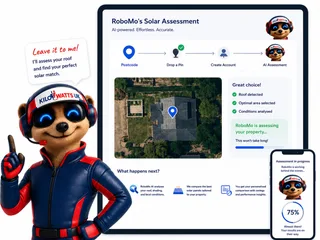

STEP 1
Choose Home, Business or Industrial
Enter your postcode to start your assessment.
STEP 2

Drop a pin on your roof
STEP 3

Create your free account
STEP 4

Sit back and watch RoboMo™ work
RoboMo™ analyses your roof and builds your personalised solar comparison.

Kilowatts UK is an authorised representative
Flower Turbines
Compact vertical-axis turbines built for real UK sites, not just open farmland.
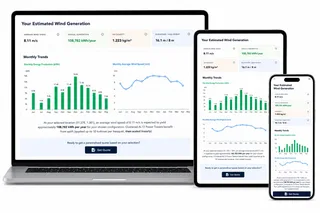
They start in light wind, sit in a small footprint, and are bird-safe by design. Cluster them as a bouquet and the group performs better together than the same turbines standing alone. Enter your postcode for a location-based generation estimate. Figures use area weather data and will differ if buildings, trees or hills sit in the way.
Starts in light UK wind
Built to generate in typical UK wind, not only open farmland.
Small rooftop or ground footprint
Compact towers for roofs, yards and tight sites.
Bird-safe slow rotation
Slow vertical-axis spin, bird-safe by design.
Bouquet clusters raise output
Grouped turbines outperform the same units standing alone.

Step 1
Enter your postcode
Start designing your wind energy system in seconds.
STEP 2

Choose a location
STEP 3

Place your cluster
Tap the map where you want the turbine cluster to go.
STEP 4

Instant generation forecasts
Compare different turbine layouts and see annual generation forecasts instantly.
STEP 5

No commitment required
Explore different configurations before deciding whether to request a quotation.
Related articles
Mo's Mission Nominations
FAQ
Need Help? RoboMo's Got Answers
Is solar a good option for office buildings in the UK?
Solar can be a good option for UK offices when the building has steady daytime electricity use, a suitable roof, clear ownership or landlord consent, and a long enough occupation period to benefit from the savings. Offices often use power during daylight hours for lighting, IT, lifts, ventilation, cooling, server rooms and shared facilities, which can make self-consumption strong. The best projects are sized around actual half-hourly electricity demand, not simply the maximum number of panels that can fit on the roof.
How much roof space does an office solar system need?
As a broad guide, 1 kWp of solar PV capacity usually needs about 4 to 6 square metres of usable roof area. A 50 kWp system may need roughly 200 to 300 square metres, while a 100 kWp system may need around 400 to 600 square metres. The usable area can be reduced by rooflights, plant rooms, vents, parapets, maintenance walkways, fragile roof zones, drainage routes, shading and fire access requirements.
How much does commercial solar for offices cost?
Typical installed costs for smaller UK commercial solar systems are often around £900 to £1,300 per kWp, while larger systems are often around £600 to £1,000 per kWp before VAT and site-specific extras. A 50 kWp office system might cost around £45,000 to £65,000 before VAT and extras, while a 100 kWp system might cost around £70,000 to £110,000. Final pricing depends on roof condition, access, structural requirements, electrical works, metering, DNO requirements, fire requirements and monitoring.
What is the typical payback period for office solar panels?
Payback periods for UK office solar are commonly around 4 to 8 years, but this varies by installed cost, electricity price, self-consumption, export rate, maintenance costs, financing costs and tax position. The strongest returns usually come from using solar electricity in the building, because avoided grid import is normally worth more than exported electricity. A proper financial model should use the office’s actual half-hourly consumption and tariff rather than generic assumptions.
How much electricity can an office solar system generate?
UK commercial solar systems typically generate around 850 to 1,100 kWh per kWp per year, depending on location, orientation, shading and design. For example, a 50 kWp system may generate about 42,500 to 55,000 kWh per year, while a 100 kWp system may generate about 85,000 to 110,000 kWh per year. Output is highest from spring to early autumn and lower in winter, so generation should be compared with the office’s seasonal electricity use.
Do office solar panels need planning permission?
Many non-domestic rooftop solar installations in England may fall under permitted development rights, but this must be checked for the specific building. Planning requirements can change if the building is listed, in a conservation area, subject to existing planning conditions, or if the project involves ground-mounted panels or solar carports. Rules also vary across the UK, so planning status should be confirmed before treating a project as approved.
Do commercial office solar systems need DNO approval?
Most commercial office solar systems need approval from the local Distribution Network Operator before connection. Very small systems may fall under G98 rules, but many office projects require a G99 application. The DNO may approve the system as proposed, require export limits, request additional information, or identify reinforcement works. DNO requirements should be checked early because they can affect cost, timescales and system size.
What roof checks are needed before installing office solar panels?
A roof condition review and structural survey should be completed before committing to installation. The checks should cover remaining roof life, load capacity, wind uplift, fixing method, waterproofing, roof warranty restrictions, access routes, fragile areas, asbestos risk, drainage and fire access. Installing solar on a roof that may need replacement soon can be poor value because the panels may need to be removed and reinstalled.
Can solar panels work on flat office roofs?
Yes, flat office roofs can work well for solar when the structure, waterproofing, access and shading are suitable. Flat roofs often use east-west mounting to fit more panels and spread generation across the working day, which can suit office electricity demand. The mounting design may be ballasted, mechanically fixed or a hybrid system, and it should be chosen with structural capacity, wind loading and roof warranty requirements in mind.
Is solar suitable for multi-let office buildings?
Solar can work for multi-let offices, but the commercial and metering arrangements need to be resolved early. Key issues include who owns the roof, which meter the solar connects behind, whether the system supplies landlord or tenant loads, how savings are allocated, who receives export income and who pays for maintenance. Landlord consent, lease terms, service charge rules and tenant billing arrangements may all affect the project structure.
Can tenants install solar panels on a leased office?
A tenant will normally need landlord consent before installing solar panels on a leased office roof. The lease may restrict roof access, alterations, plant installation, cable routes, electrical works and rights to export or sell electricity. Tenants should review the lease, obtain written consent and agree what happens at lease expiry before committing to design or procurement.
Are batteries necessary for office solar?
Batteries are not automatically necessary for office solar because many offices use electricity during the day when solar generation is available. A battery may be worth considering if the site exports a lot of solar power, has significant evening demand, faces export limits, uses time-of-use tariffs, has EV charging, or wants peak demand management. Battery storage should be modelled against actual half-hourly import and export data because it adds cost, space requirements, fire considerations and maintenance responsibilities.
Can office solar be combined with EV charging?
Yes, solar can be combined with workplace EV charging, and daytime vehicle charging can improve solar self-consumption. However, EV chargers can also create new electrical peaks if they are not controlled properly. Solar, EV charging, load management, spare electrical capacity and future fleet plans should be assessed together so the system is designed around the building’s real power limits and usage patterns.
Are solar carports a good option for offices?
Solar carports can be useful where an office has limited roof space and a large car park, especially if staff, visitor or fleet vehicles are parked during the day. They are usually more expensive per kWp than rooftop solar because they involve structural frames, foundations, civil works, drainage, impact protection and potential planning considerations. They can be valuable, but they need a site-specific cost, planning and electrical review.
Will office solar panels eliminate electricity bills?
Solar panels can reduce imported electricity, but they will not usually eliminate electricity bills. Offices will still import power at night, during low-generation periods, in winter and whenever demand exceeds solar output. Standing charges, some network charges, capacity charges and demand-related costs may also remain. The financial benefit depends on how much solar generation is used on site and how the electricity tariff is structured.
Can offices get paid for exporting solar electricity?
Eligible offices may be able to receive export payments through the Smart Export Guarantee, but rates vary by supplier and export income is usually worth less than using the electricity on site. Export must be measured with suitable metering, and certification or accreditation requirements may apply depending on system size. The business case should normally be based mainly on avoided import costs, not export revenue.
Are there grants for commercial office solar panels?
There is no universal UK upfront government grant for commercial office solar, and the Feed-in Tariff is closed to new applicants. Some local councils, regional net zero programmes or business support schemes may offer funding from time to time, but availability changes by location and funding round. Businesses should also check tax treatment, Annual Investment Allowance eligibility and any business rates implications with their accountant or adviser.
What information is needed for an office solar feasibility study?
A good feasibility study should use 12 months of half-hourly electricity data, recent bills, MPAN and meter details, roof drawings, structural information, roof warranty details, asbestos records where relevant, switchboard information, lease documents, landlord requirements, insurance requirements and details of future changes such as EV charging, heat pumps, refurbishments or occupancy changes. This information helps the installer estimate self-consumption, export, DNO requirements, connection method, cost and payback more accurately.
How should an office solar system be sized?
An office solar system should be sized around the building’s actual electricity profile, available usable roof area, grid connection limits and commercial objectives. Oversizing can lead to high export at lower value or DNO restrictions, while undersizing may miss useful savings. Half-hourly consumption data is the best basis for comparing generation against demand and estimating how much electricity will be used on site.
What should an office look for in a commercial solar installer?
A credible commercial solar installer should ask for electricity data, MPAN details, tariff information, roof drawings, structural information, switchboard details, lease requirements and insurance requirements before finalising a design. Their proposal should explain the chosen system size, expected generation, self-consumption, export assumptions, DNO route, connection method, monitoring, maintenance and exclusions. Buyers should also check commercial PV experience, insurance levels, health and safety processes, warranty terms, commissioning documents and references from similar buildings.
How long do commercial solar panels and inverters last?
Commercial solar panels commonly have design lives of 25 to 30 years, with performance warranties often guaranteeing a percentage of original output after 25 years. Inverters usually have shorter lifespans, often around 10 to 15 years, so a whole-life financial model should allow for inverter replacement. Ongoing monitoring, inspections and maintenance are important to identify faults and protect long-term performance.
What are the most common mistakes with office solar projects?
Common mistakes include sizing the system only around roof area, ignoring half-hourly demand data, assuming export income will drive the return, failing to check DNO requirements early, installing on a roof with limited remaining life, overlooking landlord or tenant consent, treating batteries as automatically worthwhile, forgetting inverter replacement and failing to plan monitoring or maintenance. A good project should resolve roof, grid, metering, consent, fire and financial assumptions before procurement.