


How Many Solar Panels Does a UK Home Need?
Published: 2026-07-25 16:04:14
Updated: 2026-07-31 18:56:03
Discover how many solar panels you need for your UK home with Kilowatts UK.
How many solar panels does a UK home need?
Most UK homes need around 8 to 13 solar panels, but the useful answer is a system size, not a panel count. A typical domestic solar PV system is often in the 3.5 to 4.5 kWp range, depending on annual electricity use, panel wattage, roof space, orientation, shading and whether the household plans to add a battery, electric vehicle or heat pump.
Panel count changes as panel wattage changes. Ten 430 W panels make a 4.3 kWp array, while ten 400 W panels make a 4.0 kWp array. The same roof could therefore need fewer or more panels depending on the specification. Before choosing a package, it helps to understand how solar works and why real-world generation is different from the panel’s laboratory rating.
For many homes, the best design is not the largest possible array. Ten well-positioned panels on an unshaded roof can be better value than more panels spread across shaded or awkward roof sections. A good quote should show expected annual generation, the roof layout, the inverter design, any battery assumptions, export arrangements and any DNO requirements.
The quick answer by electricity use
Start with your annual electricity consumption in kWh, shown on your electricity bill or online supplier account. Ofgem’s commonly used domestic electricity typical consumption values include around 2,700 kWh a year for a medium electricity user, with lower and higher benchmark users sitting either side of that. Your own bill is more important than the benchmark, especially if you work from home, charge an EV, use electric heating or have high appliance use. The table below is a starting estimate, not a quote. It assumes modern domestic panels around 430 W each, reasonable roof conditions and a design that aims to offset a useful share of annual consumption rather than cover every unit used. The final system size still needs a roof survey, shading assessment and electrical design, especially because solar panel generation varies by property.
| Annual electricity use | Indicative solar size | Approximate panel count with 430 W panels | Notes |
|---|---|---|---|
| 1,800 to 2,500 kWh | 2.5 to 3.5 kWp | 6 to 8 panels | Often suits smaller or lower-use homes where roof space or budget is limited |
| 2,500 to 3,500 kWh | 3.5 to 4.5 kWp | 8 to 11 panels | Common range for many average UK homes |
| 3,500 to 5,000 kWh | 4.5 to 6.0 kWp | 11 to 14 panels | May suit larger households, home working or higher daytime demand |
| Over 5,000 kWh | 6.0 kWp and above if suitable | 14 panels and above | Needs careful checking of roof space, export arrangements and future demand |
The short sizing method
A solar PV system is sized in kWp, while your electricity bill is measured in kWh. The kWp rating describes the system’s peak output under standard test conditions. kWh describes the amount of energy generated or consumed over time. In UK conditions, the same kWp system will generate different annual kWh depending on postcode, roof angle, orientation, shading and equipment design.
A practical first estimate is to match the system size to your annual electricity use, then adjust it for the property. Many UK domestic systems sit around 3.5 to 4.5 kWp because that range often balances roof space, cost, generation and household demand. A 4 kWp system may need roughly 16 to 22 m² of clear roof space depending on panel size, margins, mounting layout and obstructions.
- Check your annual electricity use in kWh from your bill or supplier account.
- Note when electricity is used, especially daytime versus evening use.
- Measure clear roof area, excluding chimneys, dormers, roof windows, vents and awkward margins.
- Check orientation, pitch and shading from trees, chimneys and neighbouring buildings.
- Consider future demand from an EV, heat pump, battery or increased home working.
- Ask for a design based on the actual roof, not only a generic panel package.
The sizing method should lead to a design conversation, not a fixed answer. A reliable installer will explain why a particular array size is being proposed and what assumptions sit behind the expected generation and savings.
A worked example for an average UK home
Imagine a home using 3,000 kWh of electricity a year. The roof has a mostly south-facing, lightly shaded plane with enough space for ten modern panels. If each panel is rated at 430 W, ten panels create a 4.3 kWp solar array.
A well-sited UK solar array may generate roughly 800 to 1,000 kWh per kWp per year as a broad planning assumption, although the actual figure varies by location, roof pitch, orientation and shading. On that basis, a 4.3 kWp system might be modelled somewhere around 3,400 to 4,300 kWh a year before site-specific adjustment. A south-facing roof in southern England may sit towards the stronger end of that range, while a less favourable roof or a more northerly location may sit lower.
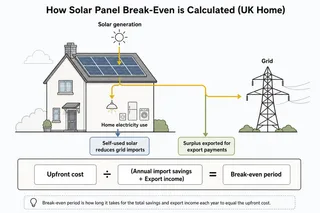
That does not mean the home will use every unit generated. Solar output is strongest during daylight hours and highest in spring and summer, while household demand may peak in the evening or winter. Without a battery, some generation may be exported. With a battery, more of the daytime generation may be stored for later use, but the battery adds cost and must be sized sensibly. Annual electricity use: 3,000 kWh. Panel specification: 430 W per panel. Panel count: 10 panels. Array size: 10 × 430 W = 4,300 W, or 4.3 kWp. Approximate roof area: often around 18 to 22 m² for the panels themselves, with final layout depending on the product and roof margins. Expected generation: must be modelled for the actual postcode, roof pitch, orientation and shading rather than promised from a national average. This example shows why panel count alone is not enough. The same ten panels on an east-west roof, a shaded roof or a roof in a different part of the UK could produce a different annual result.
Typical panel numbers by household situation
A smaller home with modest electricity use may only need a compact array. A larger family home may justify more panels if the roof space, budget and electrical connection allow it. Panel count also changes with panel wattage: higher wattage panels can reduce the number of panels needed for the same kWp system, although they still need suitable roof space. The figures below are a practical guide. They should be treated as an early design range, not a guarantee of generation, bill savings or payback.
| Household situation | Likely solar approach | What changes the panel count |
|---|---|---|
| Low-use home | Smaller array may be enough if roof space is limited | Annual kWh use, daytime occupancy and export expectations |
| Average UK home | Often around 8 to 13 panels for a typical domestic system | Panel wattage, roof orientation, shading and usable roof area |
| High-use family home | Larger array may be worthwhile if roof and grid connection allow | EV charging, appliances, home working and battery plans |
| Home planning a heat pump | Size for future electricity demand, not only today’s bill | Heating design, insulation, seasonal consumption and roof capacity |
| Home with limited roof space | Higher wattage panels or fewer roof faces may be considered | Dormers, chimneys, vents, roof margins and access constraints |
Why roof space usually decides the upper limit
Your electricity bill might suggest a larger solar system, but the roof decides what can actually be installed. Each panel typically needs around 1.5 to 2.2 m², depending on the product. Installers also need practical space for roof edges, maintenance access, mounting rails and obstructions. A clean rectangular roof plane is much easier to design than a roof broken up by dormers, soil pipes, roof windows and chimneys.
Roof condition matters as much as roof size. Solar panels are long-term equipment, so installing them on a roof that may need replacement in the next few years can be a false economy. It is usually better to deal with roof repairs first than to pay for panels to be removed and refitted later.
A good survey should consider roof structure, fixing points, tile type, cable routes, scaffold access and inverter location. Solar panels and mounting rails add load to the roof, and the fixing system needs to be appropriate for the property rather than arranged only to look tidy from the ground.
Orientation, pitch and shading affect how many panels make sense
South-facing roofs are usually the strongest performers in the UK. East and west-facing roofs can still work well, especially where the household uses electricity in the morning and evening. A roof pitch around the common UK domestic range can be suitable, with 30 to 40 degrees often working well for year-round generation.
Shading is often the biggest design problem. Even partial shading from a chimney, nearby tree, aerial, dormer or neighbouring building can reduce output, especially on a simple string inverter system. This does not always make solar unsuitable, but it may change the panel layout, inverter design or whether optimisers or microinverters are worth considering.
- South-facing roofs usually maximise annual generation.
- East-facing roofs can support morning household demand.
- West-facing roofs can be useful for late afternoon and evening use.
- North-facing roofs normally need careful modelling before proceeding.
- Heavy shading can make a larger system perform like a smaller one.
- Split roof arrays may need more detailed inverter design.
Where shading is limited to one section of roof, the installer may design around it rather than abandon the project. Where shading is heavy for much of the day, fewer panels on the best roof area may be better than filling every available space. If you are unsure which roof face matters most, start with the basics of solar panel direction.
Electricity use matters more than house size
A three-bedroom home does not automatically need a set number of panels. Two houses of the same size can have very different electricity use depending on occupancy, appliances, working patterns, heating type and whether an EV is charged at home.
Daytime use is especially important because solar electricity is generated during daylight hours. If the home is empty all day and there is no battery, more electricity may be exported to the grid. Export can still have value under the Smart Export Guarantee, but using your own solar electricity directly is often a key part of the financial case.
Include future plans early. If you expect to add an electric vehicle, heat pump or battery, ask for the system design to show both current and future scenarios. Retrofitting extra panels later can be possible, but it may mean new scaffolding, inverter changes, DNO considerations and revised certification paperwork.
When a battery changes the answer
A battery does not usually reduce how many panels can fit on the roof, but it can change how many panels are worth installing. Without a battery, excess solar generation is exported when the home cannot use it. With home battery storage, more daytime generation can be stored for evening use, improving self-consumption.
Battery sizing should follow the household’s usage pattern rather than a generic bundle. A home with high evening demand may benefit more than a home that already uses most electricity during daylight hours. The battery, inverter and solar array should be designed as one system, especially where backup power, time-of-use tariffs or future EV charging are being considered.
A battery also adds cost and design complexity. It needs a suitable installation location, compatible equipment, safe cable routes and realistic expectations. It should not be treated as a fix for a poorly sited solar array.
DNO, export limits and why 3.68 kW is often misunderstood
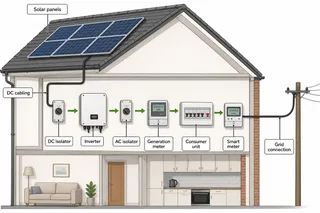
For UK homes, the electrical connection can affect the final design as much as the roof. The common 3.68 kW figure is not simply a limit on the number of solar panels. It relates to 16 amps per phase, commonly discussed under Engineering Recommendation G98 for small-scale generation connections. For a single-phase home, that is about 3.68 kW AC export or inverter output under the relevant connection conditions.
This matters because a solar array has a DC kWp rating, while the inverter and grid connection have AC ratings and export settings. A system can sometimes have more than 3.68 kWp of panels if the inverter output or export is limited, but the installer must handle the DNO process correctly. Larger or non-standard connections typically fall under G99, where approval is needed before commissioning. Export limitation can be a design route in some cases, but it must be specified, accepted where required and supported by suitable equipment.
Ask the installer to explain whether the proposal is being handled under G98 notification or a G99 application, and whether any export limit applies. The important question is not only “how many panels are on the roof?” but “what will the system be allowed to export to the local network?”
G98 route
Commonly used for type-tested small-scale generation within the 16 A per phase conditions, with the required DNO notification process.G99 route
Used where the connection falls outside G98 conditions, usually requiring DNO approval before installation or commissioning.Export capacity
The amount the system is permitted or configured to send to the grid.Export limitation
A possible design approach where equipment restricts grid export, subject to correct specification and DNO requirements.Inverter capacity
The AC output rating of the inverter connected to the property.Installed panel capacity
The DC kWp size of the solar array on the roof.
This distinction is important for trust and cost. A quote that simply says “DNO included” should still explain the connection route, any export cap and whether the homeowner may face delays while approval is obtained.
MCS, SEG and export payments
MCS certification is important if you want to access Smart Export Guarantee payments. SEG suppliers generally require evidence that the installation and installer meet MCS or an equivalent recognised standard, along with suitable export metering. Requirements can vary by supplier, so the quote should make clear what documentation will be provided and what MCS certification means for the installation.
The Feed-in Tariff is closed to new applicants, so current financial assumptions should not rely on old FIT payments. For new installations, the financial case usually depends on avoided electricity imports, SEG export payments, electricity prices, system cost, battery use and how much solar electricity the household can use directly.
Export arrangements should be checked before accepting a quote. Some suppliers require an export MPAN and meter readings capable of measuring exported electricity. The SEG rate is set by the supplier and can change, so savings estimates should not treat export income as fixed for the life of the system.
Common mistakes when estimating panel numbers
Many homeowners begin with a target such as “I want twelve panels” or “I want to cover my whole bill”. That is understandable, but a reliable design starts with measured consumption, roof constraints and realistic generation estimates.
Another common mistake is ignoring the inverter. A string inverter can be cost-effective on a simple, unshaded roof, but shading on one panel can affect the string. Microinverters or power optimisers may help on complex roofs, although they add cost and should be justified by the site conditions rather than included automatically.
- Choosing panel count before checking annual kWh use.
- Filling shaded roof areas that add little useful generation.
- Ignoring roof age and future roof maintenance.
- Assuming all panels perform the same on every roof.
- Forgetting future EV or heat pump demand.
- Comparing quotes without checking generation assumptions.
Judge a quote by the quality of the design as well as the headline price. Look for a roof plan, estimated annual generation, inverter specification, mounting approach, certification details and a clear explanation of any assumptions. Treating the 3.68 kW figure as a simple panel-count limit rather than an export and connection issue.
How location changes solar performance in the UK
Solar panels work across the UK, including in cloudy weather, because they generate from daylight rather than only direct sunshine. Location still affects annual yield. Southern England generally receives more solar resource than Scotland, so the same system can generate different annual energy depending on where it is installed.
Cooler UK temperatures can help panel efficiency compared with very hot climates, but winter daylight is shorter and generation is lower. This seasonal variation matters when sizing a system for homes with heat pumps or high winter electricity use, because solar output is strongest when heating demand is usually lowest.
A national average is useful for a first estimate, but it is not enough for a final decision. Installer software should model the specific roof pitch, orientation, shading and postcode rather than relying only on broad UK assumptions.
Cost and value factors to compare
Cost is affected by system size, access, roof complexity, inverter type, battery choice, scaffolding, consumer unit work and any additional electrical upgrades. As a broad UK market reference, consumer guidance such as Energy Saving Trust material has commonly placed a typical domestic solar PV system in the mid-thousands of pounds, and many straightforward 4 kWp quotes are often discussed in the region of £6,000 to £8,000 excluding a battery. Actual prices vary by property, specification, installer, access and electrical work, so use that range only as context rather than a guaranteed price. Do not compare quotes only by total price. A cheaper system with fewer panels, lower generation, poorer monitoring or unsuitable inverter design may be worse value than a slightly higher quote with a better layout and clearer documentation. If you are comparing designs, use the specification and assumptions to compare home solar options, not just the number of panels.
| Factor | Why it affects value | What to check in the quote |
|---|---|---|
| Panel wattage | Higher wattage can reduce panel count for a given system size | Total kWp, panel datasheets and warranty terms |
| Roof complexity | More roof faces and obstructions can increase labour and design work | Layout drawing, scaffold assumptions and cable routes |
| Shading solution | Optimisers or microinverters may help but add cost | Evidence that shading justifies the design |
| Battery inclusion | Can improve self-use but changes payback and equipment needs | Usable capacity, location, warranty and compatibility |
| Inverter choice | Affects efficiency, monitoring, export control and future expansion | AC rating, warranty, location and replacement expectations |
| Export arrangements | Export value depends on supplier terms, metering and allowed export | SEG rate assumption, export MPAN or metering route, export limit and whether savings rely on self-consumption or export income |
| DNO position | Grid connection requirements can affect timing and system design | Whether the job is G98 or G99 and whether approval is needed before commissioning |
| Certification and handover | Documentation affects SEG eligibility, future sale queries and maintenance | MCS certificate, electrical certificate, warranties and user handover pack |
When fewer panels may be the better decision
More panels are not always better. If the extra panels sit on a shaded, awkward or poor-facing roof area, they may add cost without adding much useful generation. A smaller array on the best part of the roof can sometimes give a cleaner, more reliable and better-value installation. Fewer panels may also make sense if the household has low electricity use, no battery, limited daytime demand or no plans to stay in the property long enough to benefit from the system. Solar can still be attractive, but the design should match the home rather than chase the largest possible array. Workmanship matters too. A careful installation on a modest array is usually preferable to a crowded roof layout with poor access, awkward cable runs and unnecessary shading losses.
What to ask before accepting a solar quote
Before accepting a quote, ask the installer to explain how they calculated the number of panels. The answer should refer to your electricity consumption, roof survey, expected generation, inverter choice, export assumptions and whether any DNO approval is needed.
It is reasonable to ask for more than one design option. For example, a quote could compare a smaller system without a battery, a larger system with a battery, or an option that leaves capacity for future EV charging. The best choice depends on budget, roof space, electricity use and how long you expect to stay in the home.
What annual generation is expected for this specific roof. What generation model or assumptions have been used. How much electricity is likely to be used on site. How much electricity is expected to be exported. Whether the SEG rate has been assumed or confirmed. Whether an export MPAN or export metering arrangement is needed. A reliable installer should be comfortable explaining the design in plain English. If the answer is only a panel count and a headline saving figure, ask for more detail before proceeding. Whether shading has been modelled or only visually assessed. Whether DNO approval is required before installation or commissioning. Whether the installation will be MCS certified for SEG eligibility. What assumptions are being made about future electricity use. What happens if the roof needs repair after the panels are installed. What warranties apply to panels, inverter, battery and workmanship.
Sources and assumptions used in this guide
The figures in this guide are intended for UK homeowner planning, not final design. A proper quote should use the property’s actual electricity data, roof survey, shading assessment, equipment datasheets and current supplier terms.
The main assumptions reflect publicly available UK consumer and industry references rather than a single universal rule. Ofgem’s typical domestic consumption values are used as context for low, medium and high electricity users. MCS and Ofgem Smart Export Guarantee guidance are relevant to certification and export payment eligibility. Energy Networks Association Engineering Recommendations G98 and G99 are the basis for the common DNO connection distinction. Consumer pricing context is drawn from broad UK guidance and market quoting patterns, but actual installed costs must be confirmed by property-specific quotations.
Electricity use: Ofgem typical domestic consumption values are a benchmark only; your annual bill is the better sizing input. Generation estimate: Broad planning assumptions of around 800 to 1,000 kWh per kWp per year need site-specific modelling by postcode, pitch, orientation and shading. Panel wattage: Around 400 to 450 W panels are common in many current domestic quotes, but the actual datasheet rating should be checked. DNO rules: The key distinction is usually AC export or inverter output under G98 or G99, not simply the DC kWp size of the panels. SEG eligibility: Check the chosen supplier’s current SEG requirements, export metering process and rate before relying on export income. Costs: Treat any national price range as context only; access, roof complexity, equipment, battery choice and electrical work can materially change the quote. A reliable answer to how many solar panels a UK home needs is not a single national figure. Start with the 8 to 13 panel range for an average home, then refine it using your bill, roof, shading, future plans and a proper installation design. If you want the roof and usage checked properly, you can book a survey before choosing a final system size.
Plan, Compare & Buy Renewable Energy Solutions
AI does the thinking.
You get the perfect solar match.
Use RoboMo™ to assess your property, compare available technologies and connect with trusted UK installers, suppliers and manufacturers.
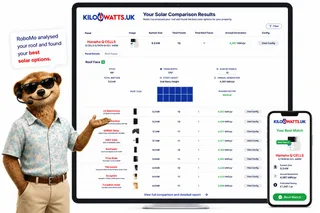
Simply enter your postcode, drop a pin on your roof, create your free account and let RoboMo™ analyse your property to find the best solar panels for your home.

You don't have to think
RoboMo™'s AI analyses your roof and does all the hard work.

Accurate & tailored
AI-powered assessment based on your roof, location, and conditions.

Best options, maximum savings
Compare top solar panels for the best performance and value.

Simple, fast & effortless
Provide a few details, sit back and watch your results unfold.
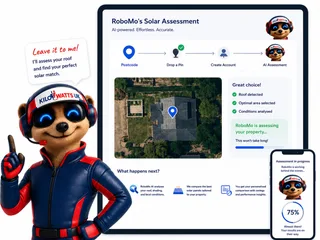
STEP 1
Choose Home, Business or Industrial
Enter your postcode to start your assessment.
STEP 2

Drop a pin on your roof
STEP 3

Create your free account
STEP 4

Sit back and watch RoboMo™ work
RoboMo™ analyses your roof and builds your personalised solar comparison.

Kilowatts UK is an authorised representative
Flower Turbines
Compact vertical-axis turbines built for real UK sites, not just open farmland.
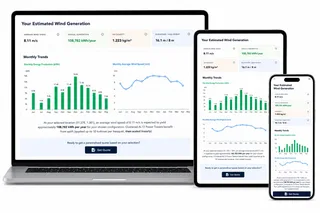
They start in light wind, sit in a small footprint, and are bird-safe by design. Cluster them as a bouquet and the group performs better together than the same turbines standing alone. Enter your postcode for a location-based generation estimate. Figures use area weather data and will differ if buildings, trees or hills sit in the way.
Starts in light UK wind
Built to generate in typical UK wind, not only open farmland.
Small rooftop or ground footprint
Compact towers for roofs, yards and tight sites.
Bird-safe slow rotation
Slow vertical-axis spin, bird-safe by design.
Bouquet clusters raise output
Grouped turbines outperform the same units standing alone.

Step 1
Enter your postcode
Start designing your wind energy system in seconds.
STEP 2

Choose a location
STEP 3

Place your cluster
Tap the map where you want the turbine cluster to go.
STEP 4

Instant generation forecasts
Compare different turbine layouts and see annual generation forecasts instantly.
STEP 5

No commitment required
Explore different configurations before deciding whether to request a quotation.
Related articles
Mo's Mission Nominations
FAQ
Need Help? RoboMo's Got Answers
How many solar panels does a typical UK home need?
Many UK homes need around 8 to 13 solar panels, but the better measure is system size in kWp. A typical domestic system is often around 3.5 to 4.5 kWp, depending on electricity use, roof space, panel wattage, shading and future plans. The final number should be based on a roof survey and a site-specific generation estimate.
How do I work out the right solar system size for my home?
Start with your annual electricity use in kWh from your bill or supplier account. Then compare it with a likely system size in kWp, allowing for roof orientation, pitch, shading and how much electricity you use during daylight hours. A good quote should show expected annual generation, likely self-consumption and export assumptions.
Does house size decide how many solar panels I need?
House size is only a rough guide and can be misleading. A small home with an EV or high appliance use may need more electricity than a larger low-use household. Your annual kWh use and daily usage pattern are more important than the number of bedrooms.
How much roof space do solar panels need?
A 4 kWp solar PV system may need roughly 16 to 22 square metres of clear roof space, depending on the panel size and layout. Chimneys, dormers, roof windows, vents, edges and access margins can reduce the usable area. Roof condition also matters, as it is usually better to repair or replace a poor roof before installing panels.
Do south-facing roofs need fewer panels than east or west-facing roofs?
South-facing roofs usually generate the most electricity over a year in the UK, so they often make the best use of each panel. East and west-facing roofs can still work well, especially if the household uses electricity in the morning or late afternoon. Heavy shading can reduce output and may mean fewer well-positioned panels are better than filling every roof section.
Should I install more panels if I plan to buy an EV, battery or heat pump?
It can make sense to design for future electricity demand, not just today’s bill. An EV, heat pump or increased home working can raise annual consumption and change when electricity is used. Ask the installer to model both your current use and likely future use before deciding the array size.
Does a home battery change how many solar panels I need?
A battery does not usually change how many panels physically fit on the roof, but it can change how many are worth installing. It can store daytime solar generation for evening use, which may improve self-consumption. Battery size should be matched to your usage pattern, inverter design and tariff assumptions rather than chosen as a generic bundle.
Is 3.68 kW a limit on how many solar panels I can install?
Not exactly. The 3.68 kW figure is commonly linked to single-phase connection rules and inverter output or export, not simply the number of panels on the roof. Some systems may have more DC panel capacity than this if the inverter or export is designed appropriately, but the installer must handle the correct DNO process.