


Commercial solar ROI explained in the UK
Published: 2026-07-18 19:02:35
Updated: 2026-07-26 18:32:26
Understand commercial solar roi in the UK, with clear explanations, examples, and practical next steps.
Commercial solar ROI in the UK, in short
Commercial solar ROI is the financial return a business gets from installing solar PV. In the UK, payback commonly falls around 3 to 8 years, but the real answer depends on daytime electricity use, installed cost, roof suitability, electricity tariff, export value, finance, tax treatment, maintenance, grid connection limits, lease terms, and whether battery storage has a genuine business case.
The strongest returns usually come from using solar electricity on site. Every kilowatt hour used directly can reduce imported electricity, while exported electricity is often worth less. That is why two buildings with the same roof size can have very different returns.
A practical commercial solar ROI assessment should answer five questions.
- How much electricity will the system generate.
- How much of that generation will the business use at the time it is produced.
- What will each unit of solar electricity actually be worth under the site’s tariff.
- What costs, permissions, lease obligations, maintenance, finance, and future risks should be allowed for.
- Whether storage, export limitation, or a smaller system would improve the financial result.
For most UK businesses, commercial solar is not a simple “number of panels multiplied by savings” calculation. A reliable ROI model needs real demand data, a realistic site survey, clear ownership assumptions, and cautious treatment of export income.
What commercial solar ROI actually means
Commercial solar ROI can mean several things, so it is important to know which measure is being discussed. A quick sales estimate may focus on simple payback, while a finance team may prefer internal rate of return, net present value, or post-tax lifetime savings.
Simple payback is the easiest measure. It shows how many years it takes for savings and export income to equal the upfront cost. It is useful, but it ignores the timing of future savings, inverter replacement, finance costs, tax effects, degradation, and what happens after payback.
More detailed ROI modelling normally considers the value of solar generation over the life of the system. Commercial solar panels often have performance warranties of 25 to 30 years, and many continue operating beyond that with lower output. Inverters are likely to need replacement during the system life, commonly after around 10 to 15 years, although timing depends on equipment, environment, loading, maintenance, and warranty terms. The main ROI measures are different because they answer different questions. Simple payback: Shows how long it takes to recover the initial investment. Annual return: Compares yearly benefit with the installed cost. Net present value: Compares future benefits and costs in today’s money. Internal rate of return: Measures the investment return while accounting for timing. Lifetime savings: Estimates the total financial benefit over the system life. Post-tax return: Shows the effect after tax treatment, capital allowances, finance costs, and accounting rules. For a business decision, simple payback is a useful starting point, not the full answer. A board-level investment case should normally include sensitivity testing, maintenance allowances, inverter replacement, tariff assumptions, and a clear explanation of what happens if electricity prices or site operations change.
The main factors that drive ROI
The most important ROI driver is usually the avoided cost of grid electricity. If a business uses solar power while it is being generated, it avoids buying that electricity from its supplier. That avoided unit value is normally higher than the export price paid for surplus generation.
Self-consumption is therefore central. A factory, cold store, retail unit, leisure centre, farm process building, or seven-day operation may use a high share of solar generation on site. A warehouse with low daytime consumption may export more, which can weaken ROI unless export terms are strong.
Installed cost also matters. Larger systems often have a lower cost per kWp, but only where access, grid connection, roof structure, and electrical works are straightforward. A smaller system on a simple metal roof can outperform a larger system on a difficult roof if the larger project needs major enabling works. Roof condition is often underestimated. If the roof needs replacement soon, fitting solar can create future removal and reinstatement costs. Fragile roofs, asbestos-containing materials, corroded sheets, rooflights, parapets, plant rooms, and poor access can all reduce usable area or increase cost. Grid connection is another major variable. Many larger commercial systems need DNO approval, and export capacity may be limited. Export limitation equipment can sometimes allow a larger system, but the financial model must reflect any restriction on surplus generation. The business’s electricity tariff can also materially change ROI. A site on a flat-rate tariff is easier to model than a site with half-hourly settlement, time-of-use rates, capacity charges, reactive power charges, pass-through network costs, or seasonal contract variations. In those cases, each unit of solar generation should be valued against the import cost it actually avoids at that time, not against a blended annual pence-per-kWh figure.
A simple commercial solar ROI example
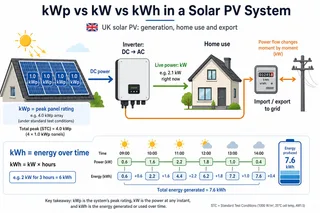
A 100 kWp commercial rooftop system might cost around £90,000 and generate around 90,000 kWh per year in much of England. If the business uses 80% of that generation on site, 72,000 kWh offsets grid electricity. If that electricity is worth 22p per kWh, the on-site saving is around £15,840 per year.
If the remaining 18,000 kWh is exported at 8p per kWh, export income is around £1,440 per year. The gross annual benefit is therefore around £17,280 before maintenance, tax, finance, degradation, insurance changes, and future inverter replacement. On that simplified basis, the payback is around 5.2 years.
This example is useful because it shows the logic, not because it applies to every site. A lower self-consumption rate, higher installation cost, lower electricity tariff, or restricted export arrangement would lengthen payback. Higher daytime use, lower installed cost, and higher avoided electricity cost would shorten it. For real projects, the model should be built from half-hourly electricity data where available. Using only annual consumption can overstate savings, especially where the business uses little power at weekends, during summer shutdowns, or outside daylight hours. A cautious ROI example should also include ongoing and future costs. These may include monitoring, inspection, testing, cleaning where required, corrective maintenance, insurance conditions, inverter replacement, metering costs, and finance charges. If those are excluded, the headline payback can look stronger than the real investment case.
How the ROI calculation works
A good ROI calculation separates solar generation into electricity used on site and electricity exported. It then values each part differently. This is important because imported electricity includes a mixture of energy, network, policy, supplier, and tax elements, while export payments are usually calculated separately.
The calculation should not assume that every unit generated is worth the full retail electricity price. It should also avoid treating standing charges as savings, because they usually remain even after solar is installed.
The key inputs are normally as follows.
System size
The installed solar capacity in kWp.Export value
The payment expected for surplus electricity sent to the grid.Import tariff
The actual avoided cost of electricity at the time solar is generated.Installed cost
The full project cost including access, design, electrical works, metering, and any enabling works.Self-consumption
The share of generation used directly by the business.Annual generation
The expected kWh output after allowing for orientation, pitch, shading, losses, and location.
A robust model should also test different scenarios. Electricity prices may rise or fall, operations may change, and export tariffs can vary. Sensitivity analysis is often more useful than a single optimistic payback number. Useful scenarios include: The aim is not to make the figures pessimistic. It is to show whether the investment still works if the business, tariff, or site conditions change. Maintenance allowance — The cost of inspections, testing, monitoring, cleaning where needed, and fault response. Inverter replacement — A future cost that should be allowed for within the system life. Insurance and compliance — Any additional cost linked to insurer requirements, fire safety measures, documentation, or periodic inspection. Finance and tax — The effect of borrowing, lease structures, capital allowances, VAT treatment, and accounting rules. Degradation — The expected gradual reduction in panel output over time. Downtime allowance — A realistic assumption for outages, faults, or planned works. Base case — Current tariff, realistic generation, and normal operations. Low-price case — Lower future import prices and weaker export income. High-price case — Higher import prices or stronger time-of-use savings. Low-use case — Reduced daytime demand, closures, relocation, or process changes. Grid-constrained case — Limited export capacity or export limitation. Maintenance case — Higher maintenance costs or earlier inverter replacement. Finance case — Different borrowing rates, lease costs, or power purchase agreement assumptions.
Calculating ROI with complex electricity tariffs
Many commercial and industrial sites do not have a simple single-rate electricity tariff. They may have half-hourly metering, time-of-use prices, seasonal rates, maximum demand charges, capacity charges, DUoS and TNUoS elements, reactive power charges, supplier pass-through costs, Climate Change Levy treatment, or negotiated supply contracts.
For these sites, commercial solar ROI should be calculated against the value of electricity avoided in each settlement period. A solar unit generated at a high-cost weekday afternoon may be worth more than a unit generated during a low-cost weekend period. A blended average import rate can be misleading if the site’s demand and solar output do not align evenly across the year.
A more accurate process is: Obtain at least 12 months of half-hourly import data, and ideally more if operations vary seasonally. Map expected solar generation against each half-hour period. Identify how much solar is used on site in each period and how much is exported. Value self-consumed electricity against the avoidable import cost for that period. Exclude costs that solar does not reduce, such as most standing charges. Treat export separately using the expected export contract or Smart Export Guarantee rate where applicable. Demand charges need particular care. Solar may reduce peak import if the site’s peaks occur during daylight and coincide with solar output. However, solar should not automatically be credited with reducing maximum demand charges unless the model proves it. A cloudy day or evening peak may still set the chargeable maximum demand. Reactive power charges and capacity-related charges also need expert review. Solar PV may affect site power flows, but it does not automatically remove the need for agreed capacity or power factor management. If the investment case relies on reducing these charges, the assumptions should be checked against the supply contract, metering data, and electrical design. For sites with variable production, the ROI model should be based on operations, not just historical consumption. A manufacturer adding a new shift, a cold store expanding refrigeration, a logistics site installing EV chargers, or a farm changing processing schedules may have a very different future load profile from the previous year’s bills. Test seasonal shutdowns, weekend demand, production shifts, and future electrification plans.
Why daytime electricity use matters so much
Solar PV produces electricity during daylight hours, with more output in spring and summer. Businesses that use electricity at the same time as the system generates usually get better ROI because they buy less electricity from the grid.
This is why usage profile is as important as roof size. A building with a modest roof but high daytime consumption can produce a stronger return than a large roof serving a low-load site. Summer-heavy loads, such as cooling, refrigeration, irrigation, or food processing, can match solar production particularly well.
Seven-day operation can also improve self-consumption. If a site is closed at weekends, some generation may be exported unless background loads are high. Schools and some offices can have lower demand during peak summer generation, so their returns need more careful modelling. Daytime demand should be assessed at half-hourly level where possible. A site may have high annual consumption but still poor solar matching if most electricity is used overnight, in winter, or in short process peaks. Conversely, a site with moderate annual consumption may produce strong ROI if it has consistent weekday and weekend daytime loads. The best system size is often the one that maximises valuable self-consumption, not the one that fills every available roof space. Oversizing can still make sense where export terms are strong, where future load growth is likely, or where the business has a strategic carbon target, but it should be a conscious decision rather than a default design.
Battery storage and commercial solar ROI
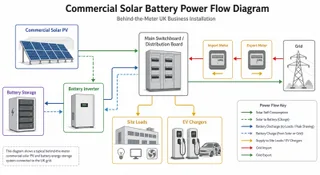
Batteries can increase self-consumption by storing surplus solar for later use. They may also help reduce peak import, support time-of-use tariff management, provide limited resilience for selected loads if designed for that purpose, or improve the economics of a site with constrained export capacity. However, battery ROI is highly site-specific and should not be assumed.
A commercial battery may help where:
- The site exports a meaningful amount of low-value solar during the day but imports later at higher prices.
- The business has time-of-use tariffs with a clear price difference between charging and discharging periods.
- Peak demand charges are material and peaks are predictable enough to manage.
- Export capacity is limited by the DNO and storage can reduce curtailment.
- EV charging, refrigeration, or shift patterns create a useful evening or overnight demand.
- The business needs a wider energy management strategy, not only solar payback.
A battery may weaken ROI where: Battery modelling should include round-trip efficiency, usable capacity, degradation, cycle limits, warranty terms, control strategy, maintenance, fire safety measures, and any revenue assumptions. It should also make clear whether the battery is being justified by self-consumption, peak reduction, tariff optimisation, resilience, export management, or a combination of these. Resilience should be treated carefully. A standard grid-connected solar and battery installation will not necessarily keep a building running during a power cut. Backup operation usually needs additional design, protection, isolation, and load management. If resilience is part of the business case, it should be specified from the start rather than assumed later. For some businesses, Commercial solar battery storage can improve the overall return. For others, the best ROI is achieved by installing solar first and leaving battery storage as a later option once more operating data is available. The site already uses most solar generation directly. The difference between import and export prices is too small. Peak demand is irregular, weather-dependent, or outside the battery’s useful control window. The battery is oversized for the site’s surplus generation or load profile. Warranty limits, degradation, cycling assumptions, or replacement costs are ignored. Fire safety, space, ventilation, access, or insurance requirements add significant cost.
UK costs, output, and payback ranges
Commercial solar costs vary widely, but small commercial rooftop systems may cost around £900 to £1,300 per kWp installed. Medium systems often sit around £700 to £1,100 per kWp. Larger commercial and industrial rooftops can fall below £700 to £900 per kWp where access, roof condition, and grid connection are straightforward.
As a rough guide, a 30 kWp system may cost around £27,000 to £39,000, a 100 kWp system around £70,000 to £110,000, and a 250 kWp system around £175,000 to £250,000. These ranges can change materially where there are roof repairs, asbestos works, battery storage, switchgear upgrades, export limitation, complex cable routes, structural strengthening, specialist access, planning conditions, or unusually expensive access requirements.
UK generation also varies by location and design. A well-designed UK rooftop solar system commonly generates around 800 to 1,100 kWh per kWp per year. Southern England sites often perform towards the higher end, while northern, Scottish, and upland sites may be lower. Roof orientation, pitch, shading, soiling, inverter design, and downtime all affect the actual result. Commercial payback commonly falls around 3 to 8 years, but that range should not be treated as a guarantee. The payback can be longer where export reliance is high, finance costs are high, tariffs are low, or the building needs substantial enabling works. It can be shorter where electricity costs are high, demand is steady through daylight hours, and the roof is simple to install on. Battery storage can extend or shorten payback depending on the site. Adding a battery increases capital cost, but may improve value where it captures otherwise exported electricity or reduces expensive imports. It should be modelled separately from the solar PV so the business can see the return on the solar alone, the battery alone, and the combined system.
Government support, policy, and export income
UK commercial solar is not generally supported by a universal upfront grant scheme. The Feed-in Tariff scheme is closed to new applicants. Current support is more indirect, through export payments, tax treatment, planning policy, business rates rules, and wider energy policy.
The Smart Export Guarantee provides a route to payment for eligible exported electricity up to 5 MW, but rates are market-led and commercial arrangements vary by supplier. Larger systems may use negotiated export contracts or power purchase agreements. Export should not be assumed until metering, supplier requirements, and DNO approval are understood.
Businesses following UK government support for solar should monitor policy from HM Treasury, DESNZ, Ofgem, local planning authorities, and Distribution Network Operators. Political discussion around solar often focuses on energy security, grid capacity, planning reform, land use, supply chains, and consumer bills. Commercial rooftop solar is often less contentious than large ground-mounted schemes, but it is still affected by grid and policy decisions. Tax treatment can make a material difference to post-tax ROI. Businesses may be able to use capital allowances on qualifying solar PV expenditure, subject to the rules that apply at the time and the business structure. VAT treatment differs between domestic and commercial installations, and professional advice should be taken before relying on any tax assumption. Finance structure also affects ROI. A cash purchase, asset finance, hire purchase, operating lease, roof rental arrangement, or power purchase agreement can all produce different outcomes. A no-upfront-cost option may help cash flow, but the lifetime saving may be lower than ownership. The model should show who owns the system, who receives the generation benefit, who takes maintenance risk, and what happens at the end of the finance term.
Roof, planning, grid, and insurance checks
A commercial solar ROI model is only as good as the technical assumptions behind it. In real projects, the feasibility stage often changes the financial case because roof, grid, safety, and insurance findings reveal costs not visible from a desk estimate.
Many commercial rooftop installations in England may fall under permitted development where conditions are met, but planning permission for solar panels may still be needed for listed buildings, conservation areas, National Parks, sensitive settings, or designs that exceed permitted limits. Scotland, Wales, and Northern Ireland have different planning rules and local interpretation.
Grid approval can affect system size, export capacity, timing, and cost. Smaller systems may fall under simplified connection routes where eligible, while larger systems usually require a more detailed application. The DNO may require export limitation, protection equipment, switchgear changes, metering alterations, or reinforcement. Insurance requirements should be checked early. Insurers may specify requirements for cable routing, DC isolators, labelling, emergency shutdown information, fire access, thermographic inspection, and documentation. Battery systems introduce additional fire safety considerations, including location, separation distances, access, ventilation, detection, suppression strategy, and emergency response information where relevant. Important site checks include the following.
- Roof condition and remaining roof life.
- Structural capacity and wind uplift requirements.
- Fragility, asbestos, corrosion, and safe access.
- Shading from plant, parapets, vents, trees, and nearby buildings.
- Cable route length between roof, inverters, and main intake.
- DNO export capacity and connection requirements.
These checks can prevent a project with an attractive headline payback from becoming difficult, delayed, or uneconomic. Metering arrangements for import, export, and generation. Main switchgear capacity and protection requirements. Fire access, maintenance walkways, and roof zoning. Battery location, if storage is being considered. Landlord, lender, lease, and insurer approvals.
Lease, landlord, and property ownership issues
Landlord and tenant situations can be central to commercial solar ROI. Many UK businesses occupy premises where the tenant pays the electricity bill but the landlord owns the roof. In that situation, the financial benefit, installation rights, roof maintenance obligations, and property control may sit with different parties.
Before approving a project, the business should check the lease and obtain legal advice where needed. The lease may restrict alterations, roof access, external equipment, cable routes, plant installation, subletting, or energy export. Consent may also be needed from a landlord, superior landlord, lender, managing agent, freeholder, or insurer.
Key points to agree in writing include: Who pays for the solar PV system and any enabling works. Who owns the panels, inverters, mounting system, meters, and battery if included. Who receives the electricity savings and export income. Who is responsible for maintenance, monitoring, insurance, repairs, and replacement. How roof access will work for installation, inspection, cleaning, and emergency response. What happens if the roof needs repair or replacement. A short lease can undermine ROI if the tenant may leave before payback. A longer lease, an agreed extension, a landlord contribution, or a clear transfer arrangement can improve bankability. If a tenant funds the system, it needs confidence that it can either benefit for long enough, remove the equipment economically, or agree compensation on exit. For landlords, solar can improve building attractiveness, reduce occupier energy costs, support sustainability objectives, and create a potential income stream. However, the landlord should still consider roof life, future redevelopment, insurance conditions, metering, tenant changes, and maintenance access before granting consent. The safest approach is to resolve lease and landlord issues early. A project can look financially strong but fail commercially if ownership, savings, access, and end-of-lease obligations are unclear. What happens at lease expiry, break clause, assignment, renewal, or property sale. Whether the system must be removed and who pays for removal and reinstatement. How any roof warranty, cladding warranty, or building insurance conditions are protected. Whether the landlord receives rent, a licence fee, a share of savings, or another commercial benefit.
When commercial solar may not be suitable
Commercial solar is usually strongest for owner-occupiers or long-term tenants with high daytime electricity use, a sound roof, predictable site operations, and a reasonable grid connection. It is less straightforward where the financial benefit and roof ownership sit with different parties.
It may not be suitable if the roof needs replacement soon, the structure cannot take the load without costly strengthening, or asbestos works dominate the budget. A short lease or planned relocation can also undermine the investment case if the business may leave before payback.
Low daytime demand is another warning sign. If most generation would be exported and export rates are weak, a large system may produce poorer ROI than a smaller, better-matched system. The largest possible array is not always the best financial design. Commercial solar may also be harder to justify where: The DNO allows little or no export and the site cannot use enough electricity on site. The business has a very low import tariff or limited avoidable unit cost. The roof has multiple obstructions, rooflights, shading, or access restrictions. The building is likely to be redeveloped, vacated, sold, or re-roofed. Lease terms do not allow long enough to recover the investment. Insurer requirements or fire strategy constraints make the design expensive. Landlord and tenant situations need careful handling. If the tenant pays the electricity bill but the landlord owns the roof, the project needs a clear agreement on who funds the system, who receives the savings, who maintains it, and what happens at lease end or property sale. The model depends on battery savings that have not been proven by tariff and demand data.
Common mistakes that weaken ROI
Many poor commercial solar decisions come from oversimplified assumptions. A realistic model should be cautious enough to survive technical checks, tariff changes, and operational realities.
Overvaluing export: Surplus electricity is often worth less than electricity used directly on site. Using a blended import rate without checking the tariff: Time-of-use and half-hourly tariffs need period-by-period modelling. Ignoring half-hourly data: Annual consumption alone can hide low weekend or summer demand. Assuming demand charges will fall: Solar only reduces these charges if it reliably reduces the chargeable peak. Filling the whole roof: Fire access, maintenance walkways, rooflights, shading, and wind zones reduce usable area. Forgetting roof life: Future roof replacement can require panel removal and reinstatement.
The best projects usually start with demand data, roof feasibility, grid constraints, lease position, and a clear commercial objective. They do not start by asking how many panels can physically fit on the roof. Excluding maintenance — Monitoring, inspections, cleaning where needed, and inverter replacement should be budgeted. Assuming batteries always help — Commercial solar battery storage can improve some projects but weaken others if added without a clear use case. Ignoring battery degradation — Usable capacity, cycle limits, efficiency, and warranty conditions affect storage ROI. Missing DNO limits — Export restrictions can change both system size and expected revenue. Treating tax as simple — Capital allowances, VAT, leases, and PPAs need proper advice. Leaving lease consent too late — Landlord, lender, managing agent, or insurer approvals can affect cost and timing. Not planning for exit — Lease expiry, relocation, roof replacement, or property sale can change the investment case.
Practical next steps for a UK business
Start by collecting half-hourly electricity data, current tariff details, site plans, roof information, and any lease or landlord documents. These inputs help separate a realistic ROI estimate from a generic proposal.
For complex tariffs, ask for a model that uses half-hourly consumption and expected half-hourly solar output. The model should show which import costs are genuinely avoided, how export is valued, and whether any demand charge, capacity charge, or time-of-use saving has been justified.
Next, decide what the business is trying to achieve. Some sites want the shortest payback, some want long-term electricity price protection, some want lower carbon emissions, and some need a finance structure with little upfront capital. The best design depends on that priority. If battery storage is being considered, ask for the solar-only case and the solar-plus-battery case separately. The proposal should explain the battery’s role, expected cycling, degradation, usable capacity, warranty assumptions, fire safety requirements, and financial contribution. A battery should have a defined purpose, not be added simply because it is available. If the property is leased, review the lease early and open discussions with the landlord before detailed design. The project should not proceed on assumptions about roof rights, ownership, access, removal, reinstatement, or savings allocation. Clear documentation protects both the occupier and the property owner. Ask any installer or consultant to show the assumptions behind the ROI model. The proposal should separate on-site savings from export income, include maintenance and inverter replacement, explain DNO assumptions, identify planning or landlord issues, state whether insurance requirements have been considered, and make clear whether battery storage is justified. If you are comparing quotes, use Kilowatts UK to compare commercial solar options. Larger factories, warehouses, logistics sites, and energy-intensive premises can also compare industrial solar options where the project is closer to an industrial-scale installation. Commercial solar can be a strong UK investment, but the return is site-specific. The most reliable ROI comes from matching system size to real daytime demand, checking the roof, lease and grid early, and using cautious financial assumptions rather than headline savings alone.
Plan, Compare & Buy Renewable Energy Solutions
AI does the thinking.
You get the perfect solar match.
Use RoboMo™ to assess your property, compare available technologies and connect with trusted UK installers, suppliers and manufacturers.
Simply enter your postcode, drop a pin on your roof, create your free account and let RoboMo™ analyse your property to find the best solar panels for your home.

You don't have to think
RoboMo™'s AI analyses your roof and does all the hard work.

Accurate & tailored
AI-powered assessment based on your roof, location, and conditions.

Best options, maximum savings
Compare top solar panels for the best performance and value.

Simple, fast & effortless
Provide a few details, sit back and watch your results unfold.
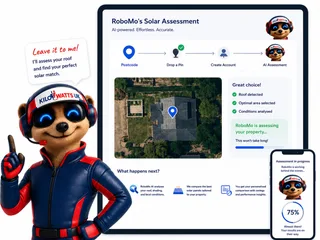
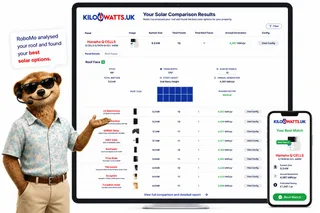
STEP 1
Choose Home, Business or Industrial
Enter your postcode to start your assessment.
STEP 2

Drop a pin on your roof
STEP 3

Create your free account
STEP 4

Sit back and watch RoboMo™ work
RoboMo™ analyses your roof and builds your personalised solar comparison.

Step 1
Enter your postcode
Start designing your wind energy system in seconds.
Are you an installer, distributor or renewable energy business?
Kilowatts UK is expanding the Flower Turbines partner network across the UK.
Become A Flower Turbines PartnerKilowatts UK is an authorised representative
Flower Turbines
Compact vertical-axis turbines built for real UK sites, not just open farmland.
They start in light wind, sit in a small footprint, and are bird-safe by design. Cluster them as a bouquet and the group performs better together than the same turbines standing alone. Enter your postcode for a location-based generation estimate. Figures use area weather data and will differ if buildings, trees or hills sit in the way.
Starts in light UK wind
Built to generate in typical UK wind, not only open farmland.
Small rooftop or ground footprint
Compact towers for roofs, yards and tight sites.
Bird-safe slow rotation
Slow vertical-axis spin, bird-safe by design.
Bouquet clusters raise output
Grouped turbines outperform the same units standing alone.
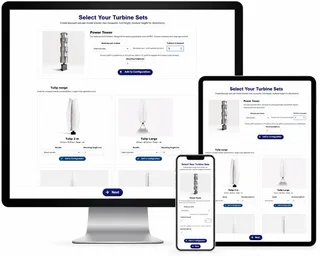
STEP 2

Choose a location
STEP 3

Place your cluster
Tap the map where you want the turbine cluster to go.
STEP 4

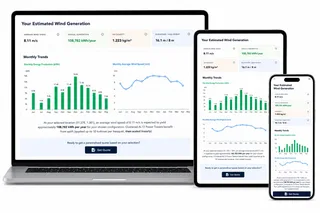
Instant generation forecasts
Compare different turbine layouts and see annual generation forecasts instantly.
STEP 5

No commitment required
Explore different configurations before deciding whether to request a quotation.
Related articles
Mo's Mission Nominations
FAQ
Need Help? RoboMo's Got Answers
What is commercial solar ROI?
Commercial solar ROI is the financial return a business receives from installing solar PV. It is usually measured through simple payback, lifetime savings, net present value, internal rate of return, or post-tax return. Simple payback shows how long it takes for electricity savings and export income to recover the installation cost, but a fuller ROI model should also include maintenance, inverter replacement, finance costs, tax treatment, system degradation, and changes in electricity prices.
How long does commercial solar take to pay back in the UK?
Commercial solar payback in the UK commonly falls around 3 to 8 years, but the actual figure depends on the site. Businesses with high daytime electricity use, a suitable roof, straightforward grid connection, and high avoided electricity costs often see stronger returns. Payback can be longer where the system exports a large share of generation, installation costs are high, tariffs are low, or roof, lease, planning, or grid issues add cost.
What has the biggest impact on commercial solar ROI?
The biggest driver is usually how much solar electricity the business can use on site while it is being generated. Self-consumed solar normally replaces imported electricity, which is usually worth more than exported electricity. Other major factors include installation cost, roof condition, system size, electricity tariff, export rate, DNO connection limits, finance structure, maintenance costs, tax treatment, and whether the business expects its electricity use to change.
Why does daytime electricity use matter for commercial solar?
Solar PV generates during daylight, with higher output in spring and summer. A business that uses electricity at the same time can reduce imported grid electricity and improve ROI. Sites such as factories, cold stores, leisure centres, food processors, farms, retail units, and seven-day operations often have better solar matching than buildings with low daytime loads or long summer shutdowns.
Is it better to install as many solar panels as possible?
Not always. The best financial design is often the system size that maximises valuable self-consumption, not necessarily the largest system that fits on the roof. Oversizing can still make sense if export terms are strong, future electricity demand is expected to grow, or the business has wider carbon reduction goals. However, if most extra generation would be exported at a low rate, a smaller system may produce a better ROI.
How should a commercial solar ROI calculation be done?
A reliable ROI calculation should estimate annual solar generation, split that generation into electricity used on site and electricity exported, then value each part separately. It should use real demand data where possible, ideally half-hourly electricity data, and should include installed cost, maintenance, inverter replacement, degradation, export income, finance costs, tax assumptions, insurance requirements, and any grid or enabling works. Standing charges should usually not be treated as savings because they often remain after solar is installed.
Why is half-hourly electricity data important?
Half-hourly electricity data shows when a business actually uses power, which is essential for estimating how much solar generation will be used on site. Annual consumption alone can be misleading because it does not show weekend closures, seasonal shutdowns, overnight loads, or short demand peaks. For businesses on complex tariffs, half-hourly data also helps value solar against the actual import cost avoided in each period.
How do complex electricity tariffs affect solar ROI?
Complex commercial tariffs can include time-of-use rates, seasonal prices, capacity charges, demand charges, DUoS and TNUoS elements, reactive power charges, and supplier pass-through costs. Solar ROI should be calculated against the avoidable cost in each relevant period rather than a simple blended average rate. Solar may reduce some demand-related costs, but only if generation reliably coincides with the site’s chargeable peaks.
How much does commercial solar cost in the UK?
Commercial solar costs vary by project size and site complexity. Small commercial rooftop systems may cost around £900 to £1,300 per kWp installed, medium systems often sit around £700 to £1,100 per kWp, and larger straightforward commercial or industrial rooftops may fall below £700 to £900 per kWp. Costs can increase where there are roof repairs, asbestos works, structural strengthening, complex access, switchgear upgrades, long cable routes, export limitation, planning conditions, or battery storage.
How much electricity does commercial solar generate in the UK?
A well-designed UK commercial rooftop solar system commonly generates around 800 to 1,100 kWh per kWp per year. Output depends on location, roof orientation, pitch, shading, panel layout, inverter design, soiling, downtime, and maintenance. Sites in southern England often perform towards the higher end of the range, while northern, Scottish, upland, shaded, or less optimally oriented sites may generate less.
Is exported solar electricity worth the same as electricity used on site?
Usually not. Electricity used on site normally avoids the cost of buying power from the grid, including some energy and non-energy elements of the import tariff. Exported electricity is paid separately and is often worth less per kWh than the imported electricity it could have replaced. This is why a solar ROI model should separate self-consumption from export rather than valuing all generation at the same rate.
Can battery storage improve commercial solar ROI?
Battery storage can improve ROI where a business exports low-value solar during the day but imports more expensive electricity later, has strong time-of-use price differences, faces predictable peak demand charges, or has export constraints. However, batteries do not automatically improve returns. A battery should be modelled separately from solar and should include usable capacity, round-trip efficiency, degradation, cycle limits, warranty terms, maintenance, fire safety requirements, and replacement assumptions.
Will solar and battery storage keep my business running during a power cut?
Not automatically. A standard grid-connected solar PV or solar-plus-battery system will usually shut down during a power cut for safety unless it has been specifically designed for backup operation. Resilience requires additional design, protection, isolation, load management, and clear decisions about which circuits or equipment need support. If backup power is part of the business case, it should be specified at the start.
Do commercial solar panels need planning permission?
Many commercial rooftop solar installations in England may fall under permitted development if they meet the relevant conditions, but planning permission may still be required for listed buildings, conservation areas, National Parks, sensitive locations, or designs that exceed permitted limits. Scotland, Wales, and Northern Ireland have different rules. Planning should be checked early because consent requirements can affect cost, timing, design, and ROI.
Does a commercial solar system need DNO approval?
Many commercial solar installations need approval from the Distribution Network Operator, especially larger systems or systems that may export electricity to the grid. The DNO may limit export capacity, require protection equipment, request metering changes, or specify reinforcement works. Export limits can materially affect ROI, so grid assumptions should be checked before relying on headline savings.
What roof checks are needed before installing commercial solar?
A commercial roof should be checked for condition, remaining roof life, structural capacity, wind loading, fragility, asbestos, corrosion, rooflights, shading, access, fire routes, maintenance walkways, and cable routes. If the roof needs replacement soon, solar may create future removal and reinstatement costs. A strong financial case can change quickly if roof repairs, structural strengthening, or access constraints are discovered late.
How do leases and landlords affect commercial solar ROI?
Leases can be critical because the tenant may pay the electricity bill while the landlord owns the roof. Before proceeding, the parties should agree who funds the system, who owns the equipment, who receives savings and export income, who maintains and insures it, how roof access works, and what happens at lease expiry, break clause, assignment, roof repair, property sale, or removal. A short lease can weaken ROI if the tenant may leave before payback.
Is commercial solar suitable for every business?
No. Commercial solar is usually strongest for owner-occupiers or long-term tenants with high daytime electricity use, a sound roof, predictable operations, and a workable grid connection. It may be less suitable where the roof needs replacement, the structure cannot support the system without expensive works, the business has low daytime demand, export is heavily restricted, the lease is short, or the building is likely to be sold, vacated, redeveloped, or re-roofed.
What ongoing costs should be included in commercial solar ROI?
A realistic ROI model should include monitoring, inspection, testing, maintenance, cleaning where needed, fault response, insurance requirements, metering costs, inverter replacement, and any finance charges. It should also allow for panel degradation and possible downtime. Excluding these costs can make a payback estimate look better than the true long-term investment case.
Are there government grants for commercial solar in the UK?
There is no universal upfront UK grant scheme for commercial solar, and the Feed-in Tariff is closed to new applicants. Businesses may benefit from export payments, tax treatment, capital allowances where applicable, local or sector-specific schemes, or finance options, but availability and eligibility vary. Any grant, tax, or allowance assumption should be checked before it is included in the ROI model.
How does tax affect commercial solar ROI?
Tax treatment can materially affect post-tax ROI. Capital allowances may apply to qualifying solar PV expenditure depending on the rules at the time and the business structure. VAT, leases, hire purchase, power purchase agreements, and accounting treatment can also change the financial outcome. Businesses should take professional tax advice rather than relying on generic assumptions.
What is the best way to compare commercial solar quotes?
Compare quotes using the same assumptions for system size, generation, self-consumption, export value, import tariff, maintenance, inverter replacement, finance, tax, grid connection, roof works, and battery storage. A good proposal should show on-site savings separately from export income, explain DNO and planning assumptions, state what is included in the installed cost, and provide sensitivity testing rather than relying only on an optimistic payback figure.