


Asset finance vs lease vs PPA vs PAYG in the UK
Published: 2026-07-18 20:02:13
Updated: 2026-07-27 09:45:04
Find out commercial solar finance comparison in the UK, including costs, what affects price, and how to choose an installer.
Asset finance, lease, PPA and PAYG in brief
Asset finance usually suits a UK business that wants to own the solar PV system and keep the strongest long-term savings. A lease suits businesses that want predictable payments and a defined use-of-asset arrangement. A PPA, or Power Purchase Agreement, suits sites wanting little or no upfront capital cost in return for a long-term electricity purchase commitment. PAYG, or pay-as-you-go solar, can suit flexible service-led arrangements, but it is less standardised in the UK commercial rooftop market.
The right answer depends on daytime electricity use, roof condition, grid connection, tax position, credit strength, landlord consent, and how long the business expects to remain on site. For a commercial solar project, the headline panel price is only one part of the decision. The more important questions are:
- Who owns the solar asset?
- Who funds it?
- Who maintains and insures it?
- Who receives export income?
- Who benefits from capital allowances or other tax treatment?
- Who carries risk if generation, electricity prices, occupancy, or roof condition changes?
For many owner-occupiers with stable demand and taxable profits, asset finance can produce the best lifetime result because the business can own the system after the finance period and continue using generated electricity for many years. For businesses that cannot or do not want to use capital, a PPA or lease can be more practical. For tenants, multi-let sites, older roofs, or uncertain occupancy, the finance model may be secondary to property consent, roof access rights, and contract exit terms. As a simple guide, UK commercial rooftop solar generation is often modelled at around 750 to 1,000 kWh per kWp per year depending on location, orientation, pitch, shading, and design. A 200 kWp system might therefore generate roughly 150,000 to 200,000 kWh a year before degradation and site-specific losses. The financial value depends heavily on how much of that electricity is used on site rather than exported. What happens at the end of the contract?
Quick decision matrix for UK businesses
A simple way to compare the options is to start with ownership, commitment length, and risk allocation. If the business wants maximum control and can support repayments, asset finance is often the first model to test. If the business wants another party to own and maintain the system, a PPA or PAYG structure may be more suitable, provided the long-term contract terms are acceptable.
Asset finance: Best considered where the business wants ownership, has a stable site, uses a good proportion of electricity during daylight, and can access suitable borrowing. Lease: Best considered where fixed payments and simpler budgeting matter more than outright ownership from day one. PPA: Best considered where the site has a strong daytime load, good credit profile, and appetite for a long-term electricity purchase commitment. PAYG: Best considered where a provider offers a clear service model with transparent metering, billing, maintenance, exit, and ownership terms.
In practice, businesses often compare commercial solar options side by side. A low monthly payment can still be poor value if indexation is high, maintenance exclusions are wide, export income is retained by another party, or the contract is difficult to exit. A higher repayment under asset finance may still be attractive if the system is owned after the finance term and continues generating for 20 to 30 years.
What each finance route means
Asset finance means the business funds the solar system through debt or asset-backed finance. This can include hire purchase, a finance lease, or a secured business loan. Under some structures the business owns the system at the end of the term, while under others the funder may own it during the agreement. Terms vary, but commercial asset finance is often modelled over several years rather than over the full technical life of the solar PV system.
The business usually receives most of the electricity benefit under asset finance, but it also carries more responsibility for maintenance, insurance, monitoring, and performance risk. That means the financial model should include realistic operating costs, inverter replacement, insurance implications, and degradation. Solar panels are often warranted for 20 to 30 years, but inverters may need replacement earlier, commonly around the 10 to 15-year point depending on equipment, duty, and warranty terms.
A lease is closer to paying for the use of the system over an agreed period. Payments are normally fixed or indexed, and the contract should explain who owns the equipment, who maintains it, what happens at the end of the term, and whether the business can buy, extend, or remove the system. Modern accounting treatment can mean some leases still affect the balance sheet, so this should not be assumed away. UK businesses should ask their accountant how the arrangement would be treated under their reporting framework. A PPA, or Power Purchase Agreement, normally means a third-party investor pays for, owns, and maintains the solar system. The host site buys the electricity generated by the system, usually at a rate agreed in the contract. That rate may be fixed, indexed, or linked to market prices. PPAs can remove upfront capital expenditure, but they create a long-term payment obligation and often require roof access rights, metering rules, insurance provisions, and buyout terms. UK commercial rooftop PPAs are often long-term contracts. The exact term depends on system size, credit quality, electricity demand, property rights, and funder requirements, but businesses should expect to review the agreement as a major property and energy contract rather than a simple utility tariff. PAYG, or pay-as-you-go solar, is less standardised. It may be structured around generation, actual consumption, or a monthly service charge. It can look attractive where flexibility is important, but the details matter. The business should understand exactly how payments are calculated, whether savings are realistic, who owns the equipment, what happens if the site closes, and how faults are handled. A practical comparison should therefore show not only the starting payment, but also the total expected cost over the contract, the ownership position at the end, and the sensitivity to lower generation or lower self-consumption.
How costs and savings differ
Commercial solar costs vary widely because roof access, structural requirements, cable routes, grid works, scaffolding, craneage, surveys, and shutdown constraints can be as important as the panel price. As a broad UK guide, small commercial rooftop systems of around 30 kWp to 100 kWp often sit at about £800 to £1,200 per kWp. Medium systems of around 100 kWp to 500 kWp often sit at about £650 to £1,000 per kWp. Larger simple rooftop systems above 500 kWp can sometimes be below £700 per kWp.
Those ranges are indicative and can be misleading if the roof is complex. Costs can rise where there is asbestos, fragile roofing, roof strengthening, long AC cable routes, restricted access, edge protection, craneage, export limitation equipment, or work that must be completed out of hours. Commercial solar battery storage should usually be assessed separately, because it can improve self-consumption but is not automatically financially justified.
A well-designed UK commercial solar system often generates around 750 to 1,000 kWh per kWp per year depending on location, roof orientation, pitch, shading, and design. Southern England sites tend to sit toward the higher end of that range, while Scotland and northern sites tend to sit lower. East-west layouts may generate less per kWp than a south-facing layout, but they can cover more roof area and spread output across the working day. Self-consumption is usually more valuable than export. A business saving imported electricity normally receives more value than it would from exporting surplus generation. Export income depends on the export tariff or offtake arrangement, and eligible smaller systems may be able to use the Smart Export Guarantee where suitable metering and installation evidence are in place. Ofgem provides guidance on the Smart Export Guarantee, but commercial eligibility and rates depend on supplier terms, metering, and installation evidence. A simple worked example shows why the finance model and load profile matter. These numbers are illustrative only: If the site uses 70% of solar generation on site, the annual energy value before finance, tax, maintenance, and degradation would be about:
- 119,000 kWh self-consumed at 22p = £26,180
- 51,000 kWh exported at 6p = £3,060
- Total indicative annual value = £29,240
- 68,000 kWh self-consumed at 22p = £14,960
- 102,000 kWh exported at 6p = £6,120
- Total indicative annual value = £21,080
If the same system only achieves 40% self-consumption, the annual energy value falls to about: That gap can decide whether asset finance, lease, PPA, or PAYG is suitable. It also explains why half-hourly electricity data is more reliable than annual consumption alone. UK government support for commercial solar is more tax-led and export-payment-led than grant-led for most businesses. There is no broad UK grant scheme covering most commercial rooftop installations. Annual Investment Allowance, full expensing, writing-down allowances, VAT recovery, business rates treatment, and capital allowances can all affect the comparison, but they depend on the exact entity, ownership structure, location, and contract. HMRC guidance on capital allowances should be checked with a tax adviser. A PPA usually leaves ownership-related tax benefits with the asset owner rather than the site user. Business rates treatment also needs care because rules can differ across England, Scotland, Wales, and Northern Ireland, and they may depend on whether electricity is mainly used on site or exported. The Valuation Office Agency and devolved rating bodies should be checked before assuming a particular outcome.
What lenders, lessors and PPA providers look for
Finance approval is not based only on the technical design. Funders want confidence that the customer can meet its obligations and that the asset can remain in place long enough to produce value. A business with strong accounts, stable operations, owner-occupied premises, and high daytime electricity consumption will usually have more options than a short-term tenant with uncertain demand.
PPA providers often prefer larger systems, reliable counterparties, and sites where most solar electricity will be used onsite. If a warehouse has a very large roof but little electricity demand, the project may become export-led and less attractive unless the export route is strong. Manufacturers, cold stores, logistics hubs, retail sites with refrigeration, leisure centres, hotels, and daytime-heavy offices can be better matched to solar output. Larger sites may also need to compare industrial solar options where system size, load profile, and grid constraints are more complex.
Leasing and asset finance providers will also look at credit strength, existing borrowing, security, profitability, trading history, and the business’s ability to make payments under conservative assumptions. Some SMEs may be asked for security or personal guarantees. Where credit capacity is needed for core trading activity, a no-upfront-cost model may be more appealing even if it gives up some long-term upside. Funders and PPA providers will commonly review: Recent accounts and management accounts. Trading history and credit profile. Property ownership or remaining lease term. Landlord and lender consent where relevant. Half-hourly consumption data. Current and expected electricity tariffs. PAYG providers need particularly careful due diligence because the UK commercial market is less standardised. The provider’s ability to monitor, bill, maintain, and support the system over the full term matters as much as the headline price. Businesses should ask for sample bills, metering methodology, service levels, fault response commitments, and a clear explanation of what happens if the site closes or changes occupier. Roof condition, structural capacity, and remaining roof life. DNO export position and metering requirements. Insurance, access, and maintenance arrangements. Contract assignment and exit rights.
Property, roof and grid issues that change the answer
The best finance model can fall away if the roof, landlord, or grid connection does not support the project. A desktop quote is useful for early comparison, but it is not enough for final commitment. Structural checks, roof condition, access design, DNO status, and property rights can all change the system size and the contract structure.
A tenant will normally need landlord consent before installing solar. For a PPA, the provider may require a roof lease, access agreement, or rights that survive a property sale. The building mortgagee may also need to consent. Break clauses, dilapidations, reinstatement costs, and assignment rights should be reviewed before the business signs a long-term agreement.
Grid connection is another common constraint. Smaller systems may fall under G98 or relevant G99 fast-track arrangements, while larger or more complex systems often need a G99 application. The local Distribution Network Operator may approve full export, require export limitation, or specify upgrade works. Import capacity does not automatically mean export capacity is available. The Energy Networks Association provides information on connecting generation to the distribution network, including G98 and G99 processes. Roof safety and condition can be just as important as electrical design. HSE guidance on asbestos and working at height should be considered where older commercial roofs, fragile materials, or skylights are present. Solar should not be used to postpone necessary roof works, because removing and reinstalling panels later can be expensive.
- Roof age and remaining warranty period.
- Structural capacity and wind loading.
- Asbestos, fragile roof areas, and skylights.
- Shading from parapets, roof plant, trees, and nearby buildings.
- Fire access routes and maintenance walkways.
- Access for future roof repairs.
Roof works are often best completed before solar installation. Removing and reinstalling a funded solar system later can be expensive, and responsibility for those costs should be written into the contract. For a PPA or lease, the host business should check whether roof repairs trigger compensation, downtime payments, or extension of the agreement. DNO export limits and metering requirements. Building insurance requirements. Landlord, mortgagee, and superior landlord consent. Dilapidations and reinstatement obligations.
Comparing proposals without being misled
The most reliable commercial solar finance comparison uses half-hourly consumption data, not only annual electricity bills. Annual consumption can hide weekend shutdowns, seasonal peaks, holiday periods, and daytime demand patterns. A school, factory, office, cold store, hotel, and warehouse can all have very different solar economics even with the same annual electricity use.
A robust proposal should separate generated electricity into self-consumed electricity and exported electricity. It should also show the import tariff used, the export assumption, degradation, maintenance costs, monitoring costs, inverter replacement, insurance implications, tax treatment, and any DNO or roof survey allowances.
For owner-funded or asset-financed systems, the comparison should show cash outflow, finance repayments, interest, maintenance, inverter allowance, tax assumptions, and residual asset value. For a PPA, it should show the PPA unit rate, indexation, expected annual payments, export treatment, buyout terms, and what happens if consumption falls. For a lease or PAYG model, it should show payment calculation, service obligations, end-of-term options, and exit costs. Missing half-hourly consumption analysis: The savings forecast may overstate onsite use and understate export. No clear export assumption: The model may treat surplus electricity as more valuable than it really is. No inverter replacement allowance: The forecast may ignore a likely major lifecycle cost. No degradation assumption: The model may treat year-one generation as if it continues unchanged. No indexation detail: A cheap starting PPA rate may become less attractive over time. No end-of-term wording: The business may not know whether it can buy, extend, remove, or transfer the system. Payback should not be shown without finance costs where finance is being used. Lifetime savings should be tested against lower generation, lower export prices, lower self-consumption, higher maintenance costs, and different future import price assumptions. A proposal that only works under aggressive electricity price inflation is weaker than one that still performs under conservative assumptions. A fair comparison should normalise each proposal using the same inputs: Businesses should also ask whether quoted savings are shown before or after VAT, corporation tax, capital allowances, finance interest, and maintenance. Different providers may present “savings” differently, so the assumptions should be made explicit. No maintenance responsibility — Fault response, monitoring alerts, and labour exclusions may be unclear. No insurance review — The business may miss premium, notification, or fire-risk requirements. No roof repair clause — The business may be exposed if panels need to be removed for roof works. No DNO allowance — Grid costs or export limitation may reduce the project benefit.
When each option may be unsuitable
None of the four routes is automatically right. The wrong contract can lock a business into payments that no longer suit its site, load profile, or property plans. The common mistake is focusing on the first-year saving while ignoring ownership, exit rights, roof repairs, indexation, and the value of the electricity after the finance term.
PAYG may be unsuitable
Payment rules are opaque, exit fees are high, metering is unclear, savings are not independently modelled, or the provider’s long-term service capability is uncertain.A PPA may be unsuitable
The site cannot commit to a long agreement, credit strength is weak, landlord rights are complex, roof access cannot be secured, or daytime consumption is too low for the system size.A lease may be unsuitable
The property lease is shorter than the solar lease, end-of-term obligations are unclear, accounting impact is unacceptable, or fixed payments exceed conservative energy savings.Asset finance may be unsuitable
The business has short site occupancy, weak cash flow, limited borrowing capacity, uncertain roof condition, limited daytime use, or little ability to use ownership-related tax benefits.
Short occupancy is one of the biggest warning signs. If the business may move within a few years, it should not assume that a buyer, landlord, or incoming tenant will accept the contract. Assignment, buyout, termination, and reinstatement provisions should be checked before the financial model is treated as bankable. A site with low daytime demand can also be a poor fit for an oversized system. Solar generation is strongest during daylight hours, so businesses with evening-heavy demand may need to consider a smaller system, battery storage, load shifting, or a different commercial arrangement. Battery storage can help in some cases, but it should be modelled against real half-hourly data rather than added automatically. Older roofs need particular caution. If the roof may need replacement within the solar contract term, the business should either complete roof works first or agree who pays for panel removal, storage, reinstatement, lost generation, and any PPA compensation during downtime.
Practical next steps before choosing
Before comparing asset finance, lease, PPA, and PAYG offers, gather the information that affects both technical design and finance approval. The better the input data, the more meaningful the comparison will be.
The last twelve months of electricity bills. Half-hourly consumption data where available. Current import unit rate, standing charge, and contract end date. Site address, MPAN, and metering details. Roof plans, roof age, and warranty information. Structural information and asbestos records where relevant.
Ask each provider to show ownership, maintenance, export revenue, indexation, buyout, exit, insurance, monitoring, fault response, roof access, and end-of-term treatment in writing. If two proposals use different assumptions, normalise them before deciding. A fair comparison should use the same electricity data, same export assumptions, same lifecycle costs, and the same view on roof and grid constraints. It is also sensible to involve the right advisers before signing: an accountant for tax and balance-sheet treatment, a solicitor for lease or PPA terms, an insurance broker for building and liability implications, and a competent solar designer for technical assumptions. This does not need to slow the project down, but it can prevent expensive surprises later. For many UK businesses, the best route is the one that matches the property plan as much as the energy plan. Ownership can create the strongest long-term benefit, but only where the business can carry the responsibilities. Third-party-owned models can reduce upfront cost, but the contract must be strong enough to live with for many years. Property ownership or remaining lease term. Landlord consent position for tenant sites. Building insurance requirements. Planned roof works or redevelopment. Planned load changes such as commercial EV charger installation or electrified heating. Credit and tax information needed for finance assessment.
Plan, Compare & Buy Renewable Energy Solutions
AI does the thinking.
You get the perfect solar match.
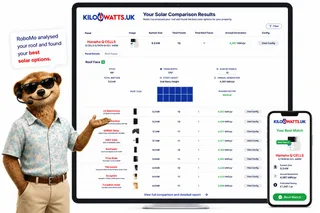
Use RoboMo™ to assess your property, compare available technologies and connect with trusted UK installers, suppliers and manufacturers.
Simply enter your postcode, drop a pin on your roof, create your free account and let RoboMo™ analyse your property to find the best solar panels for your home.

You don't have to think
RoboMo™'s AI analyses your roof and does all the hard work.

Accurate & tailored
AI-powered assessment based on your roof, location, and conditions.

Best options, maximum savings
Compare top solar panels for the best performance and value.

Simple, fast & effortless
Provide a few details, sit back and watch your results unfold.
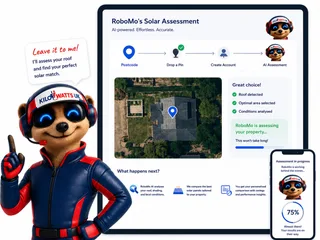
STEP 1
Choose Home, Business or Industrial
Enter your postcode to start your assessment.
STEP 2

Drop a pin on your roof
STEP 3

Create your free account
STEP 4

Sit back and watch RoboMo™ work
RoboMo™ analyses your roof and builds your personalised solar comparison.

Kilowatts UK is an authorised representative
Flower Turbines
Compact vertical-axis turbines built for real UK sites, not just open farmland.
They start in light wind, sit in a small footprint, and are bird-safe by design. Cluster them as a bouquet and the group performs better together than the same turbines standing alone. Enter your postcode for a location-based generation estimate. Figures use area weather data and will differ if buildings, trees or hills sit in the way.
Starts in light UK wind
Built to generate in typical UK wind, not only open farmland.
Small rooftop or ground footprint
Compact towers for roofs, yards and tight sites.
Bird-safe slow rotation
Slow vertical-axis spin, bird-safe by design.
Bouquet clusters raise output
Grouped turbines outperform the same units standing alone.
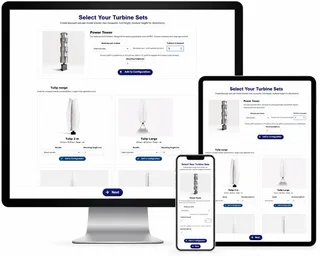
Step 1
Enter your postcode
Start designing your wind energy system in seconds.
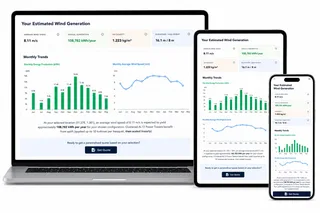
STEP 2

Choose a location
STEP 3

Place your cluster
Tap the map where you want the turbine cluster to go.
STEP 4

Instant generation forecasts
Compare different turbine layouts and see annual generation forecasts instantly.
STEP 5

No commitment required
Explore different configurations before deciding whether to request a quotation.
Related articles
Mo's Mission Nominations
FAQ
Need Help? RoboMo's Got Answers
What is the difference between asset finance, a lease, a PPA and PAYG solar?
Asset finance usually means the business funds the solar PV system through borrowing or asset-backed finance and may own the system during or after the finance term, depending on the agreement. A lease means the business pays for use of the system under agreed terms, with ownership and end-of-term options set out in the contract. A PPA, or Power Purchase Agreement, usually means a third party funds, owns and maintains the system while the site buys the electricity it generates. PAYG, or pay-as-you-go solar, is a more flexible service-led model where payments may be linked to generation, consumption or a monthly service charge, but it is less standardised in the UK commercial rooftop market.
Which commercial solar finance option gives the best long-term savings?
Asset finance often gives the strongest lifetime savings for owner-occupiers or stable tenants that can support repayments, use a high proportion of solar electricity on site and want to own the system after the finance period. This is because the business can continue benefiting from generated electricity for many years after the main finance cost ends. A PPA, lease or PAYG arrangement may still be better where preserving capital, avoiding ownership responsibility or simplifying operation is more important than maximising long-term return.
Is a commercial solar PPA really no upfront cost?
A commercial solar PPA can involve little or no upfront capital cost because the system is normally funded by a third-party investor. However, it is not free solar. The business commits to buying electricity from the system under a long-term contract, usually with rules covering the unit rate, indexation, metering, roof access, maintenance, buyout rights, assignment and termination. The value of a PPA depends on whether the agreed electricity price remains attractive over the contract term and whether the site can reliably use the generated power.
Who owns the solar panels under each finance model?
Under asset finance, ownership depends on the finance structure and may sit with the business from the start or transfer at the end of the agreement. Under a lease, the lessor often retains ownership unless the contract includes a purchase option or transfer mechanism. Under a PPA, the third-party investor or provider usually owns the solar asset. Under PAYG, ownership varies by provider, so the contract should clearly state who owns the equipment, who can remove it, and what happens at the end of the term.
What information is needed to compare solar finance proposals properly?
The most useful information includes 12 months of electricity bills, half-hourly consumption data, current import tariff, export assumptions, MPAN and metering details, roof plans, roof age, structural information, asbestos records where relevant, property ownership or lease details, landlord consent position, insurance requirements and any planned changes to electricity demand. Half-hourly data is especially important because annual electricity use alone does not show when power is being consumed, and solar savings depend heavily on daytime self-consumption.
Why is self-consumption so important for commercial solar?
Self-consumption is important because electricity used on site usually has a higher value than electricity exported to the grid. If a business avoids buying electricity at its import rate, the saving is often much greater than the payment it would receive for surplus exported power. Two sites with the same system size and generation can have very different returns if one uses most of the solar output during the working day and the other exports a large share.
How much electricity does a commercial solar system generate in the UK?
A UK commercial rooftop solar system is often modelled at around 750 to 1,000 kWh per kWp per year, depending on location, roof orientation, pitch, shading, layout and equipment design. For example, a 200 kWp system might generate roughly 150,000 to 200,000 kWh per year before allowing for degradation and site-specific losses. Southern locations and well-orientated roofs often perform toward the higher end of the range, while shaded, complex or northern sites may generate less.
What costs should be included in a commercial solar finance comparison?
A fair comparison should include installation cost, finance repayments or PPA payments, interest, maintenance, monitoring, inverter replacement, insurance implications, grid connection costs, export limitation equipment if needed, roof survey costs, access equipment, lifecycle degradation and end-of-term costs. It should also show who receives export income, who is responsible for faults, who pays if panels need to be removed for roof repairs, and whether payments increase through indexation.
Can tenants install commercial solar panels?
Tenants can often install commercial solar panels, but they usually need landlord consent and may also need approval from a mortgagee, superior landlord or managing agent. The remaining property lease term must be long enough to support the solar contract, especially for a PPA or lease. Tenants should review break clauses, dilapidations, assignment rights, reinstatement obligations, roof access rights and what happens if the business moves before the solar agreement ends.
What role does the roof condition play in choosing a solar finance option?
Roof condition can decide whether a project is viable at all. If the roof is old, fragile, asbestos-containing, shaded, structurally limited or likely to need replacement during the solar contract term, the business should address this before signing. Removing and reinstalling panels later can be expensive, and under a PPA or lease there may also be downtime, compensation or contract extension issues. Roof works are often best completed before the solar installation.
Does a commercial solar project need grid approval?
Many commercial solar projects need notification or approval through the Distribution Network Operator, commonly under G98 or G99 processes depending on system size and connection characteristics. The DNO may approve the proposed export level, require export limitation or specify network upgrade works. Import capacity does not automatically mean export capacity is available, so grid position should be checked before treating a financial model as final.
Are there grants for commercial solar panels in the UK?
For most UK businesses, commercial solar support is more commonly tax-led and export-payment-led than grant-led. There is no broad UK grant scheme that covers most commercial rooftop installations. Tax treatment may involve Annual Investment Allowance, full expensing, writing-down allowances, VAT recovery, business rates and capital allowances, depending on the business, location, ownership structure and contract type. A PPA will usually leave ownership-related tax benefits with the asset owner rather than the host site.
How long are commercial solar PPAs?
Commercial rooftop PPAs are typically long-term agreements, because the third-party investor needs enough time to recover the installation cost and earn a return. The exact term depends on system size, electricity demand, credit quality, roof rights, grid position and funder requirements. A business should treat a PPA as a major energy and property contract rather than a simple electricity tariff, especially where it includes roof access rights, buyout clauses, indexation and assignment provisions.
What happens at the end of a solar finance agreement?
The end-of-term outcome depends on the contract. Under asset finance, the business may own the system outright after the finance term or may have a final payment or transfer process. Under a lease, the business may be able to extend, buy, return or remove the system depending on the wording. Under a PPA, there may be options to buy the system, extend the agreement or have it removed. PAYG contracts vary, so end-of-term ownership, removal costs and renewal terms should be confirmed in writing.
When might asset finance be unsuitable for commercial solar?
Asset finance may be unsuitable where the business has weak cash flow, limited borrowing capacity, uncertain site occupancy, a poor roof condition, low daytime electricity demand or little ability to benefit from ownership-related tax treatment. It can also be less attractive if the business wants to preserve credit capacity for core trading activity. Although asset finance can produce strong lifetime savings, the business carries more responsibility for repayment, maintenance, insurance and performance risk.
When might a PPA, lease or PAYG model be unsuitable?
A PPA may be unsuitable where the site cannot commit to a long-term agreement, roof rights are complicated, credit strength is weak or daytime demand is too low for the proposed system size. A lease may be unsuitable if payments exceed conservative savings, the property lease is shorter than the solar lease or end-of-term obligations are unclear. PAYG may be unsuitable if metering, billing, maintenance, exit fees or ownership terms are not transparent.
Should battery storage be included with commercial solar finance?
Battery storage can improve self-consumption by storing surplus solar electricity for later use, but it is not automatically financially justified. It should be modelled separately using half-hourly consumption data, import tariffs, export value, battery cost, cycle assumptions, degradation, maintenance and available revenue opportunities. For some sites, a smaller solar system without a battery may provide a better return than a larger system with storage.
What should a business check before signing a commercial solar contract?
Before signing, the business should confirm ownership, payment terms, indexation, export income, maintenance responsibility, monitoring, fault response, insurance, roof access, DNO position, tax assumptions, buyout rights, assignment rights, termination costs and end-of-term options. It is also sensible to involve an accountant, solicitor, insurance broker and competent solar designer before committing, because the contract affects property, energy costs, tax, accounting and operational risk.