


Net zero reporting and on-site solar for UK companies: UK
Published: 2026-09-28 20:49:39
Updated: 2026-09-29 15:51:53
On-site solar supports UK company net zero reporting only where self-use cuts the electricity bought. Export does not reduce the Scope 2 total.
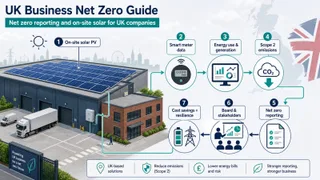
Net zero reporting and on-site solar for UK companies - UK business guide
UK business guide B Solar Scope 2 and SECR
Net zero reporting and on-site solar for UK companies
On-site solar can support net zero reporting for UK companies only where it cuts the electricity the organisation actually buys, inside the boundary used for the report. That self-consumed output can lower a Scope 2 figure and the purchased-electricity line in a Streamlined Energy and Carbon Reporting disclosure. Exported generation is not, in ordinary practice, a deduction from that total, and the array does not by itself make the company net zero.
The result turns on whose inventory the site sits in, who owns the plant and the renewable certificates, whether generation matches the building's demand, and which duty is being filed. A voluntary pathway, a SECR report and a public-contract carbon reduction plan are separate exercises.
Net zero reporting and on-site solar for UK companies is settled by meters and contracts, not by a panel brochure. Finance, sustainability and facilities teams need to decide whether a behind-the-meter system can be used in a statement they already have to make, and what evidence will stand up. A green tariff, an off-site contract and a rooftop array are not substitutes for one another. Price against grid electricity is a later question, and it is not answered by a national figure.
What a company net zero claim actually requires
The UK net zero target, in the Climate Change Act 2008 as amended, is a national goal of net zero greenhouse gas emissions by 2050. That target does not by itself require every company to publish a net zero report. In corporate use, net zero usually means a voluntary pathway to cut emissions deeply and neutralise what remains. It is not a single-year inventory, and it is not a carbon-neutral claim built mainly on offsets.
Inventories use scopes, and the split decides what a roof can change. Scope 1 is direct emissions from controlled sources such as boilers and owned vehicles. Scope 2 is indirect emissions from purchased electricity, heat, steam and cooling. Scope 3 is other value-chain emissions. On-site solar affects Scope 2 only where it changes the electricity the organisation buys. If panel manufacture is counted at all, it sits in Scope 3, not as a credit against the rooftop output.
A large array can therefore leave most of a reported footprint untouched. Gas heat, fleet fuel, process emissions and purchased goods do not fall because the roof is generating. If a later project electrifies heat, the Scope 2 line can grow, and the same array then covers a different slice of the inventory. The narrative has to follow that shift rather than freeze the first year's wording.
What SECR records, and where solar appears
Streamlined Energy and Carbon Reporting is a UK duty under the Companies (Directors' Report) and Limited Liability Partnerships (Energy and Carbon Report) Regulations 2018. It applies to quoted companies and to large unquoted companies and large LLPs. It calls for energy use, the related emissions, an intensity metric and a short account of energy efficiency action, with the method stated. It follows company type and size, not the existence of a net zero slogan.
Size tests come from company law and have been revised, so they have to be taken from the rules for the financial year in question. The regime also has a low-energy-use exemption. Its threshold should be read from the regulations and the government environmental reporting guidance for that year, not carried forward from memory or from another group's accounts. In outline, quoted companies report on a wider basis than large unquoted companies and LLPs, which report UK energy and related emissions. An array enters the inventory only if the site sits inside the organisational boundary used for that report.
Solar appears as a change in purchased energy and in the efficiency narrative, not as a badge. If import falls, the energy-use figure can fall, and the emissions figure follows the conversion factor stated for that year. The intensity metric can still move the other way if the denominator changes, for example if floor area or output shrinks. The narrative should say what was commissioned, when, and what was measured. It should not describe a future array as if it had already saved energy in the year under review. A carbon reduction plan prepared because the company supplies central government is not a SECR filing. ESOS and a science-based target are different regimes again. Completing one does not satisfy the others. Any value test and template for a public-procurement plan should be read from the contract documents in force, not assumed from SECR guidance.
Which kilowatt-hours change Scope 2
UK reporters normally use the government greenhouse gas conversion factor for the reporting year. That factor is reissued annually and should not be copied from an old spreadsheet into a new filing. Location-based Scope 2 uses a grid-average factor. Market-based Scope 2 uses contractual instruments. A supplier slogan is not a factor. Whether a directors' report is expected to show both figures should be confirmed against the guidance for that financial year. Do not assume disclosure practice from an older template.
A kilowatt is a rate of power. A kilowatt-hour is the quantity that enters the inventory. Self-consumed solar reduces the kilowatt-hours on the import meter. That quantity feeds a location-based Scope 2 calculation. Exported solar does not, in ordinary greenhouse-gas accounting practice, come off the Scope 2 total. Export can be described separately, as generation sold or as an avoided-grid figure outside the scopes. It is not a negative line in the directors' report total. Scope 2 guidance has been under review. Claims about future hourly matching, or about the end of annual certificate practice, need a dated source. Until that is confirmed, describe current practice and say that it can change.
The practical test is a meter diagram, not a yield estimate. Import, generation and export are three different numbers. Only the overlap between generation and site demand, measured rather than modelled, is import avoided. For the carbon report, commercial solar is compared with grid electricity by multiplying avoided import by that year's conversion factor. It is not a standing price advantage. There is no single kilogram figure for grid electricity that can be hardcoded. A Renewable Energy Guarantee of Origin is an Ofgem certificate issued per megawatt-hour of eligible renewable generation. It is an attribute record, not the kilowatt-hour on the import meter. Selling the certificates and still telling customers that the site is powered by that solar double-counts the same attribute. Marketing claims remain subject to the Competition and Markets Authority's Green Claims Code and to Advertising Standards Authority rules, even where the SECR arithmetic is sound.
How green tariffs, contracts and rooftop solar differ
A green tariff, an off-site contract and a rooftop array answer different reporting questions. A properly evidenced green tariff is a market-based claim about electricity the company still buys. It does not change the location-based grid factor. It does not cut SECR purchased kilowatt-hours. Behind-the-meter use does cut purchased kilowatt-hours. An off-site power purchase agreement sits between those poles. Its carbon result follows the contract and whether instruments are retired against that supply, not the mere existence of a solar farm elsewhere. If a third party owns the array and the occupier buys the power, the occupier is still purchasing electricity. The factor is whatever the contract and the retired instruments support. Private-wire sales, landlord supplies and service-charge recharges need the same reading. The contract should say whose inventory the kilowatt-hour enters. Both parties should not claim it.
Overview
The table is a reporting map, not a ranking of products. A company that must show a fall in purchased energy will not get that fall from certificates alone. A company making a market-based claim about a green supply should not describe that claim as if the location-based total had also fallen. Where certificates from the roof are transferred to a supplier or an aggregator, the occupier should assume the market-based renewable claim has gone with them. That remains true even if grid import is lower because the power was used on site.
Why warehouses, offices and retail parks report differently
There is no single share of a company footprint that on-site solar will remove. An office with gas heat and a large Scope 3 total is not the same case as a warehouse or cold store with a flat daytime electrical load. A shop or retail park unit open into the evening is different again. Output per kilowatt-peak is site-specific. Latitude, tilt, orientation, shading, soiling and downtime all change it. The figure in a report should come from measured data or from a project calculation, not from a national average.
Load shape decides how much generation can displace import. A daytime warehouse load is more likely to absorb midday output than a retail unit whose trade peaks after the array has fallen away. That does not make the warehouse a guaranteed saving. It does not make the shop a write-off. It means the self-consumption assumption has to be built from the site profile, using half-hourly data where it exists, rather than from roof area. Evening demand can be served by the grid, shifted by storage, or left outside what the array can cover. None of those options is continuous renewable supply from panels that generate only in daylight.
Tenure and the network decide whether that output exists in the year being reported. Commercial rooftop solar for UK offices, warehouses and retail parks depends on a right to use the roof for long enough, and on a connection the local distribution network operator will energise. Plant above the operator's small-scale limit generally needs an application, commonly under G99. The correct process should be confirmed for that capacity and that network. The offer can cap export, require reinforcement, or push energisation into a later reporting year. Export limitation can look helpful for the self-consumption share and still cut yield if the building cannot absorb midday generation. Energy that was curtailed was never generated, so it cannot be reported as a saving. On multi-let offices and retail parks the roof owner and the electricity user are often different reporters. A landlord who owns the plant and a tenant who pays for power through a recharge are not both entitled to the same reduction. Agree the commissioning date, any network-operator witnessing or energisation step, and the reporting calendar before the efficiency narrative is drafted. Planning, business rates, VAT and capital allowances differ by nation and between roof and ground-mount. Check them for the nation the building sits in. Do not copy them from domestic solar rules.
What evidence will stand up at year end
The reporting result is set by the contract and the meters, not by the brochure yield. The file that reaches the person signing the accounts should show how import, generation and export are metered. It should state who owns the plant and who owns the certificates for that year. If those statements disagree with the marketing line, the marketing line is the item that has to change.
Inverter portals are a weak audit trail for a statutory or voluntary inventory. They can help an operator spot a fault. They are a poor substitute for reads that reconcile to the import bill and to the financial year, including a partial first year. Output from a system commissioned part-way through the year is not a twelve-month result. Warranty length and the inverter replacement interval are product terms. They belong in the maintenance plan, taken from the warranty and the monitoring record, not in the carbon factor.
Connection design changes the carbon figure before anyone opens a spreadsheet. A G99 offer that delays energisation can mean the current year's narrative must say the array was not yet generating, even if the contract was signed. A battery needs its own note. Round-trip losses mean the building receives less than the battery absorbed. If the battery also charges from the grid, that import is still purchased electricity. The battery does not create a new environmental attribute. It does not turn overnight demand into solar. Structural condition, fire strategy and the roof warranty do not appear in SECR guidance. They decide whether any saving exists in the year the narrative claims it.
An MCS certificate can matter for some small-scale export-tariff rules. It is not, by itself, proof of a SECR reduction. Solar listed as an idea in an energy-audit assessment is not a saving until it is built and metered.
When on-site solar will not shift the report
On-site solar is a weak reporting tool where electricity is not a material emission. A services firm with a small office load and a large supply-chain footprint cannot evidence a net zero pathway from a rooftop array alone. The array may still be a sensible operational project, but it should not be written as the pathway. Readers who only want a purchased green tariff, and no on-site plant, need the contractual-instrument route, not a roof survey dressed up as a carbon strategy.
The site itself can rule the project out of the reporting year even where the load looks electrical. Short leases without landlord consent, structurally inadequate roofs, heavy shading, and connections the network will not accept at a useful scale are poor candidates. So is any claim of round-the-clock renewable supply from an array that is dark in the evening, unless overnight demand is treated separately. Panels do not reduce Scope 1 process emissions, fleet fuel or purchased goods. Treating them as if they did is a common reason a later review unpicks the narrative.
Cost does not rescue a weak reporting case. There is no single commercial solar panel cost for UK warehouses, offices or retail parks that a reporting guide can honestly publish. Installed cost moves with roof type, access, electrical upgrade, export limit and the year of the quotation. A figure borrowed from an older case study should not be presented as current. Anyone who needs a quoted install price needs a site survey. If that survey proceeds, the carbon comparison remains measured import avoided, multiplied by the conversion factor for the reporting year.
What to settle before the narrative is written
Before the energy-efficiency paragraph is drafted, agree the organisational boundary, the meter diagram, and which party may claim each kilowatt-hour. Confirm whether certificates will be retained, retired against the occupier's supply, or sold. Mark the expected commissioning date against the financial year. Ask whether the distribution network operator's process could push energisation into a later year. If a battery is proposed, decide in writing whether it may charge from the grid.
Those points change the design as much as they change the report. Export limits, roof works, fire constraints and a split between landlord and tenant alter programme and the year in which a saving can be claimed. None of them is visible from a panel datasheet. The person preparing the accounts narrative should see the meter diagram before the wording is locked, not after the array is photographed.
Where the boundary, the meters and the lease do support an array, installation choices are a separate decision from the reporting rules. Teams comparing routes for a warehouse, office or similar UK roof can compare commercial solar panel installation options on the basis of the site, not on a national cost range. Bring the meter diagram and the connection position to that conversation. The design should be judged against the inventory it is supposed to change.
Plan, Compare & Buy Renewable Energy Solutions
AI does the thinking.
You get the perfect solar match.
Use RoboMo™ to assess your property, compare available technologies and connect with trusted UK installers, suppliers and manufacturers.
Simply enter your postcode, drop a pin on your roof, create your free account and let RoboMo™ analyse your property to find the best solar panels for your home.

You don't have to think
RoboMo™'s AI analyses your roof and does all the hard work.

Accurate & tailored
AI-powered assessment based on your roof, location, and conditions.

Best options, maximum savings
Compare top solar panels for the best performance and value.

Simple, fast & effortless
Provide a few details, sit back and watch your results unfold.
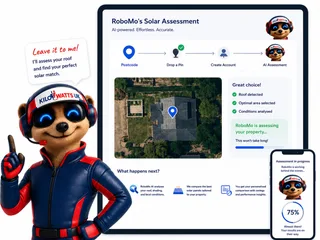
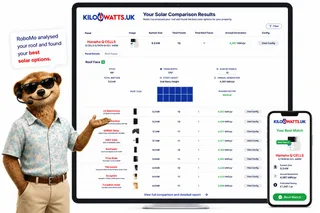
STEP 1
Choose Home, Business or Industrial
Enter your postcode to start your assessment.
STEP 2

Drop a pin on your roof
STEP 3

Create your free account
STEP 4

Sit back and watch RoboMo™ work
RoboMo™ analyses your roof and builds your personalised solar comparison.

Kilowatts UK is an authorised representative
Flower Turbines
Compact vertical-axis turbines built for real UK sites, not just open farmland.
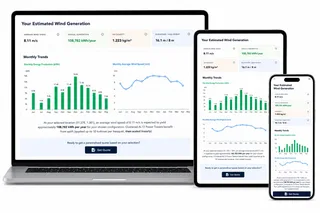
They start in light wind, sit in a small footprint, and are bird-safe by design. Cluster them as a bouquet and the group performs better together than the same turbines standing alone. Enter your postcode for a location-based generation estimate. Figures use area weather data and will differ if buildings, trees or hills sit in the way.
Starts in light UK wind
Built to generate in typical UK wind, not only open farmland.
Small rooftop or ground footprint
Compact towers for roofs, yards and tight sites.
Bird-safe slow rotation
Slow vertical-axis spin, bird-safe by design.
Bouquet clusters raise output
Grouped turbines outperform the same units standing alone.
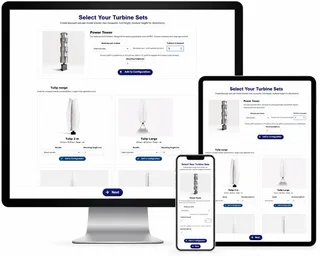
Step 1
Enter your postcode
Start designing your wind energy system in seconds.
STEP 2

Choose a location
STEP 3

Place your cluster
Tap the map where you want the turbine cluster to go.
STEP 4

Instant generation forecasts
Compare different turbine layouts and see annual generation forecasts instantly.
STEP 5

No commitment required
Explore different configurations before deciding whether to request a quotation.
Related articles
Mo's Mission Nominations
FAQ
Need Help? RoboMo's Got Answers
Does on-site solar make a UK company net zero?
No, an array does not by itself make a company net zero. It can support reporting only where self-consumed output cuts the electricity the organisation actually buys, inside the boundary used for the report. The UK net zero target in the Climate Change Act 2008, as amended, is a national goal for 2050 and does not by itself require every company to publish a net zero report. In corporate use, net zero usually means a voluntary pathway to cut emissions deeply and neutralise what remains, not a single-year inventory or a claim built mainly on offsets. Gas heat, fleet fuel, process emissions and purchased goods do not fall simply because the roof is generating.
Which solar kilowatt-hours can reduce Scope 2?
Only self-consumed solar changes Scope 2 in ordinary practice, and export does not come off the total. Scope 2 is indirect emissions from purchased electricity, heat, steam and cooling, so on-site solar affects it only where it reduces the electricity the organisation buys. Import, generation and export are three different numbers, and only the measured overlap between generation and site demand is import avoided. That quantity feeds a location-based calculation using the government conversion factor for the reporting year, which is reissued annually and should not be copied from an old spreadsheet. Export can be described separately, outside the scopes, and there is no single kilogram figure for grid electricity that can be hardcoded.
How should on-site solar be shown in a SECR report?
Solar appears as a change in purchased energy and in the efficiency narrative, not as a badge. Streamlined Energy and Carbon Reporting, under the Companies (Directors' Report) and Limited Liability Partnerships (Energy and Carbon Report) Regulations 2018, applies to quoted companies and to large unquoted companies and large LLPs, and it follows company type and size rather than a net zero slogan. An array enters the inventory only if the site sits inside the organisational boundary, and the narrative should state what was commissioned, when, and what was measured. It should not treat a future array as if it had already saved energy in the year under review. Size tests and any low-energy-use exemption should be taken from the regulations and guidance for that financial year, and a carbon reduction plan, ESOS or a science-based target is a separate exercise that SECR does not satisfy.
Does a green tariff reduce purchased electricity in the same way as rooftop solar?
No, a green tariff, an off-site contract and a rooftop array are not substitutes for one another. A properly evidenced green tariff is a market-based claim about electricity the company still buys, so it does not cut SECR purchased kilowatt-hours and it does not change the location-based grid factor. Behind-the-meter use does cut purchased kilowatt-hours by the self-consumed amount. An off-site power purchase agreement sits between those positions, and its carbon result follows the contract and whether instruments are retired against that supply, not the mere existence of a solar farm elsewhere. A market-based claim should not be described as if the location-based total had also fallen.
Can a company sell its REGOs and still claim the solar attribute?
No, selling the certificates and still claiming the site is powered by that solar double-counts the same attribute. A Renewable Energy Guarantee of Origin is an Ofgem certificate issued per megawatt-hour of eligible renewable generation, and it is an attribute record rather than the kilowatt-hour on the import meter. Where certificates from the roof are transferred to a supplier or an aggregator, the occupier should assume the market-based renewable claim has gone with them. That remains true even if grid import is lower because the power was used on site. Marketing claims remain subject to the Competition and Markets Authority's Green Claims Code and to Advertising Standards Authority rules, even where the SECR arithmetic is sound.
Will solar cut the same share of emissions on every type of site?
No, there is no single share of a company footprint that on-site solar will remove. An office with gas heat and a large Scope 3 total is not the same case as a warehouse or cold store with a daytime electrical load, or as a shop open into the evening. Load shape decides how much generation can displace import, and the self-consumption assumption should be built from the site profile, using half-hourly data where it exists, rather than from roof area. The reported figure should come from measured data or a project calculation, because latitude, tilt, orientation, shading, soiling and downtime all change output. Evening demand may be met from the grid, shifted by storage, or left outside what panels that generate only in daylight can cover.
Who reports the saving if the landlord owns the panels and the tenant uses the power?
They should not both claim the same reduction. If a third party owns the array and the occupier buys the power, the occupier is still purchasing electricity, and the factor is whatever the contract and the retired instruments support. Private-wire sales, landlord supplies and service-charge recharges need the same reading, and the contract should say whose inventory the kilowatt-hour enters. On multi-let offices and retail parks the roof owner and the electricity user are often different reporters. Agree the commissioning date and the reporting calendar before the efficiency narrative is drafted, and do not copy planning, rates, VAT or capital allowance treatment from domestic solar rules.
What evidence should support the solar figure at year end?
The result is set by the contract and the meters, not by the brochure yield. The file that reaches the person signing the accounts should show how import, generation and export are metered, and who owns the plant and the certificates for that year. Inverter portals can help an operator spot a fault, but they are a poor substitute for reads that reconcile to the import bill and to the financial year, including a partial first year. Energy that was curtailed was never generated, so it cannot be reported as a saving. If the meter and contract statements disagree with the marketing line, the marketing line is the item that has to change.