


Net Zero Energy Prices: It's Not the Whole Story
Published: 2025-10-16 20:40:00
Updated: 2026-08-01 05:53:26
Energy Prices Rising Under Net Zero, But It Is Not the Whole Story.
Energy Prices Rising Under Net Zero, But It Is Not the Whole Story
Over the past year, a familiar message has circulated across headlines and social media: “Even if wholesale electricity prices fall, household bills could still rise by 20 percent.” That sounds worrying, and in many ways it is. But it is also only part of a much bigger picture that most people never see.
For UK households and small businesses, the important point is this: the unit price of energy is not set by wholesale markets alone. Bills also include the cost of maintaining networks, balancing the system, paying for policy obligations, supplier operating costs, VAT, metering, and wider infrastructure investment. Net-zero is part of that story, but it is not the whole story.
Why Prices Can Rise Even When Wholesale Costs Fall
A growing share of every energy bill now comes from costs that are not simply the day-to-day price of gas or electricity. Network maintenance, grid upgrades, balancing services, renewable support schemes, social obligations, and environmental policy costs all affect what customers pay. Even if wholesale costs fall, these other elements can keep bills higher than people expect.
Warnings about bills rising by around 20 percent should be treated as scenarios rather than guarantees. The direction depends on wholesale markets, Ofgem price-cap decisions for domestic default tariffs in Great Britain, network investment, policy choices, supplier costs, and how quickly the UK can reduce its reliance on imported fossil fuels.
It is also important not to label every non-wholesale cost as a “net-zero charge”. Some costs support low-carbon generation and energy-efficiency programmes, while others pay for network operation, system resilience, customer protections, or legacy obligations. The bill impact is real, but the explanation is broader than one policy slogan. Transforming the grid is expensive, but it is necessary. The UK needs investment in generation, storage, interconnectors, flexible demand, local networks, and smarter control systems. These are not one-off costs that disappear overnight, but they are long-life investments intended to make the system more secure and less exposed to volatile fossil-fuel markets. In the short term, the transition can feel costly. In the long term, renewable generation has no fuel bill. Once wind, solar, storage, and grid infrastructure are in place, the system is less dependent on buying gas at whatever price global markets demand.
Why Ed Miliband’s Net Zero Strategy Still Makes Sense
Critics say net-zero targets drive inflation and energy poverty, but the evidence is more complicated. Poorly managed transition costs can put pressure on bills, especially if policy costs fall heavily on electricity customers. But remaining dependent on gas also carries a price, as the 2022 energy crisis showed very clearly.
The broad direction associated with Ed Miliband’s energy policy is based on a simple argument: the UK needs cleaner power, more domestic generation, and less exposure to international fossil-fuel shocks. Whether that succeeds depends on delivery, planning, grid connection speed, fair cost allocation, and protection for vulnerable customers.
Improving energy security
A more diverse system with renewables, storage, interconnectors, demand flexibility, and efficient buildings is less exposed to a single fuel source or supplier.Long-term cost advantages
Renewables cost money to build, connect, and maintain, but they do not require ongoing fuel purchases in the way gas generation does.Avoiding the cost of inaction
Climate impacts, flooding, heat, infrastructure damage, and food disruption all carry costs. Delaying investment does not make those risks disappear.Industrial growth and skilled jobs
The low-carbon sector supports work in installation, engineering, manufacturing, maintenance, software, finance, and local supply chains.Reducing dependence on global gas markets
The 2022 crisis showed how vulnerable Britain is to fossil-fuel prices. More domestic renewable power gives the UK greater control over long-term energy costs.
Net-zero does not automatically mean lower bills next year. It does mean the UK is trying to move towards a system where prices are less driven by international gas markets and more by domestic infrastructure that can be planned, maintained, and improved.
How Consumers Can Take Control and Beat Rising Energy Costs
Even with prices increasing because of infrastructure and policy costs, consumers can still take control through a generate, store, shift, and compare strategy. The right answer is not the same for every property, so start with your energy use, roof space, heating system, tariff, and budget.
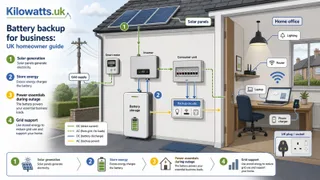
Solar, batteries, smart tariffs, insulation, efficient heating controls, and careful load shifting can all help reduce exposure to peak prices. For small businesses, the opportunity can be even stronger where daytime electricity use matches solar generation.
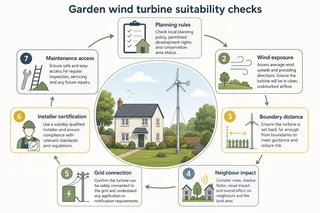
Generate your own power with solar panels: Solar remains one of the most proven ways to reduce grid reliance where the roof, budget, and usage pattern are suitable. Start comparing installers here: Residential Solar Panel Comparison Tool. Consider small-scale wind only in the right conditions: In rural, exposed, or coastal locations, wind can sometimes complement solar by producing more at night and in winter. In sheltered streets, turbulent gardens, or built-up areas, performance is often much weaker, so site assessment matters. Store excess energy with a suitable battery: Battery storage can capture surplus solar or charge from cheaper tariff periods for later use. Any system should be correctly specified, safely installed, and matched to your inverter, tariff, and demand profile. Use smart comparison to avoid overpaying: Not all tariffs reward self-generators in the same way. Export rates, standing charges, time-of-use pricing, and eligibility rules can make a big difference. Check installer standards and permissions: For solar, batteries, and export arrangements, ask installers about certification, warranties, insurance, grid notification or application requirements, and what documentation you will receive after installation. If you operate a company or organisation, explore Commercial Renewable Energy Solutions. Energy prices are rising, but that is exactly why the net-zero transition matters. Dependence on fossil fuels leaves the UK exposed to global price shocks, while a cleaner and more flexible system gives households and businesses more ways to manage their own costs. The way forward is through reliable technologies, honest advice, transparent comparison, and realistic expectations. Solar panels, suitable wind solutions, energy storage, smarter tariffs, and better efficiency all have a role, but only when they are matched to the property and usage pattern. At Kilowatts UK, we believe in empowering people with data and tools to make informed decisions. Generate smarter, compare better, and invest in renewable technologies that work. Start your comparison today and see how much smarter your next energy choice can be.
Plan, Compare & Buy Renewable Energy Solutions
AI does the thinking.
You get the perfect solar match.
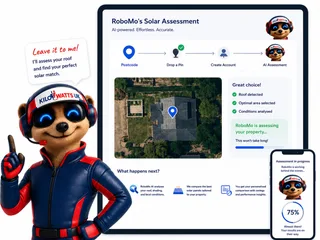
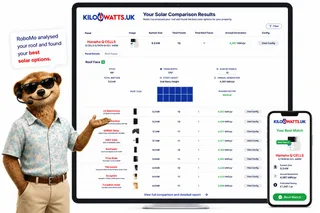
Use RoboMo™ to assess your property, compare available technologies and connect with trusted UK installers, suppliers and manufacturers.
Simply enter your postcode, drop a pin on your roof, create your free account and let RoboMo™ analyse your property to find the best solar panels for your home.

You don't have to think
RoboMo™'s AI analyses your roof and does all the hard work.

Accurate & tailored
AI-powered assessment based on your roof, location, and conditions.

Best options, maximum savings
Compare top solar panels for the best performance and value.

Simple, fast & effortless
Provide a few details, sit back and watch your results unfold.
STEP 1
Choose Home, Business or Industrial
Enter your postcode to start your assessment.
STEP 2

Drop a pin on your roof
STEP 3

Create your free account
STEP 4

Sit back and watch RoboMo™ work
RoboMo™ analyses your roof and builds your personalised solar comparison.

BATTERY ROI TOOL
See what a battery saves on your bill
Enter the day rate, off-peak rate and export rate. The calculator ranks batteries in the Kilowatts shop over 10 years.
Home batteries also suit offices and small commercial sites. Industrial batteries are listed on their own calculator.

Step 1
Enter your postcode
Start designing your wind energy system in seconds.
Are you an installer, distributor or renewable energy business?
Kilowatts UK is expanding the Flower Turbines partner network across the UK.
Become A Flower Turbines PartnerKilowatts UK is an authorised representative
Flower Turbines
Compact vertical-axis turbines built for real UK sites, not just open farmland.
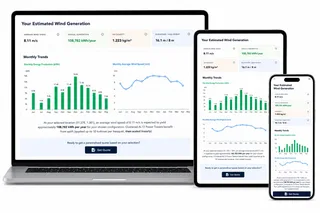
They start in light wind, sit in a small footprint, and are bird-safe by design. Cluster them as a bouquet and the group performs better together than the same turbines standing alone. Enter your postcode for a location-based generation estimate. Figures use area weather data and will differ if buildings, trees or hills sit in the way.
Starts in light UK wind
Built to generate in typical UK wind, not only open farmland.
Small rooftop or ground footprint
Compact towers for roofs, yards and tight sites.
Bird-safe slow rotation
Slow vertical-axis spin, bird-safe by design.
Bouquet clusters raise output
Grouped turbines outperform the same units standing alone.

STEP 2

Choose a location
STEP 3

Place your cluster
Tap the map where you want the turbine cluster to go.
STEP 4

Instant generation forecasts
Compare different turbine layouts and see annual generation forecasts instantly.
STEP 5

No commitment required
Explore different configurations before deciding whether to request a quotation.
Related articles
Mo's Mission Nominations
FAQ
Need Help? RoboMo's Got Answers
Why are UK energy prices still rising even when wholesale electricity costs are falling?
Household bills include far more than just the wholesale cost of gas or electricity. Network upgrades, renewable support schemes, grid balancing, and environmental levies now make up a large share of the total. Even if market prices drop, these fixed costs remain — they reflect the investment needed to modernise the UK energy system under Net Zero.
Does the UK’s Net Zero plan make energy more expensive?
In the short term, yes — because the UK must invest heavily in new generation, storage, and smart grid technology. But long term, Net Zero helps stabilise prices. Renewable energy sources like wind and solar have no ongoing fuel costs, meaning that once infrastructure is built, the cost of energy gradually falls instead of rising with fossil fuel markets.
Are small wind turbines like Aeroleaf or Airturb a good investment?
Many small wind turbines have failed to deliver on their claims. Models such as Aeroleaf and Airturb often perform poorly in typical UK wind conditions and can require frequent maintenance. Always check for independently verified performance data and clear maintenance schedules before buying. For genuine small-wind performance, look into Flower Turbines’ engineered vertical-axis systems.
What makes Flower Turbines different from other small wind systems?
Flower Turbines are designed around real aerodynamic science. Their Tulip turbines have an industry-leading start-up speed of just 0.75 m/s and benefit from the ‘Bouquet Effect’, where multiple turbines enhance each other’s airflow. They publish transparent data and use sealed bearings with clear maintenance intervals, focusing on reliability and verified performance.
How can homeowners lower energy bills during the Net Zero transition?
Combine generation, storage, and smart comparison. Use solar panels to generate your own power, add small wind systems like Flower Turbines where suitable, and install home batteries such as Fogstar lithium units to store excess energy. Finally, compare tariffs at Kilowatts.uk to ensure you’re on the best plan for self-generators.
Can businesses also benefit from renewable energy under Net Zero?
Absolutely. Commercial properties can install solar panels, wind systems, and battery storage to cut operational costs and carbon output. The Kilowatts.uk commercial energy comparison service helps organisations find the most effective renewable solutions and qualified installers nationwide.
Where can I compare solar and wind installers in the UK?
You can compare fully vetted renewable energy installers at Kilowatts.uk. Use the [Residential Solar Panel Comparison Tool](https://kilowatts.uk/services/residential/renewable-energy/residential-solar-panel-installation/compare/) or explore [Commercial Renewable Energy Solutions](https://kilowatts.uk/services/commercial/) to find trusted MCS and NICEIC-certified providers.