


Flower Turbines UKPN approval: what does it mean?
Published: 2026-06-28 23:26:45
Updated: 2026-08-13 00:16:47
Discover what Flower Turbines' UK Power Networks approval means for small wind buyers in the UK, and how it affects their projects.
Did Flower Turbines receive UK Power Networks approval?
Yes. Flower Turbines received approval from UK Power Networks for one way to connect its small vertical-axis wind turbine technology into the UKPN distribution network.
That is a useful development for UK small wind projects, but it needs to be described precisely. The approval supports a specific connection method. It is not blanket UK approval, planning consent, MCS certification, export tariff approval, or a guarantee that the turbine will perform well at every site.
Whether a Flower Turbines project works in practice still depends on:
- The local Distribution Network Operator, or DNO.
- The exact electrical configuration.
- The turbine, controller, inverter, protection and export control arrangement.
- The site’s wind resource and turbulence.
- Planning constraints.
- Structural suitability.
UK Power Networks is a Distribution Network Operator, not the whole UK electricity system. UKPN covers London, the East of England, and the South East of England. Its acceptance of a connection route is relevant and encouraging, but it does not automatically bind other DNOs. Kilowatts UK set up the call with Dr Farb from Flower Turbines and Alice Callinan from UK Power Networks, and the author attended that discussion. That first-hand context helps explain the approval in practical terms. However, the formal basis for any project remains the UKPN approval document and the site-specific DNO process. Installer competence. Export tariff requirements. Ongoing inspection and maintenance.
Short summary for UK homeowners and businesses
Flower Turbines makes small vertical-axis wind turbines. In plain English, UKPN accepted one proposed electrical route for connecting the technology to its local distribution network. That does not mean every Flower Turbines installation can simply be connected anywhere in Britain.
The key points are:
UKPN approval is a DNO connection acceptance for a defined route. It is not national approval for every UK network area. It is not the same as planning permission. It is not proof that every site has enough usable wind. It does not remove the need for competent electrical and mechanical design. It does not guarantee export payments. For a real project, the installer still needs the approved arrangement, the exact equipment list, the correct protection settings, the DNO application route, and evidence that the site can safely export or limit export as agreed. It does not mean other DNOs will automatically accept the same arrangement. It does not mean a project can depart from the approved equipment or settings.
What UKPN approval actually means
A DNO approval is about safe connection to the local electricity distribution network. The DNO checks whether a generator can operate without creating unacceptable network issues, such as:
- Unsafe islanding.
- Voltage rise.
- Reverse power flow concerns.
- Fault-level or protection coordination issues.
- Uncontrolled export above an agreed limit.
- Interference with other local generation or network equipment.
For Flower Turbines, the approval should be understood as acceptance of one connection method. In real projects, that usually means a defined technical arrangement rather than a general statement that any turbine, inverter, controller, installer method, or export setup will be accepted. The approval may depend on details such as: Those details must be checked against the UKPN document before installation. If a site changes the design, combines the turbine with solar PV or batteries, or uses a different inverter, the DNO may treat it as a different proposal. This is why the phrase “one way to connect” matters. It makes the claim useful without overstating it. The turbine model. The turbine controller. The inverter or converter. Protection relay settings. Anti-islanding behaviour. Export limit. Commissioning process. Single-line diagram. Monitoring or control arrangement. Site notification or application route.
What UKPN approval does not mean
The most common mistake is to treat a DNO approval as if it answers every other project question. It does not.
Grid approval means the local network operator has accepted a proposed electrical connection route. Planning approval is handled through the local planning authority and depends on location, visual impact, noise, height, heritage, neighbour impact, and local constraints. Product certification relates to whether equipment meets applicable standards and may involve type-test evidence or other certification. Export tariff eligibility is arranged with an electricity supplier, not the DNO, and may require separate evidence. Performance approval would require site wind assessment and energy modelling, not just a grid connection document. Structural approval would require a competent assessment of the roof, mast, mounting system, foundations, fixings, vibration and loading.
A project can have an acceptable grid connection route and still be unsuitable because the site is too sheltered, planning is too difficult, the structure is not appropriate, maintenance access is poor, or the economics do not work.
How a small wind turbine connects to the UK grid
A small wind turbine does not normally connect to a consumer unit like a simple household appliance. It needs a controlled electrical pathway from the rotating machine to equipment that can synchronise safely with the grid.
In principle, the route includes:
- The turbine.
- Turbine controller.
- Inverter or converter.
- Isolation equipment.
- Protection equipment.
- Metering.
Where the turbine is part of a hybrid site with solar PV, a battery, or EV charging, the controls need to be coordinated rather than treated as separate systems. The installer needs to know whether the proposal falls under G98, G99, G100, or a project-specific DNO arrangement. The crucial point is that the approved route must be followed. Substituting equipment because it is cheaper, available sooner, or easier to install can invalidate the basis on which the connection was accepted. Site distribution board. Export limitation equipment where required. Commissioning evidence and handover records. G98 is commonly associated with small generation up to 16 amps per phase. G99 applies to larger or more complex generation. G100 becomes relevant where export limitation is used.
Why the DNO cares about remote control and export control
Small generators can affect the local distribution network, especially where many properties already have solar PV, batteries, EV chargers, or heat pumps. The issue is not only how much energy the turbine can produce over a year. The DNO also cares about what happens at any moment when local demand is low and generation is high.
Export limitation can sometimes make a connection more acceptable because it prevents a site from exporting above an agreed level. Monitoring can help demonstrate that a system behaves as designed. In some constrained or larger installations, remote shutdown or active control may be part of the connection discussion.
That does not mean every small domestic wind turbine needs direct DNO remote control. It means the designer must understand the network constraint and provide the right evidence. If the approved Flower Turbines route includes export control, protection settings, monitoring requirements, or commissioning conditions, those conditions must be treated as part of the design, not optional extras.
What an installer should check before using this route
A competent installer should not rely on a headline approval alone. The project file needs enough detail to show that the actual installation matches the accepted arrangement.
Before using the Flower Turbines UKPN route, the installer should check:
- Approved single-line diagram.
- Exact turbine and controller details.
- Inverter or converter datasheets.
- Type-test evidence where applicable.
- Protection and anti-islanding settings.
- Export limitation method if required.
Wind systems also have mechanical considerations that solar PV projects do not usually have to the same degree. Bearings, braking, overspeed protection, vibration, fatigue loading, roof structure, corrosion risk, fixings, access equipment and maintenance intervals all matter. A tidy electrical diagram is not enough if the turbine location is structurally or mechanically unsuitable. Isolation and earthing arrangement. Metering arrangement. Commissioning process. DNO notification or application route. Maintenance and safe access plan. Structural suitability of the mounting location. Noise and vibration considerations. Manufacturer installation instructions. Handover documents for the customer.
Where Flower Turbines may make sense in the UK
Flower Turbines may be most relevant where there is consistent wind, open exposure, a suitable mounting position, and enough on-site electricity demand to use the generation well.
Potentially suitable sites may include:
Commercial premises. Farms. Estates. Schools. Community buildings. Coastal sites. These are generally more plausible candidates than sheltered urban streets. Vertical-axis turbines can accept wind from different directions, which may be useful in variable wind conditions. However, that does not make them immune to poor siting. Buildings, parapets, trees, valleys, neighbouring rooflines and local obstructions can create turbulence and reduce output. A manufacturer’s rated power is not the same as annual generation. A turbine rated at a particular output will only reach that rating under certain wind conditions. Many UK sites, especially low rooftop and urban sites, do not experience strong clean wind for long enough to deliver attractive annual output. Open rural sites. Industrial or business park locations with good exposure. Sites already considering hybrid renewable systems.
Sites where caution is needed
Small wind can disappoint when it is installed because the technology looks interesting rather than because the site has been properly assessed. The weaker the wind resource, the more important it becomes to avoid optimistic assumptions.
Caution is especially important for:
Sheltered streets with taller surrounding buildings. Low roofs in dense housing estates. Noise-sensitive locations close to neighbours. Listed buildings. Conservation areas. Leasehold properties without freeholder consent. A mast-mounted turbine in clean airflow is often more credible than a roof-mounted turbine in turbulent air. That does not mean roof mounting is impossible, but it does mean vibration, loading, access, noise, and output assumptions need careful checking. Roofs with uncertain structural capacity. Sites with difficult maintenance access. Locations with high turbulence. Customers expecting solar-like maintenance demands. Projects relying on export income that has not been confirmed.
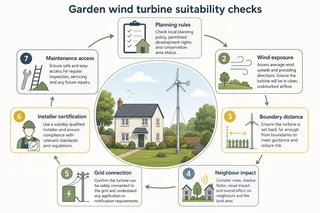
Planning and permissions are still separate
Grid connection approval does not give planning permission. Planning rules differ across England, Scotland, Wales, and Northern Ireland, and local planning authorities can apply additional constraints.
In England, permitted development rights for domestic wind are subject to detailed conditions. Commercial sites, multiple turbines, protected landscapes, conservation areas, listed buildings, and neighbour impacts can all push a project into formal planning territory.
Planning considerations may include: Turbine height. Appearance. Noise. Shadow effects. Proximity to boundaries. Heritage constraints. The safest practical approach is to check planning before committing to equipment. If the local planning authority is likely to object, a DNO-approved connection route will not rescue the project. Landscape sensitivity. Wildlife considerations. Neighbouring amenity. Highways or aviation constraints in some locations.
Export payments and batteries
The DNO does not usually buy exported electricity. Export payments are normally arranged through an electricity supplier under the Smart Export Guarantee or another export tariff.
Eligibility can depend on the supplier’s rules, metering, certification, and evidence that the generator is acceptable under the tariff. Some suppliers may require MCS certification or an accepted equivalent route. Others may have specific rules for small wind, metering, commissioning documents, or hybrid systems.
This matters because a customer may hear “grid approved” and assume “paid export is guaranteed”. That is not correct. A smart or export-capable meter is usually needed. The export tariff must be confirmed with the supplier before export income is included in the business case. A battery can improve self-consumption by storing wind generation for later use, but it also adds design complexity. The DNO will look at the combined behaviour of wind, solar PV, battery inverter, and any export limitation. If each system tries to control export separately, the site can become harder to approve and commission. A coordinated design is usually better than adding technologies one by one without an overall control strategy.
Costs and value depend heavily on the site
Small wind projects vary widely because the turbine is only one part of the installation.
The final cost and value case can be affected by:
Turbine model and specification. Mast, bracket, or mounting system. Foundations or structural works. Access equipment. Delivery and lifting requirements. Electrical integration. Those factors mean headline equipment prices can be misleading. A low-cost turbine is not necessarily a low-cost project once structural work, access, commissioning and compliance are included. The value case should be built around realistic annual generation, not rated output. For small wind, the site’s actual wind resource matters more than marketing claims. A credible assessment should consider height, turbulence, surrounding obstructions, local exposure, consumption profile, export assumptions and maintenance expectations. Planning support. DNO applications. Export limitation. Monitoring. Commissioning. Maintenance access. Replacement parts. Insurance or landlord requirements. Interaction with solar PV, batteries or EV charging.
Practical next steps if you are considering Flower Turbines
Start by separating interest in the product from viability of the project. A grid connection route is useful, but the site still has to justify the installation.
The sensible sequence is:
Check whether your property is in the UKPN region or another DNO area. Obtain the exact approved connection arrangement and equipment list. Assess the wind resource and turbulence at the intended mounting position. Check planning constraints with the local planning authority. Confirm whether the project is G98, G99, G100, or site-specific. Review how wind will interact with solar PV, batteries, EV charging and existing site loads. A good project will have a clear electrical design, a realistic wind assessment, a planning route, a documented connection process, and an installer who understands small wind rather than treating it as solar PV with moving parts. Confirm export tariff requirements before assuming export income. Check structural suitability before committing to a roof or mast location. Confirm who will install, commission, maintain and support the system. Budget for inspection, maintenance and future component replacement. Keep the DNO evidence, commissioning records and handover pack.
Bottom line
Flower Turbines received UK Power Networks approval for one way to connect into the UKPN distribution network. That is a meaningful step for UK deployment, especially because DNO acceptance is often one of the practical barriers for small generation.
It should still be described carefully.
It is not blanket UK approval, not National Grid approval, not planning permission, not automatic export tariff eligibility, and not proof that every site will perform well. The approval is best seen as a usable connection route that may help suitable UKPN-area projects move forward, provided the installation follows the accepted design and the site itself makes sense.
Plan, Compare & Buy Renewable Energy Solutions
AI does the thinking.
You get the perfect solar match.
Use RoboMo™ to assess your property, compare available technologies and connect with trusted UK installers, suppliers and manufacturers.
Simply enter your postcode, drop a pin on your roof, create your free account and let RoboMo™ analyse your property to find the best solar panels for your home.

You don't have to think
RoboMo™'s AI analyses your roof and does all the hard work.

Accurate & tailored
AI-powered assessment based on your roof, location, and conditions.

Best options, maximum savings
Compare top solar panels for the best performance and value.

Simple, fast & effortless
Provide a few details, sit back and watch your results unfold.
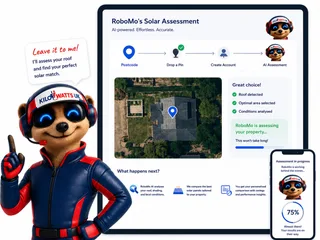
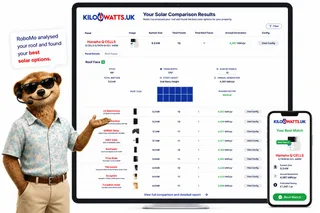
STEP 1
Choose Home, Business or Industrial
Enter your postcode to start your assessment.
STEP 2

Drop a pin on your roof
STEP 3

Create your free account
STEP 4

Sit back and watch RoboMo™ work
RoboMo™ analyses your roof and builds your personalised solar comparison.

Step 1
Enter your postcode
Start designing your wind energy system in seconds.
Are you an installer, distributor or renewable energy business?
Kilowatts UK is expanding the Flower Turbines partner network across the UK.
Become A Flower Turbines PartnerKilowatts UK is an authorised representative
Flower Turbines
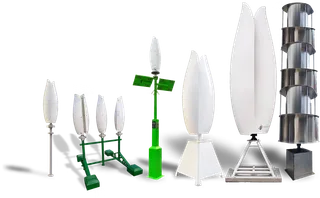
Compact vertical-axis turbines built for real UK sites, not just open farmland.
They start in light wind, sit in a small footprint, and are bird-safe by design. Cluster them as a bouquet and the group performs better together than the same turbines standing alone. Enter your postcode for a location-based generation estimate. Figures use area weather data and will differ if buildings, trees or hills sit in the way.
Starts in light UK wind
Built to generate in typical UK wind, not only open farmland.
Small rooftop or ground footprint
Compact towers for roofs, yards and tight sites.
Bird-safe slow rotation
Slow vertical-axis spin, bird-safe by design.
Bouquet clusters raise output
Grouped turbines outperform the same units standing alone.
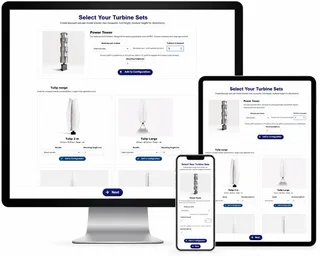
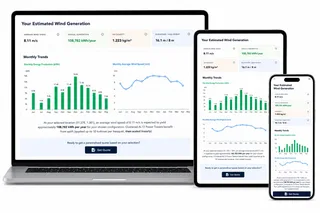
STEP 2

Choose a location
STEP 3

Place your cluster
Tap the map where you want the turbine cluster to go.
STEP 4

Instant generation forecasts
Compare different turbine layouts and see annual generation forecasts instantly.
STEP 5

No commitment required
Explore different configurations before deciding whether to request a quotation.
Related articles
Mo's Mission Nominations
FAQ
Need Help? RoboMo's Got Answers
Did Flower Turbines receive UK Power Networks approval?
Yes. Flower Turbines received approval from UK Power Networks for one defined way to connect its small vertical-axis wind turbine technology into the UKPN distribution network. This is a useful step for suitable projects in the UKPN region, but it is not a general approval for every Flower Turbines installation or every UK location.
What does the UKPN approval actually mean?
The approval means UK Power Networks has accepted a specific electrical connection route for the technology, subject to the relevant equipment, controls, protection settings and connection conditions. In practice, the installation still needs to match the approved arrangement, including the turbine, controller, inverter or converter, protection equipment, export control and commissioning process where required.
Is this the same as national UK grid approval?
No. UK Power Networks is a Distribution Network Operator covering London, the East of England and the South East of England. Its approval is relevant to the UKPN distribution network, but it does not automatically apply to other DNO areas in Britain. Projects outside the UKPN area still need to follow the relevant local DNO process.
Does UKPN approval mean I can install a Flower Turbine without further checks?
No. A grid connection approval is only one part of a project. You may still need planning permission, a suitable mounting location, structural assessment, electrical design, DNO notification or application, export tariff approval, commissioning records and a maintenance plan. The site also needs enough usable wind to make the project worthwhile.
Does this approval mean Flower Turbines has planning permission?
No. Planning permission is separate from grid connection approval. Planning is handled by the local planning authority and can depend on turbine height, appearance, noise, neighbour impact, conservation status, listed building status, landscape sensitivity and local restrictions. A project can be acceptable to the DNO but still fail planning requirements.
Does UKPN approval guarantee export payments?
No. Export payments are usually arranged with an electricity supplier, not the DNO. A supplier may require specific metering, commissioning documents, MCS certification or other evidence before accepting exported electricity under the Smart Export Guarantee or another tariff. Export income should not be included in the business case until the tariff requirements have been confirmed.
What is the difference between UKPN approval, G98, G99 and G100?
UKPN approval relates to acceptance by the local distribution network operator for a defined connection route. G98 generally applies to small-scale generation up to 16 amps per phase, while G99 applies to larger or more complex generation. G100 is relevant where export limitation is used to keep exported power within an agreed limit. The correct route depends on the full site design, not just the turbine model.
Can I use different equipment from the approved Flower Turbines connection route?
Not without checking. The approval may depend on specific turbine, controller, inverter, converter, protection and export limitation arrangements. Changing equipment, settings or the electrical design can make the installation different from the approved route and may require a new DNO review or application.
Is a Flower Turbine suitable for any home or business?
No. Small wind depends heavily on site conditions. Flower Turbines may be more suitable for exposed sites with consistent wind, good mounting options and enough on-site electricity demand. Sheltered streets, low roofs, dense urban areas, sites surrounded by trees or buildings, and locations with high turbulence may produce much less energy than expected.
Does a vertical-axis wind turbine work well in turbulent wind?
Vertical-axis turbines can accept wind from different directions, which can be helpful in variable conditions, but they are not immune to poor siting. Turbulence from buildings, roof edges, trees and nearby structures can reduce output, increase vibration and add mechanical stress. A realistic site assessment is still essential.
What should an installer check before using the UKPN-approved route?
The installer should confirm the approved single-line diagram, exact equipment list, inverter or converter details, protection settings, anti-islanding behaviour, export limitation method, earthing and isolation arrangements, commissioning process, DNO notification or application route, and handover documentation. They should also assess the mounting structure, vibration, access, maintenance needs and local planning constraints.
Can Flower Turbines be combined with solar panels or batteries?
Yes, but hybrid systems need careful design. Wind, solar PV, batteries and EV charging can all affect import, export and site controls. The DNO may assess the combined behaviour of the whole system, especially where export limitation is used. A coordinated design is usually better than adding separate systems without an overall control strategy.
Does rated turbine power show how much electricity I will generate?
No. Rated power is the output a turbine can achieve under specific wind conditions, not the amount it will produce over a year. Annual generation depends on wind speed, turbulence, mounting height, exposure, obstructions, downtime and maintenance. For small wind, realistic site-specific generation estimates are more useful than headline rated output.
Are roof-mounted Flower Turbines always a good option?
Not always. Roof mounting can be possible in some cases, but it requires careful checks for structural strength, vibration, noise, access, fixing loads, maintenance and turbulence. A mast-mounted turbine in cleaner airflow may be more credible than a turbine placed on a low or sheltered roof, depending on the site.
What should I do first if I am considering Flower Turbines?
Start by checking whether your site is in the UKPN area or another DNO region. Then confirm the exact approved connection arrangement, assess the local wind resource, check planning constraints, review structural suitability, confirm export tariff requirements, and make sure the installer understands small wind connection, commissioning and maintenance requirements.