


Can I have a wind turbine in my garden?
Published: 2026-06-28 22:30:10
Updated: 2026-08-01 05:44:30
In practice, many gardens are too sheltered or turbulent for a small turbine to perform well, even where installation is technically possible.
Can I have a wind turbine in my garden?
Yes, you can have a wind turbine in your garden in the UK, but only if the site is suitable and the planning, electrical, structural, neighbour and maintenance requirements can be met. In practice, many gardens are too sheltered or turbulent for a small turbine to perform well, even where installation is technically possible.
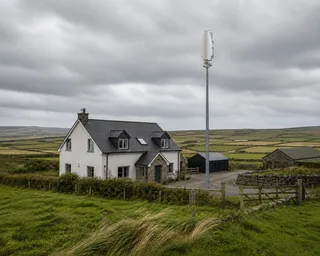
The strongest candidates are usually rural or semi-rural properties with clear exposure to the prevailing wind, space for a sensible mounting position and limited impact on nearby homes. A small urban garden surrounded by houses, trees, garages and fences is often a poor wind site because turbulence reduces output, increases wear and can make noise or vibration more noticeable.
Garden wind turbines are possible in the UK, but planning permission may be needed. Roof-mounted turbines need particular caution because roofs are often turbulent and the building structure must be suitable. Where the site is genuinely promising, residential wind power can be worth exploring as part of a wider home energy plan. The main mistake is treating a garden turbine like a simple appliance. It is a generating system with moving parts, electrical protection, weather exposure and potential planning scrutiny. The early checks matter because a badly sited turbine can be expensive, disappointing and difficult to live with.
What makes a garden suitable for a wind turbine?
A suitable garden wind site is open, exposed and free from nearby obstacles. Wind turbines need smooth airflow, not just occasional gusts. Buildings, hedges, fences, trees and neighbouring roofs disturb the wind, creating turbulence that can reduce generation and increase mechanical stress.
A good assessment looks beyond the garden boundary. It should consider the wider landscape, prevailing wind direction, nearby ridgelines, tree growth, outbuildings, access for installation, likely visual impact and future maintenance. A property on open land may be realistic, while a similar-sized garden in a dense estate may not be.
Obstructions
Trees, homes, sheds and high boundaries can create turbulence even when they are not directly beside the turbine.Wind exposure
The turbine needs clean airflow for a worthwhile amount of the year.Electrical route
The cable run, inverter location and isolation arrangements need to be practical and safe.Neighbour impact
Noise, movement, shadow effects and visual concerns can affect whether a proposal is acceptable.Mounting position
A freestanding mast often performs better than a building-mounted turbine, but it is more visible and may face closer planning scrutiny.Maintenance access
The turbine must be reachable for inspection, repair, safe isolation and eventual replacement.
If your garden is small, enclosed or irregularly shaped, a turbine may still be physically possible but not economically sensible. Suitability is not just about whether it can be installed. It is about whether it will generate enough useful electricity to justify the approval process, disruption, cost and maintenance.
UK planning rules for garden wind turbines
You may need planning permission for a wind turbine in your garden. UK planning rules depend on where you live, the turbine design, whether it is freestanding or building-mounted, the property setting and local restrictions. Some small domestic renewable installations may fall under permitted development rights in limited circumstances, but wind turbines are more sensitive than many homeowners expect.
Check with your local planning authority before buying equipment or paying a deposit. Planning rules differ across England, Scotland, Wales and Northern Ireland, and local constraints can be decisive. Your local authority, the relevant national planning guidance and any property-specific restrictions matter more than a general rule of thumb.
In broad terms, permitted development rights for domestic wind, where available, usually come with conditions. These can relate to turbine number, height, rotor size or swept area, boundary distance, location on or near buildings, noise, safety, protected landscapes, aviation or radar issues and whether the property is listed or in a designated area. Do not assume that a small turbine is automatically exempt. Planning officers may consider visual impact, noise, safety, height, proximity to boundaries, effect on neighbours and the character of the area. Even a modest turbine can be noticeable because it moves. A still mast, a rotating turbine and a vibrating fixing are not judged in the same way by neighbours or planners. Planning is not just a formality. If a turbine is installed without the right consent, you may be required to alter or remove it. A reputable installer should be willing to explain what permissions are likely to be needed, but responsibility for planning compliance ultimately sits with the property owner.
Electrical, safety and certification checks
A garden wind turbine that connects to your home is part of the electrical installation. It needs safe design, suitable protection, correct isolation and a compliant grid connection route. This is not an area to improvise, particularly where the system may export electricity or operate alongside solar panels, batteries, EV chargers or heat pumps.
For grid-connected microgeneration, installers normally consider Engineering Recommendation G98 or G99, depending on the size and type of connection. In simple terms, smaller single installations may be notified to the Distribution Network Operator under G98 after commissioning, while larger, multiple or more complex systems may require a G99 application and approval before connection. The installer should confirm which route applies to your property and DNO area.
Electrical work in homes must be carried out safely and in line with applicable Building Regulations, including Part P requirements in England and Wales where relevant, and the wider wiring rules used by competent electricians. If you want to claim export payments such as Smart Export Guarantee arrangements, your chosen energy supplier may require evidence such as MCS certification or an equivalent standard they accept. Check this before assuming export income.
Isolation
Confirm how the turbine can be safely shut down and isolated for maintenance or emergencies.Competence
Use suitably qualified professionals for electrical design, installation and commissioning.DNO process
Ask whether the system falls under ENA G98 or G99 and who submits the notification or application.MCS and export
If export payments matter to the business case, check whether the turbine, installer and paperwork will meet your supplier’s requirements.Other technologies
If you already have solar, batteries or an EV charger, ask how the combined system affects the grid connection and consumer unit.Electrical protection
Ask how the inverter, cabling, earthing, surge protection and protective devices will be specified.
These checks do not mean a domestic wind system is impossible. They mean the proposal must be designed as a proper generating installation, not as a standalone gadget.
Freestanding or roof-mounted: which is more realistic?
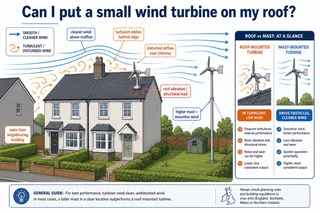
For performance, a freestanding turbine in an exposed position is usually more credible than a small turbine fixed to a house. A mast can place the rotor away from roof turbulence and, depending on the site, into cleaner airflow. The drawback is that masts are more visible, need ground space, may require foundations and can raise planning concerns.
Roof-mounted turbines can look attractive because they avoid using garden space, but roofs are not automatically good wind sites. Airflow around buildings is often turbulent, and a turbine fixed to a structure can transmit vibration or noise. The roof also needs to be suitable for the loads involved, and the installation must not compromise weatherproofing or the building fabric.
The right answer depends on the property. A sturdy rural outbuilding with open exposure is a different proposition from a terraced house in a sheltered street. Before considering roof-mounted turbines, expect a careful assessment rather than a simple statement that the turbine is small enough. For roof-mounted turbines, a structural assessment is particularly important. The issue is not only static weight. Wind loading, vibration, fixings, fatigue and water ingress all matter. If the building fabric is uncertain, the turbine should not be treated as a low-risk add-on.
How the wind turbine process usually works
A domestic wind project should begin with feasibility, not product selection. The turbine model, mast, inverter, cabling, protection equipment and connection arrangement should follow from the site assessment and your electricity use, not the other way round.
A practical process normally moves from initial screening to permissions, design and installation. Skipping the early checks is where poor projects tend to start, because the homeowner ends up with a system that is technically installed but disappointing in output or difficult to live with.
Planning check
Confirm whether consent is needed, whether permitted development applies and whether local restrictions affect the property.Site screening
Check exposure, obstructions, available space, access and likely visual impact.Neighbour review
Consider nearby windows, gardens, boundaries, noise sensitivity and visual impact before making an application.Performance estimate
Use site-specific assumptions rather than relying only on headline turbine ratings.Electrical assessment
Decide how the turbine will connect to the property and whether DNO notification or application is required.Structural assessment
Check foundations, mast design or building fixings before committing to equipment.
A turbine has moving components and is exposed to harsh weather. That makes maintenance planning more important than it is for many static renewable technologies. If access would be awkward or expensive, this should be factored into the decision at the beginning. Installation planning — Consider foundations or fixings, cable routes, access equipment, isolation and safe working. Maintenance plan — Understand inspection intervals, moving parts, warranties, fault access and who will service the system.
How much electricity could a garden turbine produce?
Output from a garden wind turbine varies heavily by site. Two identical turbines can perform very differently if one is in clean, open wind and the other is in turbulent air behind trees and buildings. This is why rated turbine power is not the same as real annual generation.
A turbine’s rated capacity is usually measured under specific wind conditions. It does not mean the turbine will produce that output continuously. A 1 kW turbine running at full output for every hour of the year would generate 8,760 kWh, but domestic turbines do not run at full output all year. The realistic annual figure depends on average wind speed, turbulence, cut-in speed, downtime, inverter losses and maintenance.
For illustration, capacity factor shows the difference between rating and real output. A 1 kW turbine averaging 10% of rated output over a year would produce about 876 kWh. At 20%, it would produce about 1,752 kWh. A poor sheltered site may be well below this, while a genuinely exposed site may perform much better. The point is not to promise a figure, but to show why site-specific evidence matters. For a homeowner, the useful question is not “how big is the turbine?” but “how much usable electricity is this specific site likely to produce across the year?” Wind can complement solar because windy periods often occur at different times from peak solar output, but this only helps if the wind resource is genuinely available. A credible estimate should consider local exposure, turbine position, nearby obstructions, system losses, downtime and how much electricity you can use on site. Export may be possible depending on the connection, metering and tariff arrangements, but it should not be assumed without checking the electrical and commercial details.
Costs, payback and value for money
Domestic wind economics are highly site-specific. The total installed cost is not just the turbine unit. It may include a mast or roof fixings, foundations, cabling, inverter equipment, electrical protection, planning work, structural input, scaffolding or lifting equipment, commissioning and ongoing servicing. This is why judging the project only by the product price can be misleading.
Be cautious with simple payback claims. A low-performing turbine in a poor location may generate very little useful electricity while still needing maintenance. A better exposed site may justify further investigation, but only if the installed cost, expected output, self-consumption, export route and servicing requirements are all realistic.
Do not judge the project only on wind turbine costs. Ask for an itemised quote and a conservative output estimate. Then compare the likely value of the electricity against solar panels, battery storage, insulation, heating controls and demand reduction.
Maintenance
Include inspections, servicing, call-outs, parts and access costs.Installed cost
Include equipment, mounting, groundwork, electrical work, access equipment, design and commissioning.Opportunity cost
Compare the same budget against solar panels, batteries or efficiency improvements.Self-consumption
Electricity used in the home is usually more valuable than electricity exported, but it depends on your tariff and arrangements.Annual generation
Use a low, central and high estimate rather than one optimistic figure.Export assumptions
Check whether export payments are available and what certification or metering evidence is required.
A sensible payback calculation should show what happens if generation is lower than expected. If the project only works financially under the most optimistic scenario, it is not a strong proposal.
Common reasons garden wind turbines disappoint
Most disappointing domestic wind projects fail for predictable reasons. The technology may not be the problem. The site, expectations or approval process often are. A windy-feeling garden is not necessarily a good turbine site, particularly if gusts are caused by turbulence around nearby structures.
Another common issue is choosing equipment before understanding the property. A turbine should be specified around site conditions, expected use and constraints. Buying a unit first and then trying to make the garden fit the product is the wrong way round.
Sheltered location: Nearby buildings and trees reduce useful wind and increase turbulence. Over-optimistic output: Headline ratings do not reflect every real garden setting. Planning assumptions: Permission or permitted development status is not checked early enough. Neighbour concerns: Noise, movement and visual impact are considered too late. Structural shortcuts: Roofs, walls, masts or foundations are not properly assessed. Grid connection gaps: DNO notification, G98 or G99 requirements are left until after equipment has been chosen. A good early test is whether you would still want the turbine if generation were modest and maintenance were required. If the answer is no, the project needs a stronger evidence base before moving forward. Poor maintenance access — Repairs become difficult because the system was sited only for installation convenience. Weak comparison — Solar panels or batteries are not assessed as alternatives before deciding on wind.
Wind turbine, solar panels or battery storage?
For many UK homes, solar panels are simpler to install, easier to predict and less sensitive to the immediate surroundings than a garden wind turbine. That does not make wind a bad technology, but it does mean domestic wind is more site-specific. Battery storage does not generate electricity itself, but it can help store solar energy or cheaper off-peak electricity where suitable.
The best solution may be a combination, especially for properties with high electricity use, electric heating, an EV charger or plans to move away from fossil fuels. The right mix depends on the property, not on a general ranking of technologies. If wind looks marginal, it can be sensible to compare solar options before committing to a turbine.
If your garden is not a strong wind site, it is usually better to find that out early and redirect the budget towards a more suitable measure. The aim is not to choose the most interesting technology. It is to choose the system that works reliably for your property.
What to ask before buying a domestic wind turbine
Before buying a garden wind turbine, ask for a site-specific explanation of expected performance, permissions, maintenance and electrical connection. A credible supplier should be comfortable discussing limitations as well as benefits. If the answer to every concern is simply that the turbine is small, be cautious.
A good proposal should explain how the expected output has been calculated, what planning route applies, how the DNO process will be handled and what maintenance will be needed. It should also identify what happens if permission is refused, if the DNO requires changes or if the site assessment shows the wind resource is weaker than expected.
Evidence: Ask how the predicted output has been estimated for your specific site. Permissions: Ask who checks planning requirements and what happens if consent is refused. Permitted development: Ask for the exact rule or guidance being relied on, not a vague assurance. Structure: Ask whether the roof, wall, mast base or foundations need independent assessment. Electrical connection: Ask how the system connects and whether ENA G98 or G99 applies. Certification: Ask whether the product and installer route will meet any MCS, export tariff or supplier evidence requirements you are relying on. A good proposal should leave you clearer about the risks, not just excited about the potential savings. If you cannot get a straight answer on planning, output, electrical connection or maintenance, pause before committing. Noise and neighbours — Ask what information is available for nearby properties and planning review. Maintenance — Ask who services the turbine, how often, and how faults are safely accessed. Alternatives — Ask whether solar, batteries or demand reduction would provide better value for the same property.
When a garden wind turbine may not be suitable
A garden wind turbine may not be suitable if your home is in a built-up area, surrounded by obstacles, close to sensitive neighbours or subject to planning constraints. It may also be unsuitable if you want a low-maintenance system with predictable output. Domestic wind can work, but it is less forgiving of poor siting than many people expect.
It may also be the wrong choice if your main energy problem is high heating demand, poor insulation or inefficient appliances. In those cases, reducing demand or improving the heating system may deliver more dependable benefits before adding generation.
Small urban gardens with surrounding houses. Sheltered plots with tall trees, fences or nearby roofs. Properties where planning constraints are likely to be difficult. Listed buildings, conservation areas or protected landscapes where visual impact is sensitive. Roofs with uncertain structure, vibration or waterproofing concerns. Homes where maintenance access would be awkward or costly. This does not mean you should dismiss wind entirely. It means the decision should follow evidence. If the site is strong, the permissions are manageable and the system is well designed, a turbine can be part of a wider low-carbon electricity plan. Sites where the DNO connection may be complex relative to the likely output. Situations where solar panels, batteries or efficiency upgrades would provide a simpler first step.
Homeowner decision checklist
A garden wind turbine is worth investigating when the property has genuine exposure, enough space, manageable planning constraints and a clear electrical route. It is much less convincing where the site is sheltered, the planning risk is high or the expected output is based mainly on headline turbine ratings.
Use this checklist before committing to a deposit. If several answers are uncertain, treat the project as feasibility-stage only.
Wind exposure: Is the turbine position open to prevailing winds, with limited turbulence from trees, buildings and boundaries? Planning route: Have you checked the local planning authority position and confirmed whether permitted development or full planning applies? Property constraints: Is the home listed, in a conservation area, in a protected landscape or affected by local planning conditions? Neighbour impact: Could nearby homes be affected by noise, movement, outlook, shadow effects or visual intrusion? Mounting and structure: Has the mast, foundation, roof, wall or outbuilding been assessed for wind loading, vibration and access? Electrical connection: Has the installer confirmed the DNO route, including whether G98 or G99 applies? If the checklist reveals major weaknesses, it is better to pause than to force the project through. Domestic wind rewards good sites and punishes marginal ones. Certification and export — If export payments matter, have you checked the paperwork your chosen supplier will require? Maintenance — Do you know the inspection intervals, likely servicing needs, fault access route and long-term responsibilities? Alternatives — Have you compared solar panels, batteries, insulation and demand reduction before choosing wind? Financial sensitivity — Does the project still make sense if annual generation is lower than the central estimate?
Final verdict: should you install a wind turbine in your garden?
You can install a wind turbine in a UK garden if the site, planning position, electrical connection and practical constraints all stack up. The strongest candidates are exposed properties with enough space, clear airflow, manageable neighbour impact and realistic expectations. The weakest candidates are sheltered urban gardens where turbulence, planning issues and maintenance needs reduce the benefit.
Start with feasibility, not a product choice. Confirm planning requirements, assess wind exposure, compare alternatives, ask how G98 or G99 will be handled and request a site-specific performance estimate. If wind is marginal, solar panels, battery storage or efficiency upgrades may be more practical.
A garden turbine is worth investigating when your property has genuinely good wind conditions. If it does not, recognising that early is not a failure. It is good energy planning. To sense-check the wider options for your property, you can book a free home energy survey.
Plan, Compare & Buy Renewable Energy Solutions
AI does the thinking.
You get the perfect solar match.
Use RoboMo™ to assess your property, compare available technologies and connect with trusted UK installers, suppliers and manufacturers.
Simply enter your postcode, drop a pin on your roof, create your free account and let RoboMo™ analyse your property to find the best solar panels for your home.

You don't have to think
RoboMo™'s AI analyses your roof and does all the hard work.

Accurate & tailored
AI-powered assessment based on your roof, location, and conditions.

Best options, maximum savings
Compare top solar panels for the best performance and value.

Simple, fast & effortless
Provide a few details, sit back and watch your results unfold.
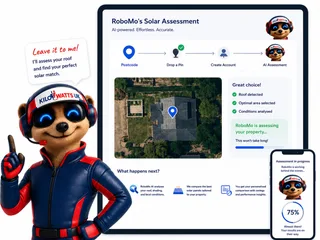

STEP 1
Choose Home, Business or Industrial
Enter your postcode to start your assessment.
STEP 2

Drop a pin on your roof
STEP 3

Create your free account
STEP 4

Sit back and watch RoboMo™ work
RoboMo™ analyses your roof and builds your personalised solar comparison.

Step 1
Enter your postcode
Start designing your wind energy system in seconds.
Are you an installer, distributor or renewable energy business?
Kilowatts UK is expanding the Flower Turbines partner network across the UK.
Become A Flower Turbines PartnerKilowatts UK is an authorised representative
Flower Turbines
Compact vertical-axis turbines built for real UK sites, not just open farmland.
They start in light wind, sit in a small footprint, and are bird-safe by design. Cluster them as a bouquet and the group performs better together than the same turbines standing alone. Enter your postcode for a location-based generation estimate. Figures use area weather data and will differ if buildings, trees or hills sit in the way.
Starts in light UK wind
Built to generate in typical UK wind, not only open farmland.
Small rooftop or ground footprint
Compact towers for roofs, yards and tight sites.
Bird-safe slow rotation
Slow vertical-axis spin, bird-safe by design.
Bouquet clusters raise output
Grouped turbines outperform the same units standing alone.


STEP 2

Choose a location
STEP 3

Place your cluster
Tap the map where you want the turbine cluster to go.
STEP 4

Instant generation forecasts
Compare different turbine layouts and see annual generation forecasts instantly.
STEP 5

No commitment required
Explore different configurations before deciding whether to request a quotation.
Related articles
Mo's Mission Nominations
FAQ
Need Help? RoboMo's Got Answers
Can I have a wind turbine in my garden in the UK?
Yes, you can sometimes install a wind turbine in a UK garden, but it depends on planning rules, site suitability, safety, neighbour impact and the quality of the wind resource. Garden turbines are most realistic for detached rural, coastal or upland homes with open land and clean airflow. They are much less suitable for small urban or sheltered suburban gardens, where buildings, fences, trees and rooflines create turbulence and reduce output.
Do I need planning permission for a garden wind turbine?
You may need planning permission, depending on where you live, the turbine type, its height, rotor size, distance from boundaries and whether your property is in a protected or sensitive area. Some small domestic turbines may qualify as permitted development, but only if every condition is met. Listed buildings, conservation areas, National Parks, National Landscapes, Article 4 Directions, local policies, leasehold restrictions and covenants can all affect what is allowed, so check with your local planning authority before buying equipment.
Are domestic wind turbines covered by permitted development rights?
In some cases, yes. In England, certain small freestanding domestic wind turbines can fall under permitted development rights if they meet strict limits on height, rotor size, location, number of turbines, blade clearance, boundary distances and recognised standards. A commonly referenced freestanding domestic limit in England is 11.1 metres to blade tip, but you should not rely on that figure alone because rules vary by nation, property type and local circumstances.
Is a roof-mounted wind turbine a good idea?
Roof-mounted wind turbines are usually less attractive technically than freestanding turbines. Roofs often create turbulent airflow, and the turbine can transmit vibration and noise into the building. Although small roof-mounted units may look convenient, they often produce limited electricity compared with expectations. Where there is enough land, a freestanding turbine on a properly designed mast is usually the more serious option.
What type of garden is best for a wind turbine?
The best gardens are open, exposed and spacious, with few nearby buildings, trees, hedges or other obstructions. Rural detached homes, coastal homes, upland properties, farms, smallholdings and houses with adjoining open land are more likely to be suitable. The turbine should be positioned where the rotor sits in clean, steady wind and where there is enough space for the mast, foundation, cabling, installation access and long-term maintenance.
Are wind turbines suitable for suburban or urban gardens?
Usually not. Dense housing, mature trees, fences, sheds and nearby rooflines create turbulent, low-quality wind that can make a small turbine underperform. A turbine may spin in gusty air but still generate very little useful electricity. For most suburban homes, solar panels, battery storage, insulation and demand reduction are usually more predictable and cost-effective starting points.
How much wind speed do I need for a garden turbine to be worthwhile?
As a broad screening guide, small domestic wind becomes more interesting where the average wind speed at hub height is around 5 metres per second or higher. Sites around 6 metres per second or more are stronger candidates. Sites below about 4 to 4.5 metres per second at hub height are often difficult to justify financially. The key measurement is wind speed where the centre of the rotor will operate, not how windy the garden feels at ground level.
Why does turbulence matter so much for small wind turbines?
Turbulence reduces generation, increases noise and places more mechanical stress on the turbine. Buildings, trees, fences, hedges and slopes disturb the wind, especially downwind of the obstruction. A turbine in turbulent air may wear faster and generate far less electricity than its brochure rating suggests. Clean, steady wind at hub height is one of the most important requirements for a successful garden turbine.
How much does a domestic wind turbine cost in the UK?
Costs vary widely. Very small roof-mounted turbines may cost around £2,000 to £6,000 installed, although output is often limited. Small freestanding turbines of around 1 kW to 2 kW may cost around £7,000 to £15,000 installed. Larger freestanding domestic turbines around 5 kW to 6 kW may cost around £20,000 to £40,000, while 10 kW domestic or farm-scale systems can cost £40,000 to £70,000 or more. The turbine itself is only part of the cost; mast, foundation, cabling, inverter, grid connection, surveys, planning and servicing can all add significantly.
What should be included in a wind turbine quote?
A good quote should include the turbine model, mast or tower, foundation, electrical equipment, inverter, cabling, trenching, grid connection work, certification, planning support, lifting equipment, commissioning and maintenance terms. It should also show expected annual generation in kWh, not just the turbine’s rated power in kW. Rated power can be misleading because actual output depends heavily on wind speed, mast height and site conditions.
Can I get paid for exporting wind-generated electricity?
You may be able to receive export payments through the Smart Export Guarantee if the installation, metering and certification meet the supplier’s requirements. The Feed-in Tariff is closed to new applicants. In most cases, electricity used directly in the home is worth more than exported electricity, so the financial case is stronger where you can use more generation on site, such as with a heat pump, EV charger, workshop or other flexible electrical loads.
Are there grants for domestic garden wind turbines?
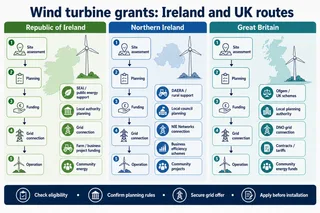
There is no universal UK grant that simply pays for every domestic garden wind turbine. Support schemes can change and may depend on location, technology, installer certification and the wider installation package. Export payments through the Smart Export Guarantee may be available if the system qualifies, but they are not the same as an upfront grant. Always ask the installer to confirm current grant eligibility, VAT treatment and export requirements in writing before relying on them in a payback calculation.
Do I need a grid connection application for a domestic wind turbine?
Most grid-connected domestic turbines need to comply with Engineering Recommendation G98 or G99. G98 is usually used for small type-tested generation up to 16 amps per phase, which is around 3.68 kW on a typical single-phase supply. Larger systems, multiple generators or more complex installations may need G99 approval before connection. Your installer should confirm the correct route with the distribution network operator before installation.
Can I use a wind turbine with solar panels or a battery?
Yes, a wind turbine can be combined with solar panels or battery storage if the system is designed correctly. Wind and solar can complement each other because wind output is often stronger in winter, while solar output is stronger in summer and daylight hours. A battery can help store surplus generation, but it will not solve a poor wind site. If the turbine does not produce much energy, adding a battery will not make the project viable.
Can I use a garden wind turbine off-grid?
Yes, but off-grid wind systems need careful design. They usually require batteries, charge controllers, safe isolation, diversion loads and protection systems so the turbine has somewhere safe to send energy when the batteries are full. Off-grid wind should not be treated as simply adding a turbine to a battery. The system must be designed for charging, braking, overload protection, high-wind conditions and safe maintenance.
Is a wind turbine better than solar panels?
Not for most homes. Solar panels are usually easier to install, easier to predict, lower maintenance and less likely to cause planning or neighbour issues. Wind can be valuable on genuinely exposed sites with strong winter wind and enough space for a proper mast. For many UK households, solar PV and energy efficiency are more practical first choices, with wind considered only where the site is clearly suitable.
Are garden wind turbines noisy?
They can be. Wind turbines may produce aerodynamic blade noise and mechanical noise from moving parts. Noise can be more noticeable at night when background noise is lower. Poor siting, turbulence, worn bearings, blade damage or vibration can make noise worse. Choosing a quality turbine, using a suitable mast, maintaining the system and placing it well away from neighbours and bedrooms can reduce the risk.
Can neighbours object to a garden wind turbine?
Yes. Neighbour concerns can affect planning and the practical success of the project. Issues may include noise, visual impact, shadow flicker, safety, vibration and proximity to boundaries or homes. Speaking to neighbours early can help identify concerns, but neighbour agreement does not replace planning permission or permitted development rules.
Do small wind turbines cause shadow flicker?
They can in some situations, although shadow flicker is usually a bigger concern for larger turbines. It happens when low sun passes through rotating blades and creates a moving shadow through windows or across occupied areas. The risk depends on turbine position, sun path, blade size, distance to neighbouring properties and local topography. Planning authorities may consider shadow flicker where a turbine could affect nearby homes.
Do small wind turbines affect wildlife?
They can, depending on the location. Bats are legally protected in the UK, and turbines near hedgerows, woodland edges, ponds, tree lines or known bat routes may raise ecological concerns. Birds, nesting sites and protected habitats may also be relevant, especially in sensitive rural or coastal areas. A planning authority may request ecological information before deciding whether a turbine is acceptable.
What safety issues should be considered before installing a turbine?
Safety considerations include mast design, foundation strength, braking and overspeed protection, safe isolation, cable protection, lightning risk, corrosion resistance, public access, livestock, children and maintenance access. The installer should explain how the turbine will shut down in high winds, how it will be serviced, how the mast can be lowered or accessed, and what checks are needed after storms or unusual noise.
How do I know whether a wind turbine will generate enough electricity?
Ask for an estimate of annual generation in kWh based on the assumed average wind speed at hub height. The estimate should explain how the wind speed was assessed and should account for nearby obstacles and turbulence. For larger domestic systems, an anemometer survey at or near the proposed hub height can reduce the risk of overestimating output. Be cautious of quotes that focus mainly on rated power rather than realistic annual generation.
Do I need a wind survey before installing a domestic turbine?
Not always, but a wind survey can be worthwhile where the investment is significant or the site is complex. Wind maps and desktop estimates are useful for early screening, but they do not prove what the wind is like at the proposed hub height in your garden. An anemometer survey at or close to hub height over several months, ideally longer for higher-cost projects, can reduce the risk of installing a turbine that underperforms.
What are the ongoing maintenance requirements?
Small wind turbines are mechanical systems and need periodic inspection and servicing. Maintenance may include checking blades, bearings, bolts, mast components, braking systems, yaw mechanisms, electrical connections and safety controls. Servicing is especially important on exposed or coastal sites. Before installing, check who will maintain the turbine, how easy it is to access, what the service schedule costs and whether spare parts will remain available.
How long does a domestic wind turbine last?
A well-specified and well-maintained domestic wind turbine can last many years, but lifespan depends on product quality, wind exposure, turbulence, corrosion, maintenance and spare-part availability. Coastal and upland sites can be harsh environments, so corrosion protection, storm resilience and servicing access matter. Before buying, check the warranty, expected service intervals, availability of replacement parts and whether the installer can support the model over its life.
How do I choose a domestic wind turbine installer?
Choose an installer who assesses the site before recommending a turbine. A credible installer should explain the expected annual output in kWh, the assumed wind speed at hub height, the planning route, mast and foundation design, grid connection requirements, noise considerations, certification, servicing schedule and warranty support. Be cautious if a proposal relies mainly on rated power, ignores nearby obstacles or avoids discussion of maintenance and planning risk.
When should I decide not to install a garden wind turbine?
You should consider walking away if the site is sheltered, the turbine would sit close to buildings or trees, planning is uncertain, neighbours are likely to be significantly affected, servicing access is poor, or the payback relies on optimistic generation figures. A well-evidenced decision not to proceed can save more money than installing a poorly performing turbine.