


Can i put a small wind turbine on my roof?
Published: 2026-07-19 14:08:46
Updated: 2026-08-01 07:31:51
The main issues are wind quality, planning rules, structural safety, noise, grid connection, cost, turbine type, turbine size, and maintenance.
Can I put a small wind turbine on my roof?
Yes, you may be able to put a small wind turbine on your roof, but for many UK homes it is not the best renewable energy option. The main issues are wind quality, planning rules, structural safety, noise, grid connection, turbine type, turbine size and maintenance access.
A roof can look like an obvious place to catch wind, but domestic roofs are often surrounded by chimneys, ridges, trees, neighbouring houses and uneven ground. These create turbulence. Turbulent wind reduces output and can increase noise, vibration and wear. A freestanding mast in a clear, exposed position usually gives a turbine a much better chance of working well.
Roof-mounted wind is worth investigating only if the property has strong, clean wind exposure, a suitable structure, realistic planning prospects and a turbine designed for building-mounted use. In many suburban and urban settings, solar panels or energy efficiency measures are likely to be simpler, quieter and more predictable, so it is sensible to compare home solar before committing to a roof turbine.
Why roof-mounted wind turbines often underperform
Small wind turbines need steady airflow, not just occasional gusts. A roof in a built-up area may feel windy, but the air over and around the building is often disturbed by roof edges, neighbouring properties, trees and chimneys. The turbine may then keep changing direction, stalling, vibrating or running below its potential.
The roof itself also matters. A turbine is not a light electrical accessory. It places dynamic loads on the building as the wind changes, the blades rotate, the unit yaws and the system brakes or shuts down. Those forces must be safely transferred into the building without damaging the roof covering, rafters, waterproofing or internal finishes.
Rooftop wind often disappoints because of poor siting, optimistic output expectations, undersized equipment, unsuitable roof fixings or poor maintenance access. A proper assessment should look at the wind resource and the building together, rather than treating the turbine as a simple bolt-on product.
Turbulence
Nearby buildings, trees, ridges and chimneys can make wind gusty and inconsistent.Structural risk
Moving parts create repeated loads and vibration that a roof may not be designed for.Neighbour impact
Noise, movement and visual prominence can be more noticeable on a roofline than in a field.Low annual output
A turbine’s rated power is not the same as the electricity it will generate over a year.Maintenance difficulty
Safe access for inspection, repair and removal is often more complex than expected.
The main checks before you consider one
Before buying any turbine, treat the project like a small engineering installation. The turbine, roof, electrics, neighbours and local planning context all have to work together.
The practical checks are usually more important than the headline turbine size. A larger-looking turbine in poor wind can produce less useful electricity than a smaller system in clean, exposed airflow.
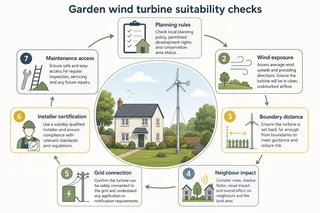
Wind exposure: Check whether the roof has clear, unobstructed wind rather than gusty air from nearby buildings, trees and roof features. Roof structure: Ask whether the roof can safely take dynamic loads, fixings and vibration over the life of the turbine. Planning position: Check current guidance and speak to the local planning authority before assuming roof-mounted wind will be allowed. Noise and vibration: Consider both airborne noise outside and vibration transmitted through the building. Electrical connection: Make sure the turbine, inverter, isolation and export arrangements are designed by a competent installer. Maintenance access: Confirm how the turbine will be inspected, stopped, repaired and removed safely. If any of these checks is uncertain, pause before ordering equipment. The cost of correcting a poor installation can be higher than the value of the electricity it produces. Insurance and ownership — Check whether the turbine affects home insurance, leasehold terms, mortgage conditions, covenants or estate rules.
UK planning permission and local restrictions
Do not assume you can install a small wind turbine on a roof without permission. The planning position depends on where the property is in the UK, the type and size of turbine, whether it is building-mounted or freestanding, and local constraints such as conservation areas, listed buildings, protected landscapes and proximity to neighbours.
For England and Wales, the Planning Portal is a useful starting point for homeowner planning guidance, but it is not a substitute for a property-specific decision. Scotland and Northern Ireland have their own planning systems and guidance. In all cases, your local planning authority is the body that will interpret planning rules for your property.
Permitted development rights, where available, come with conditions and limitations. They can also be restricted or removed by local designations, previous planning conditions or property-specific rules. A supplier’s general statement that a turbine is “permitted development” should not be treated as confirmation for your house.
Listed buildings
Listed status and the curtilage of listed buildings can make consent much more complex.Conservation areas
Conservation areas, World Heritage Sites, National Parks, Areas of Outstanding Natural Beauty and similar designations can restrict permitted development.Nation-specific rules
Planning rules differ between England, Wales, Scotland and Northern Ireland, so check the guidance that applies to your property.Building-mounted limits
Roof-mounted turbines are treated differently from freestanding turbines and may face stricter limits or exclusions.Neighbouring properties
Noise, outlook, shadowing from moving blades and visual impact can all influence planning risk.Flats and shared buildings
Leasehold, shared freehold, blocks of flats and managed estates often need additional permissions even before planning is considered.
The safest first step is to contact your local planning authority or use its pre-application advice route if available. Keep written records of the advice you receive, because the planning position is one of the first things a competent installer should ask about. Existing restrictions — Covenants, previous planning conditions, estate rules, insurance terms and mortgage conditions can override simple assumptions.
Structural safety, vibration and roof condition
A small wind turbine creates changing forces as the blades turn, stop, yaw and respond to gusts. Those forces are transferred into the mounting system and then into the roof. Roof condition and structural suitability need to be assessed before installation.
Older roofs, lightweight structures, complex roof shapes and roofs with known leaks are usually poor candidates. Even on a strong roof, fixings must be designed so that waterproofing is not compromised and loads are spread properly. A bracket that looks sturdy on the day of fitting is not enough; it must cope with years of weather, vibration and maintenance activity.
Building Regulations may be relevant where structural alteration, electrical work or roof access is involved. If there is any doubt, ask for a structural engineer or suitably competent building professional to review the proposed mounting method, loads and fixing points before equipment is ordered. Roof age and condition: Worn coverings, previous leaks, weak timbers or poor access can make installation uneconomic. Load path: The installer should explain how turbine forces pass into the structure, not just into tiles or cladding. Waterproofing: Penetrations, brackets and cable routes must be detailed to avoid future leaks. Vibration control: The system should be designed to limit vibration transfer into bedrooms, loft spaces and neighbouring structures. Safe access: Inspection and maintenance should be possible without improvised ladder work or unsafe roof access. If the roof would need major strengthening, repairs or access works, compare that cost and disruption against alternatives such as a freestanding turbine, solar panels or energy-efficiency improvements.
What a proper site survey should include
A credible roof-mounted wind proposal should start with the site, not the product. If an installer offers a turbine before asking about wind exposure, roof condition, planning constraints and the electrical connection, treat that as a warning sign.
A good survey does not have to make the project complicated, but it should make the assumptions visible. You should understand why the proposed location is suitable, what the main risks are and how realistic output has been estimated.
Access method
The quote should explain whether scaffolding, roof edge protection, lifting equipment or future maintenance access is needed.Planning review
The installer should identify likely planning constraints and advise you to confirm the position with the local planning authority.Roof inspection
The roof covering, structure, fixing points, loft access and known defects should be checked before equipment is specified.Structural review
The proposal should state whether a structural engineer or competent building professional needs to assess dynamic loads.Noise and neighbour risk
The survey should consider bedrooms, party walls, gardens, neighbouring windows and how the turbine will behave in gusty conditions.Wind exposure assessment
The survey should consider surrounding buildings, trees, roof shape, local terrain and whether the wind is likely to be clean or turbulent.
Ask for the survey findings in writing. This makes it easier to compare quotes and reduces the risk of paying for a system that cannot be installed legally, safely or effectively. Electrical assessment — The installer should check the consumer unit, earthing, isolation, inverter compatibility, export arrangements and DNO process. Output modelling — The estimate should be based on realistic site assumptions, not only on the turbine’s rated capacity. Shutdown and maintenance plan — You should know how the turbine will be isolated, stopped, serviced and removed if required.
Roof-mounted, mast-mounted or another technology?
For many properties, the better comparison is not between different roof turbines. It is between roof-mounted wind, a freestanding turbine and alternatives such as solar panels. Each has a different risk profile.
A mast-mounted turbine can reach cleaner wind if the site has enough space and exposure, but it may have its own planning, visual, foundation and access considerations. Solar panels are usually easier to assess because roof orientation, shading and usable area can be inspected more predictably than local wind turbulence. If you have outside space, it may also be worth checking the practicalities of a garden wind turbine before deciding that the roof is the only option.
This comparison often leads homeowners away from roof-mounted wind unless the site is unusually suitable. That is not a failure; it is a good design decision.
Cost and performance depend heavily on the site
It is difficult to give a reliable general figure for the cost or output of a roof-mounted small wind turbine because performance depends so strongly on local wind, turbine design, mounting method, electrical work and maintenance needs. Two similar-looking homes can have very different results.
Be cautious with simple payback claims. A turbine’s useful output is not determined by its rated capacity alone. Rated output is normally achieved under specified test conditions and wind speeds, and a domestic roof may not provide those conditions often enough. Annual generation depends on the local wind speed distribution, turbulence, turbine cut-in speed, control system, downtime and maintenance.
The true project cost may include more than the turbine itself. Survey work, structural checks, scaffolding, mounting hardware, electrical protection, grid connection work, planning support, maintenance and future removal all affect whether the project makes sense.
Wind data matters
Reliable estimates need realistic site wind assumptions, not only a regional average or sales brochure figure.Maintenance affects value
Bearings, blades, braking systems, inverters and fixings may need periodic inspection or replacement.Quotes should be itemised
Ask for survey, scaffolding, structural work, electrical protection, DNO work, commissioning and maintenance to be shown clearly.Removal should be considered
If the turbine fails, becomes noisy or is no longer economic, safe removal has a cost.Rated output is not annual output
A turbine sold as a certain kW size will not produce that amount continuously.Roof turbulence reduces performance
Gusty air can lower generation and increase wear compared with clean airflow.
If an output forecast looks unusually high, ask what wind speed, hub height, turbulence assumption and downtime allowance were used. A cautious estimate is more useful than an optimistic sales projection.
Noise, neighbours and visual impact
Noise and vibration are two of the most overlooked issues with roof-mounted wind. Even a small turbine can be noticeable if it is close to bedrooms, shared walls, gardens or neighbouring windows. Vibration can also travel through the building structure in ways that are hard to predict from product literature.
Visual impact matters too. A turbine is a moving object on the roofline, so it can attract more attention than a static panel or vent. In dense streets, this can increase the likelihood of objections or complaints.
Good design considers where people live and sleep, how the turbine will sound in gusty weather, and how it will be safely shut down if a fault or complaint occurs. Ask the installer what noise information is available for the chosen turbine and whether the local planning authority is likely to require further evidence. Airborne noise: Blade movement, yawing and braking can be more noticeable in gusty wind. Structure-borne vibration: A turbine fixed to a roof can transmit vibration into rooms below. Neighbour sensitivity: Close boundaries, bedrooms and shared walls increase the risk of complaints. Night-time impact: Windy nights can be when noise is most intrusive. Fault response: The system should have a clear shutdown procedure if noise or vibration becomes unacceptable. A turbine that is technically capable of generating electricity can still be a poor choice if it creates neighbour conflict or affects the comfort of the home.
Grid connection, batteries and using the electricity
A roof-mounted turbine usually needs proper electrical integration with the property. That means compatible generation equipment, isolation, metering where required, protection devices and a clear decision about whether electricity will be used on site, exported, stored or curtailed.
For grid-connected systems, the Distribution Network Operator, or DNO, needs to be considered. The Energy Networks Association publishes the Engineering Recommendations used by DNOs. In plain English, smaller domestic generation may fall under the G98 route, where the installer normally notifies the DNO after commissioning if the system is within the relevant limits. Larger systems, multiple generators or systems that exceed those limits may need a G99 application and DNO approval before installation.
Do not treat a turbine as a plug-in appliance unless it is specifically designed, approved and installed for that purpose. A competent installer should explain the DNO route, export limitation if needed, isolation requirements, metering arrangements, inverter protection and how the installation will be certified. If you want to be paid for exported electricity, check the requirements of your chosen export tariff or Smart Export Guarantee supplier, as they may ask for evidence such as MCS certification or an acceptable equivalent. DNO process: Confirm whether the installation is G98 notification or G99 application before work starts. Export limits: The DNO may need to know how much power can be exported to the local network. Isolation: The system should be safely isolatable for maintenance, emergency work and network requirements. Inverter compatibility: The turbine and inverter must be designed to operate safely with the property and the grid. Metering: Export payments and monitoring may require suitable metering arrangements. Batteries: A battery can change export behaviour, but it does not remove the need for proper electrical design. Wind can complement solar in some situations because it may generate at different times, but that does not automatically make a roof turbine worthwhile. If you already have or plan to install solar panels and a home battery, the wind system still needs to stand up on its own technical and economic case before you combine solar and wind. Certification — Ask what completion documents, electrical certificates and manufacturer documentation you will receive.
MCS, installer competence and paperwork
Because a roof turbine combines moving equipment, structural loads and electrical generation, installer competence matters. Look for evidence that the installer understands small wind systems, roof structures, grid connection processes and UK planning constraints, not just that they can supply a product.
MCS is a recognised UK certification scheme for small-scale low-carbon technologies and is often relevant where homeowners want recognised installation standards or export tariff eligibility. However, requirements vary by scheme, supplier and project, so check what paperwork you need before committing. Do not assume a turbine, installer or export arrangement is acceptable without written confirmation.
Product suitability: The turbine should be designed for the proposed mounting method and UK conditions. Installer evidence: Ask for relevant experience with building-mounted wind, not only solar or general electrical work. Electrical competence: The installer should be able to explain inverter protection, isolation, earthing, certification and DNO requirements. Structural competence: Roof fixings and load paths should be assessed by a suitably competent person. Planning evidence: The installer should not dismiss planning concerns without checking the site context. Handover documents: Keep manuals, warranties, certificates, DNO correspondence, maintenance instructions and shutdown procedures. A credible installer will be comfortable explaining limits and risks. Be wary of anyone who promises a quick roof installation without discussing wind exposure, planning, structure and DNO connection.
When a small roof wind turbine may be suitable
A roof-mounted turbine is most likely to be worth exploring where the building is in a genuinely exposed location and the roof structure is suitable. Rural, coastal, hilltop or open sites tend to be more promising than sheltered urban streets, although each property still needs assessment.
The turbine should be chosen for the site, not the other way round. A system that is too large, too noisy or poorly mounted can create problems even if the wind resource is reasonable.
The property has consistently clear wind exposure. The roof is structurally suitable and in good condition. Planning and neighbour issues look manageable. Safe maintenance access can be provided. The installer can explain realistic output limits. The DNO route is understood before installation. If these conditions are not met, it is usually better to consider a freestanding turbine, solar panels, a battery, insulation, heating controls or other energy improvements first. The quote includes structural, electrical, access and maintenance requirements. The project still makes sense after allowing for maintenance.
Common mistakes to avoid
Many poor small wind projects start with the product rather than the site. A homeowner sees a compact turbine online, checks that it fits on the roof, and only later discovers that the wind, structure, planning or noise situation is unsuitable.
The best approach is to rule out the obvious problems early. If the site is sheltered, the roof is weak or the planning risk is high, there is little value in spending time comparing turbine models.
Buying before checking planning. Assuming permitted development applies without local confirmation. Using rated turbine output as expected home output. Ignoring turbulence from nearby buildings and trees. Assuming a roof bracket solves structural loading. Forgetting scaffolding, maintenance, access and safe shutdown. A cautious assessment may feel slow, but it protects you from installing equipment that is expensive to run, hard to service or unlikely to deliver useful electricity. Underestimating noise and vibration complaints. Treating DNO notification or application as an afterthought. Assuming export payments will be available without checking certification and metering requirements.
Practical next steps
If you are still interested in roof-mounted wind, start with a site assessment rather than a product quote. Gather photographs of the roof, surrounding obstructions, the wider landscape and the proposed mounting position. Note any conservation, leasehold, covenant, insurance or neighbour constraints before speaking to installers.
Ask installers to explain why wind quality is suitable, how structural loads will be dealt with, what planning assumptions are being made, which DNO route applies and how the system will be maintained. If the answers are vague, seek another opinion.
Check planning first: Review the Planning Portal or relevant national guidance, then confirm the position with your local planning authority. Check ownership restrictions: Review leasehold terms, covenants, estate rules, mortgage conditions and insurance requirements. Ask for a written survey: The survey should cover wind exposure, roof condition, structure, noise, access, electrical design and output assumptions. Ask about DNO process: Confirm whether the system is likely to be G98 notification or G99 application. Compare alternatives: Consider mast-mounted wind, solar panels, batteries and energy-efficiency measures before committing. Review the full quote: Make sure scaffolding, structural work, electrical protection, certification, maintenance and removal are not hidden extras. A small wind turbine on a roof is possible in some cases, but it is rarely a simple default choice. For most UK homes, the sensible decision is to compare it against mast-mounted wind, solar panels and energy-saving measures before committing, or book a free survey to review the wider home energy options.
Plan, Compare & Buy Renewable Energy Solutions
AI does the thinking.
You get the perfect solar match.
Use RoboMo™ to assess your property, compare available technologies and connect with trusted UK installers, suppliers and manufacturers.
Simply enter your postcode, drop a pin on your roof, create your free account and let RoboMo™ analyse your property to find the best solar panels for your home.

You don't have to think
RoboMo™'s AI analyses your roof and does all the hard work.

Accurate & tailored
AI-powered assessment based on your roof, location, and conditions.

Best options, maximum savings
Compare top solar panels for the best performance and value.

Simple, fast & effortless
Provide a few details, sit back and watch your results unfold.
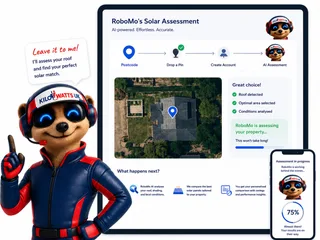

STEP 1
Choose Home, Business or Industrial
Enter your postcode to start your assessment.
STEP 2

Drop a pin on your roof
STEP 3

Create your free account
STEP 4

Sit back and watch RoboMo™ work
RoboMo™ analyses your roof and builds your personalised solar comparison.

Kilowatts UK is an authorised representative
Flower Turbines
Compact vertical-axis turbines built for real UK sites, not just open farmland.
They start in light wind, sit in a small footprint, and are bird-safe by design. Cluster them as a bouquet and the group performs better together than the same turbines standing alone. Enter your postcode for a location-based generation estimate. Figures use area weather data and will differ if buildings, trees or hills sit in the way.
Starts in light UK wind
Built to generate in typical UK wind, not only open farmland.
Small rooftop or ground footprint
Compact towers for roofs, yards and tight sites.
Bird-safe slow rotation
Slow vertical-axis spin, bird-safe by design.
Bouquet clusters raise output
Grouped turbines outperform the same units standing alone.

Step 1
Enter your postcode
Start designing your wind energy system in seconds.

STEP 2

Choose a location
STEP 3

Place your cluster
Tap the map where you want the turbine cluster to go.
STEP 4

Instant generation forecasts
Compare different turbine layouts and see annual generation forecasts instantly.
STEP 5

No commitment required
Explore different configurations before deciding whether to request a quotation.
Related articles
Mo's Mission Nominations
FAQ
Need Help? RoboMo's Got Answers
Can I put a small wind turbine on my roof in the UK?
Yes, you can sometimes put a small wind turbine on your roof in the UK, but it is only suitable for a limited range of properties. A roof turbine needs strong, clean and consistent wind, a suitable roof structure, safe access, acceptable noise levels, and the right planning and electrical permissions. Many urban and suburban roofs are poor wind sites because nearby buildings, trees, chimneys and roof edges create turbulent airflow that reduces generation and increases wear.
Is a roof-mounted wind turbine worth it?
A roof-mounted wind turbine is only likely to be worth considering if the property is detached, exposed and clear of major obstructions in the prevailing wind direction. On many normal UK homes, especially terraced or suburban properties, output can be much lower than expected and payback may be poor. Rooftop solar panels, a battery, or a pole-mounted turbine on a suitable site are often more predictable options.
Why do small roof wind turbines often produce less electricity than expected?
Small roof turbines often disappoint because the wind at roof level is usually turbulent, gusty and slowed by obstructions. A turbine’s rated power is normally measured at relatively high wind speeds, often around 10 to 12 metres per second, but many UK roofs do not experience those conditions often enough. The realistic annual output depends on the wind speed at the actual hub height, the turbine’s power curve, turbulence, downtime, and system losses.
How much electricity can a roof-mounted wind turbine generate?
A poor urban roof site may generate under 100 to 500 kWh per year, while a good exposed roof site may generate around 500 to 2,000 kWh per year. These are broad estimates, not guarantees. For comparison, a typical UK household uses about 2,700 kWh of electricity per year, so a small roof turbine will not usually power an average home by itself.
Do I need planning permission for a small roof wind turbine?
You may need planning permission, and you should check with your local planning authority before buying a turbine. Some domestic micro wind installations may fall under permitted development, but the conditions are strict and vary across England, Scotland, Wales and Northern Ireland. Planning is more likely to be an issue if your property is listed, in a conservation area, in a National Park, in a protected landscape, close to neighbours, or subject to local restrictions.
Is a roof-mounted turbine better than a pole-mounted turbine?
A pole-mounted turbine is usually better for generation because it can be positioned higher and away from roof turbulence, trees and neighbouring buildings. A roof-mounted turbine may be cheaper or easier to place in some cases, but it often has poorer wind quality and can create structural, vibration and noise issues. If you have enough land and a suitable planning position, a pole-mounted turbine should usually be compared before choosing a roof-mounted system.
Can a small wind turbine be fitted to any type of roof?
No, not every roof is suitable. A wind turbine places weight, uplift, torque and vibration loads on the building, and many domestic roofs are not designed for these forces. Older roofs, slate roofs, dormers, chimney stacks, fragile coverings and trussed rafter roofs all need careful assessment. A structural engineer or suitably competent professional may be needed before installation.
Can I mount a wind turbine on my chimney?
Mounting a wind turbine on a domestic chimney is usually unsuitable. Chimneys are not normally designed to handle turbine loads, vibration, torque and storm forces. A chimney-mounted turbine can also increase the risk of structural damage, noise transmission and maintenance problems, so it should not be assumed to be safe without professional structural advice.
Are vertical-axis wind turbines better for rooftops?
Vertical-axis wind turbines are often marketed as better for turbulent rooftop wind because they are less dependent on wind direction than traditional propeller-style turbines. However, they still need adequate wind speed and reasonably usable airflow to generate meaningful electricity. They can also transmit noise and vibration into the building, so they are not a simple fix for a poor wind site.
How do I know if my roof is a good wind site?
A good roof wind site is usually exposed, detached, higher than nearby obstructions, and clear of trees, chimneys and neighbouring buildings in the prevailing wind direction. Postcode wind estimates can be useful as a first check, but they cannot prove that your specific roof is suitable. For a serious investment, measured wind data at the proposed hub height is much more useful than relying on regional averages or manufacturer claims.
What size wind turbine can I put on a house roof?
Most roof-mounted domestic turbines are relatively small, commonly below 2 kW, because larger turbines create greater structural, noise, vibration and planning challenges. The best size is not simply the largest model that will fit; it should be matched to the wind conditions, roof structure, mounting method, electrical system and expected maintenance access. A smaller turbine in clean wind can sometimes perform better than a larger turbine in turbulent wind.
Can a roof wind turbine work with solar panels and a battery?
Yes, a wind turbine can work alongside solar panels and a battery, but the system must be designed correctly. Wind can complement solar because it may generate at night and during darker, windier periods, while a battery can increase self-consumption. However, adding wind to an existing solar system may affect export limits, inverter design, metering, protection equipment and G98 or G99 grid connection requirements.
Do I need a battery for a roof-mounted wind turbine?
A battery is not always required for a grid-connected wind turbine, but it may help you use more of the electricity on site instead of exporting it. Off-grid wind systems normally do need batteries, along with a correct charge controller, braking system and diversion or dump load. A wind turbine should not simply be connected to a socket or battery without proper electrical design.
What grid connection rules apply to a small domestic wind turbine?
Grid-connected domestic wind turbines need suitable inverters, protection equipment and the correct notification or approval route. Smaller certified generators up to 3.68 kW per phase commonly fall under G98 notification rules, while larger, combined or non-standard systems usually need G99 approval before connection. If you already have solar panels or another generator, the combined export capacity may affect the requirements.
How much does a small roof wind turbine cost?
A small roof-mounted wind turbine can cost around £2,000 to £8,000 installed, although the final price depends on the turbine, mounting system, structural work, scaffolding, cable runs, grid connection requirements and any planning or engineering reports. Very small DIY-style turbines may cost less, but they are usually intended for batteries, sheds, boats or off-grid loads rather than whole-home generation.
What maintenance does a roof wind turbine need?
A roof-mounted wind turbine has moving parts and will normally need regular inspection, servicing and occasional component replacement. Maintenance may include checking blades, bearings, brackets, fixings, cables, controllers, inverters, braking systems and any signs of vibration or water ingress. Small domestic systems may need maintenance costing around £100 to £500 per year, with larger or harder-to-access systems costing more.
Will a roof wind turbine be noisy?
A roof wind turbine can create blade noise, mechanical noise and vibration transmitted through the building. Noise is especially important where neighbours are close or where the turbine is attached directly to the structure of the home. Manufacturer noise data, mounting design, wind conditions, maintenance condition and distance from bedrooms or neighbouring properties should all be considered before installation.
What should I check before buying a roof wind turbine?
Before buying, check the wind quality at the proposed hub height, nearby obstructions, planning rules, roof structure, noise impact, maintenance access, electrical design, grid connection route and realistic annual generation. Ask for output estimates based on the turbine’s power curve and credible local wind assumptions, not just the headline kilowatt rating. It is also sensible to compare roof wind with solar panels, batteries and pole-mounted wind before committing.