


Wind turbine installation in the UK: short answer
Published: 2026-09-02 09:51:46
Updated: 2026-09-02 03:15:47
Wind turbine installation can work for a UK home, but only where the site has clean, consistent wind, a consentable location.
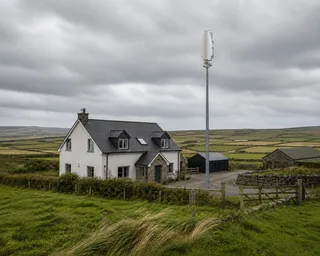
wind turbine installation - UK homeowner guide
Learn wind turbine installation with UK-specific guidance, including costs, savings, rules, and what to do next.
Wind turbine installation in the UK: short answer
Wind turbine installation can work for a UK home, but only where the site has clean, consistent wind, a consentable location, safe access and a suitable electrical connection. The main factors are wind exposure, turbulence, planning rules, mounting method, neighbour impact, maintenance access, DNO requirements and whether realistic generation justifies the extra complexity.
For most homeowners, the first decision is not which turbine looks best. It is whether the property is windy in the right way. A coastal, rural, hilltop or open smallholding site may be worth assessing. A sheltered suburban garden or built-up street often gives poor turbine performance, even if it feels gusty at ground level.
If the property is sheltered, tightly built up or planning-sensitive, solar PV, battery storage, efficiency improvements or load shifting may be better first steps. Wind should be a site-led design decision, not a simple appliance purchase. If solar looks like the more realistic starting point, you can compare home solar options before committing to a wind assessment.
What makes a home suitable for a wind turbine?
A good domestic wind site has steady, unobstructed airflow rather than occasional strong gusts. Smooth wind helps the turbine generate more consistently and reduces mechanical stress. Turbulent air can cut output, increase noise and shorten component life.
Height and surroundings often matter more than the advertised turbine size. A smaller turbine in clean wind above nearby obstructions can outperform a larger turbine placed in disturbed air behind a house, hedge, tree line or neighbouring roof.
In real site assessments, installers look beyond the turbine position. They consider prevailing wind direction, rooflines, tree height, slope, boundaries, neighbour proximity, cable routes, lifting access, maintenance access and where electrical equipment will be installed inside the property. For an early homeowner-level check, start with whether you can have wind at home before moving into product choices.
Planning permission and permits for UK wind turbines
Do not assume a domestic wind turbine can be installed without planning permission. UK planning rules vary by nation and can also be affected by local authority policy, property type, turbine height, siting, visual impact, noise, protected landscapes, listed buildings, aviation constraints and radar considerations. Planning and electrical approval are separate. A turbine may be acceptable in planning terms but still need the correct grid connection process. It may also be simple to connect but difficult to consent because of neighbours, landscape impact or restricted land status. Official sources to check include the Planning Portal for England, the relevant Scottish Government and local planning authority guidance in Scotland, Planning Aid Wales or the relevant Welsh local planning authority, and nidirect or the relevant council in Northern Ireland. Homeowners should also check with the local planning authority before buying equipment, especially where permitted development rights may not apply or may be restricted.
Overview
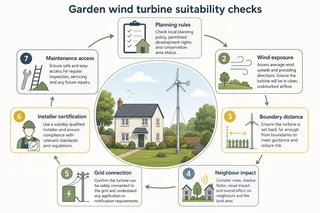
Check planning before paying a deposit. This is especially important in conservation areas, national parks, Areas of Outstanding Natural Beauty or National Landscapes, near listed buildings, close to airfields, on tight residential plots or where neighbours may be affected by noise or outlook.
Early checks should cover the local planning position, property restrictions and covenants, noise and visual impact, aviation or radar constraints, protected landscapes, safe access for installation and maintenance, and grid connection or export requirements.
How much electricity can a home wind turbine generate?
A small wind turbine’s rated capacity is not the same as its everyday output. Rated power is measured under specified wind conditions. Real generation depends on local wind speed, turbulence, tower height, turbine design, downtime, inverter behaviour, maintenance condition and how much electricity the home can use or export.
Domestic wind estimates should be modelled rather than guessed from the kW figure in a brochure. A modest improvement in wind quality can make a large difference to annual generation. A poor mounting position can make an apparently capable turbine disappointing.
Kilowatts.uk is the UK Partnership Manager for Flower Turbines. Homeowners considering Flower Turbines in the UK can use the Kilowatts Flower Turbines generation tool as an indicative starting point. Treat any tool output as an estimate based on assumptions, not a guaranteed yield, and confirm it with a site-specific installer assessment before making a financial decision.
Roof-mounted, mast-mounted and vertical wind turbines compared
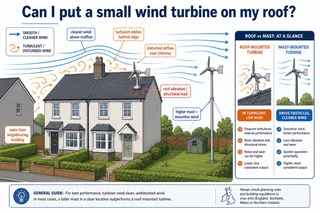
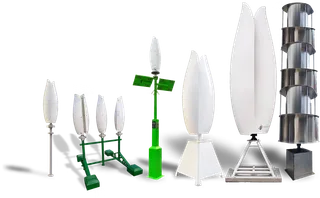
The main domestic options are roof-mounted turbines, mast-mounted turbines and vertical wind turbines. The right choice depends on available space, wind quality, planning constraints, structural risk, appearance, maintenance access and the electrical design. Mast-mounted turbines usually have the best chance of reaching cleaner wind because they can be positioned away from turbulence created by the house. Roof-mounted systems can look simpler, but roofs are often turbulent and may transmit vibration or noise into the building. Before choosing that route, check the practical issues around a roof-mounted turbine. Vertical wind turbines, including Flower Turbines, are often considered for compact or visually different installations. They still need adequate wind resource, a sound mounting design, planning acceptability and realistic generation modelling. They should not be treated as automatically suitable for every urban or suburban home.
What installers check before quoting
A proper wind turbine quote should start with the site, not the product brochure. The installer needs to establish whether the turbine can be safely installed, legally consented, electrically connected and maintained over its life.
A desktop review may be enough to rule a site out early, but it is not a substitute for proper design where a project looks viable. For promising sites, the assessment should consider wind exposure, turbulence, mast location, cable routes, inverter or controller location, isolation, earthing, consumer unit capacity, metering, export arrangements and battery compatibility if relevant.
Good installers separate technical feasibility from planning feasibility. A turbine can be physically installable but difficult to consent, or easy to consent but too sheltered to justify the equipment and maintenance.
Connecting a wind turbine to your home, battery or the grid
A grid-connected wind turbine must be integrated safely with the property’s electrical system. That normally involves suitable generation equipment, protection, isolation, inverter or controller arrangements, metering and the correct process with the Distribution Network Operator. For small domestic generation, installers often discuss Engineering Recommendation G98 and G99 processes. The correct route depends on the equipment, capacity and connection design, so homeowners should not self-assess the process from headline turbine size alone. The installer should confirm the DNO route, export assumptions and whether any export limit or additional design work applies. Battery integration can be useful, but it is not as simple as connecting a turbine to an existing battery. The turbine, controller, inverter, battery management system, grid connection and protection settings must be compatible. This is especially important where the home already has solar PV, a battery, an EV charger or a heat pump.
SEG, export payments and standards to ask about
Export income should be treated carefully in any wind turbine calculation. The Smart Export Guarantee is an obligation on certain electricity suppliers to offer export tariffs for eligible small-scale low-carbon generation, but tariff availability, metering requirements and evidence requirements sit with the supplier and can change.
Microgeneration Certification Scheme requirements may also matter, particularly where an export tariff, product assurance, installer certification or customer protection requirement is involved. Homeowners should ask the installer and intended SEG supplier what evidence is needed before buying equipment, rather than assuming eligibility after installation.
Official frameworks to ask about include the Smart Export Guarantee rules published by Ofgem, MCS standards and certification requirements where applicable, and the DNO connection process under the relevant Engineering Recommendation. You do not need to memorise the rules yourself, but the installer should identify the correct route for the actual design.
Costs, savings and payback: what changes the numbers?
Wind turbine installation costs and savings vary too much to give a reliable single figure without a site and product specification. Generic pound ranges can be misleading because the same turbine may need very different mounting, foundations, cable routes, planning work, access equipment and electrical integration from one property to another. The main cost drivers are the turbine type, mast or mounting design, groundworks, structural work, lifting access, electrical integration, planning evidence, DNO requirements, metering and ongoing servicing. Savings depend on useful generation, self-consumption, export arrangements, maintenance costs, electricity tariff and the match between generation and demand. A fair quote should show what is included and what remains provisional. If a payback estimate is provided, it should be based on realistic wind assumptions and should include system losses, downtime, maintenance and any battery losses where battery storage is included.
Overview
Be cautious about payback claims that rely only on rated capacity. A credible estimate should distinguish between gross generation, electricity used on site, exported electricity, maintenance costs and any finance or tariff assumptions.
Worked examples: when wind makes sense and when it does not
A useful way to judge domestic wind is to compare real site types. The same turbine technology can be sensible on one property and unsuitable on another because wind quality, planning risk and electrical integration vary so much. Consider an exposed rural smallholding on open land, with no close neighbours, clear prevailing winds and a practical mast location away from the house. That site may justify a detailed wind assessment, early planning enquiry and DNO discussion because the turbine has a plausible chance of reaching clean wind and being serviced safely. Now compare a sheltered suburban home surrounded by two-storey houses, mature trees and tight boundaries. Even if the garden feels windy on stormy days, the airflow is likely to be turbulent. Roof mounting may create vibration or noise issues, and planning or neighbour concerns may be disproportionate to the likely generation. In that case, solar PV, a battery, insulation or tariff optimisation may be a better first investment.
How wind works with solar panels and batteries
Wind can complement solar because UK wind resource is often stronger in colder, darker months when solar output is lower. That seasonal match can be useful for exposed homes with winter electricity demand, but it does not automatically make wind the right choice.
Solar PV is usually more predictable on ordinary rooftops because roof orientation, shading and available area can be modelled with fewer moving parts. Wind is more sensitive to local turbulence and mounting height, so the feasibility threshold is higher.
For hybrid systems, controls matter. The installer needs to decide how the turbine, solar inverter, battery, grid import and export will interact so the system remains safe and does not waste generation. Whole-home backup should not be assumed unless that function is specifically designed, installed and commissioned. For a deeper overview, see how to combine solar and wind on a UK property.
Common mistakes to avoid before installing
The most common mistake is treating a windy-feeling garden as proof that a turbine will generate well. Gusts around buildings can feel strong to people but still be poor quality wind for a turbine, especially below rooflines or near trees.
Another common error is comparing turbines by rated kW alone. A smaller turbine in clean wind may be more useful than a larger turbine in a poor location. The same applies to vertical wind turbines: design can help in some circumstances, but it cannot remove the need for site assessment.
Homeowners should also avoid assuming that export payments, planning consent or grid approval will automatically follow from buying a recognised product. These are separate checks, and each can affect the final design, cost and timescale.
A practical route for UK homeowners
The best route is to work from feasibility to specification, rather than starting with a turbine size. First, establish whether the site has a credible wind resource. Then check planning constraints, decide whether a mast, roof mount or vertical wind turbine is realistic, and ask an installer to assess the electrical connection.
If you are specifically considering Flower Turbines UK options, use the Kilowatts Flower Turbines generation tool to form an initial view, then treat the result as a conversation starter for a proper assessment. Kilowatts.uk’s role as UK Partnership Manager for Flower Turbines means it can help homeowners approach that option with UK siting, planning and connection realities in mind.
A good next step is to gather site details before requesting quotes: address or approximate location, photos of the property and surroundings, roof and land layout, nearby obstructions, current electricity use, existing solar or battery equipment, and any known planning restrictions. That gives an installer enough context to say whether wind turbine installation is worth developing or whether another renewable option is likely to be more practical. If you want help reviewing the wider home energy picture, you can book a free survey.
Plan, Compare & Buy Renewable Energy Solutions
AI does the thinking.
You get the perfect solar match.
Use RoboMo™ to assess your property, compare available technologies and connect with trusted UK installers, suppliers and manufacturers.
Simply enter your postcode, drop a pin on your roof, create your free account and let RoboMo™ analyse your property to find the best solar panels for your home.

You don't have to think
RoboMo™'s AI analyses your roof and does all the hard work.

Accurate & tailored
AI-powered assessment based on your roof, location, and conditions.

Best options, maximum savings
Compare top solar panels for the best performance and value.

Simple, fast & effortless
Provide a few details, sit back and watch your results unfold.
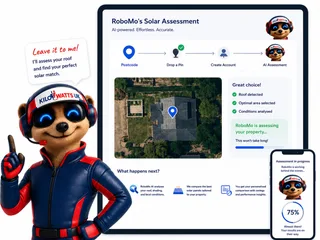

STEP 1
Choose Home, Business or Industrial
Enter your postcode to start your assessment.
STEP 2

Drop a pin on your roof
STEP 3

Create your free account
STEP 4

Sit back and watch RoboMo™ work
RoboMo™ analyses your roof and builds your personalised solar comparison.

Kilowatts UK is an authorised representative
Flower Turbines
Compact vertical-axis turbines built for real UK sites, not just open farmland.
They start in light wind, sit in a small footprint, and are bird-safe by design. Cluster them as a bouquet and the group performs better together than the same turbines standing alone. Enter your postcode for a location-based generation estimate. Figures use area weather data and will differ if buildings, trees or hills sit in the way.
Starts in light UK wind
Built to generate in typical UK wind, not only open farmland.
Small rooftop or ground footprint
Compact towers for roofs, yards and tight sites.
Bird-safe slow rotation
Slow vertical-axis spin, bird-safe by design.
Bouquet clusters raise output
Grouped turbines outperform the same units standing alone.

Step 1
Enter your postcode
Start designing your wind energy system in seconds.

STEP 2

Choose a location
STEP 3

Place your cluster
Tap the map where you want the turbine cluster to go.
STEP 4

Instant generation forecasts
Compare different turbine layouts and see annual generation forecasts instantly.
STEP 5

No commitment required
Explore different configurations before deciding whether to request a quotation.
Related articles
Solar panels
Mo's Mission Nominations
FAQ
Need Help? RoboMo's Got Answers
Is a home wind turbine suitable for most UK properties?
Not usually. Domestic wind turbines work best on exposed rural, coastal, hilltop or smallholding sites with clean, consistent wind. Sheltered suburban gardens, terraces, valleys and wooded plots often suffer from turbulence and low output, even if they feel windy at ground level.
Do I need planning permission for a domestic wind turbine?
You should check before buying any equipment. Planning rules vary across England, Scotland, Wales and Northern Ireland, and local factors such as protected landscapes, listed buildings, height, noise, visual impact and neighbour proximity can affect consent. Permitted development rights may not apply in many situations.
How much electricity will a small wind turbine generate?
Generation depends on wind speed at turbine height, turbulence, tower or mounting position, turbine design, downtime and electrical setup. The rated kW figure is not the same as real annual output. A site-specific assessment is more useful than relying on a brochure estimate.
Is a roof-mounted wind turbine a good idea?
Roof-mounted turbines can look convenient, but roofs often sit in turbulent air and may transmit vibration or noise into the building. The structure, fixings, waterproofing, wind resource and maintenance access all need careful assessment. A mast-mounted turbine away from buildings often has a better chance of reaching cleaner wind.
Can I connect a wind turbine to my battery or existing solar system?
Possibly, but compatibility must be designed properly. The turbine, controller, inverter, battery management system, protection settings and grid connection all need to work together safely. This is especially important if the home already has solar PV, a battery, an EV charger or a heat pump.
Will I be paid for exporting wind electricity to the grid?
You may be able to export electricity, but payments are not automatic. Smart Export Guarantee tariffs, metering requirements and evidence requirements are set by suppliers and can change. Ask your intended SEG supplier and installer what certification, meter and application evidence is needed before installation.
What does an installer check before quoting for a wind turbine?
A proper quote should start with the site, not just the turbine model. The installer should consider wind exposure, turbulence, mounting method, access, planning risk, cable routes, protection, isolation, metering and DNO connection requirements. They should also explain maintenance access and any assumptions behind generation estimates.
What are the main alternatives if my home is not suitable for wind?
If the site is sheltered, built up or planning-sensitive, solar PV may be a more realistic first option. Battery storage, insulation, efficiency upgrades, smart controls and load shifting can also reduce grid electricity use. Wind should be chosen because the site supports it, not simply because the property has outdoor space.