


Flower Turbines Do Tulip Wind Turbines and Power Towers work
Published: 2026-08-14 19:41:12
Updated: 2026-09-17 00:01:40
Yes! Flower Turbines can work in the UK, but only on sites with enough usable wind at the turbine position, a buildable mounting design.
Flower Turbines Do Tulip Wind Turbines and Power Towers work
Yes! Flower Turbines can work in the UK, but only on sites with enough usable wind at the turbine position, a buildable mounting design.
Flower Turbines UK: do Tulip wind turbines and AL13 Power Towers work?
Flower Turbines can work in the UK, but only on sites with enough usable wind at the turbine position, a buildable mounting design, a realistic planning route, an acceptable DNO connection and a credible annual kWh estimate. The Tulip vertical-axis design and AL13 Power Tower are interesting, but visible rotation and low cut-in wind speed are not the same as useful generation.
For most UK homes, solar PV will usually be easier to model, permit and justify. Flower Turbines are more likely to deserve serious assessment on exposed commercial, industrial, farm, campus or infrastructure sites where there is meaningful electricity demand close to the point of generation, and where Flower Turbines systems can be assessed against real site conditions.
The right question is not “does the turbine spin?” It is whether the installed system can produce enough usable electricity over a year, after losses, downtime, turbulence, maintenance, planning conditions, grid limits and self-consumption have been considered.
What Flower Turbines are and how they differ from conventional small wind turbines
Flower Turbines are vertical-axis wind turbines with a distinctive tulip-shaped rotor. A vertical-axis turbine can accept wind from changing directions without yawing into the wind like a conventional horizontal-axis turbine. That can help in complex locations, but it does not remove the need for a proper wind and turbulence assessment.
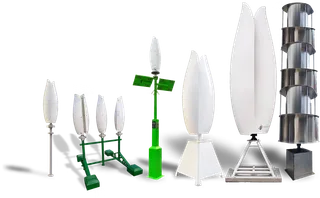
The range includes Small Tulip turbines, larger Tulip turbines, the Eco-Roof Energy Hub and the modular AL13 Power Tower. The AL13 is particularly relevant to larger commercial and industrial sites because it uses stackable one-metre turbine sections rather than relying on one large rotor.
Flower Turbines has published low cut-in wind speed figures for products including the Small Tulip and AL13 Power Tower. Cut-in speed means the wind speed at which the turbine begins to operate. It should not be treated as evidence of strong annual output. Most of the financial and carbon value comes from the full wind-speed distribution at hub height and the turbine’s power curve, not from the first moment of rotation.
Why the Bouquet Effect matters
The most distinctive Flower Turbines claim is the Bouquet Effect. Conventional wind turbines are normally spaced apart because each turbine extracts energy from the wind and leaves a disturbed wake behind it. Flower Turbines instead promotes carefully arranged clusters where neighbouring turbines are intended to interact aerodynamically.
Flower Turbines has reported that five correctly clustered Small Tulip turbines can provide substantially more energy than five equivalent turbines positioned separately. That is a manufacturer-stated comparison, so it should be treated as a layout claim to verify for the specific project, not as a universal UK performance guarantee.
The practical design question is different from many small-wind projects. A conventional small-wind assessment often starts with one turbine and asks what it might generate. A Flower Turbines assessment should ask whether the available roof, yard, car park edge or open boundary can support the right number of turbines, at the right height and spacing, with safe access and acceptable electrical design.
The AL13 Power Tower in UK projects
The AL13 Power Tower is one of the more relevant Flower Turbines products for larger UK sites because it is modular. Instead of installing one large rotor, the design uses one-metre turbine modules stacked vertically. Flower Turbines has published example configurations with multiple stacked modules and overall heights that vary according to the number of modules used.
The stated rotor diameter, construction, survival wind speed and design-life figures should be read as product information, not as a completed UK project design. The installed system still needs structural assessment, foundation or roof support design, access planning, maintenance planning and electrical integration.
The modular approach may suit sites where a single large turbine is not practical, or where multiple compact towers can be arranged around buildings, yards, car parks, access roads or boundary areas. In practice, the design and budget can change materially depending on ground conditions, roof structure, cable routes, inverter selection, isolation, monitoring, safe access and whether the site can consume the electricity as it is generated.
How much electricity could Tulip wind turbines generate?
There is no honest single annual generation figure without site data. A turbine rating is measured in kilowatts, while annual energy is measured in kilowatt-hours. The kWh figure is what matters for bill savings, carbon reporting and payback, and it depends heavily on the wind available at the actual turbine position.
Wind power is very sensitive to wind speed. In simplified terms, the energy available in moving air rises approximately with the cube of wind speed, so a modest difference in average wind speed can create a large difference in annual generation. A turbine on an exposed coastal, rural or open industrial site may behave very differently from the same turbine on a sheltered roof surrounded by parapets, plant rooms and taller neighbouring buildings.
A useful generation estimate should use the proposed mounting height, surrounding obstructions, turbulence risk, turbine power curve and expected site load profile. Brochure ratings are not enough. If a proposal includes annual kWh estimates, ask what data, assumptions and losses were used.
Flower Turbines versus solar panels in the UK
Flower Turbines and solar panels should not automatically be treated as direct rivals. Solar PV is mature, predictable and well understood, but UK output is concentrated in daylight hours and weighted towards spring and summer. Wind may produce electricity overnight and during weather conditions when solar output is low, but only if the site has a good wind resource. Flower Turbines has made manufacturer comparisons between turbine generation and solar generation by physical footprint. Those comparisons should not be applied automatically to every UK roof, yard or field. A footprint comparison may be interesting, but a buyer needs a site-specific comparison of usable annual kWh, installation complexity, maintenance, planning risk and grid connection impact. The better question is usually not “wind or solar?” but “what mix of technologies gives this site the most useful generation for the least delivery risk?” For a warehouse with good roof space, solar may still be the first renewable layer. Compact wind may then be assessed as an additional layer if the site is exposed and has suitable mounting positions, while larger sites may still want to compare commercial solar options before committing budget to wind.
Combining Flower Turbines with solar and batteries
A hybrid system can make more sense than looking at each technology in isolation. Solar, wind, batteries and energy management solve different parts of the same problem: producing electricity, matching it to demand and reducing import from the grid where practical. This is why some sites assess whether to combine solar and wind rather than choosing one technology too early.
Flower Turbines’ Eco-Roof Energy Hub is a flat-roof concept combining Small Tulip turbines with solar panels on a mounting structure designed for suitable roof areas. For the right commercial flat roof, that idea is attractive because it uses one area for more than one generation technology.
The key word is suitable. A flat roof still needs checks for structural loading, wind uplift, waterproofing, vibration transfer, roof warranty conditions, maintenance access and safe isolation. Battery storage can help use more generation on site, but it adds cost, space requirements, fire-safety considerations, controls and another layer of electrical integration, so the battery case should be reviewed alongside the wider home battery storage and energy-management design.
Are Flower Turbines suitable for urban and rooftop locations?
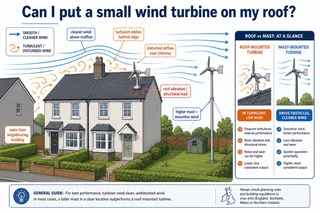
Potentially, but urban suitability should not be assumed. Vertical-axis turbines can accept wind from different directions, which is useful where wind direction changes. However, buildings, roof edges, parapets, trees and plant equipment can create turbulent airflow that reduces useful generation.
A turbine may look active in a turbulent location while producing far less electricity than expected. This is one of the most common small-wind mistakes: judging the project by visible movement rather than modelled annual kWh. The proposed turbine position matters more than a postcode average wind speed.
For rooftop projects, the engineering assessment is just as important as the wind assessment. The structure must be able to handle static and dynamic loads, vibration pathways need to be understood, access must be safe for inspection, and any fixing method must protect the roof covering and waterproofing system.
Where Flower Turbines may make the most sense
Flower Turbines look most interesting where there is useful wind exposure, limited space and a strong reason to generate electricity close to where it will be consumed. That points more naturally towards commercial and industrial sites than typical sheltered homes.
Large electricity users often gain more value from self-consuming generated electricity than from exporting it, although the exact economics depend on tariffs, metering and the site’s import and export arrangements. A site with continuous demand can therefore be a better candidate than a property that exports much of its generation at times of low on-site use.
Likely candidates include exposed business parks, manufacturing sites, farms, campuses, logistics sites, water and wastewater facilities, ports, data-centre-type loads and infrastructure sites with several possible mounting positions. Less promising candidates include sheltered suburban homes, heavily constrained conservation settings, roofs with poor access and locations where nearby buildings create chaotic airflow.
Planning permission and local constraints
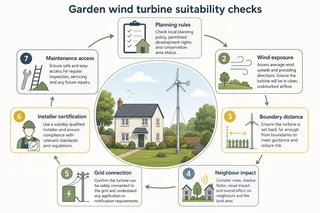
Flower Turbines still need proper planning consideration in the UK. Their compact vertical-axis design may create different issues from a conventional large turbine, but it does not remove the need to consider height, visual impact, neighbours, noise, ecology, heritage, highways, aviation, radar, structural design and cumulative effects.
Planning rules and interpretations vary by nation, local authority, project type and site context. A single small installation may be treated very differently from an array of AL13 Power Towers on a commercial site. The safest approach is to take planning advice early, before fixing the design or ordering equipment, and domestic buyers should also understand the limits around micro wind turbine rules.
Commercial arrays should be treated as infrastructure projects, not as decorative electrical accessories. The planning case is stronger when the design team can explain why the selected positions are necessary, how noise and visual impact have been considered, how maintenance access will work and how the installation fits with the wider site.
DNO connection and electrical integration
Planning permission and grid connection are separate issues. A project can be acceptable in planning terms but still need careful electrical approval, especially where export may affect the local network.
Wind generation connected to the UK electricity network may need to follow the Energy Networks Association’s G98 or G99 processes, depending on the system size and configuration. Where export is controlled, G100-compliant export limitation may also form part of the design. The correct route depends on the total generation capacity, inverter arrangement, existing solar PV, battery storage, standby generation and the site’s agreed import and export capacity.
This should be looked at early, particularly for commercial projects. Changing the inverter design, adding batteries, combining with existing solar or increasing export can alter the connection approach. Waiting until turbines have been ordered can create avoidable delays or redesign work, so any supplier claim should be checked against the practical UK grid connection route for the site.
Noise, vibration and maintenance
Noise is a legitimate concern for any wind project near homes, offices or other sensitive receptors. Flower Turbines describes its turbines as suitable for distributed environments, but a planning or design assessment still needs evidence for the actual site.
The relevant question is not whether the product is marketed as quiet. It is whether the installed system can meet the appropriate requirements at nearby sensitive locations, accounting for turbine positions, background noise, mounting method and cumulative impact if several units are installed.
Are Flower Turbines worth it in the UK?
Yes! Flower Turbines may be worth considering in the UK where wind exposure, space constraints and on-site electricity demand line up. Their strongest potential advantages are the vertical-axis Tulip design, low manufacturer-stated cut-in wind speed, modular AL13 Power Tower format, clustered layout concept and ability to complement solar and storage.
The practical next step is to assess the site here Flower Turbines systems. Establish the wind resource, identify possible positions, check planning and structural constraints, consider the DNO connection, model annual kWh and compare that result with solar, batteries and demand-side measures. That is the difference between installing something that moves in the wind and developing a system that produces useful electricity.
Plan, Compare & Buy Renewable Energy Solutions
AI does the thinking.
You get the perfect solar match.
Use RoboMo™ to assess your property, compare available technologies and connect with trusted UK installers, suppliers and manufacturers.
Simply enter your postcode, drop a pin on your roof, create your free account and let RoboMo™ analyse your property to find the best solar panels for your home.

You don't have to think
RoboMo™'s AI analyses your roof and does all the hard work.

Accurate & tailored
AI-powered assessment based on your roof, location, and conditions.

Best options, maximum savings
Compare top solar panels for the best performance and value.

Simple, fast & effortless
Provide a few details, sit back and watch your results unfold.
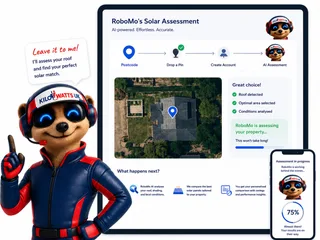

STEP 1
Choose Home, Business or Industrial
Enter your postcode to start your assessment.
STEP 2

Drop a pin on your roof
STEP 3

Create your free account
STEP 4

Sit back and watch RoboMo™ work
RoboMo™ analyses your roof and builds your personalised solar comparison.

Step 1
Enter your postcode
Start designing your wind energy system in seconds.
Are you an installer, distributor or renewable energy business?
Kilowatts UK is expanding the Flower Turbines partner network across the UK.
Become A Flower Turbines PartnerKilowatts UK is an authorised representative
Flower Turbines
Compact vertical-axis turbines built for real UK sites, not just open farmland.
They start in light wind, sit in a small footprint, and are bird-safe by design. Cluster them as a bouquet and the group performs better together than the same turbines standing alone. Enter your postcode for a location-based generation estimate. Figures use area weather data and will differ if buildings, trees or hills sit in the way.
Starts in light UK wind
Built to generate in typical UK wind, not only open farmland.
Small rooftop or ground footprint
Compact towers for roofs, yards and tight sites.
Bird-safe slow rotation
Slow vertical-axis spin, bird-safe by design.
Bouquet clusters raise output
Grouped turbines outperform the same units standing alone.


STEP 2

Choose a location
STEP 3

Place your cluster
Tap the map where you want the turbine cluster to go.
STEP 4

Instant generation forecasts
Compare different turbine layouts and see annual generation forecasts instantly.
STEP 5

No commitment required
Explore different configurations before deciding whether to request a quotation.
Related articles
Mo's Mission Nominations
FAQ
Need Help? RoboMo's Got Answers
Are Flower Turbines suitable for UK homes?
They may be suitable for a small number of exposed homes, but they are not a simple fit-and-forget option for most properties. A domestic site needs enough usable wind at the turbine position, not just a turbine that spins occasionally. Nearby buildings, trees, roof edges and turbulence can reduce output significantly.
How much electricity can a Tulip wind turbine generate in the UK?
There is no reliable single figure without site-specific wind data and the exact turbine model. Annual generation depends on wind speed at the installed height, turbulence, obstructions, the power curve, downtime and electrical losses. Ask for an annual kWh estimate with the assumptions clearly shown, not just the turbine’s rated power.
Do Flower Turbines need planning permission in the UK?
Planning requirements depend on the property, location, turbine size, mounting method and local planning authority. Wind turbines can be more visible and sensitive than solar panels, especially on homes, listed buildings, conservation areas or exposed sites. Always check the planning route before ordering equipment or assuming installation is allowed.
Will I need permission from the DNO to connect a Flower Turbine?
Most grid-connected generation needs to be considered by the local Distribution Network Operator. The correct process depends on the system size, inverter arrangement and whether other generation such as solar PV is already installed. A credible installer should confirm the DNO route before installation and explain any export limits or connection conditions.
Are Flower Turbines better than solar panels?
Not usually for a typical UK home, where solar PV is generally easier to model, install and justify. Wind can be useful where there is a strong, clean wind resource and demand for electricity outside daylight hours. The right comparison is site-specific annual usable kWh, cost, maintenance, planning risk and grid connection impact.
Can Flower Turbines be used with solar panels and batteries?
Yes, a hybrid system can be considered where the site is suitable. Solar, wind and batteries can complement each other because they may generate or store electricity at different times. The design still needs proper electrical integration, controls, safe isolation, space planning and a realistic self-consumption estimate.
What checks should I ask for before buying a Flower Turbine system?
Ask for the exact product model, power curve, mounting height, site layout, wind assessment and annual kWh forecast. The proposal should also cover structural design, access for maintenance, planning risk, DNO requirements, warranties and monitoring. Treat manufacturer claims as useful starting points, not a guarantee of UK site performance.