


Solar vs wind for business in the UK
Published: 2026-09-08 14:45:05
Updated: 2026-09-16 22:49:45
For most UK businesses, solar is the more practical starting point. Wind is worth serious consideration only on exposed sites with enough land.
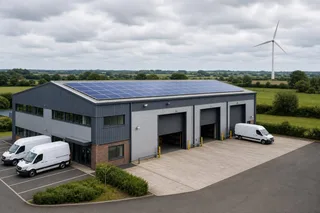
solar vs wind for business - UK comparison guide
Learn solar vs wind for business with UK-specific guidance, including costs, savings, rules, and what to do next.
Solar vs wind for business in the UK
For most UK businesses, solar is the more practical starting point. Wind is worth serious consideration only on exposed sites with enough land, low turbulence and a realistic planning route. The right answer depends on electricity demand, usable roof or land area, grid connection, planning risk, ownership constraints and how much generated power the business can use onsite.
Commercial solar usually suits warehouses, offices, schools, factories, farms, leisure sites and public-sector buildings with usable roof space and daytime demand. Onsite wind can work well for rural, coastal, agricultural and open industrial locations. It is not a like-for-like alternative for most urban or suburban premises.
A sound comparison should start with evidence, not preference. Half-hourly electricity data, roof or land surveys, lease checks, planning screening and early DNO engagement often change the system size, financial case and technology choice before a return-on-investment figure is meaningful.
Quick summary for decision makers
Commercial solar is usually easier to assess because roof area, shading, orientation, building condition and electrical demand can be modelled with reasonable confidence. It still needs proper structural, electrical, access and DNO checks, but the installation route is familiar across many UK commercial buildings. Onsite wind can generate outside daylight hours and may complement solar, especially in darker and windier periods. The difficulty is that wind output is highly sensitive to hub-height wind speed, turbulence, nearby obstacles, terrain, planning constraints and long-term servicing access. The practical decision is less about which technology is best overall and more about which one fits the site. Solar is commonly screened first because the main constraints are visible and surveyable. Wind deserves a full feasibility study where the business has open land, a credible wind resource and the appetite to manage a more development-led project.
How commercial solar works for a business site
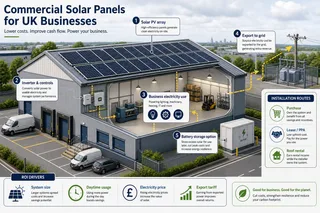
Commercial solar PV converts daylight into electricity for use on site. Surplus electricity is exported, curtailed or managed depending on the grid agreement, metering setup and controls. Systems are commonly mounted on roofs, though ground-mounted options can also be considered where land, planning and grid conditions allow.
The strongest solar cases tend to be sites with steady daytime consumption. Examples include manufacturing facilities, refrigerated premises, offices, leisure centres, education buildings and warehouses with daytime operations. The more generated electricity the business uses directly, the less imported electricity it needs during those periods.
Installers should normally begin with half-hourly electricity data and a roof review rather than a panel count. The demand profile shows weekday peaks, weekend baseload, shutdowns and seasonal changes. The roof survey then tests whether the design is buildable, safe and compatible with the building fabric, before you compare commercial solar proposals on cost and specification.
How onsite wind works for a business site
Onsite wind uses a turbine to convert moving air into electricity. Business viability depends heavily on the quality of the wind resource at the turbine hub height. Smooth, consistent wind is very different from turbulent air caused by trees, buildings, ridgelines, yards or uneven terrain.
A turbine should not be judged from how windy a site feels at ground level. Nearby obstacles can reduce output and increase mechanical wear, especially where the turbine is too low or too close to buildings, tree belts or other structures. Screening should consider hub-height resource, prevailing wind direction, terrain exposure and practical separation from turbulence sources.
This is why business wind is most plausible on open farms, estates, coastal premises, water treatment sites, rural industrial land and exposed private-wire sites. It is usually harder for dense urban and suburban premises, where turbulence, neighbours, height constraints, visual impact and planning sensitivity often undermine the case. Smaller schemes should still be checked carefully against micro wind rules before assumptions are built into the business case.
Costs, savings and ROI should be modelled from the site
Commercial solar costs and returns vary with system size, roof complexity, access, equipment specification, monitoring, structural requirements, grid works and whether battery storage is included. Wind costs and returns are even more site-specific because turbine size, foundations, access tracks, planning work, maintenance and wind resource dominate the model. The key financial question is wider than annual generation. It is how much generated electricity is used onsite, how much is exported, what imported electricity is being offset, whether export is limited, and whether the project introduces new maintenance, insurance, financing or operational obligations. Export income should not be assumed without checking the export arrangement, metering and the connection position. A sensible business case should show assumptions clearly rather than hiding behind one payback figure. It should separate expected generation, self-consumption, export, maintenance, inverter or turbine servicing, finance costs, roof works, insurance considerations and operational disruption. For leasehold premises, it should also reflect landlord consent, repairing obligations and what happens if the business relocates. For solar projects, a structured view of commercial solar ROI can help decision makers test assumptions before comparing quotes.
Planning and grid connection can change the answer
Planning and grid connection are often where the solar-versus-wind comparison becomes truly site-specific. Rooftop solar may be relatively straightforward in many commercial settings, but the route depends on the building, location, roof works, visual impact, lease terms and current planning rules. Businesses should check the latest position with the local planning authority or the UK Government Planning Portal rather than assuming permitted development always applies.
Rooftop solar, ground-mounted solar and onsite wind should be treated differently. Rooftop arrays on ordinary commercial buildings may face fewer planning hurdles than equipment on listed buildings, buildings in conservation areas or sites with sensitive visibility. Ground-mounted solar can raise land-use, screening, ecology, drainage and access questions. Wind usually carries higher sensitivity because turbines are taller moving structures and may raise noise, shadow, landscape, neighbour, ecology, aviation or radar concerns. For solar schemes, a separate commercial planning guide is useful when screening obvious blockers.
Grid connection matters because generation must operate safely with the local electricity network. In the UK, installers and network operators use recognised G98 and G99 connection routes depending on the generation setup and scale, and the correct process should be confirmed for the specific project. The Energy Networks Association framework, the local DNO’s requirements and project-specific protection settings can all affect programme and design. Early DNO engagement is more than administration. A strong commercial proposal can be weakened if the network cannot accept the intended export level without reinforcement, if export has to be limited, or if the system must be resized to fit a viable connection arrangement. Businesses comparing quotes should check who is handling the grid application, what has been assumed and which points remain provisional.
Feasibility checklist before choosing a technology
A good feasibility process separates what is already known from what still needs survey, modelling or third-party confirmation. That is especially important when comparing solar and wind because the evidence needed for each technology is different. For solar, the early evidence is usually electricity demand, roof suitability, access and electrical integration. For wind, the evidence is more development-led and should include wind-resource screening, turbine siting, planning risk and access for construction and servicing. For both, the DNO position can affect system size, export strategy and programme.
Batteries, diverters and hybrid systems
A battery is not a generator, but it can improve how a business uses solar or wind output by shifting electricity from one time of day to another. It may help where there is regular surplus generation, time-of-use pricing, peak demand exposure or evening and early-morning load that would otherwise be met from the grid.
The commercial case for a battery should be modelled from cycles, usable capacity, power rating, efficiency, warranty terms, degradation assumptions and the site’s actual demand profile. A large battery is not automatically better. A small battery may add little value if the business rarely has surplus generation or has limited price variation between import periods. Sites considering storage should assess commercial battery storage as part of the overall demand and controls strategy, not as an isolated add-on.
Solar diverters can sometimes route surplus electricity into hot water, heating or other controllable loads, but they are not a universal business solution. They make more sense where the site has a suitable thermal or flexible electrical load at the right times. For many commercial sites, a wider control strategy may be needed than a simple domestic-style diverter.
When solar is usually the better choice
Solar is usually the better first option where the business has a sound, unshaded roof and meaningful daytime electricity use. It is easier to model than wind, generally easier to install on suitable commercial buildings, and the main survey questions are well understood by competent installers.
That does not mean every commercial roof is suitable. Fragile coverings, asbestos risk, limited access, congested plant areas, old waterproofing, weak structure, fire strategy constraints or a short lease term can all make solar harder to justify. A roof that needs major refurbishment soon should normally be dealt with before panels are installed.
Solar can also be designed around different roof orientations and usage patterns. A south-facing layout may maximise output at certain times, while an east-west layout may spread generation across more of the working day and increase roof coverage. The best layout is the one that balances generation, self-consumption, mounting method, maintenance access, roof loading and electrical integration.
When wind may be worth serious consideration
Wind may be worth serious consideration where the business has open land, clear exposure, suitable separation from obstacles and a demand profile that can use generation outside daylight hours. Sites with year-round loads may benefit if the wind resource is credible and planning risk is manageable.
The challenge is proving the resource and managing development risk. A turbine is more exposed mechanically than a solar array, and maintenance access, noise limits, foundations, safe access, grid connection and long-term servicing all matter. The project should be assessed as an infrastructure development, not just as a piece of equipment purchase.
A professional wind feasibility study becomes particularly important where the turbine would be close to neighbours, sensitive landscapes, ecological constraints, aviation interests, radar considerations or complex terrain. Desktop estimates can be useful for screening, but they should not be treated as bankable performance forecasts without suitable evidence.
Common mistakes that weaken business renewable projects
Many poor solar-versus-wind decisions come from comparing headline generation figures instead of buildable, connectable and usable generation. A system that looks strong in a proposal may underperform financially if the business cannot use the output, cannot export as assumed, or faces unexpected enabling works.
The most reliable proposals make uncertainty visible. They explain what is confirmed, what is provisional and what depends on surveys, planning, DNO response or legal consent. If two quotes show very different savings, ask for the modelling basis rather than choosing the most optimistic number.
What to ask before choosing solar, wind or both
The best next step is to gather the information that will shape the design before asking for a final quote. Annual electricity use is helpful, but half-hourly consumption data is much more useful because it shows when power is actually needed.
For solar, the early questions are about roof condition, structure, shading, access, metering and the building’s electrical layout. For wind, the early questions are about exposure, turbine location, measured or assessed wind resource, planning constraints, separation distances and the evidence behind any wind-speed assumption.
A credible proposal should explain what has been assumed and what remains subject to survey, DNO response, planning review or legal consent. Decision makers should be wary of any proposal that presents a universal payback claim without showing site-specific assumptions. If funding structure is part of the decision, compare ownership and commercial solar finance options alongside the technical evidence.
Final recommendation for UK businesses
For most UK commercial premises, solar PV is the more practical starting point because it is easier to assess, easier to place on suitable buildings and often aligns well with daytime electricity use. Onsite wind is not ruled out, but it needs a stronger site-specific case and more careful development work.
If your business has a large roof and daytime load, start with a solar feasibility review, roof survey and grid check. If you also have exposed land or operate in a rural or coastal location, add a wind screening assessment rather than treating wind as a direct substitute for solar. Where demand continues into evenings, nights or winter peaks, consider whether battery storage, flexible loads or a hybrid design improves self-consumption without adding unnecessary complexity. Sites with credible solar and wind potential should assess whether it is practical to combine solar and wind before committing to either technology alone.
The best decision is the one that can be built, connected, operated and justified from real site evidence. Solar, wind and batteries can all be valuable in the right setting, but none should be selected before the roof, land, planning position, DNO route, demand profile and maintenance responsibilities are understood.
Plan, Compare & Buy Renewable Energy Solutions
AI does the thinking.
You get the perfect solar match.
Use RoboMo™ to assess your property, compare available technologies and connect with trusted UK installers, suppliers and manufacturers.
Simply enter your postcode, drop a pin on your roof, create your free account and let RoboMo™ analyse your property to find the best solar panels for your home.

You don't have to think
RoboMo™'s AI analyses your roof and does all the hard work.

Accurate & tailored
AI-powered assessment based on your roof, location, and conditions.

Best options, maximum savings
Compare top solar panels for the best performance and value.

Simple, fast & effortless
Provide a few details, sit back and watch your results unfold.
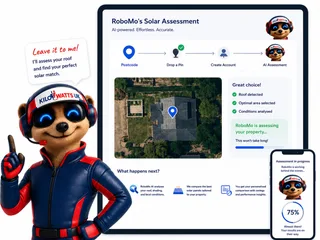

STEP 1
Choose Home, Business or Industrial
Enter your postcode to start your assessment.
STEP 2
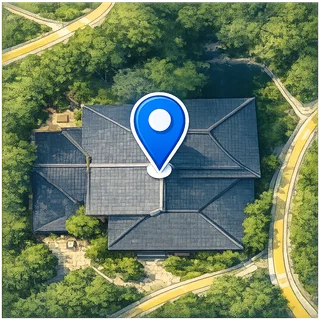
Drop a pin on your roof
STEP 3

Create your free account
STEP 4

Sit back and watch RoboMo™ work
RoboMo™ analyses your roof and builds your personalised solar comparison.

Step 1
Enter your postcode
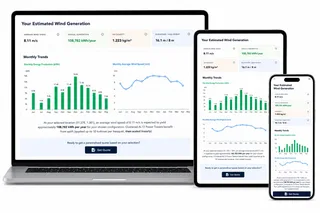
Start designing your wind energy system in seconds.
Are you an installer, distributor or renewable energy business?
Kilowatts UK is expanding the Flower Turbines partner network across the UK.
Become A Flower Turbines PartnerKilowatts UK is an authorised representative
Flower Turbines
Compact vertical-axis turbines built for real UK sites, not just open farmland.
They start in light wind, sit in a small footprint, and are bird-safe by design. Cluster them as a bouquet and the group performs better together than the same turbines standing alone. Enter your postcode for a location-based generation estimate. Figures use area weather data and will differ if buildings, trees or hills sit in the way.
Starts in light UK wind
Built to generate in typical UK wind, not only open farmland.
Small rooftop or ground footprint
Compact towers for roofs, yards and tight sites.
Bird-safe slow rotation
Slow vertical-axis spin, bird-safe by design.
Bouquet clusters raise output
Grouped turbines outperform the same units standing alone.
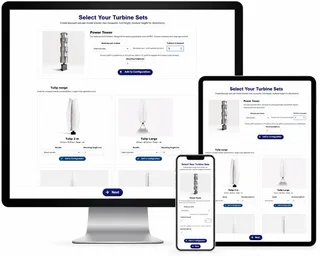
STEP 2

Choose a location
STEP 3

Place your cluster
Tap the map where you want the turbine cluster to go.
STEP 4

Instant generation forecasts
Compare different turbine layouts and see annual generation forecasts instantly.
STEP 5

No commitment required
Explore different configurations before deciding whether to request a quotation.
Related articles
Mo's Mission Nominations
FAQ
Need Help? RoboMo's Got Answers
Is solar or wind usually better for a UK business?
Solar is usually the more practical starting point for UK businesses, especially where there is usable roof space and daytime electricity demand. Wind can be viable on exposed rural, coastal or open industrial sites, but it needs stronger evidence on wind resource, planning risk and access. The best option depends on the site, demand profile, grid connection and ownership position.
When does onsite wind make sense for a business?
Onsite wind is most credible where there is open land, low turbulence and a strong wind resource at turbine hub height. Farms, estates, coastal sites and exposed private-wire locations are more likely candidates than urban or suburban premises. A professional feasibility study should check wind yield, planning issues, foundations, access and long-term servicing.
What should a business check before installing commercial solar panels?
Start with half-hourly electricity data, a roof condition review and a structural assessment. Shading, orientation, access, cable routes, metering and electrical protection can all affect the design. The installer should also confirm the correct DNO connection process before the project proceeds.
Do solar panels or wind turbines need planning permission in the UK?
It depends on the technology, location and details of the installation. Rooftop solar on commercial buildings may be simpler than ground-mounted solar or wind, but listed buildings, conservation areas and visible or unusual works can change the position. Wind projects are often more planning-sensitive because of height, noise, landscape, neighbours, ecology and aviation or radar considerations.
How should a business compare payback for solar and wind?
Do not compare technologies using generation figures alone. The model should show how much electricity is used onsite, how much is exported, any export limits, maintenance costs, finance costs and any roof, foundation or grid works. Wind returns are especially sensitive to proven hub-height wind speed and realistic servicing assumptions.
Can a business combine solar, wind and battery storage?
Yes, hybrid systems can work where the site conditions and electrical demand support them. Solar and wind can sometimes complement each other because their output patterns differ, while a battery may help shift surplus generation to another time. The value of storage should be modelled carefully against demand, tariffs, export arrangements, battery size and operational needs.
What role does the DNO play in a commercial renewable energy project?
The Distribution Network Operator checks how the generation will connect safely to the local electricity network. The correct route depends on the generation setup and scale, and projects may need to follow G98 or G99 processes. Export limits, protection requirements or network constraints can affect system size, cost and programme.
What if the business premises are leased?
Leasehold sites need early checks on landlord consent, repairing obligations, insurance, roof access and reinstatement requirements. A short lease or roof nearing replacement can weaken the case for solar because the asset may outlast the occupation or roof covering. Wind projects may also need land rights, wayleaves and long-term access for construction and servicing.