


Does Your Roof Need to Face South for Solar? UK Guide
Published: 2026-08-17 21:17:12
Updated: 2026-10-06 12:58:42
East and west roofs spread solar output across the day. Here's why self-consumption, shade and diffuse light matter more than compass bearing in the UK.
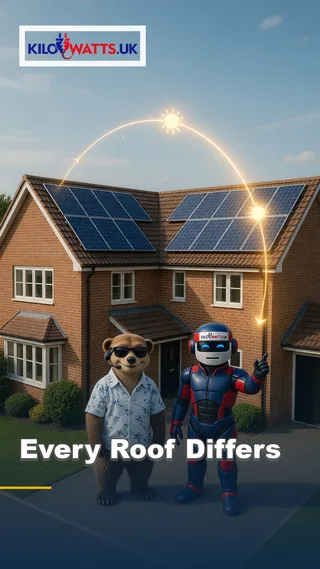
Does Your Roof Need to Face South for Solar? UK Guide
East and west roofs spread solar output across the day. Here's why self-consumption, shade and diffuse light matter more than compass bearing in the UK.
Your Roof Doesn't Need to Face South
If you have looked into solar and found your roof runs east–west, you have probably already been told the bad news by someone: south or nothing. It is one of the most persistent pieces of half-truth in UK home energy. The honest answer is more interesting. A south-facing array does produce the highest total annual output for a given number of panels - but a split east–west array produces power across a longer part of the day, with a lower midday peak and more generation in the morning and evening, which is exactly when most households actually use electricity. Because the value of solar in the UK comes largely from the units you use yourself rather than the units you export, a longer, flatter generation curve can be worth more per kilowatt-hour generated than a tall, narrow one. Add the fact that shading hurts a roof far more than bearing does, and that most British daylight is diffuse rather than directional, and the compass starts to look like the least interesting number on the survey sheet. This article unpacks every point from the episode, in plain UK terms, for anyone weighing up a roof that stubbornly refuses to face the equator.
Where the "it must face south" rule actually came from
The rule is not nonsense - it is just old advice applied to a changed situation. In the northern hemisphere the sun tracks across the southern sky, so a south-facing surface receives the most direct light over a year. If your only goal is maximum annual kilowatt-hours per panel, south wins. That was the right goal in an era when almost everything a system generated was rewarded at a good rate regardless of when it left the roof, so the shape of the day did not matter much. What matters now is different. A modern UK household is generally paid less for exported units than it pays for imported ones, which means the timing of generation matters as much as the total. A south array delivers a tall spike around the middle of the day, when many homes are at their quietest: nobody is cooking, the washing machine finished hours ago, and the car is at work. An east–west array trades some of that peak for a wider plateau. Same roof, same sun, different shape - and shape is what decides how much of your own generation you actually consume. For the wider orientation question, it helps to understand which direction solar panels can face in UK conditions.
What a longer generation window does in a real UK home
Picture a typical weekday demand curve. There is a morning burst - kettle, shower, toaster, hair dryer, heating pump - then a long quiet middle, then a heavy evening: cooking, lights, television, tumble dryer, possibly an EV plugged in on arrival. A south-facing array puts its biggest surge into the quiet middle. An east-facing plane starts producing meaningfully earlier in the morning, and a west-facing plane keeps producing later into the afternoon and evening. Split across both, you lower the midday peak and stretch the shoulders outwards, so more of your generation lands on top of demand instead of beside it. In practical terms, that can mean the morning kettle and the evening oven are partly running on your own roof rather than on imported units. Nothing about this is magic: the total energy is slightly lower over a year. But the fraction of it that never has to be bought back is higher, and that fraction is where the household economics live. If you are trying to estimate the scale of that output, start with how much electricity solar panels generate across the year.
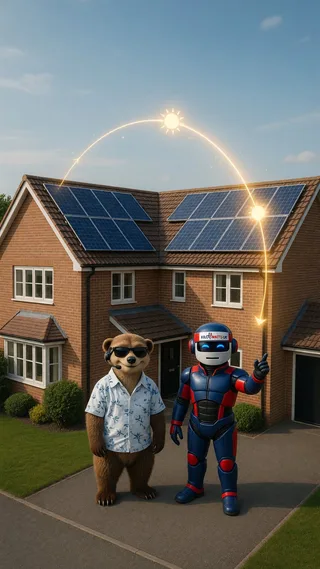
Self-consumption, not peak output, decides the value
This is the single idea worth taking away. Two systems can generate similar amounts and be worth quite different things, because value depends on what happens to each unit. A unit you use in your own home displaces a unit you would otherwise buy at the import rate. A unit you export earns whatever your export arrangement pays, which is normally less. So the useful question is not "how many kilowatt-hours will this roof make?" but "how many of them will I use?" That reframing changes several decisions at once. It explains why an east–west split is often perfectly sensible. It explains why a battery, which stores the midday surplus for the evening, tends to add more to a south-heavy array than an east–west one. And it explains why lifestyle matters: a household that is out all day and home only in the evening behaves very differently from one working from home. Any honest assessment of a roof should ask about occupancy patterns, not just bearing and pitch. If the timing does not line up with your household load, solar battery storage may be part of the design conversation.
Shade is the real limiter, not the compass
If you want one thing to worry about on a UK roof, worry about shade. A chimney stack, a neighbouring gable, a satellite dish, a tall conifer, a dormer or a flue can put a moving shadow across an array for hours a day, and shading has a disproportionate effect on a string of panels compared with the tidy, predictable loss from a non-ideal bearing. A clear east–west pair, unobstructed from first light to last, will normally serve a household better than a south roof that spends the best part of the afternoon under a shadow. This is why a proper survey looks at the whole envelope around the house and the sun's path across the year - the arc sits low in winter, so a shadow that barely registers in June can sweep across the roof for much of a December day. Where partial shade is unavoidable, panel-level electronics and sensible string layout can limit the damage, but the first and best move is always to design the array around where the shadows fall.
Grey British skies: why diffuse light has no bearing
true energy fact underneath the whole episode: UK homes still generate useful solar power on overcast days. Under cloud, sunlight is scattered by water droplets and arrives at the roof from across the entire sky dome rather than from one point. That light is diffuse, and diffuse light does not have a compass bearing to miss. On a properly grey day - which, being Britain, is a substantial share of the year - the difference between an east, west and south plane narrows considerably, because all three are looking at broadly the same bright hemisphere. Output is lower than in full sun, of course, but it is not zero and it is not trivial, and it accumulates through the long, dim shoulders of the British year. It also means that the sunniest-sounding orientation advice is calibrated for the conditions we have least of. A related point worth knowing: panels actually convert light more efficiently when they are cold than when they are hot, so a bright, crisp winter day is kinder to a module than a sweltering August afternoon. That is why it is worth knowing how solar works in winter before dismissing a roof because of British weather.
Angle of incidence: what actually stops light entering the glass
The physical limit on a panel is not which way it points but how steeply light strikes its surface. This is the angle of incidence. When light meets the glass close to head-on, almost all of it passes through and reaches the cells beneath. As the angle becomes shallower, more of it reflects away - but that reflection loss is remarkably flat across most of the range. It only rises sharply in the last sliver, when light is grazing the surface almost sideways. Anti-reflective coatings on modern module glass flatten that curve further still. The practical consequence is that a panel does not care nearly as much about a twenty or thirty degree change in bearing as intuition suggests. What a change in bearing mostly does is shift when the sun is high in that panel's sky - it moves the peak earlier or later in the day. It shuffles the timetable rather than rewriting the physics.
A practical checklist for judging your own roof
Work through these before you let anyone tell you your roof is unsuitable. First, map the shade: stand outside in the morning, at midday and in the late afternoon, and note what casts a shadow onto each roof plane - and remember shadows lengthen dramatically in winter. Second, describe your day honestly: are you home in the morning and evening, or all day? Does an EV charge at home, and when? Third, count usable planes: an east–west split gives you two, which is often more total area than a single south face. Fourth, check the roof itself - pitch, condition, age of covering, any planned re-roofing, and access for scaffolding. Fifth, think about what happens to the surplus: without storage, midday excess is exported; with storage, it can be moved to the evening. Sixth, look at your existing consumption, ideally from smart meter data, so the design targets your real load rather than an average household. Finally, ask any installer to show you the modelled generation curve for your specific roof planes, not just an annual total. If a proposal cannot explain how its shape matches your demand, it has skipped the part that decides the value. For sizing context, compare that design with how many panels a UK home typically needs.
Common follow-up questions
Is an east–west split always better than south? No. It is better in some circumstances and not others. If your household consumes most of its power in the middle of the day, or you are pairing the array with storage that can absorb a strong midday surge, a south plane may suit you very well. The point is that the answer depends on your demand pattern, not on a universal rule. Does a north-facing plane ever make sense? It is the weakest orientation and generally the last one considered, though very shallow pitches reduce the penalty because a nearly flat panel is looking mostly at the sky. It should never be the assumed default. Do I need more panels on an east–west roof for the same annual output? Slightly more, all else equal, since each plane produces a little less than an ideal south equivalent - but you often have more usable area to work with. Does a battery change the calculation? It generally increases self-consumption for any orientation, and tends to make the largest relative difference where generation is concentrated into a narrow midday peak that the household cannot use live. Does cloud make solar pointless in the UK? No - diffuse light still produces real output, and a system is sized around the whole British year, dull days included. Should I worry about panel efficiency ratings above everything? Efficiency mainly determines how much power you fit into a given area. On a roof with room to spare, layout, shading and demand matching will influence your outcome more than a small difference in module specification. If you are at the stage of choosing a system, it is sensible to compare home solar options against your actual roof and usage.
Video transcript
Mo: Solar panels have to face south... right? RoboMo: No. East and west can produce a longer generation window.
Mo: So why does a wider window matter? RoboMo: Lower midday peak. Longer output. It matches morning and evening use, when homes actually draw power.
Mo: But east and west generate less overall? RoboMo: Slightly less total. More used directly at home. Self-consumption decides value, not peak output. Mo: So does roof direction even matter? RoboMo: Less than shade. A clear east–west pair beats a shaded south roof. Mo: Even on grey days? RoboMo: Especially. Most UK light is diffuse. It arrives from the whole sky, not one direction. Mo: So what actually limits a panel? RoboMo: Angle of incidence. Steep light reflects off the glass. Compass bearing barely changes that. Mo: So the angle loss is tiny? RoboMo: Until light grazes, the glass absorbs almost everything. Bearing shifts timing, not physics. Mo: Solar panels have to face south... right? RoboMo: No. East and west can produce a longer generation window. / Mo: So why does a wider window matter? RoboMo: Lower midday peak. Longer output. It matches morning and evening use, when homes actually draw power. / Mo: But east and west generate less overall? RoboMo: Slightly less total. More used directly at home. Self-consumption decides value, not peak output. / Mo: So does roof direction even matter? RoboMo: Less than shade. A clear east–west pair beats a shaded south roof. / Mo: Even on grey days? RoboMo: Especially. Most UK light is diffuse. It arrives from the whole sky, not one direction. / Mo: So what actually limits a panel? RoboMo: Angle of incidence. Steep light reflects off the glass. Compass bearing barely changes that. / Mo: So the angle loss is tiny? RoboMo: Until light grazes, the glass absorbs almost everything. Bearing shifts timing, not physics. Compass bearing is a real variable, but it has been promoted far above its station. It shifts the timing of your generation rather than deciding whether solar works on your house at all. Shade matters more. Diffuse light - the ordinary condition of a British sky - arrives from everywhere and cares little about which way a roof faces. And the physics of the glass itself is forgiving until light is grazing across it almost sideways. What actually determines whether a system earns its keep is how much of what it makes gets used inside the building, which is a question about your household, your storage and your shadows rather than a line on a map. If someone has told you your east–west roof rules you out, it is worth getting a second look before you accept it. If you would like to see what your own roof planes would actually produce across a day - shading, orientation, pitch and your real consumption pattern included - a survey is the sensible starting point. No pressure either way: the aim is a clear picture you can judge for yourself.
Plan, Compare & Buy Renewable Energy Solutions
AI does the thinking.
You get the perfect solar match.
Use RoboMo™ to assess your property, compare available technologies and connect with trusted UK installers, suppliers and manufacturers.
Simply enter your postcode, drop a pin on your roof, create your free account and let RoboMo™ analyse your property to find the best solar panels for your home.

You don't have to think
RoboMo™'s AI analyses your roof and does all the hard work.

Accurate & tailored
AI-powered assessment based on your roof, location, and conditions.

Best options, maximum savings
Compare top solar panels for the best performance and value.

Simple, fast & effortless
Provide a few details, sit back and watch your results unfold.
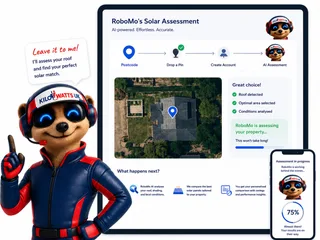
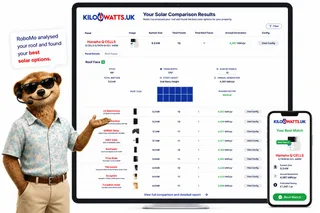
STEP 1
Choose Home, Business or Industrial
Enter your postcode to start your assessment.
STEP 2
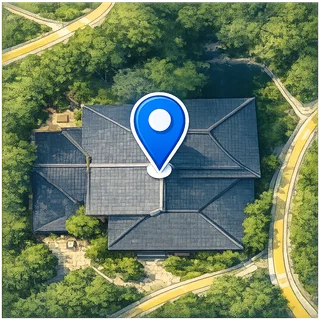
Drop a pin on your roof
STEP 3

Create your free account
STEP 4

Sit back and watch RoboMo™ work
RoboMo™ analyses your roof and builds your personalised solar comparison.

Step 1
Enter your postcode
Start designing your wind energy system in seconds.
Are you an installer, distributor or renewable energy business?
Kilowatts UK is expanding the Flower Turbines partner network across the UK.
Become A Flower Turbines PartnerKilowatts UK is an authorised representative
Flower Turbines
Compact vertical-axis turbines built for real UK sites, not just open farmland.
They start in light wind, sit in a small footprint, and are bird-safe by design. Cluster them as a bouquet and the group performs better together than the same turbines standing alone. Enter your postcode for a location-based generation estimate. Figures use area weather data and will differ if buildings, trees or hills sit in the way.
Starts in light UK wind
Built to generate in typical UK wind, not only open farmland.
Small rooftop or ground footprint
Compact towers for roofs, yards and tight sites.
Bird-safe slow rotation
Slow vertical-axis spin, bird-safe by design.
Bouquet clusters raise output
Grouped turbines outperform the same units standing alone.

STEP 2

Choose a location
STEP 3

Place your cluster
Tap the map where you want the turbine cluster to go.
STEP 4

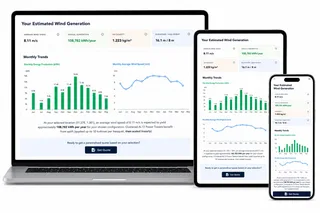
Instant generation forecasts
Compare different turbine layouts and see annual generation forecasts instantly.
STEP 5

No commitment required
Explore different configurations before deciding whether to request a quotation.
FAQ
Need Help? RoboMo's Got Answers
Do solar panels have to face south in the UK?
No. A south-facing roof usually gives the highest annual output from each panel, but east- and west-facing roofs can still work well. The best option depends on shade, roof space, pitch and when your household uses electricity.
Is an east-west solar array a good idea?
Often, yes. An east-west split usually produces less at midday than a south-facing array, but it can generate earlier in the morning and later in the afternoon. That can suit households that use more power before and after the working day.
Does shade matter more than roof direction?
Yes, shade can be a bigger problem than a non-south-facing roof. Chimneys, dormers, trees, neighbouring buildings and flues can reduce output, especially when the sun is low in winter. A proper survey should look at shading across the day and year, not just the compass bearing.
Can north-facing solar panels ever make sense?
North-facing panels are usually the weakest option in the UK and are normally considered last. They may be more viable on a very shallow roof pitch, because the panels face more of the sky rather than a steep northern horizon. An installer should model the likely output before recommending them.
Will solar panels still work on cloudy days in the UK?
Yes. Solar panels still generate from diffuse daylight when the sky is overcast, although output is lower than in direct sun. Cloudy weather also reduces the difference between roof directions because light is coming from across the sky rather than one clear direction.
Do I need a battery if my roof does not face south?
Not necessarily. A battery can help any solar system use more of its own generation, but the benefit depends on your usage pattern and export arrangement. East-west systems may already spread generation across more of the day, while south-facing systems often have a stronger midday surplus to store.
Will I need more panels on an east- or west-facing roof?
Possibly. Compared with an ideal south-facing roof, each east- or west-facing panel may produce slightly less over the year. However, many homes have more usable roof area across two roof planes, so the final design should be based on modelled output rather than orientation alone.
What should I ask an installer before deciding if my roof is suitable?
Ask for a design based on your exact roof planes, shading, pitch and electricity use, not just a generic annual output figure. It is also useful to see how generation is expected to vary through the day. A good proposal should explain how the system matches your household demand and what happens to any surplus.