


UK Commercial Solar: No-Upfront Ownership and PPAs for Homeowners
Published: 2026-07-18 16:44:13
Updated: 2026-07-26 18:35:28
A UK business can own commercial solar with no upfront cost by financing the installation instead of paying the full capital cost on day one.
Can a UK business own commercial solar with no upfront cost?
Yes. A UK business can own commercial solar with no upfront cost by financing the installation instead of paying the full capital cost on day one. This is usually done through asset finance, hire purchase, a commercial loan, or a lease-to-own structure.
“No upfront cost” does not mean free. The business still pays for the solar PV system over time, and the total amount paid will normally be higher than a cash purchase because finance costs are included.
A practical way to think about it is: Commercial solar no upfront cost ownership can work well for businesses that want to preserve cash, reduce imported electricity, and keep the long-term asset benefit. It is usually strongest where the site has good daytime electricity use, a suitable roof, acceptable finance terms, and a clear grid connection route. It is less suitable where the business has low daytime demand, a short lease, a roof nearing replacement, restrictive grid conditions, or finance terms that are too expensive. If you are comparing routes to ownership, you can compare commercial solar options before committing to a proposal.
How no-upfront commercial solar ownership works
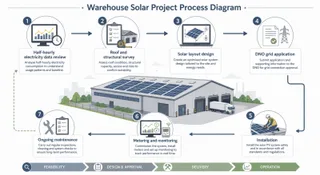
In most projects, the installer designs and prices the system first. A finance provider then assesses the business and funds the installation, either by paying the installer directly or by financing the solar asset. The business makes monthly or quarterly repayments under the agreed finance contract.
The typical process is:
Depending on the finance structure, the business may own the system from the start or become the legal owner after the final payment. Hire purchase commonly transfers ownership at the end. Some asset finance or loan structures can give effective ownership earlier. Lease-to-own arrangements need careful review because ownership depends on the contract wording. The business remains responsible for repayments even if the system produces less than expected, unless the contract includes specific performance protection. Before signing, check the generation assumptions, self-consumption estimate, maintenance plan, finance term, and end-of-term ownership position.
What commercial solar panel installation cost includes
Commercial solar panel installation cost is not just the price of the panels. A reliable quote should show what is included and what is excluded.
A typical commercial solar quote may include:
On real commercial sites, the roof and electrical infrastructure can influence cost as much as the panel specification. A modern, unobstructed roof with good access is usually simpler. A fragile roof, asbestos risk, old switchgear, long cable route, or out-of-hours shutdown requirement can increase cost. Broad UK commercial solar cost ranges are: These are broad guide figures, not fixed prices. Final costs depend on surveys, specification, access, grid requirements, electrical works, roof condition, and commercial terms. For financed ownership, the key comparison is not only installed price. It is the repayment profile compared with avoided grid electricity costs, likely export income, maintenance costs, insurance requirements, and future replacement items such as inverters.
Why commercial solar costs vary by site
The cost per kWp usually falls as system size increases, but the biggest possible system is not always the best commercial choice. A system sized only around available roof area may export too much electricity and deliver weaker returns than a system sized around daytime demand.
The main cost drivers are:
A cheaper quote can become more expensive later if it excludes roof access, structural checks, switchgear upgrades, DNO constraints, or monitoring. For financed ownership, any missed cost may increase the finance amount or require a separate capital payment. The best early-stage quotes explain assumptions clearly. They should state whether structural calculations are included, whether export approval has been checked, whether export limitation is expected, and whether maintenance and inverter replacement have been allowed for in the financial model.
How much electricity a commercial solar system may generate
UK commercial solar typically generates about 850 to 1,000 kWh per kWp per year. A well-oriented, lightly shaded roof in southern England may exceed 1,000 kWh per kWp per year. Sites in Scotland, northern England, Wales, or Northern Ireland may generate less depending on orientation, pitch, weather, shading, and design.
Broad annual generation examples are:
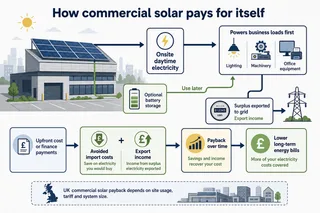
The financial result depends less on headline generation and more on self-consumption. Solar electricity used on site offsets imported electricity. Exported electricity usually earns less than the cost of buying electricity from the grid, so export income is rarely the main reason for installing commercial solar. A simplified flow is: East-west roofs can produce less annual electricity than ideal south-facing roofs, but they may spread output across more of the working day. This can suit offices, warehouses, schools, light industrial units, and retail sites where demand is not concentrated at midday.
When no-upfront solar ownership is likely to work well
No-upfront ownership works best when the business has a strong daytime load and expects to remain at the property for at least the finance term. Owner-occupiers are often simpler because they control the roof, electrical infrastructure, and long-term building decisions.
Good-fit sites often include:
- Businesses with high daytime electricity use.
- Sites operating five to seven days a week.
- Owner-occupied commercial buildings.
- Tenanted sites with long leases and landlord consent.
- Roofs in good condition with spare structural capacity.
- Sites with suitable three-phase supplies.
Examples of potentially suitable sites include cold stores, manufacturers, leisure centres, farms, schools, offices, warehouses, and retail units. Suitability still depends on the load profile, roof condition, grid position, and finance terms. A warehouse with a large roof but very low daytime consumption may need a smaller system, an export agreement, or a battery assessment before the numbers make sense. Larger manufacturing and processing sites may also want to compare industrial solar options where the project size and electrical load are closer to industrial use. Finance can be attractive where preserving working capital is more important than achieving the lowest lifetime cost. A cash purchase usually has the lowest total cost, but finance may still be the better business decision if capital is needed elsewhere. Businesses with stable trading history and finance eligibility. Sites that can use most solar generation on site.
When no-upfront ownership may be a poor fit
Some projects look attractive at first but weaken after roof, lease, grid, or usage checks. If the business may move before the finance term ends, the contract needs clear assignment, buyout, or relocation terms. Without them, the solar asset can become a problem during a move, sale, refinance, or lease event.
No-upfront commercial solar may be less suitable for:
Short leases or uncertain occupation. Roofs due for replacement or major repair. Heavy shading from nearby buildings, trees, parapets, or roof plant. Low daytime electricity use. Major export restrictions with limited self-consumption. Weak credit where finance terms are expensive. An old roof is one of the most common issues. Installing solar on a roof that needs replacement soon can lead to costly removal and reinstallation. It is usually better to complete roof works first, then install solar once the roof condition and warranty position are clear. Businesses that use most electricity at night need a cautious assessment. Commercial solar battery storage can help in some cases, but it adds cost and should be modelled separately rather than treated as an automatic addition. Buildings with unresolved asbestos issues. Listed buildings where consent is difficult. Sites where insurance requirements cannot be met. Sites where shutdowns or access would cause excessive disruption.
Ownership finance compared with a PPA
No-upfront ownership and a power purchase agreement can both avoid an initial capital payment, but they are not the same. The distinction affects ownership, risk, maintenance, accounting treatment, and the share of savings retained by the business.
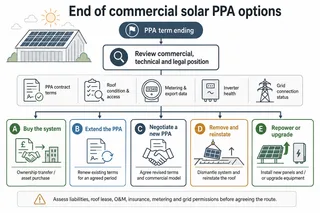
A PPA can suit businesses that want no upfront cost and prefer the asset owner to carry more operational responsibility. However, it does not usually provide ownership from day one.
Under financed ownership, the business normally keeps the full benefit of avoided grid electricity once finance is repaid. In return, it may carry more responsibility for maintenance, insurance, downtime, monitoring, and inverter replacement. Before signing, check:
- Early repayment terms.
- Ownership transfer wording.
- Removal obligations.
- Maintenance scope.
- Insurance duties.
- Buyout rights.
Assignment rights if the business sells or relocates. What happens at the end of the building lease. What happens if the system underperforms.
Roof, grid, and permission checks before committing
A commercial solar quote should not be treated as final until the roof, grid connection, and electrical infrastructure have been checked properly. These items can affect feasibility, cost, output, safety, and finance approval.
Key checks include:
Most commercial systems need DNO involvement. Smaller systems may fall under G98 rules, while larger systems usually need a G99 application before connection. If the DNO restricts export, a G100-compliant export limitation system may be needed. Solar can still be viable, but any curtailed generation should be reflected in the savings model. Planning requirements vary across England, Scotland, Wales, and Northern Ireland. Many rooftop commercial solar installations are permitted development if conditions are met, but listed buildings, conservation areas, ground-mounted systems, and visually sensitive locations need extra care. Building regulations, electrical safety, fire safety, and CDM duties may also apply. Insurance should be considered early. Some insurers require notification before installation and may ask for specific installation standards, fire access, cable routing, labelling, shutdown procedures, or periodic inspections.
What to ask before choosing an installer and finance offer
A good proposal should explain how the system size was chosen, not just how many panels fit on the roof. It should use actual electricity data where possible, ideally half-hourly data, and show assumed self-consumption, export, repayments, and sensitivity to lower output or lower electricity prices.
Useful questions include:
- Does the proposal use actual half-hourly electricity data?
- How has the system size been chosen?
- Has the roof condition been checked before final pricing?
- Are structural calculations included or excluded?
- Has DNO export capacity been assessed?
- Is export limitation required?
The installer should provide clear handover documentation after installation. This should include drawings, warranties, test certificates, datasheets, DNO approval, monitoring access, maintenance instructions, and emergency shutdown information. Do not judge proposals only on the lowest installed price. A slightly higher specification may be better value if it includes proper access design, reliable monitoring, suitable inverter placement, insurer requirements, and realistic generation modelling. It may also be worth reviewing the available commercial solar panels being proposed rather than comparing quotes on total system price alone. What happens if DNO approval changes the design? Are access equipment and safe working measures included? Are maintenance and inverter replacement included in the model? Who owns the system during and after the finance term? What are the early repayment and buyout terms? What happens if the business moves premises? What warranties apply to panels, inverters, workmanship and mounting? What monitoring is included, and who responds to faults? What documentation will be provided at handover?
How to decide if commercial solar no upfront cost ownership is right for you
The decision should be based on cash flow, risk, and site suitability. A strong project usually has a sound roof, a stable business, good daytime electricity use, acceptable finance terms, and a clear route through DNO approval and permissions.
A simple decision framework is:
Compare the finance repayments with the expected value of solar electricity used on site, likely export income, maintenance costs, downtime risk, and future replacement items such as inverters. Then test the project against less favourable assumptions, including lower generation, lower electricity prices, export limits, and business changes. If the project only works under optimistic assumptions, it needs reworking. If it remains sensible under cautious assumptions and the business expects to stay at the site, no-upfront ownership can be a practical way to install commercial solar without using capital on day one.
Plan, Compare & Buy Renewable Energy Solutions
AI does the thinking.
You get the perfect solar match.
Use RoboMo™ to assess your property, compare available technologies and connect with trusted UK installers, suppliers and manufacturers.
Simply enter your postcode, drop a pin on your roof, create your free account and let RoboMo™ analyse your property to find the best solar panels for your home.

You don't have to think
RoboMo™'s AI analyses your roof and does all the hard work.

Accurate & tailored
AI-powered assessment based on your roof, location, and conditions.

Best options, maximum savings
Compare top solar panels for the best performance and value.

Simple, fast & effortless
Provide a few details, sit back and watch your results unfold.
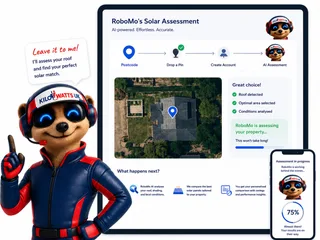
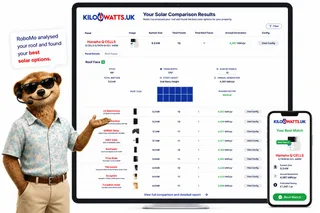
STEP 1
Choose Home, Business or Industrial
Enter your postcode to start your assessment.
STEP 2

Drop a pin on your roof
STEP 3

Create your free account
STEP 4

Sit back and watch RoboMo™ work
RoboMo™ analyses your roof and builds your personalised solar comparison.

Step 1
Enter your postcode
Start designing your wind energy system in seconds.
Are you an installer, distributor or renewable energy business?
Kilowatts UK is expanding the Flower Turbines partner network across the UK.
Become A Flower Turbines PartnerKilowatts UK is an authorised representative
Flower Turbines
Compact vertical-axis turbines built for real UK sites, not just open farmland.
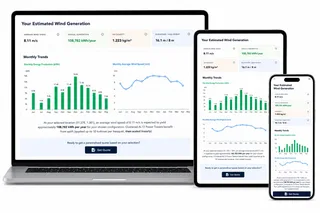
They start in light wind, sit in a small footprint, and are bird-safe by design. Cluster them as a bouquet and the group performs better together than the same turbines standing alone. Enter your postcode for a location-based generation estimate. Figures use area weather data and will differ if buildings, trees or hills sit in the way.
Starts in light UK wind
Built to generate in typical UK wind, not only open farmland.
Small rooftop or ground footprint
Compact towers for roofs, yards and tight sites.
Bird-safe slow rotation
Slow vertical-axis spin, bird-safe by design.
Bouquet clusters raise output
Grouped turbines outperform the same units standing alone.
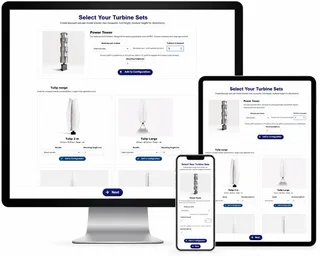
STEP 2

Choose a location
STEP 3

Place your cluster
Tap the map where you want the turbine cluster to go.
STEP 4

Instant generation forecasts
Compare different turbine layouts and see annual generation forecasts instantly.
STEP 5

No commitment required
Explore different configurations before deciding whether to request a quotation.
Related articles
Mo's Mission Nominations
FAQ
Need Help? RoboMo's Got Answers
Can a UK business own commercial solar panels with no upfront cost?
Yes. A UK business can own commercial solar with no upfront cost by using finance instead of paying the full installation cost on day one. Common routes include asset finance, hire purchase, commercial loans, and lease-to-own arrangements. The business repays the cost over time while using the solar electricity generated on site. No upfront cost does not mean the system is free, because finance charges are usually included and the total paid over the term may be higher than a cash purchase.
Does no-upfront commercial solar mean free solar panels?
No. No-upfront commercial solar means the initial capital cost is funded through a finance arrangement or third-party structure. The business still pays for the solar PV system over time, either through finance repayments or, in the case of a power purchase agreement, by buying the electricity generated by a system owned by someone else. The key question is whether the savings from reduced grid electricity are expected to support or exceed the repayments under cautious assumptions.
What finance options can be used to own commercial solar?
The main finance options include asset finance, hire purchase, commercial loans, and lease-to-own agreements. Asset finance and loans may allow the business to benefit from ownership or effective ownership while spreading the cost. Hire purchase commonly transfers ownership after the final payment. Lease-to-own can also provide a route to ownership, but the contract wording must be checked carefully to confirm when ownership transfers and what happens at the end of the term.
Who owns the solar panels during a no-upfront finance agreement?
Ownership depends on the finance structure. Under some loan or asset finance arrangements, the business may own the system from the start, subject to lender security. Under hire purchase, ownership often transfers after the final payment. Under lease-to-own, ownership depends on the specific contract terms. Before signing, the business should confirm who owns the system during the term, who owns it at the end, whether there are transfer fees, and what happens if the business sells the building or moves premises.
How is no-upfront ownership different from a solar PPA?
With no-upfront ownership finance, the business is usually working towards owning the solar asset and keeping the long-term benefit after the finance is repaid. With a power purchase agreement, or PPA, a third party usually owns, operates, and maintains the system, while the business buys the solar electricity at an agreed rate. A PPA can reduce operational responsibility, but it usually does not give the business ownership of the panels from day one.
What costs are included in a commercial solar installation?
A commercial solar installation quote should cover more than just the panels. It may include PV modules, inverters, mounting equipment, cabling, electrical protection, monitoring, design, surveys, access equipment, installation labour, DNO work, commissioning, certification, warranties, and handover documentation. Costs can rise if the site needs structural checks, switchgear upgrades, long cable runs, scaffolding, export limitation equipment, asbestos management, or out-of-hours work.
How much does commercial solar cost in the UK?
Commercial solar costs vary by system size, roof type, access, electrical infrastructure, and grid requirements. As a broad guide, smaller commercial systems may cost around £900 to £1,400 per kWp, mid-sized systems may cost around £700 to £1,100 per kWp, and larger systems may cost around £600 to £900 per kWp before finance costs. These are indicative ranges only. A final quote should be based on site surveys, electrical checks, structural suitability, and DNO requirements.
How much electricity can a commercial solar system generate?
UK commercial solar systems often generate around 850 to 1,000 kWh per kWp per year, depending on location, roof orientation, pitch, shading, and system design. For example, a 100 kWp system may generate roughly 85,000 to 100,000 kWh per year. The financial value depends mainly on how much of that electricity is used on site. Solar electricity used directly by the business usually has a higher value than exported electricity because it reduces grid imports.
When does no-upfront commercial solar ownership work best?
It usually works best for businesses with high daytime electricity use, a suitable roof, stable occupancy, acceptable finance terms, and a clear grid connection route. Owner-occupied buildings are often simpler, but leased sites can also work if the lease is long enough and the landlord gives consent. Good-fit sites often include manufacturers, warehouses, cold stores, leisure centres, schools, farms, offices, and retail units with significant daytime demand.
When might no-upfront commercial solar be a poor fit?
It may be a poor fit if the business has low daytime electricity use, a short lease, likely relocation, expensive finance terms, heavy shading, an old roof, unresolved asbestos issues, restrictive grid conditions, or insurance requirements that cannot be met. Installing solar on a roof that may need replacement soon can create extra removal and reinstallation costs. If the project only works under optimistic assumptions, the system size, finance structure, or savings model should be reviewed.
What roof checks are needed before installing commercial solar?
The roof should be checked for age, condition, covering type, drainage, roof lights, fragile areas, warranty issues, and structural capacity. The design must account for added load, wind uplift, fixing method, ballast limits, access for maintenance, and safe working requirements. A roof that is near the end of its life should normally be repaired or replaced before solar is installed.
Does a commercial solar installation need DNO approval?
Most commercial solar installations need some level of DNO involvement because they connect to the electricity network. Smaller systems may fall under G98 rules, while larger systems usually need a G99 application before connection. If export is restricted, a G100-compliant export limitation system may be required. Any export limits or curtailment should be included in the financial model so savings are not overstated.
Does commercial solar need planning permission?
Many rooftop commercial solar installations can be permitted development if the relevant conditions are met, but rules vary across the UK and depend on the building and location. Listed buildings, conservation areas, ground-mounted systems, and visually sensitive sites may need extra checks or formal consent. Building regulations, electrical safety, fire safety, CDM duties, and insurer requirements should also be considered before installation.
Should a business add battery storage to commercial solar?
Battery storage can help if the business exports a lot of solar electricity, has evening or night-time demand, or can benefit from tariff optimisation. However, batteries add cost and should be assessed separately. They are not automatically worthwhile for every commercial solar project. The business should compare the additional cost, expected battery cycling, usable capacity, warranty terms, maintenance needs, and payback against a solar-only option.
What should a business ask before choosing a solar installer and finance offer?
The business should ask whether the proposal uses actual half-hourly electricity data, how the system size was chosen, whether structural checks are included, whether DNO capacity has been assessed, whether export limitation is needed, and what happens if the DNO changes the connection terms. It should also confirm ownership terms, early repayment rules, maintenance responsibilities, warranties, monitoring, insurance duties, handover documents, and what happens if the business moves or sells the property.
How can a business decide if no-upfront commercial solar ownership is right?
The decision should be based on site suitability, cash flow, finance terms, and risk. A strong project usually has good daytime demand, a sound roof, realistic generation assumptions, manageable grid requirements, and repayments that are supported by cautious savings estimates. The business should test the numbers against lower generation, lower electricity prices, export restrictions, maintenance costs, and possible business changes before committing.