


What size home battery do you need in the UK?
Published: 2026-10-07 02:12:44
Updated: 2026-10-06 19:13:52
What battery do I need depends on usable kilowatt-hours you can shift, inverter power, and whether the charge window and connection can fill it.

What battery do i need?
Understand what battery do i need in the UK, with clear explanations, examples, and practical next steps.
What size home battery do you need in the UK?
There is no single battery that a UK home, business, farm or factory needs, and there is no safe rule of one kilowatt-hour of storage per kilowatt of solar. What battery do I need is a match between usable kilowatt-hours you can actually shift, continuous kilowatts the inverter can supply, and whether the connection, the charge window and the room can accept that hardware. A modest evening load after solar is a different job from heat-pump storage or electric vehicle charging. Power and import limits often decide the design before nameplate capacity does.
Two honest quotes can propose different kilowatt-hour figures because they assumed different daily use, different backup circuits, or a different charge rate from the roof or the grid. Treat a universal size as a guess. It ignores when the building uses electricity.
A home battery is the storage that can be filled in a real charge window and then discharged at the power the inverter can sustain for the loads you care about. Identify the energy you can usefully move from a sunny or cheap period into a later period of use. Then check whether the inverter, the supply and the place the battery will sit can deliver that energy at the power you need. If energy or power fails that test, a larger nameplate will not fix it.
Why usable energy and power must be quoted separately
Usable capacity is the energy the battery can deliver in normal operation. Nameplate or nominal capacity is larger. State-of-charge limits, temperature, efficiency and the way the manufacturer defines usable energy all reduce what arrives at the circuits later. Comparing only the largest number on a datasheet is a common way to overstate what the system will do. Power is the other limit, and it is easy to miss on a quote that leads with kilowatt-hours. A battery can still show charge and be unable to cover several loads at once if the battery or inverter power rating is low. A kettle, oven, heat pump and electric vehicle charger together can exceed that rating. Quotes should separate usable kilowatt-hours, continuous charge and discharge kilowatts, and any short peak. Homeowners often compare only the storage figure, then find the limit when two large loads run together. Chemistry, temperature and how hard the battery is cycled all change round-trip losses, cycle life and degradation, and those figures are product-specific. Lithium iron phosphate is widely used in stationary home batteries; other lithium-ion chemistries are also sold. Neither chemistry gives you a national efficiency or a national lifespan to drop into a sizing sum. Read the warranty for retained capacity, any throughput limit, and whether cover reduces over time. The year count is a commercial term. It is not a promise that day-one usable energy will still be there at the end of the term. Domestic products are often discussed from a few kilowatt-hours up to the mid-teens for a single stack, with larger systems built by adding modules. That only describes what is commonly sold. It is not a sizing rule, and current catalogue limits should be checked rather than treated as fixed. Farms, factories and other higher-load sites should not scale a home stack up and call it a design.
Which limit binds before nameplate capacity
Conflicting quotes are easier to sanity-check if you force both of them through the same four assumptions: energy to shift, continuous discharge, charge window, and the import or export cap. The figures below are labels for that method. They are not a recommended system, not a surveyed UK average, and not a connection threshold.
Assume the household wants to move 8 kilowatt-hours into a later period. Assume the only reliable charge window is 4 hours, and the continuous import the design is allowed to use in that window is 2 kilowatts. In a real survey that 2 kilowatts must be the lowest of the inverter charge rating, any supply limit, and any cap the network has actually set. Assume both quotes use an inverter with 3.5 kilowatts of continuous discharge. Quote A offers 10 kilowatt-hours usable. Quote B offers 15 kilowatt-hours usable.
Energy that can enter from the grid in the window, before conversion losses, is 2 kilowatts times 4 hours, which is 8 kilowatt-hours. After losses, stored energy is less than that product. This example does not assume an efficiency percentage, because that belongs on the datasheet for the chosen product. Both the 10 and the 15 kilowatt-hour batteries can hold what this window can deliver. The extra 5 kilowatt-hours on quote B cannot be filled from this window alone, so nameplate capacity is not what separates the quotes. Discharge power binds in the same way on both quotes. If the oven and the heat pump together sit above 3.5 kilowatts, extra stored energy does not keep both loads on the battery. The app can still show charge while those circuits import from the grid or drop off a backup arrangement. A third quote at 5 kilowatt-hours usable would fail the other way: capacity would bind first, because 5 is below the 8 kilowatt-hours the household set out to shift, even if power and the window were generous. If winter solar is the only charge source and the roof cannot deliver the energy on the days that matter, generation binds instead of the nameplate. Write the four assumptions on the quote and see which one runs out first. That is the check. A larger stack that does not move the binding limit is not a better design.
How to size from use rather than the annual bill
Installers who size carefully start from half-hourly or smart-meter data where it exists. An annual bill divided by 365 hides the evening peak and the seasonal shape. A house that uses most of its electricity while the sun is up may have little energy worth storing. A house that shifts cooking, hot water and other evening use may have a clear daily quantity to cover, even if the annual total looks similar.
Ask what portion of use falls outside generation, and what portion is a short spike rather than a steady load. Spikes are a power problem. A long evening plateau is an energy problem. Mixing those two up is why one quote adds modules and another says the inverter is already the constraint.
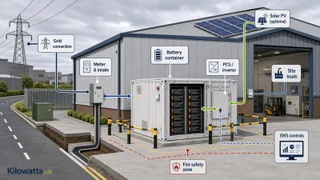
For a business, factory or farm the same method applies at a larger scale, usually on a three-phase supply. Daytime process load, seasonal demand, and motors that a battery cannot start are design issues, not reasons to copy a domestic stack. Storage there needs a measured profile and a view of what the connection can import and export. If you do not have half-hourly data yet, a few weeks of smart-meter readings across a typical week are more useful than a single annual kilowatt-hour total. Note what runs in the evening, what can be timed, and which loads you would still want in a power cut. That list is what an installer should be designing against.
Solar battery size, heat pumps and EV charging
A battery coupled to solar, whether on a hybrid inverter or as an AC-coupled retrofit, is usually filled by surplus generation and sometimes by the grid. A hybrid design puts the battery on the DC side of an inverter specified with the array, which often means a new or replacement inverter. An AC-coupled battery sits on the AC side and can be added beside an existing solar inverter, but both devices can count toward the connection. Which arrangement is feasible depends on the existing inverter, the supply, and whether the battery needs to charge from solar, the grid, or both. Cable routes and notification are different jobs, not a brochure toggle.
Solar yield in the UK is seasonal. A battery sized on a bright summer day will often sit full once the roof has done its work, while the same battery may rarely fill from the roof in winter. Sizing only on winter solar can leave capacity unused for much of the year. Sizing only on summer surplus can leave you buying most winter electricity from the grid, which is normal and not a fault in the battery.
Time-of-use tariffs change the useful size even when the roof does not. The energy you can shift is capped by how fast the battery is allowed to charge in the cheap window, and by any import limit on the connection. Export limits can cap how a hybrid or AC-coupled system behaves in the daytime even if a larger battery is fitted. A battery does not remove standing charges. Heat-pump storage is an energy and power problem together. If the heat pump’s electrical input over the expensive hours is larger than the energy you can put into the battery in the cheap or sunny window, more modules cannot close that gap. A short boost on a heat pump may also exceed the inverter’s continuous kilowatts while the battery still has charge. Say whether you want a few expensive hours trimmed, or a long winter run covered. Those are different batteries, and the second may not be realistic on a domestic supply. Electric vehicle charging often collides with the same import headroom. A charger that already uses most of what the supply can import leaves little room to fill a battery in the same hours. Storage does not create a faster charge rate, and it does not start a load the inverter cannot supply. If the car and the battery both need the cheap window, the survey should show which one gets the kilowatts, not assume both can take a full charge. Backup is a different function from daily cycling. Many systems support only selected circuits, and only within the battery’s power rating. Whole-building cover for many hours is not the default. If backup is a real requirement, name the circuits and the hours, and expect the design to be checked against power as well as stored energy.
What the survey should record before you buy
Single-phase and three-phase supplies do not accept the same charge rates or the same inverter arrangements. Consumer-unit space, spare ways, earthing, and cable routes between the battery, the inverter and the board can force a smaller system or extra electrical work before any module is added. Those checks belong in the survey, not in a comparison of kilowatt-hours. In Great Britain, connection of generation and of storage that operates in parallel with the grid is handled by the local distribution network operator under current Energy Networks Association guidance, including EREC G98 and EREC G99 or any successor those operators cite. UK Power Networks, National Grid Electricity Distribution, Northern Powergrid, SSEN, SP Energy Networks and Electricity North West do not all use the same form or the same timeline. Northern Ireland is a separate network and should be checked with its own operator. This page does not state a notification threshold. Thresholds, fast-track rules and what counts as a new plant when an inverter is added must come from the current ENA document and the DNO’s own guidance, not from an old quote and not from a sizing article. Electrical design should follow BS 7671 as it applies to the job, plus the manufacturer’s instructions. Dwelling electrical work also follows the building-regulations route for that nation, which is not the same process in England, Wales, Scotland and Northern Ireland. Where the job is being certified under MCS, ask for the current MCS battery storage standard to be named on the quote. MCS is not restated here as a legal requirement for every battery, and it is not a performance guarantee. Location is a design record, not a cupboard that looked free on a plan. There is no single national rule on this page for which room a battery may occupy. The survey should write down the proposed room, whether that product’s installation manual permits it, and any room the manual excludes, such as a living space, a bathroom or a loft, if that exclusion is in the manual for the chosen model. It should record floor construction and the stack weight from the datasheet, because a garage slab and a timber upper floor are different structural cases. It should record fire separation to habitable rooms and to the escape route, clearances, ventilation, and the cable route. It should also record any insurer conditions the owner has already been given, including whether the insurer expects to be told about the battery. Insurer conditions are policy-specific. They are not a UK-wide siting law. Commissioning should record usable capacity, charge and discharge limits, which circuits are on backup if any, and what is not supported in a power cut. Those limits are easy to lose in a sales summary and hard to discover later, when the oven and the heat pump both drop out and the app still shows charge remaining.
When a larger battery is the wrong answer
A larger battery is not automatically better. Capacity you never cycle still degrades, still needs space, and may be limited by the inverter or the grid connection. If electricity use is already mostly in daylight, or there is no solar surplus and no tariff reason to store energy, extra modules add hardware without a clear job to do.
It is also a poor fit when the loads that matter dwarf any realistic domestic or small-commercial battery. Fast electric vehicle charging, a large heat pump running for many hours, and factory or farm process equipment are often power and connection problems. Another module does not start a motor the inverter cannot supply, and it does not create import or export headroom the network has not allowed.
There is no surveyed UK average for the right home, farm or factory battery, and no official figure for what a property needs. Any example should stay tied to stated assumptions: how many kilowatt-hours you intend to shift, what power cap applies, how long the charge window is, and whether backup is in scope. Without those assumptions, a recommended size is not a fact. If the survey shows that the constraint is the consumer unit, the supply, the charge window, or a load you cannot sensibly store, the honest outcome may be a smaller battery, a different inverter arrangement, or no battery yet. That is a useful result. It is better than buying capacity the connection cannot use.
What to ask before you compare quotes
Before you compare products, ask each installer to show the load data they used and the energy they expect the battery to shift on a typical day, not only the annual generation estimate. Ask for usable capacity and continuous power on the same page as the nameplate figure. Ask whether the design charges from solar, the grid, or both, and what happens to that plan if the network limits export or import. Ask where the manual allows the unit to sit, and what the survey has written down for fire separation, floor loading and any insurer condition.
If those answers diverge between quotes, the difference is usually the assumptions, not a mystery brand advantage. Measure a few weeks of use, list the loads you care about in the evening and in an outage, and take that list to the survey. The right battery is the one that matches that evidence and the installation in front of you, not the largest stack that will physically fit.
Plan, Compare & Buy Renewable Energy Solutions
AI does the thinking.
You get the perfect solar match.
Use RoboMo™ to assess your property, compare available technologies and connect with trusted UK installers, suppliers and manufacturers.
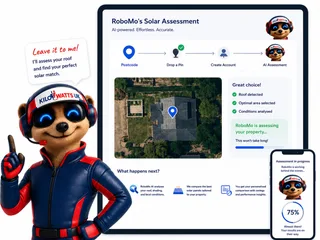
Simply enter your postcode, drop a pin on your roof, create your free account and let RoboMo™ analyse your property to find the best solar panels for your home.

You don't have to think
RoboMo™'s AI analyses your roof and does all the hard work.

Accurate & tailored
AI-powered assessment based on your roof, location, and conditions.

Best options, maximum savings
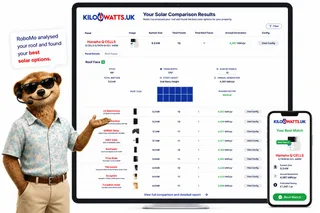
Compare top solar panels for the best performance and value.

Simple, fast & effortless
Provide a few details, sit back and watch your results unfold.
STEP 1
Choose Home, Business or Industrial
Enter your postcode to start your assessment.
STEP 2

Drop a pin on your roof
STEP 3

Create your free account
STEP 4

Sit back and watch RoboMo™ work
RoboMo™ analyses your roof and builds your personalised solar comparison.

Step 1
Enter your postcode
Start designing your wind energy system in seconds.
Are you an installer, distributor or renewable energy business?
Kilowatts UK is expanding the Flower Turbines partner network across the UK.
Become A Flower Turbines PartnerKilowatts UK is an authorised representative
Flower Turbines
Compact vertical-axis turbines built for real UK sites, not just open farmland.
They start in light wind, sit in a small footprint, and are bird-safe by design. Cluster them as a bouquet and the group performs better together than the same turbines standing alone. Enter your postcode for a location-based generation estimate. Figures use area weather data and will differ if buildings, trees or hills sit in the way.
Starts in light UK wind
Built to generate in typical UK wind, not only open farmland.
Small rooftop or ground footprint
Compact towers for roofs, yards and tight sites.
Bird-safe slow rotation
Slow vertical-axis spin, bird-safe by design.
Bouquet clusters raise output
Grouped turbines outperform the same units standing alone.
STEP 2

Choose a location
STEP 3

Place your cluster
Tap the map where you want the turbine cluster to go.
STEP 4

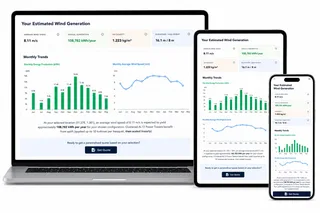
Instant generation forecasts
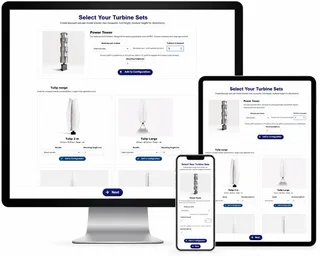
Compare different turbine layouts and see annual generation forecasts instantly.
STEP 5

No commitment required
Explore different configurations before deciding whether to request a quotation.
Related articles

FAQ
Need Help? RoboMo's Got Answers
Is there a standard home battery size for a UK property?
No. There is no single battery a UK home, business, farm or factory needs, and there is no safe rule of one kilowatt-hour of storage per kilowatt of solar. What you need depends on the usable energy you can actually shift, the continuous power the inverter can supply, and whether the connection, the charge window and the room can accept that hardware. Two honest quotes can differ because they assumed different daily use, backup circuits or charge rates.
Why do usable kilowatt-hours and inverter power both matter?
Usable capacity is the energy the battery can deliver in normal operation. Nameplate capacity is larger, because state-of-charge limits, temperature, efficiency and how the manufacturer defines usable energy all reduce what reaches your circuits. Power is a separate limit: a battery can still show charge and be unable to run several loads at once if the continuous rating is too low. Quotes should separate usable kilowatt-hours, continuous charge and discharge kilowatts, and any short peak.
Can a larger battery always store more cheap or solar electricity?
Not if the charge window or the import limit runs out first. Energy that can enter in a fixed window is set by the lowest of the inverter charge rating, any supply limit and any cap the network has actually set, and losses mean stored energy is less than that product. Extra nameplate capacity that cannot be filled in that window does not improve the design. The same logic applies if winter solar cannot deliver the energy on the days that matter.
Should battery size be based on the annual electricity bill?
An annual total divided by 365 hides the evening peak and the seasonal shape, so it is a weak sizing tool. Half-hourly or smart-meter data is more useful, and a few weeks of readings across a typical week beat a single yearly figure if you do not have a full history yet. A house that uses most electricity while the sun is up may have little worth storing, while a long evening plateau is an energy problem and short spikes are a power problem. Note what runs in the evening, what can be timed, and which loads you would still want in a power cut.
How do solar, heat pumps and EV charging change the battery you need?
UK solar yield is seasonal, so a battery sized on a bright summer day may sit full then, while the same battery may rarely fill from the roof in winter. A heat pump is an energy and power problem together: if its electrical input over expensive hours exceeds what you can put into the battery in the cheap or sunny window, more modules cannot close that gap, and a short boost may exceed the inverter rating. An EV charger that already uses most of the supply’s import headroom leaves little room to fill a battery in the same hours. Storage does not create a faster charge rate or start a load the inverter cannot supply.
Will a home battery run the whole house in a power cut?
Backup is a different job from daily cycling, and whole-building cover for many hours is not the default. Many systems support only selected circuits, and only within the battery’s power rating. If backup matters, name the circuits and the hours you want, and expect the design to be checked against power as well as stored energy. Commissioning should record what is supported in a power cut and what is not.
What should a survey check before you compare kilowatt-hour figures?
Single-phase and three-phase supplies do not accept the same charge rates or inverter arrangements, and consumer-unit space, earthing and cable routes can force a smaller system or extra electrical work. In Great Britain, generation and storage that operate in parallel with the grid are handled by the local distribution network operator under current Energy Networks Association guidance, including EREC G98 and EREC G99 or any successor those operators cite. Thresholds and forms differ by operator and must come from the current guidance, not from a sizing article. Northern Ireland is a separate network.
Is there a UK rule for which room a battery can go in?
There is no single national siting rule on a sizing page. The survey should record the proposed room, whether that product’s installation manual permits it, and any room the manual excludes. It should also record floor construction and stack weight, fire separation, clearances, ventilation, the cable route, and any insurer conditions you have already been given. Insurer conditions are policy-specific, not a UK-wide law.