


Can A Home Battery Charge From The Grid? UK Guide
Published: 2026-08-24 10:27:08
Updated: 2026-10-06 12:48:14
Yes — a home battery can fill from cheap off-peak grid electricity, then run your house through the expensive peak. Here's how it works in UK homes.

Your Battery Doesn't Only Charge From The Sun
If you have searched for whether a home battery can charge from the grid, the short answer is yes — and on a time-of-use electricity tariff that is one of the most valuable things it does. Most people picture a battery as a bucket that only fills when the sun shines, empties in the evening, and sits idle from November to February. That is only half the story. A battery paired with a suitable tariff can also fill from the grid during the cheap overnight window, then supply the house through the expensive morning and evening peaks. The electricity is the same electricity; what changes is the price you paid for it and the moment you use it. This article explains what that looks like across a full day in a real British home, why it matters most in midwinter when the roof produces very little, what conditions have to be true for it to work, and how to sanity-check whether it makes sense for your property before anyone quotes you anything.
"Mo: A battery only stores solar... right? RoboMo: No. Cheap overnight grid electricity can fill it, ready for evening."
What "charging from the grid" actually means
A home battery is a store, not a source. It does not care where the electricity came from — only when it arrived and when it leaves. Solar is the obvious filler, because generation and storage sit on the same system and the energy never leaves your property. But a hybrid inverter or a battery with grid-charging enabled can also draw electricity from your incoming supply and put it into the cells.
That capability is normally controlled by a schedule or by the battery's own software. You tell it, in effect: between these hours, buy; outside those hours, don't. During the off-peak window the meter records import as usual, at the off-peak unit rate. Later, when the house draws power, it takes it from the battery instead of the grid — so the expensive hours show little or no import at all.
This is why the episode's overlay keeps a slim 'peak grid import' trace along the bottom of the frame, and why it stays flat through every cycle. The house is still using energy. It is simply not buying it at the moment it is most expensive.
Why the overnight window changes the maths
None of this works on a flat-rate tariff. If every unit costs the same at three in the morning as it does at six in the evening, moving energy through a battery gains you nothing on imported power — you have simply added round-trip losses to the journey. The saving comes entirely from the price gap between the cheap window and the peak window.
On a time-of-use tariff, the unit rate changes across the day. A defined off-peak period — typically in the small hours — is priced lower, and peak periods are priced higher. A battery lets you buy in the cheap window and spend in the expensive one. The wider that gap, and the more of your daily consumption you can shift into it, the better the arithmetic looks.
Two practical consequences follow. First, the tariff is part of the system design, not an afterthought — a battery sized without reference to how you are billed is a battery designed in the dark. Second, tariffs change. Any assessment worth trusting should show you how the numbers behave if the price gap narrows, not just how good they look today.

Breakfast on stored energy: the morning peak
The second beat of the episode is the one that surprises people. Dawn light reaches the window, the tariff band turns amber, and the arrows reverse: energy is now leaving the battery and running the house. Kettle, toaster, hot water, heating pump, hair dryer, the boiler firing, the first hour of a home office — all of it comes off the stored charge bought hours earlier at the cheaper rate.
The morning peak is easy to overlook because it is short, but it is dense. British households cluster their heaviest short-burst loads into roughly ninety minutes. That clustering is a real national phenomenon, not just a household one: 'TV pickup' is the well-documented surge the grid plans for when millions of kettles switch on at the same moment. Your own kitchen is a miniature version of it every single morning. A battery flattens that. The house behaves exactly as it always did — nobody has to skip the kettle — but the meter barely notices, because the energy is already in the building.
Midwinter: when the roof gives little and the battery still earns
This is the objection worth taking seriously. From late November to early February, UK daylight is short and often flat, and a solar array contributes a fraction of what it does in June. If a battery only ever filled from solar, it would spend the darkest quarter of the year doing very little — which is exactly when household consumption is at its highest.
Grid charging removes that seasonal cliff. The cheap overnight window exists in December just as it does in July. The battery fills, the morning peak is covered, the evening peak is covered, and the asset keeps working through the months when you need it most. Solar, when it appears, simply tops the battery back up for free and reduces how much you need to buy the following night.
It is also worth correcting a common assumption about winter panels. Solar modules are more efficient in cold conditions than in hot ones — the limiting factor in a British winter is the small quantity of light available, not the temperature. And UK homes still generate usefully on overcast days; output falls, but it does not stop. A crisp, bright January afternoon can be a genuinely productive one.
A practical checklist before you commit
Grid charging is a capability, not an automatic feature. Work through these before you assume it applies to your quote:
- Is grid charging supported and enabled? Confirm in writing that the battery and inverter can import from the grid to charge, and that the installer will configure a schedule rather than leaving it in solar-only mode. 2. Are you on, or eligible for, a time-of-use tariff? Check whether your supply and meter support one. Without the price gap, there is nothing for the battery to arbitrage on imported energy. 3. Do you know your evening and morning load? Not your annual total — your peak-hours consumption. That figure, not roof size, drives useful battery capacity. 4. Is the battery sized to the cheap window? It needs enough capacity to cover the peak hours you want to avoid, and the charge rate to fill within the off-peak period. 5. Have you asked about round-trip losses? Storing and retrieving energy is not perfectly efficient. It should be acknowledged in the projection, not quietly omitted. 6. Does the projection show a winter case? Ask specifically what the system does in January, not just the annual average. 7. Is the network notification handled? Ask your installer how the connection is registered with your local network operator, and who is responsible for it. 8. Can settings be changed later? Tariffs and habits both move. Make sure schedules can be adjusted without an engineer visit.

Follow-up questions people ask next
Does grid charging cancel out the point of solar? No. They do different jobs. Solar produces free energy when there is light; grid charging guarantees the battery is useful when there isn't. A well-configured system prioritises solar and only buys what the schedule says it still needs.
Does it wear the battery out faster? More cycles means more use, and every battery has a finite cycle life. That is a genuine trade-off, and it is why warranty terms and expected cycle counts belong in the conversation. It is not a reason to avoid grid charging — it is a reason to read the warranty properly.
Will it fill the battery when the price is high? Only if it is configured badly. The schedule defines the window. Some systems can also respond to tariff signals automatically; ask what yours does and who controls it. Can I do this without solar panels? Technically, a battery on a time-of-use tariff can shift load with no array at all. Whether that stacks up depends entirely on your consumption pattern and the price gap available to you. Does it work during a power cut? Only if the system includes backup functionality, which is a separate specification. Do not assume it is included. What about the small stuff? Standby draw on idle appliances quietly consumes a meaningful share of household energy all day and all night. A battery will happily store energy to feed it — but it is cheaper still not to waste it in the first place.
Video transcript
Mo: A battery only stores solar... right? RoboMo: No. Cheap overnight grid electricity can fill it, ready for evening.
Mo: So at breakfast, the house is running off the battery, not the grid? RoboMo: Correct. Stored cheap energy covers the expensive morning peak instead.
Mo: And in midwinter, when the roof barely produces anything? RoboMo: The cheap overnight window still fills it. The battery keeps earning either way. Mo: A battery only stores solar... right? RoboMo: No. Cheap overnight grid electricity can fill it, ready for evening. / Mo: So at breakfast, the house is running off the battery, not the grid? RoboMo: Correct. Stored cheap energy covers the expensive morning peak instead. / Mo: And in midwinter, when the roof barely produces anything? RoboMo: The cheap overnight window still fills it. The battery keeps earning either way.
Wrapping up
The reason this episode holds a single locked-off shot for its entire run is that nothing physical needs to move for the point to land. The battery on the wall does not change. The house does not change. What changes is when energy enters the building and when it leaves — and on a time-of-use tariff, that timing is where the value sits. Grid charging is what stops a battery from being a summer-only asset. It covers the morning peak while the kettle is on, it covers the evening peak while dinner cooks, and it keeps doing both through a dark January when the roof has little to offer. The honest framing is not that a battery is magic; it is that a battery is a timing device, and timing is worth money only when your tariff makes it worth money. That is a question about your bill, your consumption and your meter — which is exactly what a proper survey is for.
Next step
If you want to know whether grid charging would genuinely pay in your home, the useful next step is a look at your actual consumption pattern and tariff rather than a generic quote. You can read how we approach residential solar and storage, compare specifications side by side, or book a no-pressure survey when you are ready. No obligation, and no one will tell you a battery is right for you if the numbers say otherwise.
Plan, Compare & Buy Renewable Energy Solutions
AI does the thinking.
You get the perfect solar match.
Use RoboMo™ to assess your property, compare available technologies and connect with trusted UK installers, suppliers and manufacturers.
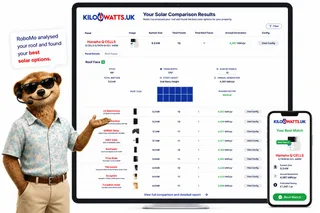
Simply enter your postcode, drop a pin on your roof, create your free account and let RoboMo™ analyse your property to find the best solar panels for your home.

You don't have to think
RoboMo™'s AI analyses your roof and does all the hard work.

Accurate & tailored
AI-powered assessment based on your roof, location, and conditions.

Best options, maximum savings
Compare top solar panels for the best performance and value.

Simple, fast & effortless
Provide a few details, sit back and watch your results unfold.

STEP 1
Choose Home, Business or Industrial
Enter your postcode to start your assessment.
STEP 2

Drop a pin on your roof
STEP 3

Create your free account
STEP 4

Sit back and watch RoboMo™ work
RoboMo™ analyses your roof and builds your personalised solar comparison.

Step 1
Enter your postcode
Start designing your wind energy system in seconds.
Are you an installer, distributor or renewable energy business?
Kilowatts UK is expanding the Flower Turbines partner network across the UK.
Become A Flower Turbines PartnerKilowatts UK is an authorised representative
Flower Turbines
Compact vertical-axis turbines built for real UK sites, not just open farmland.
They start in light wind, sit in a small footprint, and are bird-safe by design. Cluster them as a bouquet and the group performs better together than the same turbines standing alone. Enter your postcode for a location-based generation estimate. Figures use area weather data and will differ if buildings, trees or hills sit in the way.
Starts in light UK wind
Built to generate in typical UK wind, not only open farmland.
Small rooftop or ground footprint
Compact towers for roofs, yards and tight sites.
Bird-safe slow rotation
Slow vertical-axis spin, bird-safe by design.
Bouquet clusters raise output
Grouped turbines outperform the same units standing alone.


STEP 2

Choose a location
STEP 3

Place your cluster
Tap the map where you want the turbine cluster to go.
STEP 4

Instant generation forecasts
Compare different turbine layouts and see annual generation forecasts instantly.
STEP 5

No commitment required
Explore different configurations before deciding whether to request a quotation.
FAQ
Need Help? RoboMo's Got Answers
Can a home battery charge from the grid in the UK?
Yes, many home battery systems can charge from the grid if the battery and inverter support it and the feature is enabled. The system is usually set to charge during a chosen off-peak window, then discharge into the home later. Always confirm this in writing before accepting a quote, as not every setup is configured for grid charging.
Why would I charge a battery from the grid instead of just using solar?
Grid charging can be useful when electricity is cheaper at certain times of day, especially overnight. The battery can store lower-cost electricity and use it during more expensive morning or evening periods. Solar still helps by reducing how much electricity you need to buy from the grid.
Does grid charging only make sense on a time-of-use tariff?
Usually, yes. If your electricity costs the same all day, charging from the grid and then using the battery later may not save money because some energy is lost in the storage process. The value comes from the difference between off-peak and peak rates, so your tariff is central to the calculation.
Can a battery charge from the grid in winter when solar output is low?
Yes, and winter is one of the main reasons people consider grid charging. UK solar panels often produce much less in the darkest months, but an overnight off-peak tariff window can still fill the battery. This helps the battery remain useful even when the roof is generating very little.
Can I have a grid-charging battery without solar panels?
Technically, yes. A standalone battery can charge from the grid and discharge during more expensive periods if the system and tariff support it. Whether it is worthwhile depends on your household usage, the tariff difference, battery size, installation cost and expected losses.
Will grid charging wear out my home battery faster?
Using the battery more often means it will complete more charge and discharge cycles. Batteries are designed for cycling, but they do have finite lifespans and warranty conditions. Check the warranty, expected cycle life and any limits on daily cycling before relying on grid charging for savings.
Will a grid-charging battery work in a power cut?
Not automatically. Backup power requires specific equipment and configuration, and many standard battery installations shut down during a power cut for safety reasons. If backup is important to you, ask for it to be specified clearly before installation.
What should I check before buying a battery for grid charging?
Check that the battery and inverter support grid charging, that your meter and supply are suitable for a time-of-use tariff, and that the system can be scheduled easily. Ask whether the battery can charge fully within the cheap window and whether projections include round-trip losses. You should also confirm who handles any required network operator notification.