


Why Spare Solar Won't Always Charge Your EV (6A Rule)
Published: 2026-08-25 12:35:53
Updated: 2026-10-06 12:46:51
UK home EV chargers need roughly six amps — about 1.4 kW — before a session can start. Here's why small solar surpluses export instead of charging.
Why Spare Solar Won't Always Charge Your EV (6A Rule)
UK home EV chargers need roughly six amps about 1.4 kW before a session can start. Here's why small solar surpluses export instead of charging.
Why A Trickle Of Surplus Won't Charge Your Car
If you have solar panels and an electric car, the assumption is beautifully simple: whatever the house doesn't use, the car drinks. In practice there is a floor beneath which nothing happens at all. A home charger on a single-phase supply generally cannot deliver less than about six amps — roughly 1.4 kilowatts — so any surplus smaller than that can't run a charging session. It doesn't sit in the cable waiting. It goes out to the grid as export. This article explains where that six-amp floor comes from, what it means on a cloudy British afternoon, how a session actually begins when the surplus climbs past the threshold, and how a thin sliver of grid power can hold the minimum so charging doesn't stutter every time a cloud crosses the roof. It's the written companion to a ten-second episode of Solar, Clearly with Mo and RoboMo — but it stands on its own if you can't play the video.
The six-amp floor: why small surpluses export instead of charging
Charging an electric car is a negotiated conversation, not a tap you open by a millimetre. The charge point tells the vehicle how much current it is allowed to draw, and the vehicle's onboard charger converts that AC supply into DC for the battery. That conversation has a lower limit. On a single-phase domestic supply, the practical minimum is around six amps. At a nominal 230 volts, six amps works out at roughly 1.4 kilowatts.
So if your roof is producing 900 watts more than the house is using, there is nothing for the charger to do with it. It cannot offer the car 900 watts and hope for the best. The session either runs at six amps or it doesn't run. Below that threshold the charge point sits on standby — the LED breathing quietly, the cable warm-hearted but idle — and the surplus flows out to the street as export.
This surprises people because every other appliance in the house behaves differently. A fridge, a router, a lamp will happily consume whatever fraction of your generation they need. An EV charger is the one load in the home with a genuine entry fee.
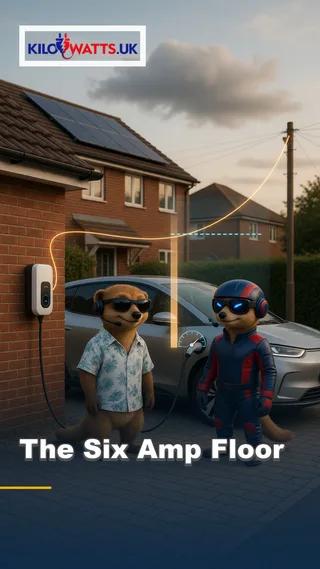
What 1.4 kW actually looks like on a real British roof
The threshold matters because 1.4 kW of genuine surplus is a bigger ask than it sounds. Surplus is not what the panels are making — it's what the panels are making minus everything the house is already doing. On a mild afternoon with the kettle idle and nobody home, a modest array can clear the bar comfortably. Put the oven on, run a wash cycle, and the same array is suddenly feeding the house rather than the driveway.
useful nuance, and it's a genuinely encouraging one: UK homes still generate useful solar power on overcast days. Diffuse light through cloud is not nothing. But 'useful' and 'above 1.4 kW of surplus' are two different bars. On a grey day your array might quietly cover the background load of the house — the fridge, the standby draw, the broadband — without ever producing the concentrated excess a charger needs to start. That's not a fault. It's just the difference between trickling and threshold-crossing.
It also explains why solar-only EV charging tends to be a spring-and-summer, middle-of-the-day activity rather than an all-year, all-hours one.
The moment the cloud moves off: how a session begins
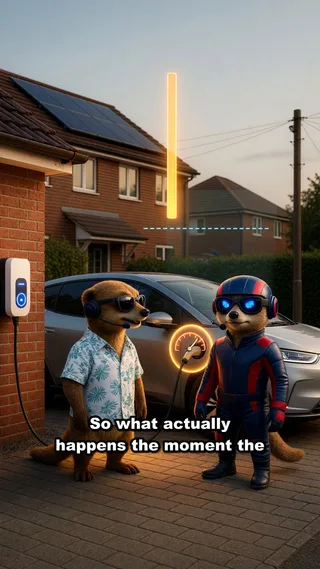
Watch a solar-aware charger on a broken-cloud day and you'll see the mechanism plainly. Cloud shades the roof, generation drops, the surplus bar collapses below the dashed minimum and the current readout falls to zero. Then the cloud slides away, generation recovers, and the surplus climbs back across the line.
At that crossing point the charger offers the car six amps. The car accepts. The energy that was heading for the street pole redirects into the cable, and from there into the battery. If generation keeps climbing, the charger ramps the current upward — seven amps, eight, ten — tracking the surplus rather than a fixed setting.
The important detail is that the start is a step, not a fade. There is no gentle ramp from zero. The session either exists at six amps or it does not exist. That single fact explains almost every 'why isn't my car charging when the sun's out?' question a solar owner ever asks.
Holding the line: the thin sliver of grid power
British clouds do not sit still. If a charger strictly refused to draw anything except solar surplus, a partly cloudy afternoon would produce a stop-start pattern: session on, session off, session on again, dozens of times. That's inefficient for the vehicle's electronics and frustrating for the driver, because every restart costs a little handshake time.
The practical answer is a blended mode. When the surplus wobbles just below the threshold, the charger tops it up with a slim slice of imported grid power — only enough to hold the minimum current and keep the session alive. The moment solar recovers, the imported sliver shrinks back towards nothing.
You are still charging predominantly on your own generation. You are simply paying a small amount of imported energy to avoid the churn of constant dropouts. Most solar-aware chargers let you choose how much tolerance you're willing to give this: a strict solar-only setting, or a blended setting with a defined amount of grid top-up permitted.
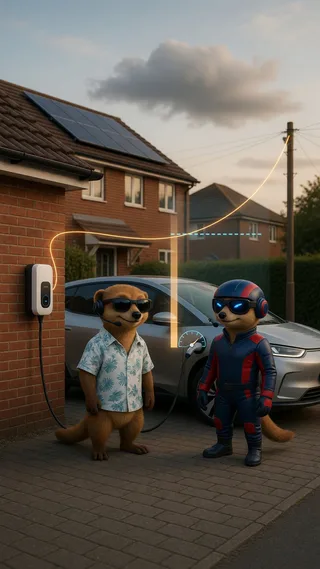
Choosing your charging mode: a practical decision guide
There is no universally correct setting — it depends on how you use the car and how much you care about a perfectly green kilowatt-hour.
Choose strict solar-only if: you have a large enough array to clear 1.4 kW of surplus routinely; the car is on the drive during daylight hours most weekdays; you're not in a hurry, and you'd rather the session pause than import a single unit.
Choose blended (grid top-up allowed) if: you have broken-cloud weather most of the year, which is to say you live in Britain; you want a session that runs cleanly from late morning to mid-afternoon without repeated restarts; your array is modest and frequently sits just either side of the threshold. Consider a scheduled overnight charge instead if: you're on a tariff with a cheaper overnight rate; you need a guaranteed state of charge by morning; the daytime surplus is genuinely marginal in winter. Many households end up using all three across the year: solar-only in summer, blended in spring and autumn, scheduled overnight in the darkest months. That's not indecision — it's matching the tool to the weather.
How to get more of your surplus into the car
A short, honest checklist for anyone trying to lift more generation over the six-amp line:
- Know your baseline. Find out what your house draws when 'nothing' is on. Standby mode on idle appliances wastes a meaningful amount of household energy, and every watt of that baseline is a watt that isn't reaching the car. Reducing it is the cheapest way to raise your effective surplus.
- Stack, don't spread. Running the dishwasher and the washing machine simultaneously at midday may leave nothing above the threshold. Sequencing high loads gives the charger clear windows.
- Plug in earlier than you think. A charger that isn't connected can't catch a surplus spike. Habitually plugging in on arrival costs nothing.
- Check your charger's minimum and tolerance settings. Some units let you set how far below the threshold they'll import to hold a session. That single setting is the difference between a smooth afternoon and a stuttering one.
- Consider where a battery fits. A home battery can absorb sub-threshold surplus that a charger can't use, then release it later. It changes the arithmetic entirely, because nothing small is wasted.
- Review array sizing honestly. If your surplus rarely reaches 1.4 kW even in June, the constraint is generation, not the charger. That's a design conversation, not a settings one.
Follow-up questions people ask next
Is the exported energy wasted? No — exported units leave your property and are used elsewhere, and depending on your export arrangement you may be paid for them. But they're worth less to you than units you use yourself, which is why the threshold matters.
Would a three-phase supply change this? Three-phase changes the arithmetic of minimum current, but most UK homes are single-phase, and upgrading a supply is a significant piece of work rather than a settings tweak. For the vast majority of households, six amps single-phase is the number that governs behaviour.
Does frequent stopping and starting harm the car? It isn't dangerous, but it's untidy and it wastes handshake time on every restart. That inefficiency, not damage, is the argument for blended charging. Will I ever fill the battery from solar alone? Often you don't need to. A typical EV range vastly exceeds the average daily journey, so the realistic goal isn't a full battery every day — it's topping up the miles you actually drove. On a decent summer afternoon, several hours above the threshold will comfortably replace a normal day's commute. Does cold weather hurt generation? Counter-intuitively, solar panels generate more efficiently in cold weather than in hot weather. The limiting factor in a British winter is daylight hours and low sun angle, not temperature.
Video transcript
Mo: Any spare solar can charge the car... right? RoboMo: No. Below roughly six amps, that surplus exports instead of charging.
Mo: So what actually happens the moment the cloud moves off? RoboMo: Surplus crosses about one point four kilowatts, and the session finally begins.
Mo: British clouds never sit still though — does it just keep stopping? RoboMo: No. A thin slice of grid power holds the minimum, so charging never drops out. Mo: Any spare solar can charge the car... right? RoboMo: No. Below roughly six amps, that surplus exports instead of charging. / Mo: So what actually happens the moment the cloud moves off? RoboMo: Surplus crosses about one point four kilowatts, and the session finally begins. / Mo: British clouds never sit still though — does it just keep stopping? RoboMo: No. A thin slice of grid power holds the minimum, so charging never drops out. The six-amp floor isn't a flaw in your system, a fault in your charger or a marketing failure. It's simply how AC charging is designed to work, and once you know it, a great deal of previously baffling behaviour becomes obvious. A small surplus exports because it must. A session starts as a step, not a fade. And a thin sliver of imported grid power is a reasonable price for keeping a charging session alive through a genuinely British afternoon of racing cloud shadow. Knowing where the threshold sits lets you make better choices — about when you plug in, how you sequence your loads, whether a battery earns its keep, and whether your array is the right size for the way you actually drive. Engineering beats hype, and in this case the engineering is refreshingly simple: six amps, roughly 1.4 kilowatts, and everything follows from that. If you're weighing up solar, a home battery or an EV charger and want to know how much surplus your roof would realistically produce, our team can model it properly rather than guess. Have a look at how residential solar installation works, compare the options side by side, or book a no-pressure survey when you're ready.
Plan, Compare & Buy Renewable Energy Solutions
AI does the thinking.
You get the perfect solar match.
Use RoboMo™ to assess your property, compare available technologies and connect with trusted UK installers, suppliers and manufacturers.
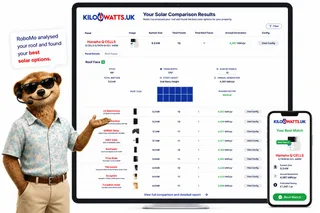
Simply enter your postcode, drop a pin on your roof, create your free account and let RoboMo™ analyse your property to find the best solar panels for your home.

You don't have to think
RoboMo™'s AI analyses your roof and does all the hard work.

Accurate & tailored
AI-powered assessment based on your roof, location, and conditions.

Best options, maximum savings
Compare top solar panels for the best performance and value.

Simple, fast & effortless
Provide a few details, sit back and watch your results unfold.
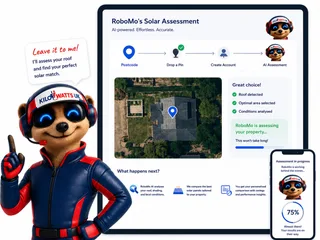
STEP 1
Choose Home, Business or Industrial
Enter your postcode to start your assessment.
STEP 2

Drop a pin on your roof
STEP 3

Create your free account
STEP 4

Sit back and watch RoboMo™ work
RoboMo™ analyses your roof and builds your personalised solar comparison.

Step 1
Enter your postcode
Start designing your wind energy system in seconds.
Are you an installer, distributor or renewable energy business?
Kilowatts UK is expanding the Flower Turbines partner network across the UK.
Become A Flower Turbines PartnerKilowatts UK is an authorised representative
Flower Turbines
Compact vertical-axis turbines built for real UK sites, not just open farmland.
They start in light wind, sit in a small footprint, and are bird-safe by design. Cluster them as a bouquet and the group performs better together than the same turbines standing alone. Enter your postcode for a location-based generation estimate. Figures use area weather data and will differ if buildings, trees or hills sit in the way.
Starts in light UK wind
Built to generate in typical UK wind, not only open farmland.
Small rooftop or ground footprint
Compact towers for roofs, yards and tight sites.
Bird-safe slow rotation
Slow vertical-axis spin, bird-safe by design.
Bouquet clusters raise output
Grouped turbines outperform the same units standing alone.


STEP 2

Choose a location
STEP 3

Place your cluster
Tap the map where you want the turbine cluster to go.
STEP 4

Instant generation forecasts
Compare different turbine layouts and see annual generation forecasts instantly.
STEP 5

No commitment required
Explore different configurations before deciding whether to request a quotation.
FAQ
Need Help? RoboMo's Got Answers
Why does my solar surplus not always charge my EV?
Most single-phase home EV charging needs a minimum current of about six amps. At 230 volts, that is roughly 1.4 kW. If your solar surplus is below that, the charger cannot offer it to the car as a smaller trickle, so the energy is exported instead.
Does the six-amp rule mean my charger or solar system is faulty?
No. It is normal behaviour for AC EV charging. The car and charge point have to agree a minimum charging current before a session can run, so small amounts of spare solar may not be usable by the car.
What counts as solar surplus for EV charging?
Surplus is what remains after your home has used what it needs. If your panels are making 2 kW but the house is using 1 kW, the surplus is only 1 kW. That would usually be below the level needed to start a single-phase EV charging session.
Will my EV start charging as soon as the sun comes out?
It will usually start only when the available surplus rises above the minimum threshold, around 1.4 kW on a single-phase supply. The start is more like a step than a gentle fade-in. Once charging has begun, a solar-aware charger can often increase or reduce current as surplus changes.
Why does my charger use a little grid electricity in solar mode?
Some solar-aware chargers use a small amount of imported power to keep the session above the minimum current. This can stop the car repeatedly pausing and restarting when clouds pass over. Many chargers let you choose between stricter solar-only behaviour and a blended mode with some grid top-up.
Is exported solar energy wasted if it cannot charge the car?
No. Exported electricity leaves your property and is used elsewhere on the grid. Depending on your export arrangement, you may be paid for it, but using your own solar directly can still be more valuable to you than exporting it.
How can I get more spare solar into my EV?
Reduce your daytime background load where practical, because every watt used by the house is a watt not available to the car. Try to avoid running several high-power appliances at the same time as solar charging. Plug the car in early enough to catch sunny periods, and check your charger's solar mode and grid top-up settings.
Would a home battery help with surplus below the EV charging threshold?
A home battery can store smaller amounts of surplus solar that an EV charger cannot use directly. That stored energy can then be used later by the house or, depending on the system setup, may contribute to charging. Whether it is worthwhile depends on your generation, usage pattern, tariff and equipment.