


Conservation area solar in Broadstairs and Thanet
Published: 2026-10-04 13:40:11
Updated: 2026-10-05 12:14:23
Conservation area solar in Broadstairs and Thanet is a planning question, not a ban. Designation, listing and Class A are separate checks for Thanet roofs.
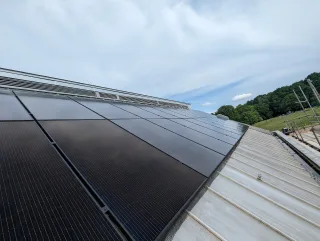
Conservation area solar in Broadstairs and Thanet
Conservation area solar in Broadstairs and Thanet from Kilowatts.uk in Broadstairs. Costs, roofs, planning and what to do next then compare a local syste
Conservation area solar in Broadstairs and Thanet
Thanet District Council, not Kent County Council, is the usual authority for householder planning in Broadstairs. A neighbour’s existing panels do not prove that your roof follows the same route. Product standards, building regulations and a notification to the network operator do not replace planning permission or listed building consent where those are required.
A conservation area is designated because its character or appearance is worth preserving or enhancing. Rooftop solar on a home in that area, or on a home whose array would affect the area’s setting, is first a heritage and planning question. This guide does not map individual Broadstairs roofs, and it does not confirm that an Article 4 direction covering solar is, or is not, in force.
Who decides, and which designation to check
For most domestic roofs the relevant planning authority is Thanet District Council. Kent County Council is not the normal decision-maker for householder solar in Kent. A highways or county contact has not cleared a roof design.
Start with Thanet District Council’s conservation-area map, published by the council, and read the appraisal for the area the map names. For a central Broadstairs address that may be the Broadstairs Conservation Area. An address elsewhere in the town, or on the edge of the designation, may fall in a different Thanet conservation area, or in none. Use the name on the map, not the town name on a quote. The appraisal explains what the council treats as significant in that area. It is background for a design, not a yes or no for a particular array.
Boundaries matter. A house just outside the line can still be relevant if the proposal affects the setting of the conservation area or of a listed building. Designation does not, by itself, forbid panels. It means character and appearance are material considerations, and permitted development rights may be limited or removed. If an application is needed, Thanet will apply its development plan and the heritage policies in the National Planning Policy Framework on conserving and enhancing the historic environment. That national policy is about significance and harm. It is not a local rule that every visible panel fails. The distribution network operator for a Thanet address is UK Power Networks. That role is electrical. It is dealt with below, and it does not decide how the array looks from the street.
What Part 14 Class A usually requires
Permitted development is a national grant of planning permission for specified classes of work. For solar equipment on a dwellinghouse, the usual class is Schedule 2, Part 14, Class A of the Town and Country Planning (General Permitted Development) (England) Order 2015, as amended. The Planning Portal’s solar-panel guidance is a homeowner summary of those tests. It is not the legislation. Confirm the instrument in force, then check for an Article 4 direction or a planning condition that removes the right at that address. This article does not state that any particular Broadstairs or Thanet roof is permitted development.
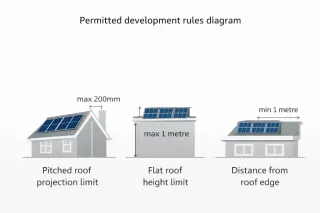
The Class A limits that usually matter, and that should be read in the current text rather than taken from a sales leaflet, are these. Equipment must not protrude more than 200 millimetres, also written as 0.2 metres, beyond the plane of the wall or roof slope, measured perpendicular to that surface. The highest part of the equipment must not be higher than the highest part of the roof, excluding any chimney. On land in a conservation area, or in a World Heritage Site, Class A does not allow equipment installed on a wall which fronts a highway. A roof slope is not the same test as a wall. Do not treat “fronts a highway” as an automatic ban on every street-facing roof unless the wording in force says so. Broadstairs is not the reason for the World Heritage Site limb of that test. The conservation-area limb is the local one to check.
Class A also limits equipment on a scheduled monument, and it contains a specific limitation for a building within the curtilage of a listed dwellinghouse or block of flats. Listed building consent remains a separate consent even where the Order grants planning permission. The conditions attached to Class A require the equipment, so far as practicable, to be sited to minimise its effect on the external appearance of the building and the amenity of the area. They also require equipment that is no longer needed for microgeneration to be removed as soon as reasonably practicable. That removal condition is not a promise that panels must come off in every Broadstairs case, and it is not a promise that they may always stay. Stand-alone solar in the garden is a different class, with its own siting limits. Do not apply roof-mounted Class A tests to a ground array, or the other way round. Flats and some leasehold houses raise a further issue: the GPDO does not give you the right to alter a roof you do not control. Marketing that says solar is always permitted development in Kent is not a rule you can rely on. A nearby installation is weak evidence. That roof may be outside the area, on a different elevation, installed under an older instrument, or unauthorised. A larger rectangle, a change of slope, or equipment added to a street elevation can turn a scheme that looked straightforward into one that needs an application.
A conservation area is not the same as listing
Listing and conservation-area status are separate designations. A house can sit in a conservation area without being listed, and a listed building can sit outside one. Works that affect the special architectural or historic interest of a listed building need listed building consent. That consent is not the same application as planning permission, and getting one does not automatically provide the other. Historic England’s guidance on energy efficiency and historic buildings, including rooftop solar, is the relevant national advice on fabric, fixings and appearance. It does not decide a Thanet application.
Being unlisted does not leave the roof unconstrained. On an unlisted house in a designated street, a street-facing slope, a prominent roof, or equipment that changes a principal elevation is the case most likely to need scrutiny. A rear or inner slope, a layout kept below the ridge, and a lower visual impact are factors councils commonly weigh. They are design considerations, not a guarantee of permission, and they are not a substitute for reading Class A for that elevation.
The reverse confusion also causes bad quotes. A newer estate in Thanet may have no conservation-area constraint and still have permitted development removed by a condition on the original consent. Search the planning history for the address before anyone describes the job as needing no application.
Which consent question actually applies
The useful comparison is not Broadstairs against the rest of Kent. It is which decision applies to this building. Planning permission, listed building consent, building regulations and network notification answer different problems. Clearing one does not clear the others.
Overview
Application fees, pre-application charges and decision times should be taken from current Thanet and national sources. They are not estimated here. Local approval rates for conservation-area solar are not established in this guide, so no percentage chance of success is offered.
What changes the design on a period roof
Heritage and energy output are settled on the same drawing. Orientation, chimney shade and neighbouring buildings decide whether a hidden slope is worth using. A rear roof that barely sees the sun can be easier to justify visually and still be a poor array. A street slope with a clean aspect can be the productive face and the one most likely to need an application if Class A does not cover it.
Older roofs in tight Broadstairs streets add constraints that an aerial photograph will miss. Slate, peg tiles and hidden leadwork can make a standard rail layout unsuitable even if panels are acceptable in principle. Fixings should be chosen for the covering and the deck, not copied from a new-build detail. Scaffold access, pavement space and party-wall arrangements on terraces affect whether a rear slope can actually be installed. Those points change the programme and the quote. They do not replace planning policy.
All-black modules and a regular rectangle are common responses because they read as one plane rather than a scatter of frames. They do not, by themselves, satisfy policy or the Class A siting condition. If an application or pre-application discussion is used, the drawing should show frame colour, the relationship to the ridge and chimneys, and how much of the slope is covered. A sales layout and a planning layout should be allowed to differ if comments reduce the array. Leasehold restrictions, freeholder consent and covenants can block external alterations even where the council route is open. Thanet District Council does not resolve those private consents for you.
Why UK Power Networks does not approve the appearance
Notifying UK Power Networks, or applying for a connection where the equipment requires it, is an electrical step. Domestic connections are handled under the G98 or G99 framework that matches the equipment and the way it is connected. This article does not state a kilowatt threshold for either recommendation. The installer should confirm the current process for that connection with UK Power Networks. The town name does not imply which route applies, and neither route approves how the array looks from the street.
Inverter location, cable routes and changes to a meter cupboard can have their own visual and building-regulations implications. On a period frontage, a new enclosure beside sash windows or in a shared passageway can be as noticeable as the panels. Building regulations, including structure and electrical safety, are a separate compliance question. A product certificate or an installer scheme does not grant planning permission.
Backup power is not a standard feature of a grid-tied array. It is a separate design choice from the heritage layout, and it should not be assumed because solar is being discussed. If battery equipment or a new enclosure is visible, include it on the planning drawing rather than treating it as an afterthought.
Is a simple yes the wrong answer?
No. A simple yes is the wrong answer whenever the address has not been checked. Conservation area solar in Broadstairs can be a reasonable project for an owner-occupier or landlord of an unlisted house, once the designation, the elevation and the Class A position are known. It is a poor fit as a simple approval guide for listed buildings, buildings in an unknown Article 4 area, flats without control of the roof, and homes where covenants or estate rules restrict external changes.
It also does not answer payback. Costs, typical array sizes, annual output and any grant position for conservation-area solar in Thanet are not established here. A generic national yield figure would not settle the planning question. A heavily shaded, structurally weak or very small roof may be unsuitable for solar whatever the heritage position. That is a survey conclusion, not a conclusion from the conservation-area name.
If a scheme is refused or withdrawn, keep the drawings and the reason. A later design should not repeat the same elevation and hope for a different reading. Neighbour support does not create a permitted development right. Neighbour objection is not, on its own, a ground for refusal, although character and amenity can still be assessed if an application is made.
What to check before you order equipment
A competent installer or planning agent identifies the conservation-area boundary and any Article 4 direction before describing a design as needing no application. They also check whether a condition removed permitted development, and whether the building is listed or in the setting of a listed building. If those checks are missing from the first quote, the price is not yet a price for a layout the council could accept.
Ask for the evidence rather than a slogan. You want the map source used for the boundary, the listing result, the planning-history search, and a layout that states which slope is used and how the array sits relative to the ridge. If an application is likely, roof plans, elevations, frame colour and a short note on views from the street are more useful than a panel count on its own. A desktop aerial view is not proof that the roof is outside the area.
If you want that check done against a Broadstairs address, the local residential solar installation service is the practical next step: a site survey for solar in Broadstairs. You can also book a free home survey. A survey can test structure, shading and a candidate layout. It cannot promise that Thanet District Council will grant permission, and it should not be presented as if it does.
Plan, Compare & Buy Renewable Energy Solutions
AI does the thinking.
You get the perfect solar match.
Use RoboMo™ to assess your property, compare available technologies and connect with trusted UK installers, suppliers and manufacturers.
Simply enter your postcode, drop a pin on your roof, create your free account and let RoboMo™ analyse your property to find the best solar panels for your home.

You don't have to think
RoboMo™'s AI analyses your roof and does all the hard work.

Accurate & tailored
AI-powered assessment based on your roof, location, and conditions.

Best options, maximum savings
Compare top solar panels for the best performance and value.

Simple, fast & effortless
Provide a few details, sit back and watch your results unfold.
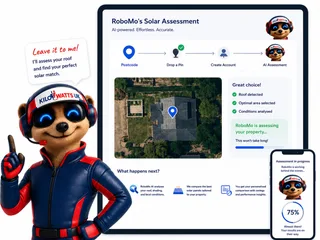
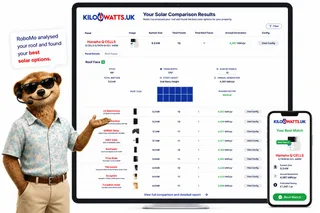
STEP 1
Choose Home, Business or Industrial
Enter your postcode to start your assessment.
STEP 2
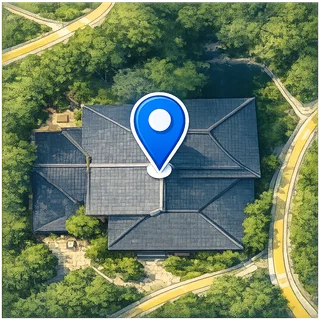
Drop a pin on your roof
STEP 3

Create your free account
STEP 4

Sit back and watch RoboMo™ work
RoboMo™ analyses your roof and builds your personalised solar comparison.

BATTERY ROI TOOL
See what a battery saves on your bill
Enter the day rate, off-peak rate and export rate. The calculator ranks batteries in the Kilowatts shop over 10 years.
Home batteries also suit offices and small commercial sites. Industrial batteries are listed on their own calculator.

Step 1
Enter your postcode
Start designing your wind energy system in seconds.
Are you an installer, distributor or renewable energy business?
Kilowatts UK is expanding the Flower Turbines partner network across the UK.
Become A Flower Turbines PartnerKilowatts UK is an authorised representative
Flower Turbines
Compact vertical-axis turbines built for real UK sites, not just open farmland.
They start in light wind, sit in a small footprint, and are bird-safe by design. Cluster them as a bouquet and the group performs better together than the same turbines standing alone. Enter your postcode for a location-based generation estimate. Figures use area weather data and will differ if buildings, trees or hills sit in the way.
Starts in light UK wind
Built to generate in typical UK wind, not only open farmland.
Small rooftop or ground footprint
Compact towers for roofs, yards and tight sites.
Bird-safe slow rotation
Slow vertical-axis spin, bird-safe by design.
Bouquet clusters raise output
Grouped turbines outperform the same units standing alone.


STEP 2

Choose a location
STEP 3

Place your cluster
Tap the map where you want the turbine cluster to go.
STEP 4

Instant generation forecasts
Compare different turbine layouts and see annual generation forecasts instantly.
STEP 5

No commitment required
Explore different configurations before deciding whether to request a quotation.
Related articles
Mo's Mission Nominations
FAQ
Need Help? RoboMo's Got Answers
Is solar banned in conservation areas in Broadstairs and Thanet?
No. Conservation-area status is not a ban, and it is not an automatic right to install panels. Whether an array is acceptable depends on the designation for that address, whether the building is listed, whether permitted development still applies to that elevation, and whether an Article 4 direction or a planning condition has removed those rights. Structure, shading and ownership of the roof still have to work.
Who decides householder solar applications in Broadstairs?
Thanet District Council is the usual planning authority for householder solar in Broadstairs, not Kent County Council. A highways or county contact has not cleared a roof design. Start with the council’s conservation-area map and the appraisal for the area the map names, rather than assuming every Broadstairs address is in the same designation.
Does a neighbour’s solar installation mean mine is allowed?
No. A nearby array is weak evidence. That roof may be outside the conservation area, on a different elevation, installed under an older set of rules, or unauthorised. Marketing that says solar is always permitted development in Kent is not a rule you can rely on.
What does permitted development under Part 14 Class A usually involve?
For solar on a dwellinghouse, the usual route is Schedule 2, Part 14, Class A of the Town and Country Planning (General Permitted Development) (England) Order 2015, as amended. Limits that usually matter include how far equipment may project from the roof or wall, and that it must not sit higher than the highest part of the roof, excluding any chimney. On land in a conservation area, Class A does not allow equipment on a wall which fronts a highway. A roof slope is not the same test as a wall, so do not treat that wording as an automatic ban on every street-facing roof unless the text in force says so.
Is a conservation area the same as a listed building?
No. A house can be in a conservation area without being listed, and a listed building can sit outside one. Works that affect the special architectural or historic interest of a listed building need listed building consent, which is separate from planning permission. Being unlisted does not leave the roof unconstrained: a street-facing slope or a change to a principal elevation is still likely to need scrutiny.
Do building regulations or a UK Power Networks notification replace planning permission?
No. Building regulations and a notification or connection application to UK Power Networks answer construction and electrical questions. They do not decide external appearance or heritage consent. Domestic connections are handled under the G98 or G99 process that matches the equipment; the installer should confirm the current route with UK Power Networks. Neither route approves how the array looks from the street.
Can leasehold rules or covenants stop solar even if the council route is open?
Yes. Leasehold restrictions, freeholder consent and covenants can block external alterations even where planning permission is not required, or has been granted. The permitted development order does not give you the right to alter a roof you do not control. Thanet District Council does not resolve those private consents for you.
Should I order panels before the address has been checked?
No. A simple yes is the wrong answer until the designation, the elevation and the Class A position are known. Check the conservation-area map, the planning history for conditions that may have removed permitted development, and whether the building is listed. Costs, typical yields and any grant position for conservation-area solar in Thanet are not settled by the area name, and a shaded or weak roof may still be unsuitable.