


Commercial solar G99 DNO connection: UK business guide
Published: 2026-09-28 19:53:20
Updated: 2026-09-29 07:52:26
Commercial solar G99 is the UK DNO connection route above G98. Export is set by the operator, not panel size, and an offer can allow, cap or refuse it.
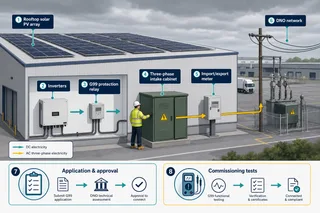
Commercial solar G99 DNO connection - UK business guide
UK business guide B Solar G99 / export limitation
Does a UK business need a commercial solar G99 DNO connection?
A commercial solar G99 DNO connection in the UK is the usual route when a business array will run in parallel with the public network and is outside the small G98 limits. Most warehouse, office, factory and shop rooftops proposed in the tens or hundreds of kilowatts fall into that category. G99 is a connection standard and process, not a grant, a quality mark or permission to build on the roof. What you may export is set by the distribution network operator for that location. It is not the panel kilowatt-peak, the inverter rating or the site's agreed import capacity.
The distribution network operator, or DNO, owns and runs the local network that serves the premises. The business does not choose it. Changing electricity supplier does not change it. Some retail parks and newer commercial estates sit on an independent distribution network operator, an IDNO. The application then goes through the IDNO, but spare capacity on the host network still matters. Engineering Recommendation G99, from the Energy Networks Association, covers generation connected in parallel with the public distribution network where the scheme is outside G98. G59 is the predecessor. It is not the route for a new commercial connection.
G98 is the route for small, fully type-tested micro-generation, commonly cited at 16 A per phase. That is often expressed as 3.68 kW per phase at 230 V, or 11.04 kW in total on a three-phase supply. Treat those figures as the usual dividing line people quote. Confirm the current EREC wording before anyone uses them as a legal test. A scheme can also fall outside G98 because it is not fully type-tested, even if the kilowatts look modest. In practice the route is decided from the AC connection design, not from a roof layout alone.
How generation capacity differs from allowed export
Export capacity is the maximum power the DNO agrees may be sent onto the network. Generation that stays behind the meter is still a network connection if it can run in parallel with the grid. Capping export, including towards zero, is not a reason to assume that no application is needed. Whether a maintained zero-export scheme needs the full G99 form set has to be checked in the current ERECs and in that DNO's policy. An older G59 installation on another site is not a template for a new connection. Agreed import capacity is the right to draw power. It does not grant the same right to export. DC kilowatt-peak can sit above the inverter's AC rating, and neither figure should be equated to registered capacity without the definition in the current EREC. Quotes that mix G99, G100 and export limitation are describing different things. G99 is the connection process. Export limitation is a control scheme, commonly designed to EREC G100, that holds export at the agreed cap. Power above that cap has to be used on site or curtailed.
Overview
On a warehouse with a light daytime load, a tight export cap can leave a large array doing less work than an unconstrained sales model implied. An office, a cold store or a shop with steady daytime demand can still use a capped system well, because more of the generation is absorbed on site. That pattern changes the value of the project. It does not change the network limit the DNO sets.
Who applies, and what the DNO actually studies
The application is built from the AC design: inverter ratings, phases, protection and the proposed export limit. Commercial supplies are usually three-phase, so the submission has to show how generation sits across the phases, not only a single total in kilowatts. Installers commonly assemble the pack. The right to alter the connection often sits with whoever holds the connection agreement. In a multi-let building that is frequently the landlord. A tenant on a leased roof should not proceed until landlord consent and connection rights are clear, including whose MPAN will be named.
The DNO, or the IDNO where one sits in front of the host network, studies the local feeder and the primary substation. Two similar warehouses on the same estate can receive different answers because one feeder is already carrying other generation. A response may allow the export requested, cap it, require network works, offer a flexible or timed arrangement, or say capacity is not available without reinforcement. Application fees, response times and reinforcement costs vary by operator and by whether works are required. No national figure can stand in for that operator's current process.
The pack commonly needs the site address, the MPAN, the proposed AC capacity, the export being requested, inverter data and a single-line diagram. Type-test evidence and interface protection settings need to match what was submitted. Factory defaults are not a substitute for settings the DNO specifies. Splitting one scheme into several small applications is not an accepted way around G99. Confirm the aggregation rule in the current EREC rather than assuming several small systems at one premises will each be treated as separate G98 plant.
What a connection response can allow, cap or refuse
A positive response is permission to connect on the terms stated. It is not planning consent, building regulations approval or a structural sign-off for the roof. Those regimes are separate. A planning consent does not authorise parallel generation, and a connection offer does not authorise the roof works. An installer proposal and a budget estimate are earlier documents. Neither is a connection offer, and neither is permission to energise.
Read the offer for the export cap, any sole-use or reinforcement works, the protection requirements and whether a witness test is required. Where a witness test is required, the plant has to be ready to show protection operation and shutdown. Energising generation before the required notification or witness can breach the connection terms. That risk is real on programmes where the roof is finished and the inverter is on site before the formal offer is back. Order long-lead equipment against the offer conditions. A constraint often changes inverter size or the export cap, and that is what changes the quote.
A later increase in capacity should be treated as a new or varied application, not as a small add-on. Changing the inverter model, or raising AC capacity, after an offer can invalidate the study even if the panel layout looks the same. If the network is constrained, the honest commercial choice is sometimes a smaller AC system matched to site load, rather than a larger array that will be curtailed. That decision belongs in the design review, before deposits are paid on inverters.
How an export limit changes the case against grid electricity
Commercial solar is often compared with grid electricity as if every kilowatt-hour generated either cuts an import bill or earns an export payment. That comparison only holds for the energy the site can use, plus the energy the DNO has actually agreed may be exported. Above the cap, extra panels help only to the extent the building uses the power. A larger array does not automatically mean more export revenue.
For a UK office with a weekday daytime load, a capped-export design can still displace a useful share of imported electricity. A shop, a retail-park unit or a cold store can be similar if demand is present while the array is generating. A warehouse that is quiet through the middle of the day may see much more of a large array curtailed once the cap is hit. None of those patterns tells you the connection cost. Panel prices, export tariffs and payback are site-specific and are not fixed by G99. A warehouse quote that prices modules and inverters only, and leaves the DNO outcome as a footnote, is not yet a cost for connecting the system.
Operations and maintenance, and any performance guarantee, need the same assumptions as the offer. G99 compliance is not a performance guarantee. Curtailment and protection trips will reduce output against an unconstrained model. The commissioning pack, meaning the single-line diagram, settings, test sheets and as-built capacities, is what a later operations contractor will use if yield is challenged. A guarantee that assumes unconstrained export does not match an offer that caps export. Ask for the wording to name the export limit and the availability assumptions before you rely on it.
What to fix in the design before equipment is ordered
The connection offer is only as good as the design that was submitted. Lock the inverter model, the AC capacity, the protection settings and the export-limit scheme before equipment is ordered. Those are the items the network study uses. A later roof drawing with more modules does not, by itself, keep the offer valid if the AC side has changed. Where the DNO has specified interface protection settings, those settings are part of the connection. They are not a menu the inverter may leave on factory default.
An export-limitation scheme needs more than a tick box on a quote. The controller has to be suitable. The current transformers have to sit where they see the true site export. The scheme is expected to fail safe so that a limiter fault cannot leave the site above the cap. Confirm the current G100 clause and that DNO's policy before hardware is specified. Metering has to match how any surplus will be treated. Larger commercial supplies are often half-hourly metered. Export on that supply needs metering and settlement arrangements that fit the offer, not a domestic export assumption carried across from a house.
If those items are still open when the deposit is due, the commercial risk sits with the business, not with a generic yield chart. Ask the installer to mark which parts of the quote are conditional on the DNO response, and which equipment will be re-specified if the export cap comes back lower than requested.
When this G99 guide does not fit the site
This process fits UK businesses planning generation in parallel with a distribution network, above the G98 limits or outside G98's fully type-tested conditions. It is not a domestic rooftop guide, and it is not the right frame for a small fully type-tested system that stays inside G98. It is also not for plant that never operates in parallel with the public network. Schemes at transmission voltage, or otherwise in the heavier G99 types, need requirements beyond a typical rooftop application. Take that boundary from the current EREC and from the network operator, not from a summary written for a warehouse roof.
Standalone batteries add metering and control questions that a solar-only G99 pack does not settle. If storage is in the design, say so at application stage rather than treating it as a later add-on. A tenant who cannot show landlord consent, or who does not hold the right to alter the intake, should pause. Where MCS is relevant to a separate scheme, it does not replace DNO consent. G99 is not an MCS certificate, and an MCS certificate is not a connection offer.
What to check before you treat a quote as permission to connect
Before you compare commercial solar with staying on grid electricity alone, measure how the site actually uses power through the day and across the week. A half-hourly profile, where the supply already has one, is more useful than an annual total. Put the proposed AC capacity next to that profile and next to the export you intend to request. If the two do not meet, the business case is already conditional, even before the DNO replies.
Ask the installer, in writing, whether the design is being submitted under G98 or G99. Ask what export limit will be requested, and what happens to inverter size if the offer comes back lower. Ask who will sign the application, whose MPAN is named, and whether an IDNO is involved. Ask for the current forms and any fee from that network operator rather than a figure copied from another region. Do not energise generation because the roof is finished and the panels are already on site.
A connection offer, once it arrives, should be read against the quote, the structural design and the planning position as three separate approvals. If any one of them is still open, the project is not ready to be treated as a committed connection. The useful next step is a design review that names AC capacity, export, protection and who holds the connection agreement, then an application built to the current EREC and that operator's process.
Plan, Compare & Buy Renewable Energy Solutions
AI does the thinking.
You get the perfect solar match.
Use RoboMo™ to assess your property, compare available technologies and connect with trusted UK installers, suppliers and manufacturers.
Simply enter your postcode, drop a pin on your roof, create your free account and let RoboMo™ analyse your property to find the best solar panels for your home.

You don't have to think
RoboMo™'s AI analyses your roof and does all the hard work.

Accurate & tailored
AI-powered assessment based on your roof, location, and conditions.

Best options, maximum savings
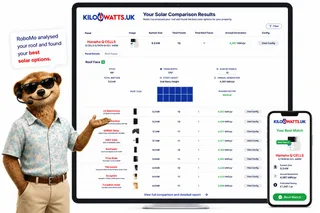
Compare top solar panels for the best performance and value.

Simple, fast & effortless
Provide a few details, sit back and watch your results unfold.
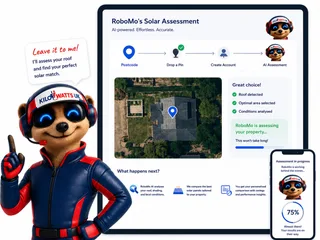
STEP 1
Choose Home, Business or Industrial
Enter your postcode to start your assessment.
STEP 2
Drop a pin on your roof
STEP 3

Create your free account
STEP 4

Sit back and watch RoboMo™ work
RoboMo™ analyses your roof and builds your personalised solar comparison.

Kilowatts UK is an authorised representative
Flower Turbines
Compact vertical-axis turbines built for real UK sites, not just open farmland.
They start in light wind, sit in a small footprint, and are bird-safe by design. Cluster them as a bouquet and the group performs better together than the same turbines standing alone. Enter your postcode for a location-based generation estimate. Figures use area weather data and will differ if buildings, trees or hills sit in the way.
Starts in light UK wind
Built to generate in typical UK wind, not only open farmland.
Small rooftop or ground footprint
Compact towers for roofs, yards and tight sites.
Bird-safe slow rotation
Slow vertical-axis spin, bird-safe by design.
Bouquet clusters raise output
Grouped turbines outperform the same units standing alone.
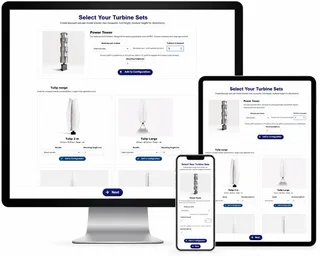
Step 1
Enter your postcode
Start designing your wind energy system in seconds.
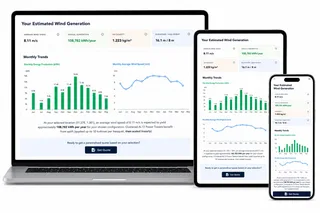
STEP 2

Choose a location
STEP 3

Place your cluster
Tap the map where you want the turbine cluster to go.
STEP 4

Instant generation forecasts
Compare different turbine layouts and see annual generation forecasts instantly.
STEP 5

No commitment required
Explore different configurations before deciding whether to request a quotation.
Related articles
Mo's Mission Nominations
FAQ
Need Help? RoboMo's Got Answers
Does a UK business need a commercial solar G99 DNO connection?
A G99 connection is the usual route when a business array will run in parallel with the public network and is outside the small G98 limits. Most warehouse, office, factory and shop rooftops in the tens or hundreds of kilowatts fall into that category. G99 is a connection standard and process, not a grant, a quality mark or permission to build on the roof. What may be exported is set by the distribution network operator for that location, not by the panel kilowatt-peak, the inverter rating or the site's agreed import capacity.
What is the difference between G98 and G99?
G98 is the route for small, fully type-tested micro-generation, commonly cited at 16 A per phase, often expressed as 3.68 kW per phase at 230 V or 11.04 kW in total on a three-phase supply. G99 covers generation connected in parallel with the public distribution network where the scheme is outside G98, including where it is not fully type-tested even if the kilowatts look modest. Treat those figures as the usual dividing line people quote, and confirm the current Engineering Recommendation before anyone uses them as a legal test. The route is decided from the AC connection design, not from a roof layout alone. G59 is the predecessor and is not the route for a new commercial connection.
Does capping export, even to zero, mean no application is needed?
Export capacity is the maximum power the DNO agrees may be sent onto the network, and agreed import capacity does not grant an equal right to export. Generation that stays behind the meter is still a network connection if it can run in parallel with the grid. Capping export, including towards zero, is not a reason to assume that no application is needed. Whether a maintained zero-export scheme needs the full G99 form set has to be checked in the current Engineering Recommendations and in that DNO's policy.
Who applies for the connection, and does changing supplier change the DNO?
The business does not choose its distribution network operator, and changing electricity supplier does not change it. Installers commonly assemble the pack from inverter ratings, phases, protection and the proposed export limit. The right to alter the connection often sits with whoever holds the connection agreement, which in a multi-let building is frequently the landlord. A tenant on a leased roof should not proceed until landlord consent and connection rights are clear, including whose MPAN will be named. If the site sits on an independent distribution network operator, the application goes through that IDNO, although spare capacity on the host network still matters.
What can a DNO connection response allow, cap or refuse?
The DNO, or the IDNO where one sits in front of the host network, studies the local feeder and the primary substation. A response may allow the export requested, cap it, require network works, offer a flexible or timed arrangement, or say capacity is not available without reinforcement. Two similar buildings on the same estate can receive different answers because one feeder is already carrying other generation. Application fees, response times and reinforcement costs vary by operator and by whether works are required, so no national figure can stand in for that operator's current process.
Is a G99 offer the same as planning permission or permission to energise?
A positive response is permission to connect on the terms stated. It is not planning consent, building regulations approval or a structural sign-off for the roof, and those regimes are separate. An installer proposal and a budget estimate are not a connection offer and are not permission to energise. Where a witness test is required, the plant has to be ready to show protection operation and shutdown, and energising generation before the required notification or witness can breach the connection terms.
How does an export limit change the comparison with grid electricity?
The comparison only holds for energy the site can use, plus energy the DNO has agreed may be exported. Above the cap, extra panels help only to the extent the building uses the power, so a larger array does not automatically mean more export revenue. An office, shop or cold store with daytime demand can still use a capped system well, while a quiet daytime warehouse may see much more of a large array curtailed. Panel prices, export tariffs and payback are site-specific and are not fixed by G99. G99 compliance is not a performance guarantee, and a guarantee that assumes unconstrained export does not match an offer that caps export.
What should be locked before equipment is ordered, and does MCS replace DNO consent?
Lock the inverter model, the AC capacity, the protection settings and the export-limit scheme before equipment is ordered, because those are the items the network study uses. Changing the inverter or raising AC capacity after an offer can invalidate the study, and a later increase should be treated as a new or varied application rather than a small add-on. An export-limitation scheme, commonly designed to EREC G100, needs a suitable controller and current transformers that see true site export and fail safe if there is a fault. Splitting one scheme into several small applications is not an accepted way around G99. Where MCS is relevant to a separate scheme, it does not replace DNO consent: G99 is not an MCS certificate, and an MCS certificate is not a connection offer.