


Government Solar Panel Scheme 2026: A Guide to UK Support
Published: 2026-06-28 22:44:28
Updated: 2026-08-01 11:17:31
In practice, support comes through targeted retrofit schemes, energy-supplier obligations, local authority routes, devolved nation programmes.
Government solar panel scheme 2026 summary
There is no single UK-wide “government solar panel scheme 2026” that gives free solar panels to every household. In practice, support comes through targeted retrofit schemes, energy-supplier obligations, local authority routes, devolved nation programmes, 0% VAT relief and export payments.
Eligibility depends mainly on:
- where you live in the UK
- household income, benefits or fuel-poverty status
- EPC rating and current heating type
- whether you own, rent or live in social housing
- roof condition, shading and structural suitability
- electrical safety and grid-connection limits
The main routes to check in 2026 are ECO4 or any successor arrangements, the Great British Insulation Scheme, local authority flexible eligibility, Scottish, Welsh and Northern Irish programmes, social housing retrofit schemes, 0% VAT on eligible installations, and the Smart Export Guarantee for exported electricity. For a broader overview, see the main guide to solar grant routes. These routes do different jobs. Some may fund or part-fund measures for eligible low-income, fuel-poor or vulnerable households. Some reduce VAT on qualifying equipment. Some pay for surplus electricity after the system is installed. A grant eligibility check is also not the same as a technical solar survey, so a household can pass an income or benefit check and still be unsuitable for panels. For 2026, dates matter. ECO4 and the Great British Insulation Scheme have published end dates in March 2026. If you are applying around that period, confirm whether the offer is under the current scheme, a transition arrangement or a replacement scheme. whether solar PV is part of a wider energy-efficiency package
What counts as a government solar panel scheme in 2026
When people search for a government solar panel scheme, they are usually looking for one of three things: a grant towards installation, a discount on the upfront price, or a payment for electricity exported to the grid. These are often described together online, but they are not the same.
ECO4 is the main supplier obligation route that can include solar PV in some circumstances. It is aimed at improving low-income, fuel-poor or vulnerable homes, and it normally works as a whole-house retrofit package rather than as a standalone solar panel grant. Insulation, heating improvements and controls may be prioritised before solar PV is considered.
The Great British Insulation Scheme is mainly an insulation scheme, not a solar panel grant. It can still matter because reducing heat loss is often the first step in making a home cheaper to run. A poorly insulated home may get more benefit from insulation before adding solar panels. The Smart Export Guarantee is not a grant. It is the route used in Great Britain for eligible small-scale generators, including solar PV, to be paid for surplus electricity exported to the grid. You normally apply after installation, and suppliers set their own export tariffs and terms. The 0% VAT relief on qualifying energy-saving materials can reduce the installed cost of domestic solar panels and eligible battery storage where the rules apply. It is normally applied by the installer on the invoice rather than claimed by the homeowner through a separate grant form.
Who is most likely to be eligible
The households most likely to receive funded or partly funded solar PV are those where solar forms part of a wider retrofit plan. In real projects, the scheme provider will look at the home as a whole, not just the roof.
You are more likely to qualify for funded or partly funded support if several of the following apply:
- your household receives qualifying means-tested benefits
- your home has a poor EPC rating, commonly D, E, F or G depending on the route
- you are classed as low income, vulnerable or at risk of fuel poverty under local rules
- your home has electric heating or high electricity demand
- your council has an active local authority flexible eligibility route
- your property is included in an area-based retrofit project
Typical qualifying benefits for ECO-style support can include Universal Credit, Pension Credit, Income Support, income-based Jobseeker’s Allowance, income-related Employment and Support Allowance, Housing Benefit, Tax Credits, and some disability-related benefits. Child Benefit may also count in some routes, subject to income thresholds. A simple example would be an owner-occupier in an EPC E home who receives Pension Credit and has electric heating. That household may be a stronger candidate for an ECO-style package because the home is inefficient, the household meets a benefit route, and solar PV could reduce electricity running costs. Another example would be a household that does not receive qualifying benefits but has a low income, high energy costs and a health condition made worse by a cold home. That household might not qualify through the standard benefit route, but it may be worth checking the local council’s flexible eligibility rules. Eligibility is not automatic. A household may meet the income rules but fail on property suitability, tenure consent, roof condition, planning constraints or scheme priorities. Equally, a home may have an excellent south-facing roof but not qualify for funded support if household income, EPC rating or local rules do not match the scheme. you live in social housing selected for a landlord-led retrofit programme your roof is technically suitable for solar PV landlord, freeholder or managing agent consent is available where needed
Who is less likely to get grant-funded solar
Higher-income households, homes with good EPC ratings and properties that already have efficient heating and insulation are less likely to receive grant-funded solar panels. These homes may still benefit from 0% VAT and export payments, but they should not assume a free installation is available.
A household is less likely to receive grant-funded solar if:
the property already has a good EPC rating household income is above scheme thresholds no one receives qualifying benefits the home is not in a local authority priority group the roof is in poor condition or due for replacement the roof is heavily shaded or too small Flats and leasehold homes can be more complicated because the person applying may not control the roof. Freeholder consent, lease terms, building management rules and roof access all matter. In blocks of flats, solar may serve communal areas rather than an individual tenant’s meter, depending on how the system is designed. A property may also be unsuitable if the roof is heavily shaded, in poor condition, too small, structurally unsuitable or due for replacement. Removing and refitting panels later for roof repairs can be expensive, so a roof nearing the end of its life should normally be dealt with before solar PV is installed. Planning constraints can also affect suitability. Many domestic roof-mounted solar installations are permitted development, but rules vary across England, Scotland, Wales and Northern Ireland. Listed buildings, conservation areas, National Parks and Areas of Outstanding Natural Beauty can require extra care or consent, so check planning permission for solar before assuming the roof is usable. the property is leasehold and roof consent is not available the electrical installation needs major remedial work before solar can be fitted the scheme prioritises insulation or heating measures instead of solar PV
Main UK solar support routes to check
The right route depends on your location, household circumstances and property type. There is no single central form that covers every UK solar support option.
ECO4
A supplier obligation route that can include solar PV where it supports the required home energy improvement package.0% VAT relief
Reduces the cost of qualifying solar and battery installations where the rules apply.Devolved nation schemes
Scotland, Wales and Northern Ireland have separate advice routes and funding arrangements that can change by year.Great British Insulation Scheme
Mainly supports insulation and may be relevant before solar because it reduces heat demand.Social housing retrofit programmes
Usually landlord-led, with councils or housing associations applying rather than individual tenants.Local authority flexible eligibility
Allows councils to identify households that may need support even if they do not meet standard benefit rules.
For each route, check three things before assuming solar PV is available: For 2026, check dates carefully. ECO4 and the Great British Insulation Scheme have published end dates in March 2026, so households should confirm whether they are applying under the existing scheme, a transition period or a replacement scheme. The wider policy backdrop is also changing, so it is worth following the latest Warm Homes Plan guidance when comparing routes. Smart Export Guarantee — Pays eligible generators in Great Britain for surplus electricity exported to the grid. whether the route is open in your nation and local authority area whether solar PV is an eligible measure or only insulation/heating support is available whether you apply directly, through a landlord, through a supplier or through an approved installer
ECO4 and solar panels
ECO4 runs from April 2022 to March 2026 under published scheme dates. It is funded by larger energy suppliers and is designed to improve the energy efficiency of low-income, fuel-poor and vulnerable households. Solar PV can be included, but it is usually not offered as a standalone free solar panel grant.
ECO4 eligibility normally depends on a combination of household status and property need. The scheme may consider:
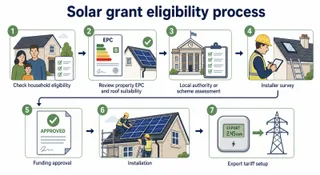
qualifying benefits or other approved eligibility routes low income or vulnerability through local authority flexible eligibility EPC rating and the improvement target for the property tenure, including owner-occupied, private rented or social housing rules whether the proposed package meets scheme requirements whether the home is technically suitable for the measures In practice, ECO4 looks at the property’s starting condition and the improvement package needed to raise the home’s energy performance. The package may include insulation, heating measures, heating controls and sometimes solar PV. Solar is more likely to make sense where the home uses electric heating or has high electricity demand. An ECO4-style application commonly works like this: ECO4 work commonly involves approved installers, TrustMark-registered businesses and PAS 2030 or PAS 2035 retrofit processes. A retrofit assessment is normally required, and a retrofit coordinator may be involved where multiple measures are installed. Private renters usually need landlord permission. Social housing tenants normally need their housing provider to be involved. Owner-occupiers may have a simpler consent route, but they still need eligibility checks and a technical survey. A realistic ECO4 example would be a low-income household in an EPC F electrically heated home. The scheme may first consider loft insulation, cavity wall insulation, heating controls or heating upgrades. Solar PV may then be considered if it helps meet the required improvement outcome and is technically suitable. It should not be assumed that solar will be the first or only measure. You complete an initial eligibility check with a supplier, approved installer, council referral route or advice service. You provide evidence such as proof of address, benefit letters, income information or landlord details. The provider checks your EPC and confirms whether the property may qualify. A retrofit assessment is arranged. The assessor reviews the home’s insulation, heating, ventilation, occupancy and possible measures. A package of improvements is proposed. Solar PV is either included, excluded or considered unsuitable. You receive written details of what is funded, whether any contribution is needed, and who will own and maintain the system.
Great British Insulation Scheme and local authority routes
The Great British Insulation Scheme runs alongside ECO4 under published rules to March 2026. It is not primarily a solar panel scheme, but it can be an important first step for homes losing too much heat. Better insulation can reduce energy use, improve comfort and make later solar or heating upgrades more effective.
Eligibility can include low-income households and homes in lower Council Tax bands with poor EPC ratings. In England, qualifying Council Tax bands are generally A to D. In Scotland and Wales, qualifying Council Tax bands are generally A to E. Private renters need landlord permission.
The application process usually involves:
- checking whether your property is in an eligible Council Tax band or benefit group
- confirming the EPC rating or arranging an assessment if needed
- contacting a participating energy supplier or approved installer
- allowing a survey to check which insulation measures are suitable
- receiving written confirmation of the proposed measure and any contribution
- getting landlord permission if the property is rented
A typical Great British Insulation Scheme example would be an EPC D semi-detached home in Council Tax band C with poor loft insulation. The scheme may offer loft or cavity wall insulation, depending on suitability. It should not be presented as a solar PV grant unless a separate eligible route is clearly explained. Local authority flexible eligibility, often called LA Flex, can help households that do not fit standard benefit-based rules but are still considered vulnerable, low income or at risk of fuel poverty. Each council sets its own statement of intent, so one area can differ from another. LA Flex may consider factors such as: If you think you may qualify through LA Flex, contact your council or check its official energy-efficiency pages. Be wary of private adverts that imply council approval without showing a clear route, written eligibility criteria and the installer’s scheme credentials. A practical LA Flex example would be a household with no qualifying benefits but a low income, high energy bills and an EPC E property. The council may be able to refer the household into an ECO-style route if its published statement of intent allows it. The final decision still depends on scheme funding, survey results and the measure package. low household income high energy costs health conditions affected by cold homes age, disability or vulnerability property condition fuel-poverty risk local priority areas
Scotland, Wales and Northern Ireland
Scotland has separate advice and funding routes through Home Energy Scotland, alongside access to Great Britain-wide routes such as ECO4 and the Great British Insulation Scheme where eligible. Support can vary by financial year, property condition, income, location and whether other measures are being installed.
Scottish households should usually start by checking:
Home Energy Scotland advice and current funding routes ECO4 eligibility Great British Insulation Scheme eligibility local authority area-based schemes whether solar PV is supported directly or only as part of a wider package Nest or any current Welsh Government home energy programme Wales has Welsh Government fuel poverty and home energy programmes. Nest has historically focused on energy efficiency and heating support for eligible low-income households, but solar PV is not always a core measure. Welsh households should also check ECO4, the Great British Insulation Scheme and local authority retrofit projects. Welsh households should usually check: Northern Ireland has separate energy policy and support arrangements. Great Britain schemes do not always apply in Northern Ireland, and the Smart Export Guarantee does not operate there in the same way. Households should check the Northern Ireland Housing Executive, local council support and electricity supplier export arrangements. Northern Ireland households should usually check: Across all nations, the same practical constraints still apply. The roof must be suitable, the electrical installation must be safe, permissions must be in place, and the grid connection process must be handled correctly. ECO4 eligibility Great British Insulation Scheme eligibility local authority flexible eligibility social housing retrofit programmes if they rent from a council or housing association Northern Ireland Housing Executive support local council energy-efficiency schemes supplier export arrangements whether any current renewable-energy grants or loans are available at the time of applying planning and grid-connection requirements specific to Northern Ireland
How to apply for solar panel support
Start by identifying which route you might qualify for, rather than looking for one universal government form. Most applications go through an energy supplier, scheme installer, managing agent, local authority referral route, devolved advice service or housing provider.
Before applying, collect your basic information. You may need:
proof of identity proof of address Council Tax bill benefit award letter income evidence EPC certificate A practical application route usually looks like this: For ECO4, the application is usually handled by a supplier, approved installer, local authority referral route or energy-efficiency provider. You should expect an eligibility check, evidence request, property assessment, retrofit design and written offer before installation. For the Great British Insulation Scheme, the application usually starts with a Council Tax band, EPC and household eligibility check. The survey then confirms which insulation measure is suitable. Solar PV should not be assumed unless another support route is being used. For LA Flex, the key step is checking your council’s published criteria. Some councils let residents enquire directly. Others work through approved installers or referral partners. If a private company says you qualify through the council, ask for the council route and written criteria. For social housing retrofit, tenants usually cannot independently approve solar panels on the roof. Contact the council or housing association and ask whether your block or estate is included in any planned retrofit programme. For 0% VAT, you do not normally submit a grant application. The installer applies the VAT treatment on the invoice if the installation qualifies under the rules. Ask for the VAT position to be shown clearly in the quote. For the Smart Export Guarantee, you apply after installation. You will usually need installation documentation, an export-capable meter, an export MPAN and supplier approval. Do not sign based only on a phone call or online eligibility result. The final offer should follow a proper survey, written specification and clear explanation of ownership, maintenance, warranties, export payments and any customer contribution. recent energy bill tenancy agreement landlord permission freeholder or managing agent consent roof photos loft access photos meter and consumer unit photos details of existing heating and insulation smart meter or MPAN information Check your EPC rating and Council Tax band where relevant. Confirm whether anyone in the household receives qualifying benefits. Check whether you own the property, rent privately, live in social housing or need freeholder consent. Contact your council, energy supplier, devolved advice service or scheme installer. Allow a home survey or retrofit assessment before agreeing to work. Review whether solar PV is included or whether the offer is for insulation or heating measures only. Ask whether the installation is fully funded, partly funded or requires a customer contribution.
What the installer should check
A good installer or retrofit provider will check much more than whether your roof faces south. They need to assess whether the system is safe, durable, compliant and likely to perform as expected.
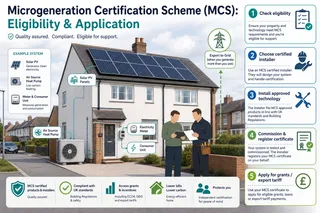
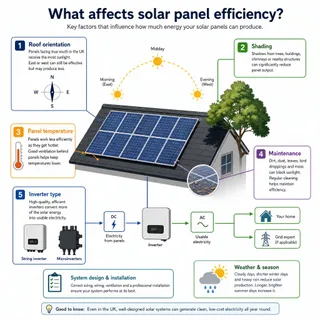
Roof condition: The roof covering, rafters, age, access and weatherproofing all affect whether panels should be fitted. Shading: Chimneys, trees, dormers, neighbouring buildings and roof features can reduce output significantly. Electrical capacity: The consumer unit, earthing, meter position and cable routes may affect installation complexity, including whether residential fuse box upgrades are needed. Grid connection: Smaller systems may follow G98 rules, while larger or more complex systems may need G99 approval before installation. Inverter and battery location: Equipment should be sited where it can operate within manufacturer limits and be accessed for maintenance. Handover documents: You should receive certificates, warranties, system information, monitoring access and grid connection paperwork.
A proper roof check should consider the covering type, roof age, signs of leaks, cracked tiles, felt condition, rafter strength, fixing method, access for scaffolding, wind exposure and whether the roof is likely to need major repairs during the life of the solar PV system. Solar panels commonly last for decades, so fitting them to a roof that needs replacement soon can create avoidable costs. A shading check should look at more than a quick glance from the ground. Chimneys, dormers, soil pipes, TV aerials, trees, nearby buildings and roof valleys can all reduce output. Even partial shading on one area of an array can affect performance depending on the panel layout, inverter and optimiser design. An electrical check should confirm that the consumer unit, earthing, bonding, meter tails, isolators and cable routes are suitable. Older properties may need remedial electrical work before solar PV can be connected safely. This does not automatically make solar impossible, but it can affect cost, timing and eligibility for funded work. A grid-connection check should confirm whether the system can be installed under G98 notification rules or needs G99 approval before installation. As a rough guide, smaller single-phase inverter systems up to the standard export limit may be handled more simply, while larger systems, combined solar-and-battery systems or higher export capacities may need prior Distribution Network Operator approval. The installer should also consider: An installer-level detail often overlooked is heat. Lofts can become very hot, which may reduce inverter efficiency and lifespan. Batteries also need suitable temperatures, safe clearances and manufacturer-approved locations. The neatest-looking location is not always the best technical location. Another common issue is assuming a battery gives automatic backup during a power cut. Most standard solar and battery systems shut down during a grid outage unless specific backup equipment and circuits are designed into the installation. roof orientation and pitch available roof area panel layout and fire access considerations inverter sizing battery compatibility generation estimate self-consumption assumptions export-limiting requirements bird protection where appropriate scaffolding and safe access planning constraints warranties and maintenance access
Costs, savings and what support actually changes
A typical domestic solar PV system is often around 3kW to 5kW. In current market terms, a 3kW system may cost roughly £5,000 to £7,000, a 4kW system roughly £6,000 to £8,500, and a 5kW system roughly £7,500 to £10,500. A home battery can commonly add around £3,000 to £8,000 depending on usable capacity and brand, so check typical solar battery costs before treating storage as an automatic add-on.
These figures can change with scaffolding, roof complexity, slate or fragile tiles, bird protection, consumer unit upgrades, monitoring equipment, battery location, DNO requirements and installer workload. Grant-funded installations may also give less consumer choice over panel, inverter or battery brands.
Support changes the cost picture in different ways: a funded retrofit scheme may cover the full cost of eligible measures a partly funded scheme may require a customer contribution 0% VAT can reduce the installed price where the rules apply the Smart Export Guarantee can provide ongoing export income insulation support may reduce energy demand before solar is considered social housing schemes may reduce tenant bills, but the landlord may own the system Solar output depends on system size, orientation, roof pitch, shading, equipment and location. A 1kWp solar PV array in the UK often generates around 750kWh to 1,100kWh per year. Southern England is usually toward the higher end of that range, while northern Scotland is usually lower. The financial result depends on how much solar electricity you use at home. Homes without a battery often use around 25% to 45% of generation on site, but actual self-consumption varies widely. A battery can increase on-site use, but it adds cost and is not automatically worthwhile for every household. Be cautious with savings claims that assume all generated electricity is used in the home. Exported electricity usually earns less than the cost of buying electricity from the grid, so the strongest savings normally come from using solar power on site. Daytime occupancy, appliance use, EV charging, hot-water controls and battery storage can all affect the result.
Smart Export Guarantee after installation
If you install solar PV in Great Britain, the Smart Export Guarantee can pay you for eligible surplus electricity exported to the grid. It is not a grant and does not reduce the upfront installation cost.
You normally apply to an SEG licensee after the system is installed. The supplier may ask for:
MCS certificate or equivalent accepted evidence proof of ownership import MPAN export MPAN meter details bank details SEG tariffs vary by supplier and terms. Some require you to buy import electricity from the same supplier, while others do not. Check payment rates, contract length, whether half-hourly export readings are required, and what happens if you switch supplier. Export payments are usually lower than import electricity prices, so using solar electricity on site normally provides stronger savings than exporting it. Export still has value, especially for households that generate more than they can use during the day. If your installation is funded through a scheme, confirm who receives the export income. In most straightforward owner-occupier installations, the homeowner applies for and receives SEG payments. In some funded, leased, social housing or third-party ownership arrangements, the position may be different and should be confirmed in writing before work begins. confirmation that your meter can record export DNO notification or approval paperwork commissioning documents
Common myths and misconceptions about government solar support
One common myth is that the government gives free solar panels to every UK household. Support is targeted. Many households will not qualify for grant-funded panels and will instead rely on 0% VAT, self-funding and export payments.
Another misconception is that ECO4 is a dedicated solar panel grant. It is not. ECO4 is a home energy-efficiency obligation that may include solar PV where it fits the required retrofit package and eligibility rules.
A third misconception is that a good online eligibility result guarantees installation. It does not. A desktop check can only indicate possible eligibility. The home still needs a retrofit assessment, roof survey, electrical checks, permissions and scheme approval. Some households assume that a south-facing roof is always suitable. Direction helps, but it is not enough. Roof condition, shading, size, structure, access, planning rules and grid connection all matter. Another myth is that solar panels work only in hot weather. Solar PV generates electricity from daylight, not heat. Output is higher in brighter conditions and lower in winter, but panels can still generate electricity on cool, bright days. If this is a concern, read more about solar in winter. Some buyers assume a battery automatically provides power during a power cut. Most standard solar and battery installations shut down during an outage for safety unless a dedicated backup system is designed and installed. Another misconception is that export payments will pay for the whole system quickly. Export income can help, but using solar electricity in the home is usually more valuable than exporting it. Payback depends on installation cost, usage pattern, tariff, system size, battery choice and export rate.
Red flags and common mistakes
The biggest warning sign is a claim that every UK household qualifies for free government solar panels. Support is targeted, and many households will only qualify for indirect help such as VAT relief or export payments.
Be careful with high-pressure sales tactics, especially if you are asked to sign immediately or pay a large upfront fee before eligibility is confirmed. A genuine scheme should be able to explain the route, eligibility basis, installer credentials and what happens next in writing.
Common mistakes include accepting estimated savings based on using 100% of generated electricity, ignoring roof repairs, overlooking landlord or freeholder consent, assuming a battery gives power-cut protection, and failing to check who receives export payments. Before accepting any funded or partly funded solar offer, ask: Who owns the panels after installation. Whether any customer contribution or finance is involved. Whether the installer is accredited for the work. Whether MCS certification will be provided for SEG purposes. Whether TrustMark registration is required for the retrofit route. Whether scaffolding, bird protection and roof making-good are included. A desktop quote can change after a proper survey. That is not automatically a problem, but any change should be explained clearly and put in writing before work begins. It is also worth understanding what MCS certification means before relying on any export-income claims. Whether the DNO application or notification is included. Who is responsible for maintenance and inverter replacement. Whether your insurer, mortgage provider or freeholder needs to be notified. Whether the quotation includes VAT correctly. Whether a battery is included or optional. Whether power-cut backup is included or not included. Whether estimated savings are based on realistic self-consumption. Whether any roof repairs are excluded. Whether export payments go to you, your landlord or another party.
Practical next steps
First, check your EPC rating, tenure, Council Tax band and benefit position. Then check the relevant route for your nation and council area. If you are in social housing, contact your landlord or housing association rather than applying independently for roof works.
Use this order:
Check whether your home already has an EPC and what rating it has. Check your Council Tax band if applying for insulation or area-based support. Confirm whether anyone in the household receives qualifying benefits. Check whether your council has a local authority flexible eligibility statement. Confirm whether you own the roof or need landlord/freeholder consent. Look at the roof condition before assuming panels can be fitted. If you may qualify for ECO4, LA Flex or a local retrofit scheme, speak to your council, an obligated energy supplier or an approved scheme installer. If you are mainly looking to reduce the cost of a self-funded installation, focus on 0% VAT, proper system design, compare home solar options and SEG export options. When comparing offers, look beyond the headline promise. A suitable residential solar panel installation should be technically sound, properly documented, realistically modelled and clear about ownership, export income, warranties and maintenance. If you want a technical starting point before committing, you can book a free survey. The best outcome in 2026 will usually come from matching the right funding route to the right property. For some homes that means solar PV now. For others, insulation, roof repairs, heating improvements, electrical remedial work or consent issues need to be dealt with first. Gather energy bills and meter information. Approach an official advice route, supplier, council or reputable installer. Ask for a survey before accepting any final offer. Get the funding, ownership, warranties and export position in writing.
Plan, Compare & Buy Renewable Energy Solutions
AI does the thinking.
You get the perfect solar match.
Use RoboMo™ to assess your property, compare available technologies and connect with trusted UK installers, suppliers and manufacturers.
Simply enter your postcode, drop a pin on your roof, create your free account and let RoboMo™ analyse your property to find the best solar panels for your home.

You don't have to think
RoboMo™'s AI analyses your roof and does all the hard work.

Accurate & tailored
AI-powered assessment based on your roof, location, and conditions.

Best options, maximum savings
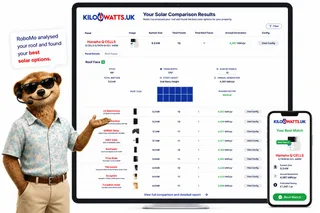
Compare top solar panels for the best performance and value.

Simple, fast & effortless
Provide a few details, sit back and watch your results unfold.
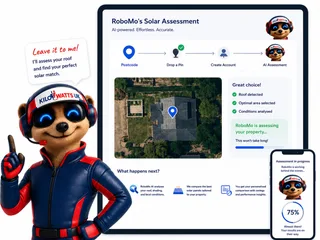
STEP 1
Choose Home, Business or Industrial
Enter your postcode to start your assessment.
STEP 2

Drop a pin on your roof
STEP 3

Create your free account
STEP 4

Sit back and watch RoboMo™ work
RoboMo™ analyses your roof and builds your personalised solar comparison.

Step 1
Enter your postcode
Start designing your wind energy system in seconds.
Are you an installer, distributor or renewable energy business?
Kilowatts UK is expanding the Flower Turbines partner network across the UK.
Become A Flower Turbines PartnerKilowatts UK is an authorised representative
Flower Turbines
Compact vertical-axis turbines built for real UK sites, not just open farmland.
They start in light wind, sit in a small footprint, and are bird-safe by design. Cluster them as a bouquet and the group performs better together than the same turbines standing alone. Enter your postcode for a location-based generation estimate. Figures use area weather data and will differ if buildings, trees or hills sit in the way.
Starts in light UK wind
Built to generate in typical UK wind, not only open farmland.
Small rooftop or ground footprint
Compact towers for roofs, yards and tight sites.
Bird-safe slow rotation
Slow vertical-axis spin, bird-safe by design.
Bouquet clusters raise output
Grouped turbines outperform the same units standing alone.
STEP 2

Choose a location
STEP 3

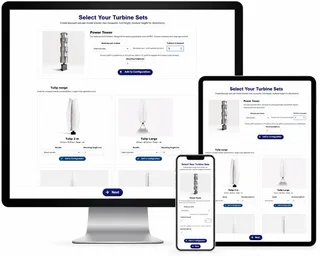
Place your cluster
Tap the map where you want the turbine cluster to go.
STEP 4

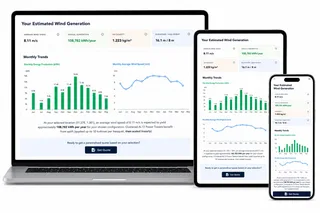
Instant generation forecasts
Compare different turbine layouts and see annual generation forecasts instantly.
STEP 5

No commitment required
Explore different configurations before deciding whether to request a quotation.
Related articles
Mo's Mission Nominations
FAQ
Need Help? RoboMo's Got Answers
Is there a UK government solar panel scheme in 2026?
There is no single UK-wide government scheme in 2026 that gives free solar panels to every household. Support is targeted and usually comes through ECO4 or successor arrangements, local authority routes, devolved nation programmes, social housing retrofit schemes, 0% VAT relief and Smart Export Guarantee export payments.
Can I get free solar panels from the government?
Some eligible households may receive fully funded or partly funded solar panels, but free solar panels are not available to everyone. Funding is usually aimed at low-income, fuel-poor or vulnerable households, and solar PV is often included only when it forms part of a wider home energy-efficiency package.
Who is most likely to qualify for funded solar panels?
You are more likely to qualify if you receive qualifying means-tested benefits, live in a home with a poor EPC rating, are on a low income, are vulnerable to fuel poverty, have high electricity use or electric heating, and your roof is technically suitable for solar panels. Local council rules, landlord consent and available scheme funding can also affect eligibility.
Does ECO4 pay for solar panels?
ECO4 can include solar PV in some cases, but it is not a dedicated solar panel grant. It is an energy-efficiency obligation for eligible low-income, fuel-poor or vulnerable households, and solar is usually considered as part of a package that may also include insulation, heating improvements and controls.
When does ECO4 end?
ECO4 has published scheme dates running to March 2026. If you apply around that period, check whether the offer is under ECO4, a transition arrangement or a replacement scheme, as rules and funding may change.
Is the Great British Insulation Scheme a solar panel grant?
No. The Great British Insulation Scheme is mainly designed to support insulation measures, not solar panels. It can still be relevant because improving insulation may reduce energy use and may be prioritised before solar PV is considered.
What is local authority flexible eligibility?
Local authority flexible eligibility, often called LA Flex, allows councils to refer households for support where they may not meet standard benefit rules but are still at risk of fuel poverty. Councils set their own criteria, which may consider income, energy costs, health conditions, vulnerability and property condition.
Can renters apply for solar panel support?
Private renters usually need landlord permission before any solar panels or major retrofit measures can be installed. Social housing tenants normally need to go through their council or housing association, as the landlord usually controls roof works and retrofit programmes.
Can leasehold flats get solar panels through a scheme?
Leasehold flats can be more complicated because the applicant may not control the roof. Freeholder consent, lease terms, managing agent approval, roof access and how the electricity will be used all matter. In some blocks, solar may be installed for communal areas rather than individual flats.
Does 0% VAT apply to solar panels?
Under current rules, 0% VAT can reduce the installed cost of qualifying domestic solar panels and eligible battery storage. It is not a grant and is normally applied by the installer on the invoice rather than claimed separately by the homeowner.
What is the Smart Export Guarantee?
The Smart Export Guarantee is a Great Britain scheme that pays eligible small-scale generators, including solar PV owners, for surplus electricity exported to the grid. It is not an upfront grant, and you normally apply after the solar system has been installed and commissioned.
Can I use both a grant and the Smart Export Guarantee?
In many cases, a household with an eligible solar installation may be able to receive export payments after installation, but you must check who owns the system and who is entitled to the export income. In funded, leased, landlord-led or social housing installations, the export payment position should be confirmed in writing.
What documents might I need when applying for support?
You may need proof of identity, proof of address, benefit award letters, income evidence, Council Tax details, an EPC certificate, recent energy bills, tenancy documents, landlord or freeholder consent, roof photos, meter details and information about your current heating and insulation.
Does passing an eligibility check guarantee solar panels?
No. An eligibility check only confirms that you may meet income, benefit or property criteria. A full assessment is still needed to check roof condition, shading, structure, electrical safety, grid connection, permissions, scheme rules and whether solar PV fits the required retrofit package.
What roof conditions can stop solar panels being installed?
Solar panels may not be suitable if the roof is in poor condition, heavily shaded, too small, structurally unsuitable, difficult to access or likely to need replacement soon. Installing panels on a roof that needs major repairs can lead to extra costs later because the panels may need to be removed and refitted.
Do I need planning permission for solar panels?
Many domestic roof-mounted solar panel installations are permitted development, but rules vary across the UK. Listed buildings, conservation areas, National Parks, Areas of Outstanding Natural Beauty and unusual roof layouts may require extra checks or consent.
What should an installer check before fitting solar panels?
A good installer should check roof condition, orientation, pitch, shading, structural suitability, electrical safety, consumer unit condition, earthing, cable routes, inverter and battery location, scaffolding needs, planning constraints and grid connection requirements. They should also provide clear handover documents, warranties and certification.
What are G98 and G99 grid connection rules?
G98 and G99 are grid connection processes used for small-scale generation such as solar PV. Smaller systems may be installed under G98 notification rules, while larger systems, higher export capacities or more complex solar-and-battery installations may need G99 approval from the Distribution Network Operator before installation.
How much do domestic solar panels cost without grant funding?
A typical domestic solar PV system is often around 3kW to 5kW. A 3kW system may cost roughly £5,000 to £7,000, a 4kW system roughly £6,000 to £8,500, and a 5kW system roughly £7,500 to £10,500. Battery storage can commonly add around £3,000 to £8,000 depending on capacity and brand.
How much electricity do solar panels generate in the UK?
A 1kWp solar PV array in the UK often generates around 750kWh to 1,100kWh per year, depending on location, orientation, pitch, shading and equipment. Southern England is usually toward the higher end of the range, while northern Scotland is usually lower.
Are solar batteries included in government solar schemes?
A battery may be included in some installations, but it should not be assumed. Funded schemes decide measures based on eligibility, property need, technical suitability and scheme rules. For self-funded installations, a battery can increase use of solar electricity at home but adds cost and is not automatically worthwhile for every household.
Do solar panels or batteries work during a power cut?
Most standard solar and battery systems shut down during a power cut for safety. Backup power is only available if specific backup equipment and circuits are designed into the installation, so this should be confirmed before you buy or accept an offer.
What are common warning signs of a misleading solar grant offer?
Be cautious if a company says every household qualifies for free government solar panels, pressures you to sign immediately, asks for a large upfront payment before eligibility is confirmed, gives unrealistic savings figures, cannot explain the funding route, or will not provide installer credentials and scheme details in writing.
What should I ask before accepting a funded solar offer?
Ask who owns the panels, whether any contribution or finance is required, whether MCS certification will be provided, whether TrustMark registration applies, who handles the grid notification or approval, who receives export payments, what warranties are included, who maintains the system, and whether roof repairs, scaffolding and bird protection are included.
What should I do first if I want solar panel support in 2026?
Start by checking your EPC rating, Council Tax band, benefit position, tenure and whether you need landlord or freeholder consent. Then check the relevant route for your nation and council area, such as ECO4, LA Flex, devolved advice services, social housing retrofit, 0% VAT and Smart Export Guarantee options.