


Solar Grants in the UK: What You Need to Know
Published: 2026-06-29 10:31:43
Updated: 2026-07-26 18:35:06
The main support is targeted at low-income households, vulnerable households, social housing, selected local authority retrofit programmes.
What solar grants are available in the UK in 2026?
There is no universal UK solar panel grant in 2026 that pays for solar panels for every homeowner. The main support is targeted at low-income households, vulnerable households, social housing, selected local authority retrofit programmes, and country-specific schemes in Scotland and Wales. Other financial help, such as 0% VAT on eligible residential installations and Smart Export Guarantee payments, can improve the economics of solar but should not be described as grants.
The most important point is that “solar grant” is often used loosely in adverts. A true grant normally means funding that does not have to be repaid. VAT relief reduces the purchase price but is not a grant. The Smart Export Guarantee pays for surplus electricity exported to the grid but is not a grant. Supplier obligation schemes may fund installed measures, but the homeowner often does not receive cash directly.
For most UK households, the practical route is to check national, devolved, and local eligibility first, then book a free home energy survey rather than assuming panels will be funded. In real projects, solar PV is normally assessed alongside roof condition, insulation, heating, ventilation, electrical safety, metering, and whether the household will use enough of the electricity generated. This guide is written for UK readers. If you are outside the UK, do not rely on UK schemes such as ECO, Warm Homes, 0% VAT, or the Smart Export Guarantee. Check your own national, state, provincial, or municipal solar incentives, tax credits, net-metering rules, installer accreditation requirements, and grid connection rules.
Quick summary of 2026 solar support.
The main UK solar support routes in 2026 are best understood as different types of help rather than one single national grant.
0% VAT relief
Eligible residential solar and battery installations can benefit from zero-rated VAT until the scheduled policy end date.Smart Export Guarantee
Households with eligible systems can be paid for surplus electricity exported to the grid.Local authority schemes
Councils may include solar PV in area-based or household retrofit programmes, but availability varies significantly by location and funding round.Social housing retrofit
Tenants may receive solar panels if their landlord includes PV in a funded improvement programme.Scotland and Wales schemes
Devolved schemes can provide energy efficiency advice and funding routes, but solar PV is not always guaranteed.Means-tested retrofit funding
Low-income and vulnerable households may receive funded energy measures, sometimes including solar PV, if the property and scheme rules allow it.
The realistic answer for a typical owner-occupier on a normal income is that a standalone free solar panel grant is unlikely. However, VAT relief, export payments, good system design, and local schemes can still make solar worth investigating. Historic tariffs — The Feed-in Tariff and older Renewable Obligation Certificate routes are closed to new applicants, although some existing accredited systems may still receive payments under their original terms.
True grants versus discounts and tariffs.
A common mistake is to treat every form of solar financial support as a grant. That can lead to poor decisions, especially where sales material implies that “free solar” is widely available.
A grant normally helps pay for the installation and does not usually need to be repaid. A loan must be repaid, even if it is interest-free or subsidised. VAT relief reduces the tax charged on eligible work, but it is not a cash payment. An export tariff pays after the system is installed and exporting, so it does not remove the upfront cost.
The Smart Export Guarantee is a good example of this distinction. It is a payment mechanism for surplus exported electricity, not a funding scheme for buying panels. GOV.UK explains the Smart Export Guarantee at the official SEG guidance. This distinction matters because a grant application usually checks household and property eligibility before installation, while an export tariff usually comes after installation and requires suitable metering, certification, and supplier acceptance. If a company says you qualify for “government-backed free solar”, ask for the exact scheme name in writing. Then check whether it is a grant, a loan, a lease, a rent-a-roof arrangement, a power purchase agreement, supplier obligation funding, or a normal paid installation being marketed aggressively.
England solar grant routes in 2026.
In England, the main grant-style support for solar PV is usually linked to wider home energy schemes rather than a standalone solar panel grant. The Warm Homes: Local Grant is the key route to check for low-income households in privately owned or privately rented homes, particularly where homes have poor energy efficiency and are not heated by mains gas.
The scheme is delivered through local authorities, so the exact offer depends on where the property is. Solar PV may be included where the council’s delivery model allows it, but it is normally assessed alongside other measures. Insulation, heating improvements, ventilation, and fabric upgrades may be prioritised before solar panels.
GOV.UK describes the Warm Homes: Local Grant at the official scheme page. Applicants should check both the national page and their council’s current energy efficiency pages, because local delivery windows can open and close. The Home Upgrade Grant is relevant background because it supported low-income off-gas homes and could include low-carbon improvements. However, Phase 2 was scheduled to run to March 2025, so it should not be treated as a live 2026 solar grant unless a local authority is still delivering an already funded project or has published a successor route. The Green Homes Grant voucher scheme should also be treated as closed. It closed in 2021 and is not a current route for homeowners seeking solar funding in 2026. If an advert or salesperson presents the Green Homes Grant as available now, that is a warning sign to verify the claim before sharing personal details or signing anything.
ECO4 and ECO4 Flex.
ECO4 is the Energy Company Obligation scheme for England, Scotland, and Wales. It is funded by energy suppliers and is aimed at improving energy efficiency for low-income and vulnerable households. Solar PV can be installed in some qualifying cases, but it is not available to everyone and is not a general solar grant.
The published ECO4 timetable ran to 31 March 2026, so anyone checking in 2026 should verify whether the scheme has ended, been extended, replaced, or is still being delivered through existing obligations. The safest sources are the GOV.UK ECO page and Ofgem’s ECO guidance.
ECO4 Flex is often misunderstood. It is not a separate solar grant. It allows local authorities to refer households that may not qualify through standard benefit routes but still meet local vulnerability or low-income criteria. Whether solar PV is included still depends on the property assessment, scheme rules, and the package of measures chosen. In practice, ECO-style schemes normally look at the whole home. A poor EPC rating, existing heating system, insulation levels, tenure, income, and vulnerability may all affect the decision. Solar PV may be less likely where the roof is unsuitable, shading is severe, or other measures deliver a better improvement under the scheme rules. Funded ECO work should also be delivered through the correct scheme and installation standards. Homeowners should expect proper assessment, paperwork, installer credentials, and clear handover documents rather than a rushed sale based only on an online eligibility form.
Social housing and landlord-led solar funding.
Social housing tenants do not usually apply for a personal solar panel grant in the same way as an owner-occupier. Instead, solar PV may be installed if the landlord, housing association, or council includes it in a funded retrofit programme.
The Warm Homes: Social Housing Fund supports social housing providers with upgrades to homes that need energy performance improvements. Measures can include fabric upgrades, low-carbon heating, and sometimes renewables. The tenant’s route is normally through the landlord, not a direct homeowner application.
Private renters may be eligible for some local or obligation-funded schemes, but landlord permission is usually essential. The landlord may need to agree to the works, provide property information, and accept any responsibilities connected with the installation. This can slow applications down, especially where ownership, roof rights, or lease terms are unclear. Leaseholders and flats are more complex than houses. Roof ownership, freeholder consent, shared electrical supplies, metering, fire safety, planning constraints, and service charge arrangements can all affect whether solar PV is possible. Renters should also ask who receives the benefit. If solar is installed on a rented property, the arrangement should be clear on electricity use, export payments, maintenance responsibility, access for repairs, and what happens at the end of a tenancy.
Scotland, Wales, and Northern Ireland.
Scotland has separate advice and funding routes through Home Energy Scotland. Support may include grants and loans for energy efficiency and clean heating, but solar PV support is often loan-based rather than grant-based and depends on current rules. Rural and island households may have different terms, so it is worth checking Home Energy Scotland’s funding finder before assuming what is available.
Warmer Homes Scotland is aimed at eligible households struggling with energy costs or at risk of fuel poverty. It can fund home energy improvements, but the measures depend on the property survey. Solar PV should not be assumed as a standard funded measure.
Wales has its own Warm Homes Programme and Nest advice service. Nest is aimed at households struggling with energy bills and can help identify support, but funded measures depend on assessment and scheme rules. Welsh households may also be able to access ECO support where eligible. The Welsh Government explains Nest at its official Nest page. Northern Ireland has a different support landscape from Great Britain. Household energy efficiency support is more commonly focused on heating and insulation, with limited general solar PV grant availability. NI Direct lists energy efficiency grant information at its energy efficiency grants page. Because energy policy is devolved in several areas, UK-wide articles can easily become misleading if they imply the same grant exists everywhere. Always check the official advice body for your nation and your local authority before relying on a solar funding claim.
0% VAT on solar panels and batteries.
The 0% VAT relief on eligible residential energy-saving materials is one of the most widely relevant forms of solar support, even though it is not a grant. It can reduce the upfront cost of an eligible solar PV installation because VAT is charged at zero rate rather than the standard rate.
The zero-rate can apply to eligible residential solar panel installations and, in eligible settings, battery storage. The temporary zero-rate is scheduled to run until 31 March 2027, with the rate expected to return to 5% from April 2027 unless policy changes. The rules are set out in GOV.UK VAT Notice 708/6.
For homeowners comparing quotes, VAT should be shown clearly. If one quote appears cheaper, check whether it has applied the same VAT treatment, whether scaffolding is included, and whether battery work is being treated correctly. A vague quote can hide costs that appear later. VAT relief helps most when the installation is otherwise suitable. It does not solve roof shading, poor panel layout, weak self-consumption, a worn-out roof, or an unsuitable consumer unit. Those issues still need a proper survey. If you are comparing a grant-funded offer with a paid installation, remember that VAT relief affects paid work differently from fully funded work. Ask the installer or scheme provider to confirm the VAT treatment in writing rather than assuming every solar-related item is treated the same way.
Smart Export Guarantee payments.
The Smart Export Guarantee pays eligible households and businesses for surplus electricity exported to the grid. It applies after installation, so it should be seen as an income stream rather than a grant towards the purchase price.
To access SEG, a household normally needs an eligible solar PV system, suitable metering, and a supplier offering an export tariff. A smart meter and export MPAN are commonly required. The installation is normally expected to be MCS-certified or certified to an equivalent recognised standard.
Export rates vary by supplier, and the best tariff can change. The important design point is that SEG pays for exported electricity only. The electricity you use in the home usually saves more than electricity you export, because it avoids buying power from the grid. That is why self-consumption is central to the financial case for solar. A battery can increase self-consumption, but it also increases upfront cost. It is not automatically worth it for every household. It tends to make more sense where there is enough surplus generation to charge it, enough evening or overnight demand to discharge it, and a tariff arrangement that supports the economics. Homeowners considering this route should compare the system design with residential solar battery storage options rather than assuming every battery will pay back in the same way. SEG should not be confused with the old Feed-in Tariff. The Feed-in Tariff paid eligible generators under a different historic structure and closed to new applicants in 2019. New solar customers should base their figures on current export tariff options, not old FiT payment assumptions.
Who is most likely to qualify for funded solar?
Grant-funded solar is usually targeted. The homes most likely to be considered are those where solar PV forms part of a wider plan to reduce bills, improve energy performance, or address fuel poverty.
Off-gas homes
Homes not heated by mains gas are often prioritised in some schemes because running costs and carbon impacts can be higher.Poor EPC homes
Properties rated D, E, F, or G are more likely to be targeted than homes already rated A to C.Social housing tenants
These households may receive solar through landlord-led retrofit programmes rather than direct applications.Electrically heated homes
Solar PV may be more attractive where daytime electricity use is significant and the home is otherwise suitable.Low-income owner-occupiers
These households are more likely to qualify where income, benefits, EPC rating, and property type meet scheme rules.Low-income private tenants
These households may qualify where the landlord consents and the property meets the relevant criteria.
Even where a household appears eligible, the property still has to work technically. A shaded roof, fragile roof covering, asbestos, limited roof space, or major electrical upgrade requirement can change the outcome. Eligibility also does not guarantee solar PV specifically. A scheme may decide that insulation, ventilation, heating controls, or heating upgrades are a better first step for the property. Households referred through local routes — Some councils use local eligibility criteria for residents who are vulnerable to cold homes, fuel poverty, or high energy costs.
Who is less likely to get a solar grant?
Households on higher incomes are less likely to qualify for grant-funded solar unless there is a local scheme with broader criteria. Homes already performing well on energy efficiency are also less likely to be targeted, because public funding normally focuses on poorer-performing properties.
A grant may also be unlikely where the customer wants a cash payment rather than installed measures. Many schemes pay installers or delivery partners directly. The applicant may receive the installed improvement, not money in their bank account.
Properties can also fail practical checks. Roof repairs, structural concerns, heavy shading, complex access, listed building restrictions, conservation area issues, leasehold roof rights, or unsuitable electrics can all make solar PV difficult or uneconomic. A good installer or retrofit assessor should flag these issues before a system is designed. For some households, the better route is not a grant but a well-specified paid installation using VAT relief and an export tariff. That decision depends on roof orientation, electricity use, daytime occupancy, battery suitability, budget, and future plans such as an EV or heat pump. Be especially cautious if you are told that eligibility is guaranteed without an EPC check, roof survey, income or benefits evidence, and written scheme details. Genuine funded retrofit usually involves documentation before installation approval.
How eligibility is usually checked.
Solar grant eligibility is rarely decided by a single yes-or-no question. Most schemes combine household checks with property checks and then decide which measures are appropriate.
The process usually starts with income, benefits, tenure, and local authority checks. A home energy assessment then looks at EPC rating, heating system, insulation, ventilation, roof condition, and whether solar PV would be suitable. In funded retrofit, the recommended package may not be the measure the applicant originally expected.
Property check
The assessor reviews EPC rating, heating type, insulation, roof suitability, shading, access, and technical constraints.Household check
The scheme reviews income, benefits, vulnerability, tenure, and sometimes local authority referral routes.Measure selection
The scheme decides whether solar PV, insulation, heating upgrades, ventilation, or other measures are appropriate.Installer approval
Grant-funded work normally needs installers with the right accreditation and scheme approval.Grid and metering check
The installer should consider DNO requirements, export limits, smart metering, and SEG eligibility where relevant.Handover and certification
The installer should provide commissioning paperwork, electrical certification, warranties, and any relevant MCS documentation.
This is why homeowners should be cautious about instant online “free solar” claims. A genuine funded route normally requires assessment, documentation, and eligibility checks before an installation is confirmed.
What a good solar quote should include.
If you do not qualify for a grant, or if you are comparing grant-funded work with self-funded options, the quality of the quote matters. The cheapest price is not always the best value if the design assumptions are weak.
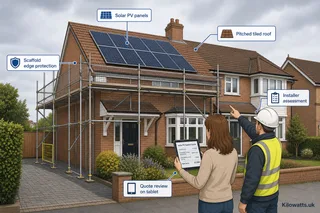
A proper quote should state the system size, number of panels, panel model, inverter model, battery model if included, warranties, estimated annual generation, shading assumptions, scaffolding, roof access, bird protection, monitoring, VAT treatment, and whether DNO work is included. If you are paying for the system yourself, it is worth using a home solar panel comparison route so the specification, not just the headline price, can be assessed.
Installer-level details can make a large difference. Slate roofs can take longer than concrete tile roofs. Flat roofs need mounting frames and wind-loading consideration. Old roofs may need repairs before panels are fitted. A consumer unit may need upgrading. Bird protection may be sensible in areas with nesting problems, but it should be priced clearly. For grid connection, small domestic systems often fall under G98 notification after installation, while larger systems or higher export capacity may need G99 approval before installation. The common single-phase export threshold is 3.68 kW per phase. Export limitation can allow a larger array while capping export, but it needs to be designed and documented properly. A good quote should also be clear about ownership and export rights. This is particularly important if the installation is marketed as “free”, discounted, landlord-funded, or third-party funded. You should know who owns the panels, who maintains them, who receives export payments, and what happens if you sell the property.
Proper installation and maintenance matter.
Solar grants and tariffs are only useful if the installation is safe, durable, and properly specified. Poor design or poor workmanship can reduce generation, delay export payments, invalidate warranties, cause roof issues, or create electrical safety problems.
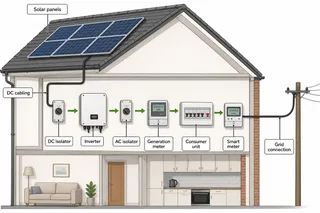
A suitable solar installation should normally include a roof condition check, shading assessment, structural and fixing considerations, inverter location planning, cable route planning, isolator placement, electrical testing, and DNO compliance. The installer should also explain whether the system is MCS-certified, whether Building Regulations notification is required, and what documents you will receive at handover.
Maintenance is usually modest, but it should not be ignored. Homeowners should monitor generation, check inverter or app alerts, keep warranty documents, and arrange investigation if output drops unexpectedly. Panels are often cleaned by rainfall, but heavy soiling, bird activity, nearby trees, or coastal exposure can make periodic inspection sensible. Do not climb onto a roof yourself to clean panels; use competent professionals with proper access equipment if work is needed. Key handover documents should include:
- MCS certificate or equivalent recognised certification where applicable.
- Electrical installation certificate.
- DNO notification or approval evidence where relevant.
- Product warranties for panels, inverter, battery, and mounting system.
- Workmanship warranty.
- Monitoring instructions.
Battery systems need particular care because they involve additional electrical equipment, software settings, warranties, ventilation and location requirements, and sometimes tariff integration. If a battery is included in a grant-funded or paid system, ask how it will be monitored, who supports it, and what happens if the inverter or battery app reports a fault. A well-installed system should be designed for the home, not just the grant criteria. The best outcome is a roof that remains watertight, an electrical system that is compliant, a customer who understands how to use the system, and clear paperwork for future warranty, export tariff, and property sale purposes. Emergency shutdown or isolation instructions. Maintenance guidance.
Solar support comparison for 2026.
Different support routes help different people. The chart below separates grant-style funding from tax relief and export payments, because they affect the project in different ways.
A low-income household in a poor-EPC off-gas home should usually check grant and council routes first. A typical homeowner who does not meet means-tested criteria should focus on system design, 0% VAT eligibility, SEG export options, and whether the property is technically suitable.
Warm Homes and local grants: Best for eligible low-income households where the council is running a relevant scheme. ECO-style support: Best for households meeting supplier obligation criteria, subject to current scheme status and property assessment. Social housing retrofit: Best for tenants whose landlord is delivering funded improvement works. Devolved schemes: Best for households in Scotland or Wales who need country-specific advice and funding checks. Northern Ireland support: Best checked through NI Direct and local advice routes because the landscape differs from Great Britain. 0% VAT relief: Best for eligible residential installations where the homeowner is paying for solar or battery work. The right route depends on circumstances. Two neighbouring homes can receive different answers because income, EPC rating, roof layout, heating type, tenure, and council funding can all differ. Smart Export Guarantee — Best for eligible installed systems exporting surplus electricity to the grid. Self-funded solar — Best for households that do not qualify for grants but have a suitable roof, good electricity use profile, and a clear quote. Historic FiT or ROC payments — Relevant only to already accredited legacy systems, not new 2026 applicants.
Closed schemes and common misconceptions.
Several older schemes still appear in search results, sales scripts, and forum discussions. They can cause confusion for anyone looking for solar grants in 2026.
The Feed-in Tariff closed to new applicants in 2019. Existing customers remain on their original arrangements, but new solar owners cannot apply for it. The Smart Export Guarantee is not the same scheme because it pays for exported electricity, not total generation.
Before the Feed-in Tariff became the best-known small-scale solar support scheme, the Renewables Obligation used Renewable Obligation Certificates, usually called ROCs, to support renewable generation. The Renewables Obligation was more commonly associated with larger-scale renewable electricity generation, although some smaller generators were historically accredited under it before later policy changes. It is not a current domestic solar panel grant and should not be presented as a route for new household solar installations in 2026. Existing accredited installations may still have legacy rights under their original arrangements, but that is different from a new homeowner applying for funding today. The Green Homes Grant voucher scheme closed in 2021. It should not be advertised as a current solar funding route. The Renewable Heat Incentive also closed to new applicants. The Boiler Upgrade Scheme supports eligible heat pumps and biomass boilers, not solar PV. GOV.UK explains the Boiler Upgrade Scheme at its official application page. Be cautious with phrases such as “government-backed free solar for everyone”. Sometimes they refer to means-tested retrofit funding. Sometimes they refer to finance products. Sometimes they are simply misleading. Always check the named scheme, eligibility criteria, installer accreditation, and whether you are being offered a grant, loan, lease, power purchase arrangement, or normal purchase. If a company uses old FiT, ROC, or Green Homes Grant language to justify a 2026 solar offer, ask them to identify the live legal scheme behind the claim. If they cannot, do not proceed until you have verified the offer independently.
Guidance for non-UK readers.
This article focuses on the United Kingdom. Solar incentives in other countries can work very differently, even where the language sounds similar.
If you are outside the UK, check:
National renewable energy grants or rebates. State, provincial, regional, or municipal incentives. Tax credits or tax deductions. Net metering or export tariff rules. Whether batteries qualify separately from solar panels. Local grid connection limits. Do not assume that UK rules such as 0% VAT, ECO4, Warm Homes funding, MCS certification, G98 or G99 grid connection processes, or the Smart Export Guarantee apply in your country. For overseas readers, the safest starting point is your official government energy department, electricity regulator, local grid company, and consumer protection body. Planning, permitting, and building code requirements. Approved installer or product certification schemes. Consumer protection rules for solar finance, leases, or power purchase agreements.
Practical next steps.
Start by identifying your route. If you are on a low income, receive benefits, live in a poor-EPC home, are off the gas grid, or struggle with energy bills, check your local council and the relevant national scheme pages first. If you are in social housing, ask your landlord or housing association whether your home is included in any retrofit programme.
If you are unlikely to qualify for a grant, look at the normal solar decision. Check roof condition, shading, orientation, electricity use, battery suitability, export tariff options, and whether you may add an EV or heat pump later. A self-funded system can still be sensible, but only if the design matches the property and usage. If your electrics need attention before installation, items such as residential fuse box upgrades should be priced into the decision rather than left until the end.
Before agreeing to anything, ask for written confirmation of the scheme name, whether funding is a grant or another arrangement, what you will pay, who owns the system, what happens to export payments, what warranties apply, and which accreditations the installer holds. Businesses looking at similar funding, VAT, and export issues should compare commercial solar options separately because the design, metering, and usage profile can be very different from a home. The best 2026 answer is therefore realistic rather than headline-grabbing: solar grants exist, but they are targeted. Most households should check eligibility, avoid “free solar” assumptions, and compare the grant route with a properly specified paid installation using VAT relief, export payments, safe installation, and proper maintenance.
Plan, Compare & Buy Renewable Energy Solutions
AI does the thinking.
You get the perfect solar match.
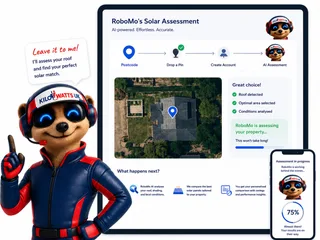
Use RoboMo™ to assess your property, compare available technologies and connect with trusted UK installers, suppliers and manufacturers.
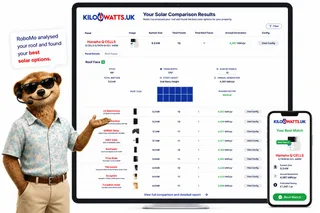
Simply enter your postcode, drop a pin on your roof, create your free account and let RoboMo™ analyse your property to find the best solar panels for your home.

You don't have to think
RoboMo™'s AI analyses your roof and does all the hard work.

Accurate & tailored
AI-powered assessment based on your roof, location, and conditions.

Best options, maximum savings
Compare top solar panels for the best performance and value.

Simple, fast & effortless
Provide a few details, sit back and watch your results unfold.
STEP 1
Choose Home, Business or Industrial
Enter your postcode to start your assessment.
STEP 2

Drop a pin on your roof
STEP 3

Create your free account
STEP 4

Sit back and watch RoboMo™ work
RoboMo™ analyses your roof and builds your personalised solar comparison.

Step 1
Enter your postcode
Start designing your wind energy system in seconds.
Are you an installer, distributor or renewable energy business?
Kilowatts UK is expanding the Flower Turbines partner network across the UK.
Become A Flower Turbines PartnerKilowatts UK is an authorised representative
Flower Turbines
Compact vertical-axis turbines built for real UK sites, not just open farmland.
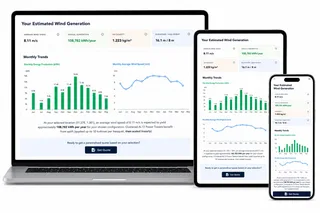
They start in light wind, sit in a small footprint, and are bird-safe by design. Cluster them as a bouquet and the group performs better together than the same turbines standing alone. Enter your postcode for a location-based generation estimate. Figures use area weather data and will differ if buildings, trees or hills sit in the way.
Starts in light UK wind
Built to generate in typical UK wind, not only open farmland.
Small rooftop or ground footprint
Compact towers for roofs, yards and tight sites.
Bird-safe slow rotation
Slow vertical-axis spin, bird-safe by design.
Bouquet clusters raise output
Grouped turbines outperform the same units standing alone.
STEP 2

Choose a location
STEP 3

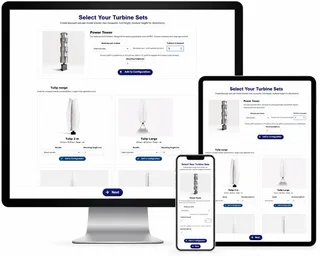
Place your cluster
Tap the map where you want the turbine cluster to go.
STEP 4

Instant generation forecasts
Compare different turbine layouts and see annual generation forecasts instantly.
STEP 5

No commitment required
Explore different configurations before deciding whether to request a quotation.
Related articles
Mo's Mission Nominations
FAQ
Need Help? RoboMo's Got Answers
Is there a UK Government solar panel grant for everyone in 2026?
No. In 2026 there is no single universal UK Government grant that gives every homeowner free solar panels. Solar PV support is mainly available through targeted schemes for low-income households, fuel-poor homes, vulnerable households, social housing retrofit projects, and selected local authority programmes. Eligibility usually depends on income, benefits, EPC rating, property type, heating system, tenure, postcode, local funding availability, and whether the roof and electrical system are suitable.
What solar grants are available in the UK in 2026?
The main routes to check are ECO4 or any successor obligation scheme, ECO4 Flex where still available, Warm Homes local schemes in England, social housing retrofit funding, Home Energy Scotland support, Welsh Government Nest and Warm Homes support, and local authority programmes. Solar PV may be included where it fits the scheme rules and the property assessment, but it is not guaranteed. VAT relief, Smart Export Guarantee payments, loans, and group-buying schemes can reduce costs or improve payback, but they are not the same as upfront grants.
Can ECO4 pay for solar panels?
ECO4 can support solar PV in some cases, but it is not an automatic free solar scheme. ECO4 is designed to improve the energy performance of eligible homes and may fund measures such as insulation, heating upgrades, heating controls, ventilation, and microgeneration. Solar panels are more likely to be considered where they help meet the required improvement for the property, particularly in some electrically heated homes, but the final package depends on assessment, scheme rules, installer approval, and current scheme status.
Is ECO4 still available in 2026?
ECO4 was scheduled to run until 31 March 2026, so households checking later in 2026 should confirm whether it has ended, been extended, replaced, or is still being delivered through existing obligations. The safest approach is to check the current GOV.UK, Ofgem, energy supplier, and local authority guidance before relying on an advert or salesperson. If ECO4 is no longer open in your area, there may still be other local or devolved retrofit schemes to check.
What is ECO4 Flex?
ECO4 Flex is a route that allows local authorities to refer households that may not receive qualifying benefits but are still low income, vulnerable, or at risk of fuel poverty. Each participating council sets local criteria through a Statement of Intent. A referral can help with eligibility, but it does not guarantee solar panels because the property still needs technical assessment and the delivery partner must approve the proposed package of works.
Can I get solar panels through the Warm Homes scheme?
Possibly, depending on where you live, your household circumstances, the EPC rating of the property, and the local scheme design. Warm Homes local funding in England is aimed at improving low-income, poorly performing homes, and solar PV may be included where suitable. However, assessors may prioritise insulation, ventilation, heating controls, low-carbon heating, or other upgrades before solar panels if those measures deliver a better whole-house improvement.
Are social housing tenants eligible for solar grants?
Social housing tenants usually access solar support through landlord-led retrofit programmes rather than by applying for an individual solar grant themselves. Councils and housing associations may receive funding to improve groups of homes, and solar PV can be included where it forms part of the approved retrofit plan. Tenants should ask their landlord whether their property is included in any current or planned energy-efficiency programme and how electricity use, maintenance, and export payments will be handled.
Can private renters get solar panel funding?
Private renters may be eligible under some schemes, but landlord consent is essential. A tenant normally cannot approve roof works, electrical alterations, scaffolding, or long-term maintenance responsibilities without the property owner’s agreement. Some schemes also have specific rules for privately rented homes, including minimum EPC requirements, landlord contribution rules, and limits on what measures can be installed.
Are leaseholders and flats eligible for solar grants?
Leaseholders and flats can be more complicated than standard freehold houses. Roof ownership, freeholder consent, management company approval, shared roof space, fire safety, metering, electrical supplies, service charges, and planning restrictions can all affect whether solar PV is possible. Grant funding does not remove the need for legal, technical, and building consent checks.
Are VAT relief and the Smart Export Guarantee solar grants?
No. VAT relief can reduce the installed cost of qualifying residential solar panels and batteries, but it is normally applied through the installer’s quote rather than paid to you as a grant. The Smart Export Guarantee pays eligible households for electricity exported to the grid after installation, but it does not reduce the upfront installation cost. Both can improve the financial case for solar, but neither is an upfront grant.
How does 0% VAT help with solar panels?
Eligible residential solar panel installations can benefit from 0% VAT on qualifying energy-saving materials, which can reduce the upfront price compared with standard VAT treatment. The temporary zero rate is scheduled to run until 31 March 2027, with the rate expected to return to 5% from April 2027 unless policy changes. VAT treatment should be shown clearly on quotes, especially where batteries, scaffolding, electrical work, or additional upgrades are included.
How does the Smart Export Guarantee work?
The Smart Export Guarantee pays eligible customers for surplus electricity exported to the grid. It applies after the solar PV system is installed and exporting, so it is an income stream rather than a grant towards the purchase price. To qualify, you usually need suitable metering, a supplier offering an export tariff, and an installation that is MCS-certified or certified to an equivalent recognised standard. Export rates vary by supplier, so it is worth comparing tariffs.
Who is most likely to qualify for solar panel funding?
Households are more likely to qualify where they have low income, receive qualifying benefits, live in a home with a poor EPC rating, use electric heating, are off the gas grid, or are identified as vulnerable or fuel poor. Private renters may need landlord consent, and social housing tenants usually depend on their landlord’s retrofit programme. Even if the household qualifies, the roof, electrics, metering, and property permissions must also be suitable.
Who is less likely to qualify for a solar grant?
Households on higher incomes are less likely to qualify for grant-funded solar unless there is a local scheme with broader criteria. Homes that already have a good EPC rating are also less likely to be targeted because public funding normally focuses on poorer-performing properties. A grant may also be unlikely where the roof is unsuitable, the home needs major roof repairs, shading is severe, or the customer wants a cash payment rather than installed energy-efficiency measures.
What documents might I need for a solar grant application?
You may need proof of benefits, income evidence, council tax details, an EPC, tenancy documents, landlord consent, proof of ownership, and sometimes evidence of health vulnerability or fuel poverty. Requirements vary by scheme, council, and delivery partner. If the property does not have a current EPC, an assessment may be needed because many schemes target homes with lower EPC ratings.
Can I get free solar panels if my roof is suitable?
Not necessarily. Roof suitability is only one part of the process. Grant eligibility also depends on household circumstances, scheme availability, EPC rating, tenure, local funding rules, and the outcome of a whole-home assessment. A suitable roof may make solar technically possible, but it does not create an automatic entitlement to funding.
What makes a property suitable for solar panels?
A proper survey should check roof direction, pitch, shading, roof condition, available roof space, rafter strength, roof covering, loft access, cable routes, inverter location, consumer unit condition, earthing, and meter setup. South-facing roofs often generate the most electricity, while east-west roofs can also work well. Heavy shading, poor roof condition, complex access, asbestos, unsuitable electrics, or limited roof space can reduce suitability or increase costs.
Do solar grant installations need to be MCS-certified?
Many grants and export tariffs require an MCS-certified installation or equivalent recognised evidence. MCS certification is also commonly needed when applying for Smart Export Guarantee payments. A reputable installer or scheme provider should clearly explain certification, grid connection, handover documents, warranties, electrical certificates, and any DNO notification or approval requirements.
Will I need planning permission for grant-funded solar panels?
Many domestic roof-mounted solar panel installations fall under permitted development rights, but not all. Listed buildings, conservation areas, flats, leasehold properties, and homes with unusual roof arrangements may need extra consent. Freeholder, management company, or landlord approval may also be required. Grant funding does not remove planning, building regulation, grid connection, or property consent requirements.
What grid connection checks are needed for solar panels?
The installer should check whether the system can be connected under the correct distribution network operator process. Smaller domestic systems are often notified under G98 after installation, while larger systems or higher export capacity may need G99 approval before installation. Export limitation can sometimes allow a larger solar array while capping exported power, but it must be designed, installed, and documented properly.
Are there solar grants in Scotland, Wales, and Northern Ireland?
Scotland, Wales, and Northern Ireland have different support routes, so the answer depends on where the property is. Scotland has Home Energy Scotland advice and funding routes, but solar PV support may be loan-based rather than grant-based depending on current rules. Wales has Nest and Warm Homes support, with measures decided after assessment. Northern Ireland has a different support landscape, with household energy efficiency funding more commonly focused on heating and insulation than general solar PV grants.
Are the Feed-in Tariff and Green Homes Grant still available?
No. The Feed-in Tariff closed to new applicants in 2019, although existing accredited systems may still receive payments under their original terms. The Green Homes Grant voucher scheme closed in 2021 and is not a current solar funding route. Older Renewable Obligation Certificate arrangements are also not a new domestic solar grant for 2026 applicants. Be cautious if a company uses closed schemes to promote a current solar offer.
Can a solar battery be funded through a grant?
Sometimes, but it depends on the scheme and the property assessment. Some retrofit programmes may include battery storage where it supports the overall energy plan, but many schemes focus first on insulation, heating, ventilation, and solar PV. For self-funded installations, batteries may benefit from eligible VAT treatment, but they add cost and should be assessed against household electricity use, solar generation, tariff options, and likely payback.
How can I avoid misleading free solar adverts?
Ask for the exact scheme name in writing and check whether the offer is a true grant, a loan, a lease, a rent-a-roof arrangement, a power purchase agreement, supplier obligation funding, or a normal paid installation. Be wary of claims that everyone qualifies, that funding is guaranteed without an EPC or income check, or that you must sign immediately. Genuine funded retrofit usually involves eligibility checks, property assessment, written documents, approved installers, and clear ownership and maintenance terms.
What should a good solar quote include?
A good quote should state the system size, number of panels, panel model, inverter model, battery model if included, warranties, estimated annual generation, shading assumptions, scaffolding, roof access, bird protection, monitoring, VAT treatment, and whether DNO work is included. It should also explain who owns the system, who receives export payments, what maintenance is required, and what happens if you sell the property. Cheap quotes can be poor value if they omit access costs, electrical upgrades, certification, or realistic generation assumptions.
What handover documents should I receive after installation?
You should receive clear handover documents including an MCS certificate or equivalent recognised certification where applicable, electrical installation certification, DNO notification or approval evidence where relevant, product warranties, workmanship warranty, monitoring instructions, maintenance guidance, and emergency isolation information. These documents matter for warranty claims, export tariff applications, future servicing, and selling the property.
How should I check whether I qualify for solar support?
Start by checking the official scheme routes for your nation, then check your council’s website for ECO4 Flex, Warm Homes, or other local delivery. Find your EPC rating, confirm whether you own the property or need landlord consent, gather income or benefits evidence, and arrange a proper technical survey. Be cautious of adverts promising guaranteed free solar panels before checking your household eligibility, property suitability, installer credentials, and the exact funding terms.