


UK Home Battery Size Calculator: Debunking the Myth
Published: 2026-07-25 16:49:16
Updated: 2026-08-12 03:29:44
Discover how to choose the right battery for your UK home and unlock the benefits of renewable energy.
What size home battery do I need in the UK?
For many UK homes, the right battery size is the amount of electricity you can realistically shift, not your total daily use. Start by estimating your regular evening and overnight demand. Then compare it with your surplus solar generation, or with the energy you can charge during a cheaper off-peak period. The sensible size is usually limited by the smallest of those figures, then adjusted for usable capacity, inverter power, tariff and installation constraints.
A home battery size calculator should ask when you import, export and use electricity. A household using 10 kWh a day does not automatically need a 10 kWh battery. If most use happens while solar panels are generating, a large battery may sit underused. If most use happens after sunset, a larger usable capacity may be justified.
Use any calculator result as a starting range, not a final specification. Before buying, an installer should check your smart meter data, solar export, inverter limits, usable rather than nominal capacity, DNO process, battery location and whether backup power is part of the design.
The battery sizing myth that causes overspending.
The common myth is simple: a home using 10 kWh a day needs a 10 kWh battery. In real projects, that assumption is often wrong because a battery does not serve the whole day equally. It stores electricity from one period and releases it in another, so the timing of use is the key design factor.
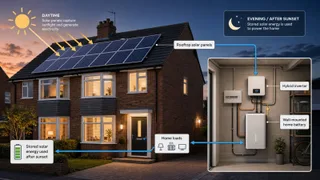
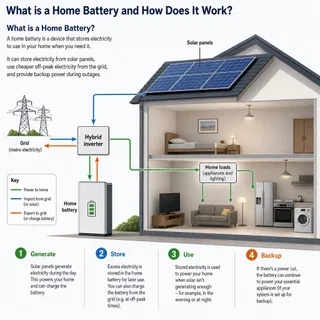
A battery is useful only when there is energy available to charge it and a later load that can use that stored energy. For a solar home, the charging source is often exported daytime generation that would otherwise leave the property. For a home without solar, it may be cheaper off-peak grid electricity, if the tariff, inverter and battery settings allow that strategy.
Capacity and power are separate. Capacity, measured in kWh, tells you how much energy the battery can store. Power, measured in kW, tells you how much load it can support at one time. A battery can have enough capacity for the evening but still be limited if several high-load appliances run together.
Quick home battery size estimator.
A practical first estimate is to size the battery around shiftable energy. The target usable capacity is usually the lower of your regular evening or overnight import, your regular solar export, or the energy the system can charge during the available off-peak window. If you are using both solar and off-peak charging, calculate each case separately, then discuss the combined operating strategy with an installer.
The basic method is not a savings calculation. It helps you avoid obvious over-sizing or under-sizing before you compare quotes. Financial modelling still needs tariff details, export payments, system cost, battery degradation assumptions, round-trip losses and how often the battery is likely to cycle. For wider budget context, use a battery cost guide alongside the sizing estimate.
Use this simple worksheet:
Step one
Find your typical evening and overnight import from half-hourly smart meter data.Step six
Allow for round-trip efficiency when modelling savings, because not every kWh charged into a battery is returned as usable household electricity.Step two
Find your regular surplus solar export or off-peak charging opportunity.Step five
If a quote gives nominal capacity, ask the installer to confirm usable capacity from the manufacturer datasheet.Step four
Check whether the proposed inverter can charge the battery in the available time.Step three
Take the lower of those figures as your initial target usable capacity.
For example, if a household regularly imports 6 kWh after sunset but only exports 4 kWh of solar on many suitable days, a starting target of around 4 kWh usable capacity is more logical than matching the full 6 kWh load. If the same household can also charge from an off-peak tariff, the calculation changes, but only if the tariff and hardware are set up to use that stored energy reliably.
Worked UK examples using the estimator.
The examples below are deliberately simple. They are not promises of savings and they are not product recommendations. Their purpose is to show why the same annual electricity use can lead to different battery sizes once timing, solar export and off-peak charging are considered. In a real design, the figures would come from half-hourly smart meter data, inverter monitoring, export readings and manufacturer datasheets. An installer should also check whether future changes, such as an EV charger or heat pump, will alter the load profile enough to affect the battery recommendation.
| Example household | Main sizing assumption | What the estimator suggests | Important caveat |
|---|---|---|---|
| Solar-only three-bedroom home | Evening import is higher than regular solar export. | Start near the regular export figure, not total daily use. | A larger battery may not fill often in darker months. |
| Solar home with an EV | The EV can dominate demand but may charge separately. | Size the home battery for household loads unless the design specifically includes EV charging strategy. | A domestic battery is not usually sized just to refill an EV. |
| Off-peak tariff household | The battery can charge during a cheaper period and discharge later. | Start with the lower of later household demand and what the inverter can charge in the window. | Tariff terms, losses and future price changes affect value. |
| Heat pump household | Electrical demand may be higher in colder weather. | Use seasonal data rather than a summer average. | Winter solar may be limited when heat demand is highest. |
Overview
A useful design conversation starts when the installer can explain why the recommended size differs from this rough estimate. The reason may be modular battery increments, usable capacity, inverter limits, tariff settings, backup requirements or plans for later expansion.
What data a good calculator should use.
A calculator based only on annual consumption is too blunt for battery sizing. Annual use hides the shape of the day, and battery value depends on that shape. Two households can use the same annual kWh but need very different batteries if one has a steady daytime load and the other has a sharp evening peak. Smart meter half-hourly data is usually the best starting point for import patterns. If you have solar PV, inverter monitoring and export data are just as important. A battery has to be charged by something, so the available surplus matters as much as the household demand you want to cover. A good calculator or installer assessment should also ask about the property and equipment. Location, cable routes, consumer unit space, inverter type, backup expectations, tariff settings and future electrification plans can all change the suitable home battery storage design.
| Sizing input | Why it matters | What to check before choosing |
|---|---|---|
| Evening and overnight demand | This is often the load the battery is expected to cover. | Half-hourly import data from your smart meter. |
| Solar export | Exported solar is the energy most likely to be stored instead. | Inverter portal, generation meter or export readings. |
| Usable capacity | This is the capacity you can actually use day to day. | Product datasheet and installer proposal wording. |
| Charge power | This affects whether the battery can fill during a solar peak or off-peak window. | Battery inverter rating and system settings. |
| Discharge power | This affects how many loads the battery can support at once. | Inverter output and appliance demand. |
| Tariff structure | Import and export prices affect whether storing energy is worthwhile. | Current tariff terms and off-peak periods. |
| Site constraints | Location can affect product choice, cable routes and labour. | Wall strength, access, temperature, clearances and consumer unit space. |
| Future changes | EVs, heat pumps and home working can change the load profile. | Planned upgrades and likely usage patterns. |
Overview
The best inputs are real readings from your own home. Where data is missing, a calculator can still help, but the result should be treated as provisional.
Usable capacity matters more than headline capacity.
Battery quotes can be confusing because the headline capacity is not always the same as the usable capacity. The nominal capacity is the broad size of the battery pack. Usable capacity is the amount the system allows you to access in normal operation. Manufacturers may reserve part of the battery to protect its long-term operation.
This distinction matters when comparing quotes. A product described with a larger headline figure may not provide proportionally more usable energy than another system. The proposal should state the usable capacity clearly, or at least provide the manufacturer datasheet so the figure can be checked.
Round-trip efficiency is a separate issue. If you charge a battery from solar or the grid, some energy is lost during conversion and storage. That does not necessarily make the battery unsuitable, but it means savings should be modelled using realistic delivered energy rather than assuming every kWh charged comes back unchanged.
Why inverter power can change the right answer.
The kWh figure tells only part of the story. A battery also needs enough charge power to fill when energy is available and enough discharge power to support the loads you expect. This is where many simple calculator estimates become too optimistic.
For solar charging, the battery and inverter must be able to absorb surplus generation at the right time. For off-peak charging, the system must be able to charge sufficiently within the tariff window. For discharge, the inverter must support the household loads without constant grid import during peaks.
High-load appliances need care. Ovens, electric showers, EV chargers and some heating equipment can draw more power than a domestic battery inverter is intended to cover. The design should distinguish between reducing grid import over an evening and running every appliance from the battery at once.
When a smaller battery is the better choice.
A smaller battery can be the right choice when evening use is modest, solar export is limited or the home already consumes much of its solar generation during the day. In those cases, extra capacity may not cycle often enough to justify the added cost and space.
This is common in homes where someone is at home during daylight hours, appliances are already timed around solar generation, the PV system is small, or the roof is shaded. The battery may still help, but the useful capacity should be based on the energy actually available to store.
Smaller systems may also be simpler to site, although installation still needs proper checks. Batteries require suitable mounting, access, clearances, cable routes and manufacturer-approved environmental conditions. A convenient-looking location is not necessarily a suitable one.
A smaller battery is not a compromise if it matches the load profile. It can be the more accurate design.
When a larger battery may make sense.
A larger battery may be sensible where there is a strong charging source and meaningful later demand. Larger PV arrays, regular daytime export, high evening use and suitable time-of-use tariffs can all support more storage, provided the inverter and installation design match the intended use.
Homes with heat pumps, EVs, electric hot water or higher occupancy may have larger and more variable electrical loads. Even then, a bigger battery is not automatically better. The system should be sized around the loads the battery is actually expected to support, rather than assuming all future electricity use should pass through the battery.
Larger batteries can also trigger more design questions. The installer may need to consider AC-coupled versus hybrid design, consumer unit capacity, export control, physical siting, manufacturer clearances and the correct DNO process for the proposed inverter arrangement.
Backup requirement
More capacity can extend backup duration, but only if the system is designed for backup operation.Regular solar export
More storage can be useful if daytime generation is often being exported and evening import remains high.Future electrification
A planned heat pump or EV may change demand, but the expected operating pattern should be modelled rather than guessed.Off-peak charging strategy
Larger capacity may make sense if the tariff window and inverter power allow reliable charging before peak periods.
A larger battery should come with a clear explanation of how often it is expected to charge and discharge. If that explanation is missing, the extra capacity may be speculative.
Solar battery, grid-charged battery or both.
Most UK homeowners first consider batteries alongside solar PV, but a battery can also be charged from the grid where the system and tariff support it. The best approach depends on whether the aim is to store spare solar, shift off-peak electricity, provide backup capability or combine several goals.
For a new solar installation, a hybrid inverter may integrate panels and battery within one design. For an existing solar home, an AC-coupled battery may be considered because it can often be added without replacing the original solar inverter, subject to compatibility and design checks. Neither approach is always better, and adding a battery should still be assessed against the existing PV system.
Export tariffs matter as well. If exported solar has a reasonable value, storing every spare unit may not always produce the best financial result. If evening import is much more expensive than export value, storage may be more attractive. This is why sizing should be linked to tariff modelling rather than a fixed kWh rule.
Backup power is a separate specification.
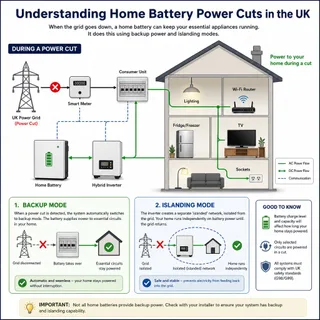
A home battery does not automatically keep the whole property running during a power cut. Backup operation normally requires compatible equipment, correct wiring and a decision about which circuits will be supported. It should be specified at the start, not assumed after the quote is accepted.
Some battery systems are intended only for normal grid-connected operation. Others can support selected backup loads, usually within defined power limits and installation requirements. Backup design can affect consumer unit work, earthing arrangements, changeover equipment, location and the final cost.
Be realistic about what backup means. Keeping lights, broadband and refrigeration running is very different from running an EV charger, electric shower or several cooking appliances during a power cut. Capacity affects how long loads can run, but discharge power and backup wiring decide what can run at all.
UK rules and source notes installers should understand.
Grid-connected batteries and inverters interact with the local electricity network, so they are not treated like ordinary plug-in appliances. The installer should handle the correct DNO notification or application route for the proposed system. In the UK, this commonly involves Engineering Recommendation G98 or G99 processes, depending on the inverter arrangement and capacity.
The homeowner does not need to become a network engineer, but the quote should make the route clear. If export limitation is proposed, the installer should explain how it will be configured and monitored. If the battery is being added to existing solar PV, the combined inverter arrangement needs to be considered rather than looking at the battery in isolation.
Trustworthy sizing relies on manufacturer datasheets and current guidance rather than generic claims. Usable capacity, charge and discharge power, operating temperature range, installation clearances, warranty conditions and backup capability should all be checked against the specific product being quoted.
DNO process
The installer should confirm whether the proposed system follows the relevant G98 or G99 route.MCS context
Where solar PV and battery work form part of an MCS installation, the installer should explain what is covered and what documentation you will receive.Tariff terms
Import and export rates, off-peak windows and eligibility rules affect the value of battery operation.Smart meter data
Half-hourly readings give a much better sizing basis than annual consumption alone.Manufacturer datasheets
The usable capacity, power limits and installation conditions should be taken from the actual product documentation.
Rules, tariffs and product specifications can change, so avoid relying on old assumptions. Ask the installer to confirm the current requirements for your system at the time of quotation.
What installers should check before confirming size.
A good installer should not size a battery from a quick phone call and an annual kWh figure alone. They should ask about your present electricity use, solar generation if installed, export behaviour, tariff, future plans and the physical installation space. If you are planning an EV charger, heat pump or electric hot water system, that should be part of the design discussion.
They should also explain the chosen inverter arrangement. AC-coupled systems, hybrid inverters and modular battery stacks can all be suitable in the right setting, but each has different implications for compatibility, monitoring, charging behaviour and future expansion.
The proposal should be clear enough that you can compare it with another quote. If two installers recommend different capacities, the explanation should be visible in the assumptions, not hidden behind product names.
DNO handling
The installer should explain the notification or application process for the proposed system.Power limits
The charge and discharge ratings should match the intended operating strategy.Backup status
The quote should say whether backup is included, excluded or available as an additional design option.Capacity basis
The quote should identify usable capacity rather than relying only on nominal capacity.Usage evidence
The recommendation should refer to smart meter data, solar monitoring or clearly stated assumptions.Installation constraints
The proposed location should meet manufacturer requirements and practical access needs.
A proposal that cannot explain why a size has been chosen is not ready for a like-for-like comparison.
Common sizing mistakes to avoid.
The biggest mistake is buying capacity that looks impressive but does not match the home’s daily rhythm. A battery that is too small may leave useful solar export unused or fail to cover the evening period. A battery that is too large may cost more while spending too much time partly full or partly unused.
Another common mistake is ignoring inverter power. If the system cannot charge quickly enough during a short cheap-rate window, or cannot discharge fast enough to cover the loads you expect, the headline kWh figure will not deliver the result you had in mind.
Winter performance is also often misunderstood. Solar generation is seasonal, and the months with the highest electrical demand may not be the months with the most surplus solar. That does not make batteries unsuitable, but it does mean summer export patterns should not be treated as year-round evidence.
These mistakes are avoidable if you ask for the assumptions behind the recommendation. A quote should explain what the battery is expected to do on a normal day.
How to compare quotes using a calculator result.
A calculator result is most useful as a benchmark. If one quote suggests a much larger or smaller battery than your estimate, it is not automatically wrong, but the installer should be able to explain the difference. Valid reasons can include modular battery sizes, usable capacity, inverter limits, backup requirements, tariff strategy or future load changes.
Look beyond the biggest kWh number. A good proposal should connect the recommended size to your usage data and goals. It should also make clear what is excluded, such as backup operation, consumer unit upgrades, extra monitoring equipment, export control devices or later expansion.
If your data is incomplete, gather it before committing. Download smart meter readings where available, review solar export data if you already have PV, and note any planned changes such as working from home, replacing gas heating with a heat pump or adding an EV.
The best quote is not always the largest battery or the lowest price. It is the design with the clearest evidence behind it.
The sensible next step.
The best UK home battery size is the one that matches your usable surplus, evening or off-peak demand, tariff and installation limits. A calculator can narrow the range, but final sizing should be justified with real data and the actual equipment being proposed.
Before accepting a quote, ask the installer to show the assumed usable capacity, expected charging source, inverter power, backup status, tariff strategy and DNO process. If the battery is part of a new PV project, it can help to compare home solar options before deciding how much storage to include.
Use the estimator to prepare better questions, then test the result against your smart meter data, solar export, product datasheets and site constraints.
Plan, Compare & Buy Renewable Energy Solutions
AI does the thinking.
You get the perfect solar match.
Use RoboMo™ to assess your property, compare available technologies and connect with trusted UK installers, suppliers and manufacturers.
Simply enter your postcode, drop a pin on your roof, create your free account and let RoboMo™ analyse your property to find the best solar panels for your home.

You don't have to think
RoboMo™'s AI analyses your roof and does all the hard work.

Accurate & tailored
AI-powered assessment based on your roof, location, and conditions.

Best options, maximum savings
Compare top solar panels for the best performance and value.

Simple, fast & effortless
Provide a few details, sit back and watch your results unfold.
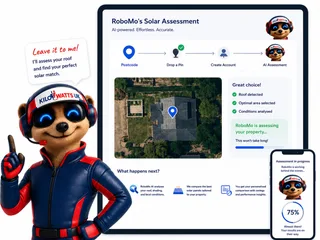
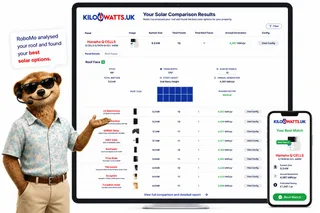
STEP 1
Choose Home, Business or Industrial
Enter your postcode to start your assessment.
STEP 2

Drop a pin on your roof
STEP 3

Create your free account
STEP 4

Sit back and watch RoboMo™ work
RoboMo™ analyses your roof and builds your personalised solar comparison.

Kilowatts UK is an authorised representative
Flower Turbines
Compact vertical-axis turbines built for real UK sites, not just open farmland.
They start in light wind, sit in a small footprint, and are bird-safe by design. Cluster them as a bouquet and the group performs better together than the same turbines standing alone. Enter your postcode for a location-based generation estimate. Figures use area weather data and will differ if buildings, trees or hills sit in the way.
Starts in light UK wind
Built to generate in typical UK wind, not only open farmland.
Small rooftop or ground footprint
Compact towers for roofs, yards and tight sites.
Bird-safe slow rotation
Slow vertical-axis spin, bird-safe by design.
Bouquet clusters raise output
Grouped turbines outperform the same units standing alone.
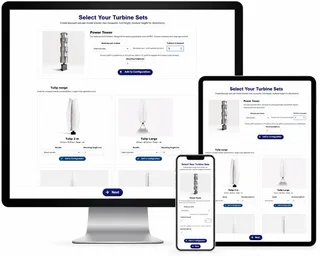
Step 1
Enter your postcode
Start designing your wind energy system in seconds.
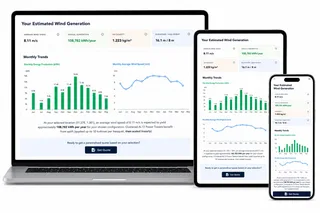
STEP 2

Choose a location
STEP 3

Place your cluster
Tap the map where you want the turbine cluster to go.
STEP 4

Instant generation forecasts
Compare different turbine layouts and see annual generation forecasts instantly.
STEP 5

No commitment required
Explore different configurations before deciding whether to request a quotation.
Related articles
Mo's Mission Nominations
FAQ
Need Help? RoboMo's Got Answers
What size home battery do I need in the UK?
For many UK homes, the right battery size is not about your total daily energy use, but about how much electricity you can realistically shift. Start by estimating your regular evening and overnight demand. Then compare it with your surplus solar generation or off-peak charging opportunity.
Is the common myth of '1 kWh per day' correct?
No, this assumption is often wrong because a battery does not serve the whole day equally. It stores electricity from one period and releases it in another, so the timing of use is the key design factor.
How do I size my home battery?
A practical first estimate is to size your battery around shiftable energy. The target usable capacity is usually the lower of your regular evening or overnight import, your regular solar export, or the energy the system can charge during an available off-peak window.
Why should I consider a smaller home battery?
A smaller battery may be suitable if your evening use is modest, solar export is limited, or you already consume much of your solar generation during the day. A smaller system can also be simpler to site and require less installation effort.
When might a larger home battery make sense?
A larger battery may be sensible where there is a strong charging source and meaningful later demand. This could include homes with heat pumps, EVs, electric hot water or higher occupancy.
Why does usable capacity matter more than headline capacity?
Usable capacity matters because the nominal capacity of a battery is not always the same as the amount you can actually use day to day. Manufacturers may reserve part of the battery to protect its long-term operation.
What data should my home battery calculator use?
A good calculator or installer assessment should ask about your household's energy consumption patterns, roof size and orientation (if you have solar panels), local energy storage regulations, and the timing of your energy use.
Why is inverter power important for home battery sizing?
Inverter power affects how much charge power a battery needs to fill when energy is available, as well as how much discharge power it can support to cover household loads. High-load appliances need care, and the design should distinguish between reducing grid import over an evening and running every appliance from the battery at once.