


How to choose the right battery size
Published: 2026-09-22 19:59:54
Updated: 2026-09-24 09:15:11
Choose a battery size by matching usable capacity to the electricity you can realistically store and use on a normal day.
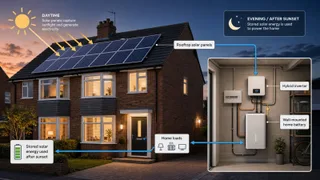
How to choose the right battery size?
Understand how to choose the right battery size in the UK, with clear explanations, examples, and practical next steps.
How to choose the right battery size
Choose a battery size by matching usable capacity to the electricity you can realistically store and use on a normal day. In a UK home, the main factors are evening and overnight demand, solar surplus, off-peak tariff windows, usable rather than nominal kWh, discharge power, backup expectations and installation limits. If you are still comparing the basics, start with a broader home battery storage guide before looking at specific capacities.
A bigger battery is not automatically better. If it rarely fills, or still has plenty of charge every morning, some capacity is not doing useful work. If it empties early most evenings, the battery may be too small for your demand pattern, or it may need a different tariff and control strategy.
Battery capacity is measured in kilowatt hours, or kWh. Battery power is measured in kilowatts, or kW. Capacity affects how long the battery can supply energy. Power affects how many appliances it can support at the same time. A battery can have enough kWh for the evening but still import from the grid when several high-load appliances run together.
Start with half-hourly electricity data
Annual electricity use is useful background, but it is too blunt for battery sizing. Two homes can use the same yearly kWh and need very different batteries if one uses most electricity after sunset and the other uses it during the day.
Start with half-hourly smart meter data, an energy supplier app export, a solar monitoring app, or several weeks of readings showing when you import from the grid. You are trying to find the demand a battery could realistically cover, not the total amount of electricity the home uses. For a worked UK sizing overview, see this battery sizing guide.
For a solar household, the practical question is how much grid import happens after the panels have stopped contributing, or during periods when stored solar could have displaced paid-for electricity. For a non-solar household using a time-of-use tariff, the question is how much peak-rate demand could be shifted into a cheaper charging window. Look first at evening and overnight import, as this is the load many batteries are expected to cover. Then consider whether the home is occupied during the day, as direct solar use can leave less surplus for storage. Seasonal variation matters too: winter demand can rise while solar generation falls, so a battery sized around summer surplus may disappoint. Flexible appliances should also be separated from core household demand. Washing machines, dishwashers, immersion heaters and EV charging may be better scheduled than supplied by a larger battery. Large electrical loads such as heat pumps, ovens, electric showers and EV chargers can also exceed the useful output of many domestic battery systems.
Use a simple sizing calculation
A practical first calculation is to estimate your average evening and overnight import, then compare it with the battery’s usable capacity. Do this over several typical days rather than choosing one unusually sunny, cold or busy day.
For example, if your smart meter data shows that you often import around 6 kWh between late afternoon and the next morning, a usable capacity around that level may be worth investigating. If the battery you are considering has a larger nominal figure but a smaller usable figure, use the usable figure in the calculation. Allow for conversion losses, because not every kWh charged into the battery comes back as useful electricity.
The same method can be used for time-of-use charging. If you normally import a chunk of electricity during expensive evening hours, the useful battery size is linked to that avoidable peak import, the length of the cheap-rate charging window and the battery’s charge power.
This is only a first-pass method, not a final design. A good installer should also look at roof generation, tariffs, inverter limits, export settings, backup requirements, location constraints and planned future loads.
Think in size bands, not exact rules
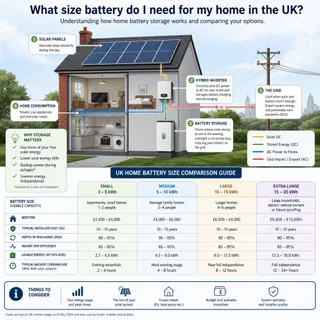
There is no universal domestic battery size because household patterns vary too much. Broad size bands can still help you understand what an installer is proposing before you get into individual brands and models. Smaller batteries are often considered where evening use is modest, solar surplus is limited, or the homeowner wants a cautious first step. Mid-sized systems are common where there is regular evening demand and enough PV surplus or off-peak charging opportunity to use the capacity often. Larger batteries tend to make more sense where there is higher overnight use, larger PV generation, a heat pump, strong time-of-use tariff use, or a specific backup aim. Treat these bands as a conversation starter, not a design standard. Half-hourly data and product specifications should override any rule of thumb.
Overview
The right choice is the one that is used regularly without depending on perfect summer conditions. If a quote is based only on “largest affordable battery” or “one standard package for every home”, ask for the sizing logic.
Match the battery to your solar surplus
If you have solar PV, the battery should usually be sized around the surplus electricity your panels can generate and your home can later use. A large battery connected to a small, shaded or poorly oriented array may look attractive in summer but sit underused through much of the year.
Installers normally look at PV array size, roof orientation, shading, inverter arrangement and export behaviour. A clear south-facing roof with strong summer output creates a different sizing case from an east-west roof with steadier generation, or a shaded roof where surplus arrives in short bursts. If the battery is being planned alongside panels, it can help to compare home solar options before settling on the storage size.
Export tariffs also matter. Under the Smart Export Guarantee and other export arrangements, you may be paid for electricity sent to the grid. If your export value is attractive compared with the value of storing electricity, oversizing the battery can weaken the financial case. If evening import is expensive and export value is modest, storing more solar can be more useful. Tariffs change, so any calculation should be treated as an assumption rather than a permanent guarantee.
Consider time-of-use tariffs and off-peak charging
A home battery does not have to be charged only by solar. Some UK households use a time-of-use tariff so the battery charges during cheaper off-peak periods and discharges when electricity is more expensive. This can be especially useful in winter, when solar generation may not fill the battery consistently. If you do not have PV, the economics and control strategy are different, so check whether a battery without solar suits your tariff and usage pattern.
The right size then depends on the cheap-rate window, the battery’s charge power and the amount of peak-rate demand you can realistically avoid. A battery may have enough capacity but still fail to fill if the off-peak window is short or the charge rate is limited.
Before relying on this strategy, check the tariff terms, smart meter requirements and supplier conditions. Ofgem regulates the retail energy market, but individual tariff structures and export payments vary by supplier. Your installer should also explain how the battery schedule is configured, because tariff-based operation depends on accurate monitoring, internet connectivity and suitable control settings.
Work through common UK household examples
Worked examples are useful because they show why the same battery capacity can be sensible in one home and poor value in another. The figures below are deliberately illustrative rather than price or savings forecasts, because real results depend on meter data, tariffs, solar design and product specifications.
A low-use home with a modest PV system may only have a few kWh of evening import to cover on a typical day. If the occupants are at home during daylight hours, they may already use much of their solar generation directly. In that case, a smaller battery or careful appliance scheduling may be more sensible than a large battery that rarely fills.
A family home with stronger evening use may have more opportunity for storage. Cooking, lighting, entertainment, laundry and general plug loads often happen after solar output has reduced. If the PV system regularly exports during the day, a balanced battery sized around typical evening import may increase self-consumption without carrying too much unused capacity. A home with a heat pump, EV or electric hot water load needs closer design work. These loads can be large, seasonal and sometimes better managed by controls or tariffs than by simply adding more battery capacity. A battery may support general household loads while the EV or heat pump is scheduled separately, rather than trying to supply everything from storage.
Size against usable capacity, not the headline number
When manufacturers describe a battery, the headline capacity is not always the amount of electricity you can use in the home. Some capacity may be held in reserve to protect the cells, and some energy is lost as electricity is converted during charging and discharging.
Ask for the usable capacity, discharge power, charge power, operating reserve and warranty conditions. Manufacturer datasheets are the right place to check these details. If a quotation lists only nominal kWh, it is incomplete for sizing purposes. For budget planning, compare the specification with typical home battery costs rather than judging value from capacity alone.
Warranty terms also influence sizing. Some warranties refer to time, throughput, operating conditions, depth of discharge, approved installation methods or software settings. A battery cycled heavily under a time-of-use strategy may have a different usage pattern from one mainly storing summer solar surplus, so the warranty assumptions should be understood before purchase.
Check kWh capacity against kW power
Capacity and power are often confused, but they answer different questions. Capacity tells you how much energy can be stored. Power tells you how quickly that energy can be delivered to the home.
If the battery inverter cannot discharge fast enough to meet the home’s instantaneous demand, the property may still import from the grid even while the battery has charge available. This is common when several appliances run at once, or where a large load starts suddenly.
That does not mean every home needs a high-power battery. It means the battery should be matched to the loads it is expected to support. Capacity affects how long the battery can supply energy before it is empty. Discharge power affects whether it can cover appliances running at the same time. Charge power affects whether it can fill during solar peaks or a short off-peak window. Backup power only matters if power-cut operation has been designed into the system, while inverter behaviour affects how quickly the system responds to changing household demand.
Decide whether backup is part of the design
Most grid-connected home batteries are installed to reduce imports and improve solar self-consumption, not to make a property fully independent during a power cut. Backup can be possible with some systems, but it is not automatic.
If backup matters, say so before the quote is prepared. It may require the right inverter, changeover or isolation equipment, suitable circuits and a design that separates essential loads from non-essential loads. Retrofitting backup later can be more complicated than including it from the start. This separate guide explains how a battery may work during a power cut and why backup needs to be designed deliberately.
For many homes, a realistic backup aim is to support selected essentials rather than the whole property. Fridge-freezers, lighting, broadband equipment and a few sockets are a different design problem from electric showers, ovens, EV charging or a heat pump running at full demand.
Check DNO and installation constraints early
A battery quote is not only a capacity calculation. The installer also needs to check where the battery can be installed, how it will connect, whether the consumer unit and metering arrangement are suitable, and whether the system will be AC-coupled or DC-coupled. Grid connection processes matter. In the UK, installers commonly deal with Distribution Network Operator notification or application processes, with ENA engineering recommendations such as G98 and G99 forming part of the connection context depending on the system arrangement. The correct route depends on the inverter setup, total generation, export settings and local network requirements, so it should be handled by a competent installer rather than guessed. MCS guidance and certification may also be relevant where solar PV and battery work is part of a certified renewable installation, and some finance, export or warranty arrangements may depend on paperwork being correct. The key point for the homeowner is to ask what will be notified, what will be certified and what documents will be provided after commissioning.
Compare AC-coupled and DC-coupled options
AC-coupled batteries are often used as retrofits because they have their own battery inverter and can be added alongside an existing solar PV system. DC-coupled batteries are commonly considered when solar and storage are designed together, although the right choice depends on equipment compatibility.
Neither arrangement is automatically best. AC-coupling can be flexible for retrofits, while DC-coupling can suit integrated solar and battery designs. The decision should consider existing inverter age, manufacturer compatibility, cable routes, monitoring, efficiency, export control and future expansion.
This is also where quote quality matters. A proposal should explain why the coupling method suits your property rather than simply listing a product bundle. Not every existing solar inverter is battery-ready or worth adapting. Long or awkward cable routes can affect installation complexity and disruption. Accurate CT clamp placement and monitoring are essential for correct battery behaviour. If export needs to be controlled, the control equipment must be installed and commissioned correctly. Future plans such as EV charging, heat pumps and PV expansion can also change the best design choice.
Avoid common battery sizing mistakes
The most common mistake is assuming the largest battery gives the best result. A battery that regularly sits partly full in the morning or rarely reaches full charge may be technically fine but oversized for the available storage opportunity.
Another mistake is comparing batteries by nominal capacity only. A product with a larger headline kWh figure may not be better if usable capacity, discharge power, warranty conditions, software controls, location requirements or installation complexity are weaker for your property.
Behaviour can also undermine the design. If an EV is accidentally charged from the home battery, or high-demand appliances run during the wrong tariff window, the battery may cycle in ways that reduce its intended benefit. Commissioning should include sensible reserve levels, solar charging priorities, tariff schedules and backup settings where applicable.
Spot quote red flags before you commit
A good battery quote should explain the sizing logic, not just the model name. It should show the assumed usable capacity, how the battery will charge, what it is expected to cover and what it will not cover.
Be cautious if the proposal ignores half-hourly data, treats annual consumption as the only sizing input, or recommends a standard size without asking about occupancy, tariffs, solar export, EV charging, heat pumps or backup. These are not minor details. They can change the correct specification.
You should also expect clear commissioning information. The system should be set up so monitoring works, import and export readings make sense, tariff windows are correct, and any backup reserve is intentional rather than accidental.
What to ask before accepting a battery quote
You do not need to become a battery designer, but you should understand the assumptions behind the recommendation. If the installer cannot explain why that battery size fits your data, ask for the reasoning before you proceed.
The best quotes connect the battery to the whole property. They consider solar PV output, evening demand, tariff windows, export value, inverter power, consumer unit condition, battery location, grid connection process and any planned future loads. If you want a property-specific starting point, you can book a free home energy survey.
Before accepting a design, gather recent electricity data and note likely changes such as an EV, heat pump, home office, electric hot water or occupancy change. These details can matter more than a small difference between two battery brands.
A practical rule of thumb for UK homes
For most UK homes, the right battery size is the usable capacity that can be filled and emptied regularly enough to justify its role. It should cover a realistic portion of evening, overnight or peak-rate demand without depending on perfect summer solar conditions.
Start with half-hourly import data, then compare it with expected solar surplus and any off-peak charging opportunity. Check usable kWh, charge and discharge power, coupling method, warranty conditions, export assumptions, DNO process and backup limitations before choosing a product.
The best result is usually a balanced system: enough storage to reduce avoidable imports, not so much that capacity sits idle, and designed around the property’s real wiring, roof, tariff and future energy plans.
Plan, Compare & Buy Renewable Energy Solutions
AI does the thinking.
You get the perfect solar match.
Use RoboMo™ to assess your property, compare available technologies and connect with trusted UK installers, suppliers and manufacturers.
Simply enter your postcode, drop a pin on your roof, create your free account and let RoboMo™ analyse your property to find the best solar panels for your home.

You don't have to think
RoboMo™'s AI analyses your roof and does all the hard work.

Accurate & tailored
AI-powered assessment based on your roof, location, and conditions.

Best options, maximum savings
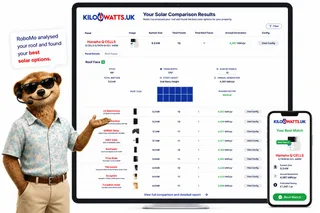
Compare top solar panels for the best performance and value.

Simple, fast & effortless
Provide a few details, sit back and watch your results unfold.
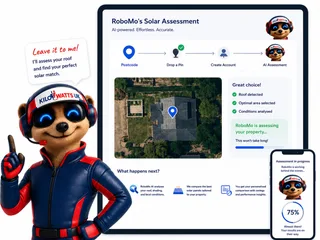
STEP 1
Choose Home, Business or Industrial
Enter your postcode to start your assessment.
STEP 2

Drop a pin on your roof
STEP 3

Create your free account
STEP 4

Sit back and watch RoboMo™ work
RoboMo™ analyses your roof and builds your personalised solar comparison.

Kilowatts UK is an authorised representative
Flower Turbines
Compact vertical-axis turbines built for real UK sites, not just open farmland.
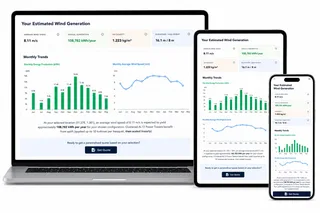
They start in light wind, sit in a small footprint, and are bird-safe by design. Cluster them as a bouquet and the group performs better together than the same turbines standing alone. Enter your postcode for a location-based generation estimate. Figures use area weather data and will differ if buildings, trees or hills sit in the way.
Starts in light UK wind
Built to generate in typical UK wind, not only open farmland.
Small rooftop or ground footprint
Compact towers for roofs, yards and tight sites.
Bird-safe slow rotation
Slow vertical-axis spin, bird-safe by design.
Bouquet clusters raise output
Grouped turbines outperform the same units standing alone.
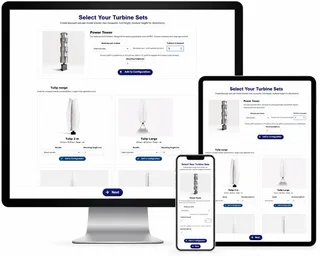
Step 1
Enter your postcode
Start designing your wind energy system in seconds.
STEP 2

Choose a location
STEP 3

Place your cluster
Tap the map where you want the turbine cluster to go.
STEP 4

Instant generation forecasts
Compare different turbine layouts and see annual generation forecasts instantly.
STEP 5

No commitment required
Explore different configurations before deciding whether to request a quotation.
Related articles

Mo's Mission Nominations
FAQ
Need Help? RoboMo's Got Answers
What is the best way to choose a home battery size?
Start with your half-hourly electricity data rather than annual usage alone. Look at how much electricity you normally import in the evening, overnight or during peak-rate periods. Compare that with the battery’s usable capacity, allowing for losses and whether you can fill it often enough from solar or off-peak charging.
Should I size a battery using nominal capacity or usable capacity?
Use usable capacity, not just the headline or nominal kWh figure. Some battery capacity is held in reserve to protect the cells, and conversion losses mean not every kWh charged will be returned for use. Ask the installer to show the usable kWh, charge power and discharge power for the exact model quoted.
Is a bigger home battery always better?
No. A battery that rarely fills, or still has plenty of charge left most mornings, may be larger than you can use effectively. The right size is one that regularly stores electricity you would otherwise export or buy at a higher rate.
How does solar PV affect the battery size I need?
If you have solar panels, the battery should be matched to your regular surplus generation and the electricity you can use later. A large battery on a small, shaded or low-surplus system may be underused for much of the year. Roof orientation, shading, inverter setup and export tariff all affect the decision.
Can I size a battery for an off-peak electricity tariff instead of solar?
Yes, some UK households use a battery to charge during cheaper off-peak periods and discharge during higher-rate times. The size should reflect the amount of peak-rate usage you can realistically avoid, the length of the cheap-rate window and the battery’s charge power. Check the tariff terms, smart meter requirements and supplier conditions before relying on this approach.
What is the difference between battery kWh and kW?
kWh is capacity, so it tells you how much energy the battery can store. kW is power, so it tells you how quickly the battery can charge or discharge. A battery can have enough capacity for the evening but still import from the grid if its discharge power cannot cover several appliances running at once.
Should a battery be sized to run an EV, heat pump or electric shower?
Large loads need careful design rather than simply choosing a bigger battery. EV charging, heat pumps, immersion heaters, ovens and electric showers can use a lot of power and may be better managed by tariffs, timers or separate controls. Decide which loads the battery is expected to support before accepting a quote.
Will a home battery keep my house running in a power cut?
Not automatically. Many grid-connected batteries are installed to reduce imports and increase solar self-consumption, not to provide backup. If backup is important, tell the installer at the start because it may require suitable equipment, wiring and a clear decision on which circuits should be supported.