


What EV charger installation in Kent involves
Published: 2026-10-06 02:55:54
Updated: 2026-10-05 19:56:31
EV charger installation in Kent means a dedicated home charge point, set by supply, PME earthing, parking consent and the UK Power Networks step.
EV charger installation in Kent
EV charger installation in Kent from Kilowatts.uk in Broadstairs. Costs, roofs, planning and what to do next then compare a local system.
What EV charger installation in Kent involves
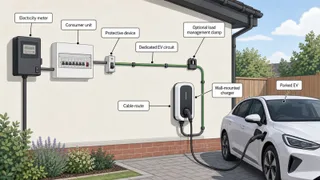
EV charger installation in Kent means fitting a dedicated Mode 3 home charge point at a private address. That is usually a wall- or post-mounted unit on its own circuit from the consumer unit, with a tethered lead or a socket. It is not a public rapid charger, a workplace bay, or a three-pin socket used as a permanent charging method. For many houses with a driveway or garage you control, the job is feasible once supply capacity, earthing and the cable route are designed properly. It is a weak fit if the only parking is on the public highway. Those three checks, plus consent and the network step, decide the job more than the badge on the unit.
Most of the county is served by UK Power Networks through South Eastern Power Networks, but the distribution network operator should be confirmed from the postcode rather than assumed from the county boundary. That check is the same in Medway, Dartford, Ashford, Dover and the rest of Kent. A county label does not prove the connection. Most houses have a single-phase supply, so a common domestic arrangement is a unit around 7 kW, about 32 A, if the vehicle and the connection can accept that. Three-phase supplies exist but are property-specific. A looped service, a full consumer unit, or a long run to the parking position can change the design even when the charger rating stays the same.
What the installer is actually designing
The visible holster is a small part of the work. The installer is specifying a fixed circuit under BS 7671. Electric vehicle charging installations are dealt with in Section 722 of that standard: the protective device, cable size for the length and the installation method, residual-current protection that suits that charge point, and discrimination so a fault on the charger does not leave the house without power. Outdoor equipment needs an enclosure rated for the location, and the route must not create a trip hazard on your own land.
In practice the quote changes when the consumer unit has no spare way, the garage is remote, the driveway run is long, or the supply is PME, also called TN-C-S, which is common. On that earthing arrangement the design usually needs open-PEN detection in the charge point or a separate earth electrode. That choice belongs in the written design. It is not an informal extra a homeowner can waive, and a commando socket added without that design is not the same job. Ask for the earth-fault measure in writing before you compare prices. A quote that is silent on PME is not pricing the same installation.
What limits the power you can actually use
Usable power is set by the incoming supply, the consumer unit and the other large loads already in the house, not by the rating printed on the unit. A charge point rated at about 7 kW can deliver up to about 7 kWh in an hour only if the vehicle accepts that rate and the circuit can actually run at about 32 A. How many miles that adds depends on the car’s efficiency. There is no fixed Kent mileage figure, and a higher nameplate does nothing if the car or the supply cannot take it.
If the spare capacity on a single-phase supply is below what a full charge circuit needs alongside the other loads, the usual design response is load curtailment rather than an automatic supply upgrade. Dynamic load management uses a current transformer, often called a CT clamp, on the incoming supply so the charger reduces output when the house load rises and recovers when other appliances switch off. That arrangement has to appear in the written quote: where the clamp is fitted, what the charger does if the signal is lost, and whether the network assessment still treats the unit at its full rating. Curtailment can keep a constrained board compliant. It is not a promise that UK Power Networks will treat the job as notification only.
Home AC charging is not rapid charging. Rapid charging is high-power DC, almost always on a commercial site with a different supply. Fitting a domestic unit will not reproduce motorway stop times. Where a property already has three-phase, a higher AC rate may be possible, but that is a supply question for that meter, not a default upgrade for Kent. County-level guesses about how many homes have three-phase are not a sound basis for a quote. A household that needs repeated long-distance top-ups at home in under an hour, or a commercial fleet yard, needs a different supply design entirely.
Parking, consent and when to stop
Off-street parking that you control is the usual prerequisite for a standard home charge point. A short run from the consumer unit to a driveway wall is the straightforward case. A parking space outside the curtilage, a bay that belongs to a landlord or freeholder, or a cable that must cross a public pavement raises a different set of problems: consent, sometimes planning, and highways approval that is separate from the electrical installation. Do not assume every ordinary house is automatically clear of planning. Listed buildings, conservation areas, flats and anything that affects the highway can need consent even when a plain driveway install on an unlisted house would not. District and unitary planning notes are not interchangeable. Canterbury, Tunbridge Wells, Dartford, Ashford and Dover each publish their own planning position. Medway is a unitary authority, so highways and planning there are not the same desk as Kent County Council. For a cable, gully or licensed crossing on the public highway, take the current position from the highway authority for that street: Kent County Council where it is the highway authority, and the relevant unitary council in Medway. A neighbouring install or a product brochure is not evidence of what is allowed now. Renters and flat leaseholders can still be suitable if they have written consent and a compliant place to park and mount the unit. Owner-occupier assumptions do not carry over automatically.
Grants, smart rules and tariff savings
The Office for Zero Emission Vehicles has run charge-point grant schemes aimed at particular housing situations rather than a universal driveway subsidy. Current eligibility, amounts and the installer authorisation required must be read on the live gov.uk OZEV pages. An old forum rate is not evidence of what is paid now, and a grant is not automatic for every Kent homeowner. MCS, which many people know from solar, should not be assumed to be the EV charge-point scheme unless the current official page says so. If a grant is claimed, OZEV authorisation for that scheme on the installation day is a separate test from general electrical competence.
Many new private charge points placed on the GB market must meet the Electric Vehicles (Smart Charge Points) Regulations 2021. Exact duties should be checked against the regulations in force and the product’s declaration of conformity, not against an older quote that simply says all smart chargers comply. A smart unit does not by itself reduce the bill. Any saving depends on the tariff, whether the car or charger can schedule a charge, and whether the vehicle is actually plugged in during the cheap window. A brick garage or a metal enclosure can leave approved hardware without a reliable connection, so the unit behaves as if it were not smart. Ask how the data link will be made before you treat a time-of-use tariff as part of the payback.
DNO process and Building Regulations
Whether UK Power Networks expects notification only, or a formal application, depends on the additional load and the existing connection. Thresholds and typical timescales should be confirmed for that supply against current UK Power Networks EV connection guidance. They are not a county-wide rule you can read off a charger brochure, and they are not the same in every street simply because the postcode is in Kent. A connect-and-notify job and a supply alteration are different processes. A looped service, or a request to unloop, can add a network step the household cannot book around.
A practical sequence is a site survey, a written design, then either notification or an application, then installation, then the Building Regulations completion route. This article does not state a number of weeks, because the date moves with that supply and with the network process at the time. Ask the installer which of those steps they are assuming, and what happens to the date if the service is looped or the job is not accepted as notification only.
In England this is fixed electrical installation in a dwelling and is typically notifiable under Building Regulations Part P, as part of a competent job, not as a courtesy email after the unit is on the wall. Notification is usually made by someone registered with a competent-person scheme, such as NICEIC or NAPIT, or by another accepted route such as the local authority building-control process. Those names are examples of how the electrical notification is evidenced. They are not a substitute for OZEV authorisation if a grant applies, and they are not a guarantee that every scheme member is authorised for every grant on the day you book.
How to compare quotes before you commit
Installed cost in Kent is not a single figure, and this article does not state one. Any price you are given should be dated to that quote and tied to a defined scope, because cable length, civils, consumer-unit work, the earthing method and a distribution-network alteration all move the total. A brochure price that omits PME earthing, a new consumer unit, or a long trench is the comparison that most often misleads. Two quotes are only like-for-like if both state the earth-fault measure, the cable route, whether load curtailment is included, and whether the installation date depends on notification only or on a network application.
Photograph the consumer unit, the meter, the parking position and the proposed cable route before you ask installers to price the same job. Decide tethered or socket, and which connector the present car and the likely next car use, before first fix. A tethered lead is simpler day to day if you have one connector type and a short, controlled bay. A socket unit is more flexible if cars will change, but you then own a separate cable and you still need a safe place to store it. Changing the lead later is not free of electrical work. A property with a known looped service, a very small supply, or no spare ways is not automatically impossible, but it is unsuitable for a quote that ignores those items.
A neighbouring approval, a national price claim, or a rapid-charger kilowatt figure does not make those five answers unnecessary.
What to do next
Note whether the supply equipment is marked single-phase or three-phase, measure the parking position you actually control, and check the live OZEV pages if a grant might apply to your housing situation. If the bay is on a pavement, in a lease, or on a listed or conservation-area building, settle the consent desk first: the district or Medway planning authority for the building, and the highway authority for any crossing of the public street.
Then ask an installer to assess the circuit, earthing and DNO route, rather than to swap in a 7 kW product without looking at the board and the bay. A written design that states the earth-fault measure, any load-curtailment clamp, the cable route and whether the network must be involved is the useful comparison.
Plan, Compare & Buy Renewable Energy Solutions
AI does the thinking.
You get the perfect solar match.
Use RoboMo™ to assess your property, compare available technologies and connect with trusted UK installers, suppliers and manufacturers.
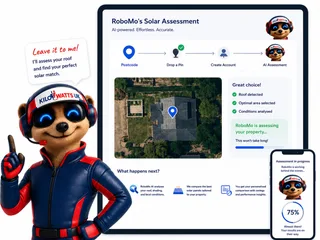
Simply enter your postcode, drop a pin on your roof, create your free account and let RoboMo™ analyse your property to find the best solar panels for your home.

You don't have to think
RoboMo™'s AI analyses your roof and does all the hard work.

Accurate & tailored
AI-powered assessment based on your roof, location, and conditions.

Best options, maximum savings
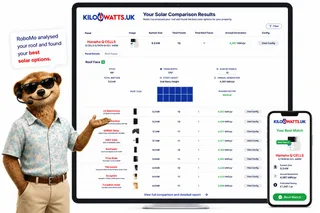
Compare top solar panels for the best performance and value.

Simple, fast & effortless
Provide a few details, sit back and watch your results unfold.
STEP 1
Choose Home, Business or Industrial
Enter your postcode to start your assessment.
STEP 2

Drop a pin on your roof
STEP 3

Create your free account
STEP 4

Sit back and watch RoboMo™ work
RoboMo™ analyses your roof and builds your personalised solar comparison.

Step 1
Enter your postcode
Start designing your wind energy system in seconds.
Are you an installer, distributor or renewable energy business?
Kilowatts UK is expanding the Flower Turbines partner network across the UK.
Become A Flower Turbines PartnerKilowatts UK is an authorised representative
Flower Turbines
Compact vertical-axis turbines built for real UK sites, not just open farmland.
They start in light wind, sit in a small footprint, and are bird-safe by design. Cluster them as a bouquet and the group performs better together than the same turbines standing alone. Enter your postcode for a location-based generation estimate. Figures use area weather data and will differ if buildings, trees or hills sit in the way.
Starts in light UK wind
Built to generate in typical UK wind, not only open farmland.
Small rooftop or ground footprint
Compact towers for roofs, yards and tight sites.
Bird-safe slow rotation
Slow vertical-axis spin, bird-safe by design.
Bouquet clusters raise output
Grouped turbines outperform the same units standing alone.


STEP 2

Choose a location
STEP 3

Place your cluster
Tap the map where you want the turbine cluster to go.
STEP 4

Instant generation forecasts
Compare different turbine layouts and see annual generation forecasts instantly.
STEP 5

No commitment required
Explore different configurations before deciding whether to request a quotation.
Related articles

FAQ
Need Help? RoboMo's Got Answers
What does a home EV charger installation in Kent usually involve?
It means fitting a dedicated Mode 3 charge point at a private address, usually a wall- or post-mounted unit on its own circuit from the consumer unit, with a tethered lead or a socket. It is not a public rapid charger, a workplace bay, or a three-pin socket used as a permanent charging method. For many houses with a driveway or garage you control, the job is feasible once supply capacity, earthing and the cable route are designed properly. It is a weak fit if the only parking is on the public highway.
Which network operator covers EV charger connections in Kent?
Most of the county is served by UK Power Networks through South Eastern Power Networks, but the distribution network operator should be confirmed from the postcode rather than assumed from the county boundary. That check is the same in Medway, Dartford, Ashford, Dover and the rest of Kent. Whether the job is notification only or needs a formal application depends on the additional load and the existing connection, and should be confirmed against current UK Power Networks EV connection guidance for that supply.
How much power can a typical home charger in Kent actually deliver?
Most houses have a single-phase supply, so a common domestic arrangement is a unit around 7 kW, about 32 A, if the vehicle and the connection can accept that. Usable power is set by the incoming supply, the consumer unit and other large loads, not by the rating printed on the unit. If spare capacity is tight, the usual design response is load curtailment with a current transformer, not an automatic supply upgrade. Three-phase supplies exist but are property-specific, and a domestic AC unit will not reproduce motorway rapid-charging times.
Why does PME earthing matter when comparing charger quotes?
Many UK supplies are PME, also called TN-C-S. On that arrangement the design usually needs open-PEN detection in the charge point or a separate earth electrode, and that choice belongs in the written design under BS 7671 Section 722. It is not an informal extra a homeowner can waive. A quote that is silent on the earth-fault measure is not pricing the same installation as one that states it.
Do I need planning permission or highways consent for an EV charger in Kent?
Off-street parking that you control is the usual prerequisite, and a plain driveway install on an unlisted house is often the straightforward case. Listed buildings, conservation areas, flats, leasehold bays and anything that affects the highway can still need consent. District and unitary planning notes are not interchangeable, and Medway is a unitary authority, so highways and planning there are not the same desk as Kent County Council. Confirm the current position with the planning authority for the building and the highway authority for that street.
Is there a grant for installing an EV charger at home in Kent?
The Office for Zero Emission Vehicles has run charge-point grant schemes aimed at particular housing situations rather than a universal driveway subsidy. Current eligibility, amounts and the installer authorisation required must be read on the live gov.uk OZEV pages. An old forum rate is not evidence of what is paid now, and a grant is not automatic for every Kent homeowner. MCS should not be assumed to be the EV charge-point scheme unless the current official page says so.
Will a smart charger automatically cut my electricity bill?
Many new private charge points placed on the GB market must meet the Electric Vehicles (Smart Charge Points) Regulations 2021, but exact duties should be checked against the regulations in force and the product’s declaration of conformity. A smart unit does not by itself reduce the bill. Any saving depends on the tariff, whether the car or charger can schedule a charge, and whether the vehicle is plugged in during the cheap window. A brick garage or metal enclosure can also leave the unit without a reliable data link.
What should I check before I accept an installer quote?
Ask whether the supply is PME and whether the design uses open-PEN detection or a separate earth electrode, and whether any CT clamp and load curtailment are written into the quote. Ask if the job is notification only or a UK Power Networks application, and what that does to the date. Ask for competent-person scheme registration, such as NICEIC or NAPIT, for the Building Regulations route, and for OZEV authorisation on the install day if a grant is claimed. Installed cost is not a single Kent figure, so compare quotes only when cable route, earthing, consumer-unit work and the network step are defined.