


Solar panel installation in Kent is a roof and network job
Published: 2026-10-06 02:37:11
Updated: 2026-10-05 19:37:51
Solar panel installation in Kent depends on the roof, shade, GPDO conditions and UK Power Networks paperwork. A survey sets design, not a county price.
Solar panel installation in Kent
Solar panel installation in Kent from Kilowatts.uk in Broadstairs. Costs, roofs, planning and what to do next then compare a local system.
Solar panel installation in Kent is a roof and network job
Solar panel installation in Kent means fitting a grid-connected photovoltaic system on a home, then connecting it so the household can use the electricity and export any surplus. Output depends on the roof, shade and structure you actually have. Planning rules and UK Power Networks decide whether that design can be switched on. The job is survey, mounting, electrical work, commissioning and the paperwork that matches the equipment installed.
It is not a solar thermal hot-water system, a commercial rooftop array, or an off-grid setup. Almost all domestic photovoltaic systems in the county are grid-tied. Batteries and electric-vehicle chargers can be included, but they change the electrical design and sometimes the connection, so they should be decided before paperwork is sent.
Kilowatts is based in Broadstairs and works across Kent, which helps with access and local building types. That is not a promise about yield. A shaded north roof in Thanet will still underperform a clear south roof elsewhere. A design for the property is the comparison that matters, not a county average.
What switch-on paperwork has to include
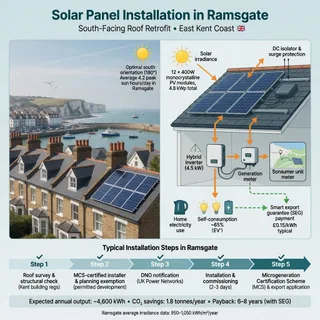
A typical domestic installation is a roof array, a string inverter or microinverters, isolators, and metering so generation can be recorded. The design is set by usable roof area, orientation, pitch and how the household uses electricity in daylight. South-east England is among the better-irradiated parts of the UK, so a clear, lightly shaded Kent roof should sit toward the better end of ordinary UK domestic yields. That is a general irradiance point, not a measured county figure, and it does not rescue a roof blocked by chimneys, trees or a neighbouring storey.
Handover is what turns panels on a roof into a system you can legally and safely use. You should receive a commissioning record that describes the equipment as installed, including the inverter, the string layout and any export limit that has been set. Shutdown labels should be fixed at the inverter and at the intake so the array can be isolated without guessing. Panel and inverter warranties are manufacturer documents. Long panel warranties are commonly quoted over decades, and modules usually outlast the first inverter, but those are manufacturer claims, not a Kent field measurement.
Electrical work in a dwelling in England falls under the Building Regulations, including Part P on electrical safety. The handover should include an electrical installation certificate for the new circuits, and evidence that building control has been notified. A competent-person installer usually self-certifies and notifies. If that route is not used, a building notice or other building-control path may be required. Ask which route applies to your job, and do not treat a roof photograph as proof that the electrical work has been certified. The same pack has to line up with the network. UK Power Networks needs a notification or an approval that matches the inverter, any export limit, and any battery that will be commissioned. If the paperwork describes panels only and a battery is fitted, the operator can treat that as a different proposal. Switch-on should wait until the commissioning record, the electrical certificate or Building Regulations notification, and the network submission describe the same system.
Smart Export Guarantee and VAT need a live check
Self-use avoids imported units. Export is a separate arrangement with your electricity supplier under the Smart Export Guarantee. Ofgem sets the framework. Suppliers set the rates, and those rates are not a national fixed price. There is no Kent export rate this guide can quote. Read the supplier’s current tariff, including any conditions on metering and deemed versus metered export, before you build a bill saving around it.
Domestic SEG payments normally require the installation to be certified under the Microgeneration Certification Scheme, or an equivalent scheme recognised for that purpose. A competent electrical install without that certification can still be a working system, but it may not qualify for export payments. Confirm eligibility against Ofgem’s SEG guidance and the supplier’s live terms. Do not assume a quote that mentions “export income” has already secured a tariff.
Value-added tax is a separate check. Qualifying installations of solar panels on residential accommodation in Great Britain have been eligible for a zero rate, subject to conditions that can change and that do not automatically cover every related item on a quote. Verify the current treatment on GOV.UK before you treat a VAT line as settled, and ask the installer which parts of the job they are zero-rating and why. There is no single Kent grant this guide can describe. Any district or supplier scheme should be read on the live page before you rely on it.
Roof, shade and structure matter more than the postcode
Installers start with the roof you have, not with a satellite pin. Orientation and pitch set the starting point. Shade from chimneys, dormers, trees and neighbouring buildings often changes the string layout, and sometimes makes part of a roof not worth using. A clear east–west pair can still be sensible. A heavily shaded south roof may not, even in a bright part of the county.
Structure is the part homeowners underestimate. Rafter or deck condition, tile or slate type, age, and whether the covering needs repair before it is loaded all affect whether an array can be warranted. Some fragile coverings, including certain slate and thatch, are a poor fit for a standard domestic mounting system. Flat roofs need a method that does not compromise the roof guarantee. If the covering is near the end of its life, re-roof before the array is designed onto a surface that will be stripped in a few years. Taking a warranted array off to replace tiles is a second job, not a small extra.
Scaffold and access change the programme as much as the panel count. Narrow streets in Thanet and the Medway towns, tight terraces, and long rural drives are different jobs even when the kilowatt rating looks similar. On a narrow street the scaffold may need a pavement or highway arrangement with the local authority. Ask who is applying, and whether that consent sits on the programme before the installation day is booked.
Planning is conditional under the GPDO
Many domestic roof arrays on unlisted houses in England are dealt with as permitted development under the Town and Country Planning (General Permitted Development) (England) Order, usually called the GPDO. That route is subject to conditions on siting, projection and, in some designations, the roof slope that faces a highway. It is not the same as “planning is never required”, and it is not the same as “every Kent roof needs an application”. The Planning Portal and the local planning authority are the places to check the current conditions for the property, rather than copying what a neighbour was told.
Listed buildings need listed-building consent for works that affect the building’s character, which a roof array often does. That consent is separate from planning permission and separate from Building Regulations. Some roofs in conservation areas also fall outside permitted development, particularly street-facing slopes. Those cases are common in Canterbury, Tunbridge Wells, Sandwich and Broadstairs, and they appear in smaller historic centres as well. Protected landscapes add another layer on some rural sites, including parts of the Kent Downs.
Street-facing roofs in tight conservation areas are often the awkward ones, even when the same house type outside the designation would be straightforward. Leaseholders and renters usually cannot commission a roof array without the freeholder’s agreement. Flats and park homes often need a different design path and may not suit a standard house roof job. Sort ownership and consent before equipment is ordered, so you are not paying for a design that cannot be fixed to the building.
UK Power Networks sits between design and switch-on
Kent’s distribution network operator is UK Power Networks. Connection rules sit with the network, not with the installer alone. The operator publishes application and notification routes for generation. Smaller domestic systems are often notified under the engineering recommendation G98. Larger systems, and some combinations with batteries or other generation, fall under G99 and may need approval before or as part of commissioning. Thresholds are set in those recommendations and can change, so this guide does not state a kilowatt or amp cut-off. The designer should apply the current document, not a remembered figure.
The application or notification has to match what is actually installed. If the inverter, export limit or storage differs from the paperwork, UK Power Networks may treat it as a different proposal. Adding a battery or a charger later can reopen a connection that was accepted for panels only. That is a common reason a “simple add-on” becomes a second design and a second wait. If storage or a charger is likely, say so at survey stage so the connection describes the finished system.
Homeowners rarely see this step, but it affects the date you can use the system. Notification is not the same as prior approval. A job that can be notified may proceed on a defined process. A job that needs approval cannot be treated as switched on because the panels are fitted. Rural parts of the county can also have tighter local network capacity or longer cable runs back to the intake. An older consumer unit with no spare ways, poor earthing, or no sensible place for the inverter is an electrical constraint, not a panel problem. Those items belong in the survey, because they change both the cost and whether the design is acceptable.
What drives cost and the time from survey to switch-on
There is no honest single price for solar panel installation in Kent, and a county average would hide the items that move a quote. The panel count is only one of them. Scaffold on a tight terrace, a pavement arrangement, a long rural drive, or a roof that needs repair before it can be loaded will change the figure more than a small difference in module brand. Consumer-unit work, a difficult cable route through thick walls, and an inverter location that is not a convenient garage wall do the same. Listed-building consent adds professional time and a decision you do not control. A connection that needs prior approval from UK Power Networks is a different programme from one that is only notified.
The roof day is rarely the longest part of the calendar. Survey and design come first, then any planning or listed-building consent, then the network notification or application that matches the equipment. Scaffold, installation, electrical certification, commissioning and handover follow. A straightforward unlisted house, with a connection that can be notified rather than approved in advance, is often limited by scaffold booking and equipment lead times. Listed consent, a conservation-area case that is not permitted development, or prior network approval stretches the programme because those decisions sit outside the installer’s diary. Re-roofing first, or consumer-unit work that has to be designed in, adds its own sequence.
Ask for a programme that separates those gates from the installation day. Treat any single county-wide lead time as a guess. A quote that bundles “installed and exporting” into one date, without saying whether UK Power Networks approval, building-control notification or listed-building consent is still outstanding, is not a programme you can rely on.
Coastal exposure and older fabric change the detail
Coastal Kent, including Thanet, Swale, Dover and the Folkestone coast, does not need a different kind of panel. Wind exposure and salt air do change fixings, cable routes and corrosion risk. Marine-grade or stainless choices are a site judgement after looking at the roof edge, not a line copied from a brochure. Loose tiles and exposed ridges matter more on a seafront terrace than on a sheltered inland estate.
Older Wealden cottages and town houses often hide the difficult metres: cable routes through thick walls, hot lofts, long runs to the intake, and consumer units that were never laid out for generation. Newer estate houses are often simpler structurally, but they can still be shaded by close neighbouring roofs or limited by a small usable area. Those constraints show up on a survey, not on a postcode lookup.
Maintenance is mostly about faults and shade, not a strict cleaning ritual. Debris in gutters and birds nesting under arrays are real issues near trees. A visual check from the pavement will not show a failed string. Monitoring that compares generation with what that roof should produce is how you notice an inverter or string problem. If generation steps down and stays down, the commissioning record and the monitoring login are more useful than another clean.
When a Kent home is a weaker fit
A clearer fit is enough unshaded roof, a structure that can take the array, daytime electricity use or a realistic plan to shift or store load, and planning and network constraints that look straightforward. Many suburban pitched roofs fall here, but only after a survey. Very low daytime use still produces electricity. The bill impact is smaller if almost all of it is exported on a modest supplier tariff, or if there is no export arrangement because the system is not certified for the Smart Export Guarantee. It is a weaker fit when the only roof is small, heavily shaded, structurally poor, or covered in a material that is hard to warrant. Listed buildings and street frontages where consent is unlikely should be treated as unresolved, not as a standard install with a planning risk added in the small print. Off-grid expectations are misplaced for a normal Kent house with a grid supply.
Overview
The table is a decision aid, not a yield forecast. Two houses on the same road can land in different rows because of a tree, a listed status, or a consumer unit that cannot take another circuit.
What to settle before you compare quotes
Before you invite prices, note roof orientation, obvious shade through the day, tile or slate type, and whether the house is listed or in a conservation area. A year’s electricity use, and whether anyone is home in daylight, tells an installer more than a target panel count. If storage or a charger is already likely, say so at survey stage so the UK Power Networks submission matches the finished system rather than a panels-only design that has to be reopened.
Ask how the array will be fixed to your covering, where the inverter and isolators will sit, and what happens if the consumer unit needs work. Ask whether the connection is a notification or a prior approval, and how that will be kept in step with the inverter, any export limit and any battery. Ask what scaffolding is assumed, who deals with any pavement arrangement, and what changes the price if access is tighter than the desktop view suggested. Ask for the commissioning record, shutdown labels, electrical certificate, Building Regulations notification route, and MCS or equivalent certificate if you want SEG payments.
Those questions also cover the points that usually sit behind a price comparison. Planning is conditional under the GPDO, not automatic, and listed-building consent is a separate decision. Export income is a supplier tariff under Ofgem’s SEG rules, normally tied to MCS or an equivalent certification, and it is not a Kent rate. VAT on qualifying residential solar should be checked on GOV.UK, not assumed from a headline. A battery added after commissioning can be a second connection, not a plug-in extra. A quote that cannot explain scaffold, re-roofing, consumer-unit work, consent and the network step has not looked at your roof.
Plan, Compare & Buy Renewable Energy Solutions
AI does the thinking.
You get the perfect solar match.
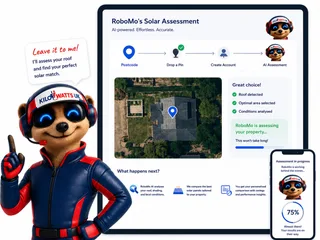
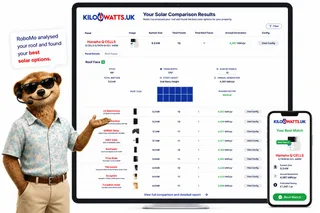
Use RoboMo™ to assess your property, compare available technologies and connect with trusted UK installers, suppliers and manufacturers.
Simply enter your postcode, drop a pin on your roof, create your free account and let RoboMo™ analyse your property to find the best solar panels for your home.

You don't have to think
RoboMo™'s AI analyses your roof and does all the hard work.

Accurate & tailored
AI-powered assessment based on your roof, location, and conditions.

Best options, maximum savings
Compare top solar panels for the best performance and value.

Simple, fast & effortless
Provide a few details, sit back and watch your results unfold.
STEP 1
Choose Home, Business or Industrial
Enter your postcode to start your assessment.
STEP 2
Drop a pin on your roof
STEP 3

Create your free account
STEP 4

Sit back and watch RoboMo™ work
RoboMo™ analyses your roof and builds your personalised solar comparison.

Step 1
Enter your postcode
Start designing your wind energy system in seconds.
Are you an installer, distributor or renewable energy business?
Kilowatts UK is expanding the Flower Turbines partner network across the UK.
Become A Flower Turbines PartnerKilowatts UK is an authorised representative
Flower Turbines
Compact vertical-axis turbines built for real UK sites, not just open farmland.
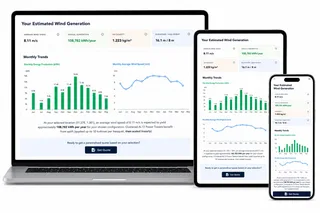
They start in light wind, sit in a small footprint, and are bird-safe by design. Cluster them as a bouquet and the group performs better together than the same turbines standing alone. Enter your postcode for a location-based generation estimate. Figures use area weather data and will differ if buildings, trees or hills sit in the way.
Starts in light UK wind
Built to generate in typical UK wind, not only open farmland.
Small rooftop or ground footprint
Compact towers for roofs, yards and tight sites.
Bird-safe slow rotation
Slow vertical-axis spin, bird-safe by design.
Bouquet clusters raise output
Grouped turbines outperform the same units standing alone.

STEP 2

Choose a location
STEP 3

Place your cluster
Tap the map where you want the turbine cluster to go.
STEP 4

Instant generation forecasts
Compare different turbine layouts and see annual generation forecasts instantly.
STEP 5

No commitment required
Explore different configurations before deciding whether to request a quotation.
Related articles
FAQ
Need Help? RoboMo's Got Answers
What does a domestic solar panel installation in Kent actually include?
For most homes it means a grid-connected photovoltaic array on the roof, with a string inverter or microinverters, isolators, metering, mounting and the electrical work to use the power and export surplus. It is not a solar thermal hot-water system, a commercial rooftop array or an off-grid setup. Batteries and electric-vehicle chargers can be added, but they change the electrical design and sometimes the network connection, so they should be decided before paperwork is sent. Survey, mounting, commissioning and handover that matches the equipment installed are all part of the job.
What paperwork should I have before the system is switched on?
You should receive a commissioning record that describes the equipment as installed, including the inverter, string layout and any export limit, plus shutdown labels at the inverter and at the intake. Electrical work in a dwelling in England falls under the Building Regulations, including Part P, so expect an electrical installation certificate and evidence that building control has been notified, often via a competent-person self-certification route. UK Power Networks also needs a notification or approval that matches the inverter, any export limit and any battery. Switch-on should wait until those documents describe the same system.
Do I need planning permission for solar panels on a Kent house?
Many domestic roof arrays on unlisted houses in England are dealt with as permitted development under the GPDO, subject to conditions on siting, projection and, in some designations, the roof slope that faces a highway. That is not the same as planning never being required, and it is not the same as every Kent roof needing an application. Listed buildings often need listed-building consent, which is separate from planning permission and from Building Regulations, and some conservation-area roofs fall outside permitted development, particularly street-facing slopes. Check the current conditions with the Planning Portal and the local planning authority, and sort freeholder consent before ordering equipment if you are a leaseholder.
How does UK Power Networks affect when I can use the system?
Kent’s distribution network operator is UK Power Networks, and connection rules sit with the network, not with the installer alone. Smaller domestic systems are often notified under engineering recommendation G98, while larger systems and some combinations with batteries or other generation fall under G99 and may need approval before or as part of commissioning. This guide does not state a kilowatt or amp cut-off, because thresholds are set in those documents and can change. Panels being fitted is not the same as the system being accepted for switch-on, and a later battery or charger can reopen a connection that was accepted for panels only.
Will I be paid for electricity I export, and is there a Kent export rate?
Export is a separate arrangement with your electricity supplier under the Smart Export Guarantee. Ofgem sets the framework and suppliers set the rates, so there is no national fixed price and no Kent export rate this guide can quote. Domestic SEG payments normally require certification under the Microgeneration Certification Scheme, or an equivalent scheme recognised for that purpose. A competent electrical install without that certification can still be a working system, but it may not qualify for export payments, so check Ofgem’s SEG guidance and the supplier’s live terms before building a bill saving around export income.
Is there a grant or a fixed VAT rate for solar in Kent?
There is no single Kent grant this guide can describe. Any district or supplier scheme should be read on its live page before you rely on it. Qualifying installations of solar panels on residential accommodation in Great Britain have been eligible for a zero rate of VAT, subject to conditions that can change and that do not automatically cover every related item on a quote. Verify the current treatment on GOV.UK, and ask the installer which parts of the job they are zero-rating and why.
Does living in Kent mean a good solar yield?
South-east England is among the better-irradiated parts of the UK, so a clear, lightly shaded Kent roof should sit toward the better end of ordinary UK domestic yields. That is a general irradiance point, not a measured county figure, and it does not rescue a roof blocked by chimneys, trees or a neighbouring storey. Orientation, pitch, shade and how the household uses electricity in daylight matter more than the postcode. A design for the property is the comparison that matters, not a county average.
Why do quotes and timescales vary so much across Kent?
There is no honest single price for solar panel installation in Kent. Scaffold on a tight terrace, a pavement or highway arrangement, a long rural drive, roof repairs, consumer-unit work, cable routes, listed-building consent and a connection that needs prior approval can move both the figure and the calendar more than a small difference in module brand. The roof day is rarely the longest part of the programme. Treat any single county-wide lead time as a guess, and ask for a programme that separates survey, consent, network notification or approval, scaffold and handover from the installation day.