


Usable vs Quoted Battery Capacity: What UK Homes Get
Published: 2026-08-30 21:24:01
Updated: 2026-10-06 12:43:03
A home battery's quoted capacity isn't always what you can use. Here's why buffers exist, how to read a quote properly, and what it means in UK homes.

Usable vs Quoted Home Battery Capacity: Why Some Energy Stays Locked
If you are comparing home battery quotes and wondering why one system "feels" smaller than its headline number, here is the short answer: a battery's quoted capacity and its usable capacity are not always the same figure. Some energy is deliberately held back in reserved buffers at the very top and very bottom of the pack, because charging a cell completely full or draining it completely empty is hard on it. That reserved energy is not lost, missing or a con. It is battery-health management, decided by the battery management system long before you ever look at an app. This companion article to the Solar, Clearly episode "The Usable Battery" explains what those buffers are, why they exist, how to spot which number a quote is actually giving you, and how to size a system around usable kilowatt-hours rather than marketing kilowatt-hours. No hype, no scare stories — just the engineering, explained the way Mo and RoboMo do it.
"Mo: Quoted battery capacity is all usable, surely? RoboMo: No. Some is held back to protect the cells."
Quoted capacity and usable capacity are two different numbers
Every home battery has a nominal or quoted capacity — the total energy the cells could theoretically hold. That figure is a specification of the hardware. Usable capacity is the portion of that total the system will actually let you charge into and discharge out of during normal operation.
The gap between the two is created on purpose. A battery management system sets limits on how far the pack is allowed to fill and how far it is allowed to empty, and it enforces those limits automatically. You cannot override them from an app, and you should not want to. When the episode opens, the battery visualisation is already draining towards the house load while the lowest band stays deliberately dim and locked — that dim band is the reserve, doing its job.
This matters commercially because two quotes can show the same headline number and deliver different real-world energy. One might be quoting nominal capacity, the other usable. Neither is necessarily being dishonest; they are simply describing the same product from different ends. Your job as a buyer is to make sure you are comparing like with like, and to ask which figure you are being shown.
Where the held-back energy actually sits: buffers top and bottom
The reserved energy is not scattered through the pack. It sits in two bands: one at the top of the state-of-charge range and one at the bottom.
The top buffer stops the pack being pushed to an absolutely full state and held there. Sitting at maximum charge is one of the conditions lithium cells least enjoy, particularly for long periods, so the system stops short and calls that "100%" in the app. The bottom buffer stops the pack being run right down to genuinely empty. Deep discharge stresses cells, and it also leaves the electronics with no headroom — a battery needs a little energy in hand to keep its own management system, communications and safety functions alive.
So when the app shows 100%, that is 100% of the usable window, not 100% of every electron in the pack. And when it shows 0%, the pack is not flat; it has reached the floor of the usable window and stopped. This is why the episode's overlay separates a full outer capacity outline from a smaller glowing usable zone. The outer outline is what the datasheet says exists. The inner zone is what your house gets to spend.

Why the buffers protect long-term value, not just cell chemistry
It is tempting to see the reserved bands as capacity you paid for and cannot touch. It helps to reframe it: the buffers are what allow the rest of the pack to keep performing for years.
Lithium batteries degrade gradually with use, and the rate of that degradation is heavily influenced by how they are treated at the extremes of charge. A pack that is repeatedly slammed to completely full and then run to completely empty will lose capacity faster than one cycled within a protected window. By reserving a slice at each end, the system trades a small amount of instantly available energy for a longer working life and more stable behaviour over that life. That is a long-term value decision, and it is exactly the sort of thing worth understanding before you buy. A battery is not a one-evening purchase; it is a decade-scale asset. The manufacturer's warranty terms usually reflect this — they are written around the pack being operated within its designed window, which is precisely what the buffers enforce. Protecting cell life is not the system being stingy. It is the system doing the thing you are paying it to do.
What this means for a real British household's evening
Practically, sizing a battery should always be done on usable kilowatt-hours against your actual evening and overnight consumption — not on the headline number.
Start from your own data. Your smart meter or in-home display will show what a normal weekday looks like. In most UK homes the demand curve is bunched: cooking, laundry, hot water, lighting, television, and an EV charge if there is one. That is the load a battery is trying to cover between sunset and sunrise, and it is the load the usable zone has to serve.
There is a neat side-effect of thinking in usable terms: it makes wasted energy expensive in a way you can see. Standby mode on idle appliances wastes a meaningful amount of household energy — devices drawing quietly all night, doing nothing useful. When that background draw is coming out of a finite usable battery zone rather than an invisible grid supply, it becomes obvious. Trimming standby loads effectively makes your battery bigger without buying more of it. The episode's third beat shows solar flow refilling the usable zone while the protected bands stay untouched. That is the daily rhythm in a well-configured system: generate, store within the safe window, discharge within the safe window, repeat. The buffers never move. Only the middle does the work.
A practical checklist for comparing battery quotes
Use this when you have two or three proposals in front of you and the numbers do not seem to line up.
- Ask directly: "Is that figure nominal capacity or usable capacity?" A good installer will answer instantly and in writing. 2. Ask for the usable figure in kilowatt-hours for every quote, so you are comparing the same measurement. 3. Check the continuous power output, not just capacity. A battery with plenty of stored energy but limited output may not cover a high-demand moment such as an oven and a kettle together. 4. Check whether the quoted usable figure is at the start of life. Capacity naturally reduces over time; the warranty should describe expected retention. 5. Look at the warranty terms alongside the capacity claim — cycles, years and retained capacity together tell you far more than any single headline number. 6. Confirm whether the system can charge from the grid as well as from solar, if you are on a time-of-use tariff and want to shift consumption. 7. Check your own consumption data before agreeing a size. Buying capacity you never discharge is money sitting idle; buying too little means importing anyway. 8. Ask what happens to the reserve during a power cut, if backup capability is part of the proposal, and whether that is included or an extra. If a quote will not state usable capacity clearly, that is worth noticing. Knowledge beats marketing, every time.

Follow-up questions people ask after this episode
Can I unlock the reserved capacity myself? No — and you should not try. The limits are enforced by the battery management system to protect the cells and to keep the installation within its warranty and safety design.
Does the buffer mean I have been oversold? Not necessarily. It means you need to know which figure you were quoted. A system quoted honestly on usable capacity is giving you the more useful number from the outset.
Why does my app say 100% when the pack is not completely full? Because the app is showing you 100% of the usable window. That is the sensible thing to display, since it is the only part you can actually spend. Do all batteries reserve the same amount? No. Different chemistries and different manufacturers set different windows. This is exactly why comparing usable figures rather than nominal figures matters. Will the usable capacity shrink over time? Some gradual reduction is normal for any lithium battery. The warranty documentation should set out what retention is expected over the covered period. Does cold weather affect it? Battery performance is temperature-sensitive, which is one reason installation location matters. Solar panels, interestingly, run the other way — they generate more efficiently in cold weather than in hot, so a crisp bright British winter day is better for the panels than the pack. Should I just buy the biggest battery available? Only if your consumption justifies it. Size against your evening load and your generation, not against the largest number on offer.
Video transcript
Mo: Quoted battery capacity is all usable, surely? RoboMo: No. Some is held back to protect the cells.
Mo: So where does the held-back energy actually sit? RoboMo: In reserved buffers at the top and bottom of the pack.
Mo: So a full charge never quite fills the whole pack? RoboMo: Correct. The system protects cell life, not the last unit. Mo: Quoted battery capacity is all usable, surely? RoboMo: No. Some is held back to protect the cells. / Mo: So where does the held-back energy actually sit? RoboMo: In reserved buffers at the top and bottom of the pack. / Mo: So a full charge never quite fills the whole pack? RoboMo: Correct. The system protects cell life, not the last unit.
Wrapping up
The point of "The Usable Battery" is not that manufacturers are hiding something. It is that a battery is a managed system, not a bucket. Some energy stays in reserved buffers at the top and bottom of the pack because that is what keeps the cells healthy across a decade of daily cycling. The number that matters to you is the usable one, and the question that matters is simply which number you are being shown. Ask it early, get it in writing, and compare quotes on the same footing. Do that, and the rest of the specification conversation becomes much easier — because you are finally comparing energy you can actually use.
Next step
If you would like to see what usable capacity would realistically cover in your home, our team can walk through your consumption data and explain the numbers without any pressure to buy. Compare options, or book a no-obligation survey when you are ready.
Plan, Compare & Buy Renewable Energy Solutions
AI does the thinking.
You get the perfect solar match.
Use RoboMo™ to assess your property, compare available technologies and connect with trusted UK installers, suppliers and manufacturers.
Simply enter your postcode, drop a pin on your roof, create your free account and let RoboMo™ analyse your property to find the best solar panels for your home.

You don't have to think
RoboMo™'s AI analyses your roof and does all the hard work.

Accurate & tailored
AI-powered assessment based on your roof, location, and conditions.

Best options, maximum savings
Compare top solar panels for the best performance and value.

Simple, fast & effortless
Provide a few details, sit back and watch your results unfold.
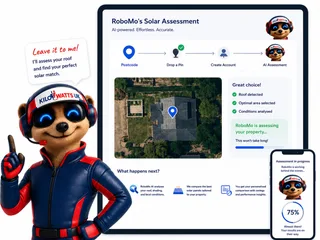
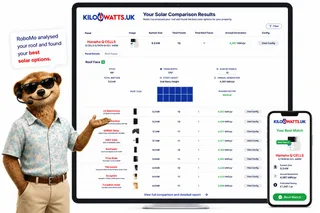
STEP 1
Choose Home, Business or Industrial
Enter your postcode to start your assessment.
STEP 2

Drop a pin on your roof
STEP 3

Create your free account
STEP 4

Sit back and watch RoboMo™ work
RoboMo™ analyses your roof and builds your personalised solar comparison.

Step 1
Enter your postcode
Start designing your wind energy system in seconds.
Are you an installer, distributor or renewable energy business?
Kilowatts UK is expanding the Flower Turbines partner network across the UK.
Become A Flower Turbines PartnerKilowatts UK is an authorised representative
Flower Turbines
Compact vertical-axis turbines built for real UK sites, not just open farmland.
They start in light wind, sit in a small footprint, and are bird-safe by design. Cluster them as a bouquet and the group performs better together than the same turbines standing alone. Enter your postcode for a location-based generation estimate. Figures use area weather data and will differ if buildings, trees or hills sit in the way.
Starts in light UK wind
Built to generate in typical UK wind, not only open farmland.
Small rooftop or ground footprint
Compact towers for roofs, yards and tight sites.
Bird-safe slow rotation
Slow vertical-axis spin, bird-safe by design.
Bouquet clusters raise output
Grouped turbines outperform the same units standing alone.
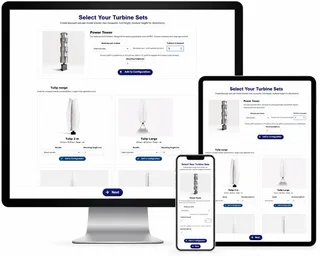
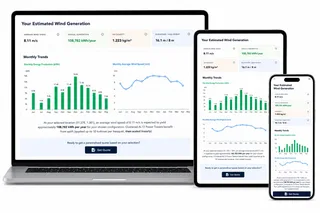
STEP 2

Choose a location
STEP 3

Place your cluster
Tap the map where you want the turbine cluster to go.
STEP 4

Instant generation forecasts
Compare different turbine layouts and see annual generation forecasts instantly.
STEP 5

No commitment required
Explore different configurations before deciding whether to request a quotation.
FAQ
Need Help? RoboMo's Got Answers
What is the difference between quoted and usable battery capacity?
Quoted capacity is the headline size of the battery pack, usually based on the total energy the cells can hold. Usable capacity is the amount the system actually lets your home charge and discharge in normal use. For comparing quotes, usable capacity is usually the more helpful figure.
Why can’t I use all of the battery’s quoted capacity?
Home batteries keep a reserve at the top and bottom of the charge range. These buffers help avoid fully charging or fully draining the cells, both of which can increase wear. The reserve is managed automatically by the battery management system.
Does 100% in the battery app mean the battery is completely full?
Usually, it means 100% of the usable capacity, not 100% of the total physical capacity. The battery still has a protected top buffer above that point. The same applies at 0%, where the battery has reached the bottom of its usable window rather than being truly empty.
How should I compare home battery quotes fairly?
Ask each installer whether the capacity shown is nominal or usable, and request the usable figure in kilowatt-hours. Also compare continuous power output, warranty terms and whether the system can charge from solar, the grid, or both. A clear quote should make these points easy to understand.
Will the usable capacity of a home battery reduce over time?
Some gradual capacity reduction is normal for lithium batteries. How much and how quickly depends on the product, usage, temperature and the manufacturer’s design. Check the warranty documents for expected capacity retention, cycle limits and any operating conditions.
Should I buy the biggest battery I can afford?
Not necessarily. A battery should be sized around your household’s real evening and overnight use, plus how much surplus solar you are likely to have. If you buy far more usable capacity than you regularly discharge, some of that capacity may sit idle.
Can I unlock the reserved battery capacity myself?
No, and it is not something you should try to do. The reserve is there to protect the cells and keep the system operating within its intended safety and warranty design. If you need more usable energy, the proper route is to discuss sizing or additional battery capacity with a qualified installer.