LinkedIn profile for Ravi Ghongade Ravi Ghongade
Founder and CEO, Cotswold Cleantech Energy


LinkedIn profile for Ravi Ghongade Ravi Ghongade
Founder and CEO, Cotswold Cleantech Energy
Article
Discover how SolarMind uses AI to optimise solar panels, home batteries and EV charging, and whether it could help reduce your energy bills.
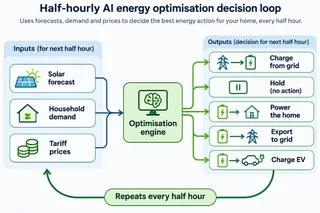
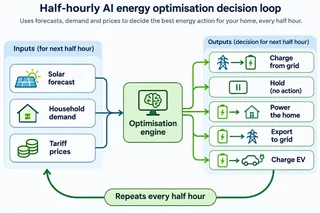
AI energy optimisation software decides, every half hour, whether a home battery should charge from the grid, hold its charge, power the house or export to the grid. It also decides when an EV should charge. It bases those decisions on forecast solar generation, expected household demand and the prices on your tariff. Whether it saves you money depends mainly on four things. These are your tariff type, the size of your battery relative to your usage, how much your consumption shifts from day to day, and whether your inverter can be controlled reliably.
For homes on a fixed single-rate tariff with a small battery, the gains are usually modest. For homes on a half-hourly or time-of-use tariff with a battery, an EV and a variable routine, the decisions get complicated quickly. That is where software tends to outperform fixed schedules set by hand.
Most battery systems ship with simple modes. Common ones are self-consumption, a timed charge window overnight, or a forced export period. These work reasonably well when prices and weather are predictable. They struggle when either changes.
A typical example is a homeowner who sets the battery to charge fully from the grid every night at the cheap rate. On a sunny spring day, the battery is then already full by morning. The solar generation it could have stored is exported at a low export rate instead. On a dull winter week, the same schedule may not charge enough to cover the expensive evening peak. Neither outcome is a fault. The schedule simply cannot see what tomorrow looks like.
Half-hourly tariffs make this more noticeable. Agile-style tariffs publish a new price for each of the 48 half-hour slots in a day, and those prices change daily. Some days include very cheap or even negative-price periods. Others have sharp evening peaks. A schedule chosen once and left alone cannot respond to that pattern. Many people also forget to update their settings when the seasons change.
An optimisation platform repeats the same decision loop across the day. It looks ahead at prices, weather and likely demand, then picks the action for the next slot that gives the best expected outcome over the whole horizon. It does not simply pick the cheapest action in the moment.
The main decisions for each slot are these.

The look-ahead is what matters most. Discharging now might seem sensible, but the system should hold if a higher price is due in two hours. Charging from the grid overnight should be skipped if a strong solar day is forecast. Getting these trade-offs right, day after day, is where the value comes from.
There are two broad approaches. Rule-based systems follow logic that people have written, such as "charge if the price is below a threshold" or "export if the battery is above a set percentage". These are transparent and predictable. Their weakness is that every rule is a compromise. A threshold that suits January can be wrong in June.
Reinforcement learning works differently. An agent is trained in a simulated environment over a very large number of scenarios. It learns which actions lead to lower overall cost, given prices, generation, demand and the physical limits of the battery. SolarMind uses this approach, with a policy trained to make charge, hold and export decisions on a half-hourly basis. The benefit is that the system can handle the interactions between solar, battery, EV and tariff without needing a separate rule for every situation.
Neither approach is magic. A learned policy is only as good as its inputs and its training. Poor solar forecasts, inaccurate consumption estimates or wrong tariff data will lead to poor decisions whatever the method. Learned systems can also be harder to explain. That is why good software should show you what it did and why, so you can check it.
Optimisation software adds value on top of hardware you already have. It cannot make up for a system that is badly matched to the home. Before expecting meaningful savings, it helps to look honestly at your setup.
The honest answer for some homes is that a well-chosen tariff and a sensible manual schedule capture most of the available value. Software becomes more useful as the number of variables grows.
Several problems come up repeatedly when homes move to automated battery control. Most are easy to avoid if you know to look for them.
Batteries and EVs are the most obvious flexible loads, but they are not the only ones. Heat pumps, hot water cylinders and immersion diverters can also be shifted in time, within limits. Pre-heating a well-insulated home before an expensive evening period, or heating hot water during a cheap or sunny slot, uses the building and the cylinder as thermal storage.
The limits matter here. Comfort comes first, and a poorly insulated home loses stored heat quickly. That reduces the benefit of shifting heating. Heat pump control also has to respect the system's design, including flow temperatures and defrost behaviour, so any optimisation should work with the heat pump's controls rather than against them. In practice, the larger and more varied the set of flexible loads, the more an integrated approach helps compared with controlling each device separately.
Give any optimisation system a fair trial across different weather and price conditions. A sunny fortnight and a grey fortnight can produce very different results, and a single week tells you little.
Look for a clear daily breakdown of what the system did. That means when it charged, held, discharged and exported, and the prices at each point. Compare costs against a realistic baseline, such as your previous schedule or a simple self-consumption mode on the same tariff. If the decisions regularly look wrong, such as exporting just before an expensive peak, it is worth investigating the inputs, especially the tariff data and consumption estimates.
Finally, keep your own control. You should be able to set an EV departure time, a minimum battery reserve and any periods you do not want the system to touch. Good automation should take the routine decisions off your hands while leaving you in charge of the ones that matter to you.
Solar comparison
Enter your postcode to assess your roof, compare solar options and get quotes from UK installers.
Choose home, business or industrial, then enter your postcode. RoboMo maps the roof and ranks panel brands by fit.
1. Postcode Start the assessment for your property.
2. Pin the roof Mark the array on the map.
3. Compare RoboMo™ builds your options.

Battery ROI tool
Enter the day rate, off-peak rate and export rate. The calculator ranks batteries in the Kilowatts shop over 10 years. Home batteries also suit offices and small commercial sites.
Reading
Read article

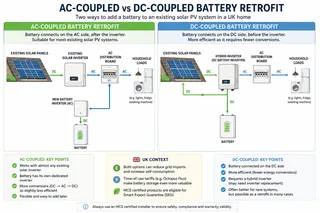
A battery without solar buys cheap overnight units for peak use. Payback depends on your tariff spread, not on generation.
Read article
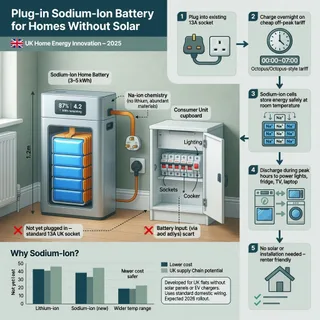
A plug-in sodium-ion battery for homes without solar is in development, not on sale. UK grid rules may still block a simple wall-socket connection.
Read article

Understand home battery lifespan uk in the UK, with clear explanations, examples, and practical next steps.
Read article
Write for Kilowatts.uk
Write it here under your own name. Sign in, put a profile up, and start a guide. Pay only if you want more links from your articles out to your own site.
Create a Kilowatts.uk account, or sign in if you already have one.
Put your name, photo and experience on a public author page.
Write a guide or a blog. Free authors can put one followed link to their own site in articles each month.
FAQ
Live help
Talk to RoboMo™ and get instant answers.
Live chat