


Flower Turbines vs HAWT for urban UK sites: UK business
Published: 2026-09-29 03:52:11
Updated: 2026-10-02 07:51:23
Flower Turbines vs a small HAWT on an urban UK site turns on hub-height wind, not the brochure. Check loads, planning, noise and connection before you buy.
Flower Turbines vs HAWT for urban UK sites - UK business guide
UK business guide Flower Turbines VAWT vs HAWT
Flower Turbines vs HAWT for urban UK sites
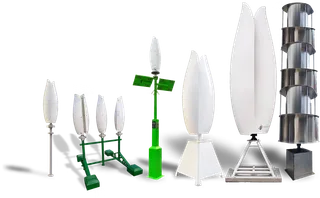
The choice between Flower Turbines and a small HAWT on an urban UK site comes down to the wind at hub height, not to which machine looks more modern on a brochure. A Flower Turbine is a branded vertical-axis wind turbine: the shaft is upright, the rotor has a tulip-like profile, and it does not yaw to one direction. A small horizontal-axis turbine must turn to face the wind and, in smooth steady flow, generally converts a larger share of the wind's energy for a given swept area. On a commercial roof, yard, or business-park plot in or on the edge of a UK town, buildings usually dominate the flow. Directional freedom does not, by itself, mean more electricity.
The useful comparison is practical. Will either machine see a real resource above the parapet or across the yard? Can the host structure take the loads? Will planning and neighbours accept the appearance, noise, and any flicker? Does the local network connection, and any export limit, make the kilowatt-hours worth having? Those questions are the same whether the rotor is horizontal or vertical. The brand name does not answer them.
This guide is for businesses, landlords, and facilities managers weighing a small free-standing or building-associated turbine on a town, city, or edge-of-town premises. It is not a way to judge a multi-megawatt wind farm, and it is not a template for a householder under domestic permitted development. The credible path is measurement or competent modelling first, then consents and connection, then hardware. Ordering from a power curve and hoping the roof is breezy enough is how small urban wind disappoints.
How a Flower Turbine differs from a small HAWT
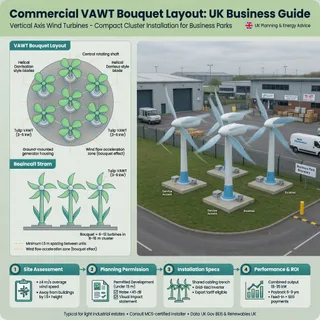
A horizontal-axis wind turbine spins about a shaft that points into the wind, with blades set like a propeller. It has to yaw so the rotor faces the flow. Almost all large UK wind farms use that layout because, in relatively smooth and directional wind, it is an efficient way to extract energy. In this comparison a HAWT means a small machine proposed for a business site, either on a mast in a yard or associated with a building. It does not mean a farm-scale turbine dropped onto a retail park. A Flower Turbine is a specific vertical-axis product, not a generic label for every upright rotor. The shaft stays vertical and the rotor is shaped so it can accept wind without yawing to a single bearing. Suppliers also offer grouped layouts, sometimes described as a bouquet, and may claim that close spacing helps the machines interact. That interaction is a product claim. It is not a standard assumption in UK yield or planning work unless it has been shown for the spacing, the heights, and the wind directions on that plot. Once the axis is clear, yield still depends on everything around the rotor. Swept area and the wind speed at that height sit between a spinning rotor and a useful meter reading. So does time spent off design conditions, and the energy the controller and inverter consume in light winds. A vertical-axis machine can keep turning when the direction jumps around a roof edge. A horizontal-axis machine can sit partly off-axis, or spend time yawing, in the same confused flow. Neither behaviour is an annual energy figure. Fatigue in turbulence, start-up in light winds, and a documented service record still decide whether the installation is an energy project or a moving object on a building.
What urban UK roofs and yards do to the wind
UK flow is often from the south-west at weather-map scale. At street level and at the height of a low commercial roof, that regional direction is often irrelevant. Neighbouring mass, parapets, plant rooms, trees, and the building you are mounting on break the flow up, slow it down, and change its direction over a few metres. Mean speed is commonly lower than on open farmland, and turbulence is high. A breezy afternoon, or a gust that flaps a flag, is not evidence of a high annual mean with low turbulence.
Two mechanisms matter on site, and they can sit on the same building. At a windward edge the flow can accelerate, which is why a roof corner sometimes feels promising. A few metres back, or behind a taller neighbour, the rotor may sit in a wake for much of the year. Two plots in the same district can differ sharply, and moving a proposed position toward a parapet can change the resource even when the postcode does not. A desktop wind map is screening only. It can suggest that a site is unlikely to be a wind project. It cannot justify a yield.
Installers who treat urban small wind seriously start with the proposed hub height, not with a regional average pasted onto a brochure curve. They look at fetch, meaning how far the wind travels over open ground before it hits the site, and at obstacles taller than the rotor. A short anemometer campaign is uncertain because it can miss a season. A full year captures more of the pattern, and even then the result belongs to that mast position, not to the roof in general. If the client will not pay for measurement or for modelling that includes turbulence, neither a Flower Turbine nor a small HAWT should be treated as a forecastable generator.
Why rated power is not the electricity you will see
Rated power is the output at a stated wind speed on a power curve. It is not the electricity the site will produce in a year, and it is not a capacity factor. Sales curves are typically drawn for controlled or relatively smooth flow. Using them unchanged on a UK city roof overstates confidence, because urban turbulence may rarely match the test conditions. Energy at the generator is also not energy after the inverter and controller. In light winds, those parasitic loads can take a large share of a small turbine's output. That was a practical lesson of earlier UK small-wind monitoring, and it still matters wherever mean speeds are modest.
Installed cost, annual energy, capacity factor, noise at a receptor, and service life for Flower Turbines on urban UK commercial sites are not established in the material behind this guide. Do not treat a pound-per-kilowatt figure, a payback year, or a homes-powered equivalent as a planning assumption. Those claims need a primary source: an independent test, a power curve with its conditions stated, or a monitored UK installation at a comparable height and exposure. A claim that closely spaced turbines increase each other's output should stay a hypothesis until it is shown for the proposed layout and wind directions.
Older UK work on small building-mounted turbines, including the Warwick Wind Trials from the late 2000s, found that many installations produced far less than sales material implied, and that some performed very poorly. Exact figures belong in the published report, not in a reconstructed summary. Those trials did not test current Flower Turbine models. They are context for urban small wind of that period, not a verdict on this product. They do justify a sceptical reading of any urban yield that has not been measured at hub height. In smooth directional wind, a well-sited HAWT is generally the higher-yielding machine for a given swept area. In confused flow it may limit itself while a vertical-axis rotor keeps turning. Rotation is not useful annual energy. Life then depends on turbulence fatigue, installation quality, and a service record you can check, not on a design life inferred from a brochure.
Planning, noise, and neighbours
Planning for a small turbine is a site and nation matter. England, Scotland, Wales, and Northern Ireland do not share one rule set. Some domestic micro-wind installations have permitted development limits in parts of the UK. That domestic route is not a template for a commercial roof, a yard on a business park, a listed building, a conservation area, or a machine that is taller or larger than those domestic limits. Commercial schemes commonly need an application. Technology preference does not remove that. Confirm the live rules for the nation and the building before anyone treats consent as a formality.
Authorities typically look at noise, appearance, and sometimes shadow flicker, alongside the usual planning tests for the plot. Regular shadow sweep is mainly a horizontal-axis issue, because the blades pass a repeating arc between the sun and a window. A vertical-axis rotor is less of a sweeping-shadow machine, but it is not silent and it is not invisible. Aerodynamic noise and mechanical noise still have to be judged against distance, background level, and any tonal character. A noise figure copied from a datasheet, without the distance and the wind speed it assumes, is not a prediction at the neighbour's façade. Vibration into an occupied building is a separate point for roof mounts of either type, and it is felt by the people inside long before it appears on a planning drawing.
Conservation areas, listed buildings, and noise-sensitive neighbours need amenity work first, not after the base is ordered. Ecology constraints can still apply on urban and edge-of-town plots, even where the site looks fully developed. If the commercial aim is a visible sustainability gesture, that aim does not shorten the consent path. A refusal, or a condition that cuts operating hours, can remove the energy case entirely. The honest early question is whether the client will accept a design that planning can live with, including a lower hub height that may also cut the yield.
Loads, access, and safety on an occupied building
A roof turbine is a structural and weathering design, not a bracket selection. The critical loads are extreme wind, fatigue from turbulence, and vibration into purlins, slabs, or a mast base. Static weight is the easy number and often the least important. A structural engineer working to current UK codes should assess the host structure, including how fixings pierce the waterproofing and how the load path reaches frames that were not designed as turbine foundations. Ground mounts shift the problem to foundations, buried services, and crane or access planning, but they do not remove it.
Commercial construction sits under Construction (Design and Management) duties. Safe access has to exist for the life of the machine, not only for installation day. On an occupied office, warehouse, or retail roof, maintenance access is often the constraint a desktop layout ignores: guard rails, fragile coverings, plant that cannot be shut down, and a route that does not put staff under a rotor. Ice, debris, and blade failure belong in the hazard assessment even where UK icing is intermittent. A yard machine needs the same thinking about people, vehicles, and overhead lines.
Warranty terms may require an approved installer and a service contract. Exclusions for turbulent sites, roof mounting, or operation outside stated wind conditions should be read, not inferred from a stated design life. A turbine warranty is not a structural sign-off, and a structural sign-off is not a yield guarantee. If the only access plan is a return visit with a cherry picker after something fails, the installation is not finished. That gap is as common on a neat vertical-axis layout as on a conventional mast.
Grid connection and the value of each kilowatt-hour
Parallel connection depends on the proposed capacity and on whether the system operates with the supply. It does not depend on vertical-axis versus horizontal-axis branding. A commercial scheme may need an application to the local distribution network operator. Above small thresholds that process is often discussed under G99. Thresholds, forms, and export limits differ by operator and they change. They have to come from the current operator and national documents, not from a product brochure or from a remembered cut-off. Electrical design should be fixed before purchase: supply capacity, any export limit, power quality, protection, and metering that can test the forecast against what the rotor actually delivers.
The Feed-in Tariff is closed to new applicants. The Smart Export Guarantee has its own eligibility rules. Do not assume a given turbine qualifies, and do not assume a grant or a certification, including Microgeneration Certification Scheme status, unless a current scheme document names that model. Certification and export-scheme status are checks, not features of the axis. If the connection allows little or no export, only the electricity used on site has a clear value, and a machine that produces little during operating hours is not worth the same as the same kilowatt-hours consumed behind the meter.
Wind and solar do not produce on the same pattern. A turbine may generate overnight or in winter gales when a shop or office is shut, and it may sit idle on a still summer afternoon when the building load is high. That mismatch is a commercial point. Metering that only shows generation, without site load, will not tell you whether the project reduced imports. Agree how performance will be judged, including hub-height wind, exported energy, and on-site use, before the order, or the first year's data will be argued rather than used.
Where each option is the stronger fit
In smooth, directional wind with a clear fetch, a well-sited small HAWT is generally the more credible energy machine for a given swept area. That is the case on a roof that stands above surrounding buildings, on a coastal or hill-edge park, or in an open yard where the rotor can yaw into a prevailing flow without spending its life in a neighbour's wake. The HAWT still needs a real hub-height resource. Exposure on a plan is not the same as a measured mean speed. Shadow flicker and yaw space become part of the layout, and a mast that is tall enough to clear turbulence may be the thing planning finds hardest to accept. Flower Turbines are in scope when that named vertical-axis machine, including a multi-unit layout, is being weighed against a small HAWT on the same plot. The case for looking at them seriously is directional confusion: a roof edge or yard where the wind jumps, so a yawing rotor would often be off-axis, and where the client will still pay for measurement before treating a bouquet layout as extra yield. Close spacing remains a claim until it is measured for those wind directions. A wish to group several small rotors does not create a wind farm resource on a sheltered street. The table below is a decision frame, not a performance ranking. It does not assign costs, decibels, or annual energy, because those figures are not established here for urban UK commercial use of current Flower Turbine models.
Overview
Read the last row as a brake on both columns. A HAWT is not proven on this roof because some other building once had a small turbine. A Flower Turbine is not proven in turbulence because it does not need to yaw. The stronger fit is the machine whose forecast survives hub-height wind, a structural check, and a consent path the client will actually pursue. Businesses comparing that named vertical-axis option can use a site-led Flower Turbines review to hold the product claim against those constraints, rather than against a generic vertical-axis story.
When rooftop solar is the more predictable project
On many unshaded UK commercial roofs, photovoltaics are the more predictable generation option. That is especially true for warehouses, offices, and retail units whose daytime electrical load lines up better with solar hours than with an unmeasured urban wind rose. It does not rule wind out on a genuinely exposed site, and it is not a claim about prices, payback, or grants. No cost or yield comparison between commercial rooftop solar and these turbines is sourced for this guide, so none is offered. The point is resource confidence. A roof that can take solar has a generation pattern that designers already know how to model. An urban turbine does not, until the wind at hub height is known.
Sheltered streets, courtyards, and low roofs in the lee of taller buildings are a poor match if the aim is a material cut in the electricity bill. If measured speeds are modest, neither a Flower Turbine nor a small HAWT is likely to function as an energy project. A visible rotor does not change that. Businesses that need a forecastable daytime yield, and whose roofs can take photovoltaics, should not treat an unmeasured urban turbine as the main option. Wind can still be studied as a secondary question on an exposed edge, after the solar layout, the structural reserve, and the network capacity are understood.
Commercial solar and a small turbine also meet at the same electrical bottleneck. Export limits, G99 applications for larger works, and the value of on-site use versus export apply to both. Adding a turbine to a roof that is already full of solar does not bypass the connection. It can make the export question harder if both generators peak together, or it can be almost irrelevant if the turbine's output is small beside the site load. That is another reason to fix the electrical design before anyone compares hardware aesthetics.
What to settle before you order a turbine
The decision is ready for quotes when the site, not the catalogue, is doing the work. That means a proposed position, a hub height, a view on turbulence, a structural opinion, a planning route for that nation and building, and a connection position that includes any export limit. If any of those is still a brochure assumption, the quote is a price for equipment, not a project. Installers should be asked to show how they moved from wind data to annual energy after inverter losses, and what they will do if the measured resource is poor. A competent refusal to install is a better outcome than a quiet rotor over a shop.
Warranty, access, and monitoring belong in the same conversation. Ask who may install and maintain the machine, which sites are excluded, and how performance will be metered against the forecast. On an occupied building, ask how blades, ice, and falling debris are managed, and whether the roof can be reached without closing the business. Those questions apply equally to a small HAWT and to a grouped vertical-axis layout. They are the difference between a specification and a hope.
If those answers are thin, pause. A small turbine on an urban UK business site can be a reasonable study where exposure is real and the client will fund the evidence. It is a weak default everywhere else. Neither axis removes planning, safety, or the need to know the wind.
Plan, Compare & Buy Renewable Energy Solutions
AI does the thinking.
You get the perfect solar match.
Use RoboMo™ to assess your property, compare available technologies and connect with trusted UK installers, suppliers and manufacturers.
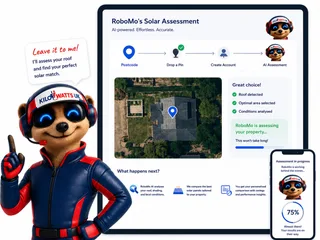
Simply enter your postcode, drop a pin on your roof, create your free account and let RoboMo™ analyse your property to find the best solar panels for your home.

You don't have to think
RoboMo™'s AI analyses your roof and does all the hard work.

Accurate & tailored
AI-powered assessment based on your roof, location, and conditions.

Best options, maximum savings
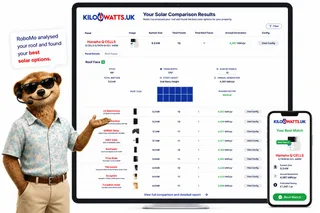
Compare top solar panels for the best performance and value.

Simple, fast & effortless
Provide a few details, sit back and watch your results unfold.
STEP 1
Choose Home, Business or Industrial
Enter your postcode to start your assessment.
STEP 2

Drop a pin on your roof
STEP 3

Create your free account
STEP 4

Sit back and watch RoboMo™ work
RoboMo™ analyses your roof and builds your personalised solar comparison.

Kilowatts UK is an authorised representative
Flower Turbines
Compact vertical-axis turbines built for real UK sites, not just open farmland.
They start in light wind, sit in a small footprint, and are bird-safe by design. Cluster them as a bouquet and the group performs better together than the same turbines standing alone. Enter your postcode for a location-based generation estimate. Figures use area weather data and will differ if buildings, trees or hills sit in the way.
Starts in light UK wind
Built to generate in typical UK wind, not only open farmland.
Small rooftop or ground footprint
Compact towers for roofs, yards and tight sites.
Bird-safe slow rotation
Slow vertical-axis spin, bird-safe by design.
Bouquet clusters raise output
Grouped turbines outperform the same units standing alone.

Step 1
Enter your postcode
Start designing your wind energy system in seconds.

STEP 2

Choose a location
STEP 3

Place your cluster
Tap the map where you want the turbine cluster to go.
STEP 4

Instant generation forecasts
Compare different turbine layouts and see annual generation forecasts instantly.
STEP 5

No commitment required
Explore different configurations before deciding whether to request a quotation.
Related articles
Solar panels
Mo's Mission Nominations
FAQ
Need Help? RoboMo's Got Answers
What is the difference between a Flower Turbine and a small HAWT?
A Flower Turbine is a branded vertical-axis wind turbine: the shaft stays upright, the rotor has a tulip-like profile, and it does not yaw to face one direction. A small horizontal-axis wind turbine spins about a shaft that points into the wind and must turn so the rotor faces the flow. In this comparison a HAWT means a small machine on a business mast or associated with a building, not a farm-scale turbine dropped onto a retail park. The brand name does not tell you whether either machine will see a useful wind at hub height.
Which is the better choice for an urban UK business site?
The choice comes down to the wind at hub height, not to which machine looks more modern. In smooth, directional wind with a clear fetch, a well-sited small HAWT is generally the higher-yielding machine for a given swept area. In confused flow a horizontal-axis machine may sit off-axis or spend time yawing, while a vertical-axis rotor may keep turning, but rotation is not useful annual energy. Claims that closely spaced Flower Turbines increase each other's output should stay a hypothesis until shown for the proposed layout, heights, and wind directions. Neither option should be ordered from a power curve in the hope that the roof is breezy enough.
Can rated power or a sales curve tell me the annual electricity?
Rated power is the output at a stated wind speed on a power curve. It is not the electricity the site will produce in a year, and it is not a capacity factor. Sales curves are typically drawn for controlled or relatively smooth flow, so using them unchanged on a UK city roof overstates confidence. Energy at the generator is also not energy after the inverter and controller, and in light winds those loads can take a large share of a small turbine's output. Installed cost, annual energy, capacity factor, and service life for Flower Turbines on urban UK commercial sites are not established in the material behind this guide, so do not treat a payback year or a homes-powered equivalent as a planning assumption.
Is a desktop wind map enough before I buy?
A desktop wind map is screening only. It can suggest that a site is unlikely to be a wind project, but it cannot justify a yield. At street level and on a low commercial roof, buildings, parapets, plant, and trees often slow the wind, raise turbulence, and change direction over a few metres, so two plots in the same district can differ sharply. Serious assessment starts at the proposed hub height and looks at fetch and obstacles taller than the rotor. If you will not pay for measurement or for modelling that includes turbulence, neither a Flower Turbine nor a small HAWT should be treated as a forecastable generator.
Does a commercial urban turbine fall under domestic permitted development?
Planning is a site and nation matter, and England, Scotland, Wales, and Northern Ireland do not share one rule set. Some domestic micro-wind installations have permitted development limits in parts of the UK, but that route is not a template for a commercial roof, a business-park yard, a listed building, a conservation area, or a machine taller or larger than those domestic limits. Commercial schemes commonly need an application, and a preference for vertical-axis or horizontal-axis hardware does not remove that. Confirm the live rules for the nation and the building before anyone treats consent as a formality. A refusal, or a condition that cuts operating hours, can remove the energy case entirely.
How do noise, flicker, and neighbours differ between the two?
Authorities typically look at noise, appearance, and sometimes shadow flicker, alongside the usual planning tests for the plot. Regular shadow sweep is mainly a horizontal-axis issue, because the blades pass a repeating arc between the sun and a window. A vertical-axis rotor is less of a sweeping-shadow machine, but it is not silent and it is not invisible. A noise figure copied from a datasheet, without the distance and the wind speed it assumes, is not a prediction at a neighbour's façade. Vibration into an occupied building is a separate point for roof mounts of either type, and conservation areas, listed buildings, and noise-sensitive neighbours need amenity work before the base is ordered.
What structural and safety checks matter on an occupied building?
A roof turbine is a structural and weathering design, not a bracket selection. Extreme wind, fatigue from turbulence, and vibration into the building usually matter more than static weight, and a structural engineer working to current UK codes should assess the host structure, fixings, and waterproofing. Commercial construction sits under Construction (Design and Management) duties, and safe access has to exist for the life of the machine, not only for installation day. Ice, debris, blade failure, people, vehicles, and overhead lines belong in the hazard assessment. A turbine warranty is not a structural sign-off, and a structural sign-off is not a yield guarantee, so read any exclusions for turbulent sites or roof mounting rather than inferring them from a stated design life.
Will either machine automatically qualify for export payments, a grant, or MCS?
Parallel connection depends on the proposed capacity and on whether the system operates with the supply, not on vertical-axis versus horizontal-axis branding. The Feed-in Tariff is closed to new applicants, and the Smart Export Guarantee has its own eligibility rules, so do not assume a given turbine qualifies. Do not assume a grant or a certification, including Microgeneration Certification Scheme status, unless a current scheme document names that model. Above small thresholds the process is often discussed under G99, but thresholds, forms, and export limits differ by operator and change, so they must come from the current distribution network operator and national documents. If little or no export is allowed, only electricity used on site has a clear value, and generation that misses the building's operating hours is worth less than the same energy used behind the meter.