


Flower Turbines for Kent coastal rooftops
Published: 2026-10-06 04:02:16
Updated: 2026-10-05 21:02:51
Flower Turbines for Kent coastal rooftops are a niche choice, not a default upgrade. Check hub wind, salt air, roof loads and planning before you buy.
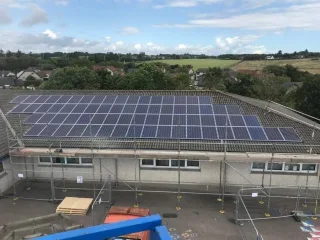
Flower Turbines for Kent coastal rooftops
Flower Turbines for Kent coastal rooftops from Kilowatts.uk in Broadstairs. Costs, roofs, planning and what to do next then compare a local system.
Are Flower Turbines realistic on Kent coastal rooftops?
Flower Turbines for Kent coastal rooftops are a niche option, not a default upgrade for a Broadstairs or Thanet building. A seafront postcode does not, by itself, make a short rooftop machine worthwhile. The decision turns on clean wind at the actual hub, a structure that can take cyclic loads, salt-air maintenance, neighbour amenity, and a planning and electrical route that still has to be checked against the live instruments named below.
Coastal east Kent is windier than much of inland Kent, but a house roof, parapet or dense street is not an open mast site. Published product claims do not establish annual energy, installed cost or service life on a UK roof. Those figures are unknown here and should not be filled in from brochures or generic small-wind averages.
Treat the turbine, the site wind, and the legal and electrical path as three separate questions. A favourable answer to one does not settle the other two. Write down the date on every official page you read. This article points to the sources. It does not freeze the rules.
How a Flower Turbine differs from a rooftop propeller
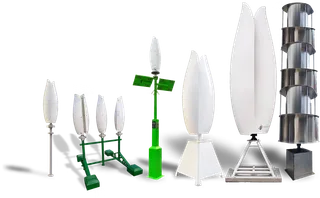
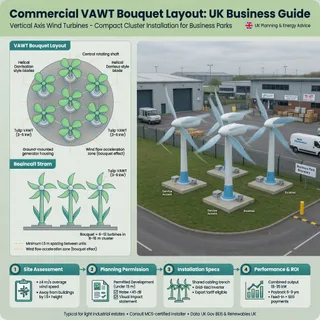
A Flower Turbine is a branded vertical-axis wind turbine. The rotor is a curved, tulip-like shell that spins about a vertical shaft, rather than a propeller that yaws to face the wind on a horizontal shaft. The maker also promotes groups of machines, sometimes called a bouquet, on the idea that neighbouring rotors can change the airflow between them. Product claims for tulip and power towers still need a site test, not a cluster diagram.
That shape does not make the machine a decorative plant, and it does not remove noise, vibration or planning weight. Aerodynamic and mechanical noise, plus structure-borne vibration, still have to be judged at bedrooms and neighbouring windows. A marketing description of a cluster effect is not a site-specific energy prediction. Spacing, wind direction and turbulence all change how rotors interact. A tight residential roof often cannot provide the spacing or the safe access a group would need.
Before comparing models, ask what primary test stands behind the tulip and bouquet claims. A useful pack states the power-curve standard, the turbulence intensity and air density of the test, whether the flow was clean or obstructed, and measured noise and vibration at stated distances and wind speeds. It should also name marine warranty clauses, not a general product promise. Without those conditions, a bouquet diagram is advertising, not a Broadstairs energy case. On a small urban roof, wind should not be assumed to beat solar. Solar is the more familiar microgeneration choice in Kent towns because the resource is easier to estimate from roof orientation and shading, and because the install is usually less sensitive to resonance in occupied rooms. A turbine also competes with existing solar, plant and fall-protection kit for the same roof area. It can put a covering warranty at risk if the roofing-system manufacturer has not accepted the penetrations and flashings in writing. Where the roof can take a conventional array, it is worth pausing to compare home solar options before treating wind as the default.
Why a Thanet postcode does not set the yield
Thanet and the open east Kent coast are among the windier parts of the South East. That regional picture does not transfer to a rotor a few metres above a roof. Buildings, parapets and nearby roofs create shear and gusts. A power curve measured in cleaner flow will overstate energy if it is applied to a short mast without wind data at the proposed hub height.
A turbine tucked behind a parapet, on a leeward slope, or in a dense Broadstairs street can see little of the coastal resource that a headline map suggests. Exposed open coast is generally windier than a sheltered inland street. A short rooftop mast is generally a poorer, more turbulent resource than an open site at greater height. There is no justified numeric conversion of that statement for this product on Kent roofs. Residential wind power still has to be judged at the actual hub, not from a coastal average.
Independent, UK-measured annual yield for Flower Turbines on coastal or urban roofs is not established for this guide. Capacity factor in urban coastal flow, payback and service life in salt air are likewise unknown. Do not treat European test figures, manufacturer curves or generic small-wind averages as a Broadstairs result. A prior wind log at hub height is more useful than a regional average. Even that log only becomes an energy estimate once a competent designer applies a power curve that actually matches the turbulent site. The log itself needs a method, not a single average. Record the instrument type, its height relative to the proposed hub, the logging period, and how nearby roofs and parapets were noted. Manufacturers often cite IEC 61400-12 for power-performance testing. Ask whether the curve you are shown was measured to that standard or another named method, and in what turbulence. A clean-flow curve is not a Kent roof result.
Salt air, roof loads and neighbour amenity
On this coast, salt, driven rain and corrosion often decide the job before aerodynamics do. Fixings, bearings, coatings, cables and roof penetrations need a marine specification, not an inland assumption. Coatings that look adequate in marketing photographs can be the wrong starting point for Thanet air. Insurance and a realistic inspection cycle belong in the design, not as an afterthought once the mast is up.
Salt-air life is not established for this product on a Kent roof, so nobody should quote a typical coastal lifespan. Ask for the corrosion category or salt-spray test the coating and fixings were specified to. ISO 12944 environment categories and ISO 9227 salt-spray tests are the sort of clauses a marine warranty should name, together with coastal exclusions and the inspection interval. A general warranty that is silent on marine air is not evidence of Thanet durability.
The turbine is only part of the design. The load path runs through the mast, roof frame and fixings into the building. Roof and mast loads must be designed for wind and fatigue, not only for the static weight of the unit. In UK structural practice, wind actions are commonly justified to BS EN 1991-1-4, with fatigue cases for cyclic loading. Resonance into occupied rooms is a common reason rooftop turbines are refused or later removed. An installer should be tracing uplift, fatigue and vibration paths, not simply whether the unit appears to fit. Neighbour amenity is wider than a noise number at the turbine. Movement in outlook, construction access, and bedrooms facing the machine all matter in tight residential streets. For sound, ask for measured levels with distance, wind speed and weighting stated, and how those levels would be judged at façades and bedrooms. Designers commonly use BS 4142 when rating sound affecting people nearby, and BS 8233 when indoor criteria for bedrooms are the concern. For structure-borne vibration, BS 6472 is a usual reference for human response in buildings. These are assessment methods to demand evidence against. They are not a Kent noise limit, and they are not proof that this machine has been tested to them. Large-windfarm methods such as ETSU-R-97 should not be copied onto a house roof unless an acoustic designer says they apply. Safe lifting and later bearing access are often impossible on a narrow house roof, which turns a small machine into a long-term maintenance problem. If the covering manufacturer will not accept the fixings, the roof warranty can fail even when the turbine itself is sound.
Planning, connection and what remains unknown
Planning is separate from wind resource. Broadstairs and other Thanet centres include conservation areas, listed buildings and tight streets, where appearance and neighbour amenity carry weight. A flower-shaped rotor is not exempt because it looks decorative. In a conservation area, motion and appearance can make consent harder, not easier.
Permitted development is not automatic because the machine is small. The instrument to read is the current Town and Country Planning (General Permitted Development) (England) Order, including amendments in force, not a brochure or a neighbour’s installation. Check that consolidated text, any official Planning Portal explanation that cites it, and Thanet District Council practice for the actual address, including conservation-area appraisals where they exist. Record the date on each page. This article does not state that a building-mounted turbine has, or lacks, a permitted development right.
Listed fabric is a further consent question. If the works would affect the character of a listed building, listed building consent is separate from planning permission. Historic England publishes general advice. Thanet District Council decides the application. Rotor size does not settle either consent. Grid connection in much of this region is through UK Power Networks. Export depends on the generator, the inverter or other interface, and the connection process in force at the time. A turbine does not plug in like an appliance. Isolation, earthing and a cable route through salt-laden air have to match that process. The industry often discusses small generation under G98 or G99, but which notification or application applies to this equipment must be taken from the current UK Power Networks connection pages for the exact interface type. Record the guidance version. Do not copy the paperwork from a domestic solar job on the same building. A separate note on UKPN approval for these machines explains why the interface type still has to be checked live. MCS listing is a directory fact, not a marketing sentence. Search the live MCS product directory for the exact model and the MCS certified installer directory for the firm that would install it, and note the search date. It is not established here that any current Flower Turbine model is listed. Smart Export Guarantee terms, if any, depend on Ofgem’s current SEG guidance and on the supplier’s rules at the time. Do not assume a turbine qualifies because solar on the same roof might. Any grant or scheme for domestic rooftop wind in England should be taken only from the current GOV.UK scheme page, with that page date recorded. None is stated here.
Who should consider one and who should not
This is more plausible where there is real exposure, a structure that can take cyclic loads, safe access for installation and maintenance, and a planning route that can accommodate motion and appearance. A non-domestic building with a flat roof, fewer immediate bedroom windows, and an owner who can fund monitoring and upkeep is closer to that description than a typical terraced house. On that kind of building, commercial wind power is still a design question, not a guaranteed coastal yield. It is a poor fit where the aim is predictable bill reduction on a constrained Broadstairs roof, especially if solar is feasible and the roof cannot spare structure, space or warranty risk. Listed buildings, tight conservation streets, weak roof decks and sites with no maintenance access are generally unsuitable. It is also unsuitable where the buyer needs a guaranteed yield or a grant-backed certified domestic product, because neither is established here. Renters and leaseholders usually cannot decide this alone. Freeholder consent, lease terms and building insurance often block rooftop plant even when the coast looks windy.
What a competent assessment checks first
Before any purchase, the useful work is measurement and constraint-checking, not a brochure comparison. A competent assessment records wind at the proposed hub height, inspects the roof build-up and load path, and checks whether the covering manufacturer will accept the penetrations and flashings. If they will not, the covering warranty may be lost even if the turbine itself is sound. The flower turbine service is the right place to start that check, not a brochure yield.
Planning and conservation constraints should be taken to Thanet District Council where the building sits in that district, including pre-application advice where the street is sensitive. Neighbours with bedrooms facing the mast should be considered early, because amenity objections are harder to design out after steelwork is ordered. Electrical design stays separate from the mechanical install. Put the connection question to the UK Power Networks process that applies to the actual equipment, and keep the MCS, Ofgem and GOV.UK checks dated rather than assumed from a solar installation next door.
Product literature is not a substitute for that site-specific calculation. Existing solar layouts should be drawn on the same roof plan so the two systems are not designed as if the other were absent. If the documents above cannot be produced, there is nothing solid to compare between models.
Sensible next steps in Broadstairs and Thanet
Start with the building, not the turbine. Note roof type, age, covering warranty, available mast position, who owns the roof, and whether bedrooms or neighbouring windows face that spot. If you cannot get safe access for a future inspection, stop there. If solar is still feasible on the same roof, compare the two on certainty of resource and on structural risk, not on a coastal headline. Solar is usually the more realistic bill-reduction choice where the roof is constrained, shaded only in part, and already able to take a conventional array without resonance in occupied rooms.
Ask an installer or structural designer what they would measure at hub height, how they would justify fatigue and vibration against the methods above, and which DNO and planning steps they would confirm before ordering equipment. Ask for marine-grade materials and an inspection cycle in writing. If those answers rely on a guaranteed annual kilowatt-hour figure, a grant, or an assumed MCS listing, treat that as a gap rather than a reason to proceed. A free home energy survey can record the roof constraints before any machine is ordered.
Keep a short source note with the enquiry. That note should name the GPDO text and date, the Thanet District Council page or pre-application reference, the MCS directory search date, the Ofgem SEG page and supplier terms, the GOV.UK scheme page if a grant is mentioned, and the UK Power Networks guidance version. Until those live checks are done, a Flower Turbine remains an unproven rooftop proposal, not a coastal upgrade.
Plan, Compare & Buy Renewable Energy Solutions
AI does the thinking.
You get the perfect solar match.
Use RoboMo™ to assess your property, compare available technologies and connect with trusted UK installers, suppliers and manufacturers.
Simply enter your postcode, drop a pin on your roof, create your free account and let RoboMo™ analyse your property to find the best solar panels for your home.

You don't have to think
RoboMo™'s AI analyses your roof and does all the hard work.

Accurate & tailored
AI-powered assessment based on your roof, location, and conditions.

Best options, maximum savings
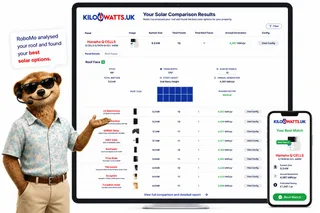
Compare top solar panels for the best performance and value.

Simple, fast & effortless
Provide a few details, sit back and watch your results unfold.
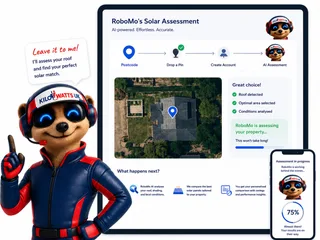
STEP 1
Choose Home, Business or Industrial
Enter your postcode to start your assessment.
STEP 2
Drop a pin on your roof
STEP 3

Create your free account
STEP 4

Sit back and watch RoboMo™ work
RoboMo™ analyses your roof and builds your personalised solar comparison.

Step 1
Enter your postcode
Start designing your wind energy system in seconds.
Are you an installer, distributor or renewable energy business?
Kilowatts UK is expanding the Flower Turbines partner network across the UK.
Become A Flower Turbines PartnerKilowatts UK is an authorised representative
Flower Turbines
Compact vertical-axis turbines built for real UK sites, not just open farmland.
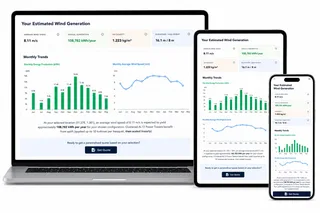
They start in light wind, sit in a small footprint, and are bird-safe by design. Cluster them as a bouquet and the group performs better together than the same turbines standing alone. Enter your postcode for a location-based generation estimate. Figures use area weather data and will differ if buildings, trees or hills sit in the way.
Starts in light UK wind
Built to generate in typical UK wind, not only open farmland.
Small rooftop or ground footprint
Compact towers for roofs, yards and tight sites.
Bird-safe slow rotation
Slow vertical-axis spin, bird-safe by design.
Bouquet clusters raise output
Grouped turbines outperform the same units standing alone.
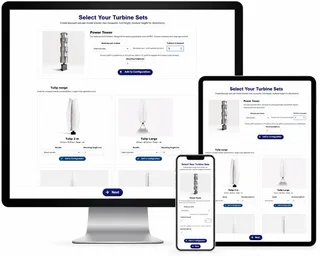
STEP 2

Choose a location
STEP 3

Place your cluster
Tap the map where you want the turbine cluster to go.
STEP 4

Instant generation forecasts
Compare different turbine layouts and see annual generation forecasts instantly.
STEP 5

No commitment required
Explore different configurations before deciding whether to request a quotation.
Related articles
FAQ
Need Help? RoboMo's Got Answers
Are Flower Turbines a realistic upgrade for a Kent coastal rooftop?
They are a niche option, not a default upgrade for a Broadstairs or Thanet building. A seafront postcode does not by itself make a short rooftop machine worthwhile. The decision depends on clean wind at the actual hub, a structure that can take cyclic loads, salt-air maintenance, neighbour amenity, and a planning and electrical route that still has to be checked against current rules. Published product claims do not establish annual energy, installed cost or service life on a UK roof.
How is a Flower Turbine different from a rooftop propeller?
A Flower Turbine is a branded vertical-axis machine with a curved, tulip-like rotor that spins about a vertical shaft, rather than a propeller that turns to face the wind. The maker also promotes groups of machines, sometimes called a bouquet, on the idea that neighbouring rotors can change the airflow between them. That shape does not remove noise, vibration or planning weight, and a cluster diagram is not a site-specific energy prediction. On a small urban roof, solar is often the more familiar microgeneration choice because the resource is easier to estimate and the install is usually less sensitive to resonance in occupied rooms.
Will a Thanet or Broadstairs postcode guarantee a good yield?
No. Coastal east Kent is windier than much of inland Kent, but a house roof, parapet or dense street is not an open mast site. Buildings create shear and gusts, so a power curve measured in cleaner flow can overstate energy if it is applied to a short mast without wind data at hub height. Independent UK-measured annual yield, capacity factor, payback and salt-air service life for this product on coastal or urban roofs are not established here. A prior wind log at the proposed hub height is more useful than a regional average.
What should I ask about salt air, roof loads and neighbour amenity?
On this coast, salt, driven rain and corrosion often decide the job before aerodynamics do. Ask which corrosion category or salt-spray test the coatings and fixings were specified to, and whether the warranty names coastal exclusions and an inspection interval. Roof and mast loads should be designed for wind and fatigue, not only the static weight of the unit, and resonance into occupied rooms is a common reason rooftop turbines are refused or later removed. Noise, vibration, outlook and safe access for later maintenance all need evidence at bedrooms and neighbouring windows, not a marketing photograph.
Do I need planning permission, and is permitted development automatic?
Planning is separate from wind resource, and a flower-shaped rotor is not exempt because it looks decorative. Permitted development is not automatic because the machine is small. Check the current Town and Country Planning (General Permitted Development) (England) Order, any official Planning Portal explanation that cites it, and Thanet District Council practice for the actual address, and record the date on each page. If the works would affect the character of a listed building, listed building consent is a further question and is separate from planning permission.
How does grid connection work, and does MCS or a grant apply?
In much of this region the network operator is UK Power Networks. A turbine does not plug in like an appliance, and which G98 or G99 notification or application applies must be taken from the current connection pages for the exact interface type. It is not established here that any current Flower Turbine model is listed on the MCS product directory, so search the live directories and note the date. Smart Export Guarantee terms, if any, depend on current Ofgem guidance and the supplier’s rules, and any grant or scheme should be taken only from the current GOV.UK page. None is stated here.
Who might consider one, and who should not?
It is more plausible where there is real exposure, a structure that can take cyclic loads, safe access for installation and maintenance, and a planning route that can accommodate motion and appearance. A non-domestic building with a flat roof and fewer immediate bedroom windows is closer to that description than a typical terraced house, and even then yield is not guaranteed. It is a poor fit where the aim is predictable bill reduction on a constrained Broadstairs roof, especially if solar is feasible. Listed buildings, tight conservation streets, weak or warrantied roofs, sites with no maintenance access, and buyers who need a guaranteed yield or a grant-backed certified product are generally unsuitable.
What should a competent assessment check before I buy?
Start with measurement and constraint-checking, not a brochure comparison. A competent assessment should record wind at the proposed hub height, inspect the roof build-up and load path, and check whether the covering manufacturer will accept the penetrations and flashings in writing. If they will not, the roof warranty can fail even if the turbine itself is sound. Planning and conservation constraints should be taken to Thanet District Council where the building is in that district, and neighbours with bedrooms facing the mast should be considered early.