


Commercial VAWT bouquet layout: UK business guide
Published: 2026-09-29 04:14:12
Updated: 2026-10-02 11:51:05
A commercial VAWT bouquet layout groups small vertical-axis turbines tightly. UK businesses still need wind, planning consent and a grid connection.
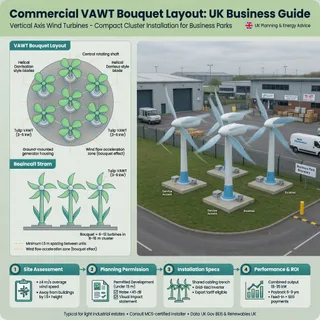
Commercial VAWT bouquet layout - UK business guide
UK business guide Flower Turbines bouquet / cluster
What a commercial bouquet layout actually is
UK enquiries about a commercial VAWT bouquet layout come from businesses and landlords asking whether a close group of small vertical-axis turbines can be built. In the Flower Turbines product family, a bouquet means that tight cluster used as on-site generation. It is not a wind farm and not a UK planning category. Consider it only where rotor-height wind, foundation space, planning for the group, and a connection for every machine are all credible. A sales image is not consent, a connection offer or a measured annual yield.
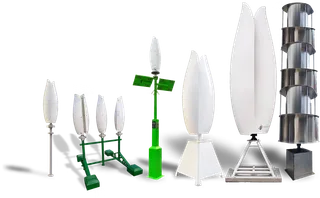
A vertical-axis wind turbine spins on an upright shaft and does not yaw to face the wind. A horizontal-axis turbine is the propeller type and must point into the wind. Those are different machines. Other small vertical-axis products use different shapes and spacing. A layout drawn for one product family should not be treated as the design rules for another.
Rated power, swept area and annual energy are different quantities. Rated power is output at a stated high wind speed. It is not the kilowatt-hours a sheltered commercial plot will produce over a year. Extra machines add swept area, so a group can produce more than one machine if the wind is there. They do not multiply a resource the site does not have.
Why close spacing is not a wind-farm layout
A bouquet puts neighbours close enough for their airflow to interact. That interaction can change output, and sometimes raise it, compared with the same machines standing alone. Published work on closely spaced vertical-axis arrays is background physics for that idea. It is not a measurement of annual energy for a named machine on a British business park. The size and direction of any change depend on spacing, rotation direction, the wind rose and the turbine itself.
In a conventional wind farm, horizontal-axis machines are usually kept many rotor diameters apart so that one wake does not starve the next. Those separation habits do not describe a bouquet. A bouquet does not inherit the output of a multi-megawatt turbine. Close spacing can also add fatigue, noise and visual bulk. Any aerodynamic benefit has to be designed with those effects, not assumed because each rotor is short.
The geometry may also be a warranty condition. Moving units to suit parking bays, signage or a planning preference can leave the spacing the bouquet claim was based on. A tidy site plan is not automatically the cluster that was modelled. Spacing and foundation loads should come from the current installation manual. A marketing render should stay a picture until those dimensions are on the drawing.
What limits annual energy on a business park
Many UK commercial plots are in towns, business parks or retail areas. Mean wind speed at rotor height there is often lower, and turbulence higher, than an open-country map suggests. Power in the wind scales with the cube of wind speed, so a modest drop in speed cuts energy sharply. A dense or architectural grouping does not create wind the site lacks.
Open, elevated or coastal commercial land has a better chance than a courtyard, a street canyon or a sheltered warehouse roof. A regional wind map is not a measurement at the real rotor height. Historical NOABL-style estimates have a record of over-reading sheltered UK sites. A short mast, a remote-sensing campaign or a conservative model that includes turbulence is a design choice. It should not be presented as a legal minimum unless a current standard is cited for that site.
Verified annual energy, capacity factor and any bouquet uplift for these clusters on UK commercial sites were not available as independent public meter data. If a supplier offers a case study, it needs the site wind speed, the period, the number of turbines, the spacing, and a clear statement of whether the figures are metered or modelled. A percentage boost without that context is not a figure to take to a board. Installed cost, design life, warranty and maintenance cost are unknown unless they come from current documents for the proposal in front of you.
Does a business cluster need planning permission?
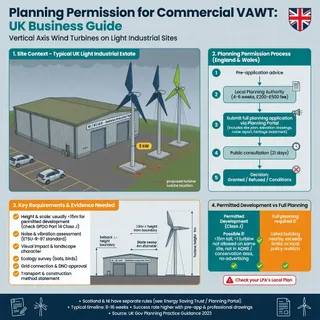
For a commercial installation in England, assume planning permission is needed. Domestic micro-wind permitted development does not carry across to a business bouquet. Scotland, Wales and Northern Ireland use separate consent systems. A conversation about one nation is not an approval, or the same process, in another.
A cluster is a larger visual mass than one short machine. Noise, heritage, ecology and aviation interests are assessed for the group at that location. They are not waived because each rotor is small. Noise is judged at receptors, so a group drawn to face a service yard may still face housing across the boundary. Heritage settings, tight residential edges and sites with aviation or radar constraints often fail on consent even when the machines would physically fit.
A visualisation is not a consent. Public appeal decisions for this product class on UK commercial sites should be checked, not assumed. The useful early step is a pre-application that shows real height, the group footprint, erection access and the nearest sensitive neighbours. That screen is cheaper than designing foundations for a layout the authority will not accept.
How the network sees several small machines
The distribution network operator decides the connection. Several small inverters can add up to a larger application even when each unit looks modest, particularly if the site already has solar or standby generation. The operator looks at combined generation, protection and export, not at a brochure description of the machines as small.
In Great Britain the usual frameworks are G98 notification and G99 application. Do not guess which route applies to a given bouquet from rotor size. It depends on the equipment list, any generation already connected, any export limit and the host operator's current process. Check that against current Energy Networks Association guidance. Type-test evidence, protection settings and earthing have to match the application actually made. If the inverter model, the number of machines or the export limit changes later, the operator may treat that as a different proposal.
Do not assume domestic microgeneration paperwork covers a commercial cluster. Scheme scope has to be checked for the date of the project. Export limitation, metering and ownership of exported units are contract terms, not features of the rotor. A grid-tied cluster is on-site generation, not automatic backup, unless a separate storage and islanding design has been specified and accepted. If rooftop solar is also proposed, the two technologies compete for the same connection headroom even though they use different parts of the site.
Bouquet, one turbine, or rooftop solar
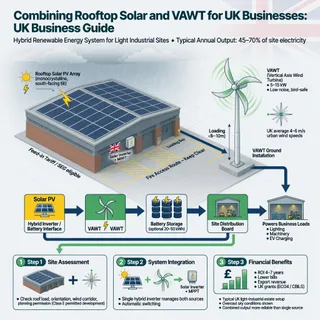
Businesses often reach this question while also looking at rooftop solar for offices, warehouses or retail parks, or at one larger turbine. Those are different site tests. Wind needs an open aspect and creates moving visual and noise effects. Solar needs roof area and daylight. Suitability for one does not decide the other. A solar quotation, or a comparison between solar and grid electricity, does not fill a gap in wind evidence. The useful comparison is what each option asks of the site and of the consent process. None of the points below is a yield or a price. A payback range would be invented unless measured or properly modelled energy, installed price, operating cost and the value of each unit of electricity were all evidenced for that site.
When a commercial bouquet is the wrong project
A bouquet is only a candidate where there is space for a structurally approved group, a credible wind resource at rotor height, and an owner prepared to treat planning, grid and maintenance as a project. That can include some business-park edges, coastal commercial land, campuses with open ground, or industrial plots away from sensitive neighbours. The sector name does not establish suitability. Warehouse, office, hospitality and retail labels say nothing about the wind at rotor height.
It is a poor fit where the only plane is a crowded roof, a courtyard between tall buildings, or a screened car park with low wind and close neighbours. It is also a poor fit if the business needs a reliable offset to a large daytime load and has no evidence that the wind can supply a meaningful share of that load. Accepting wind from any direction avoids yaw error. It does not replace missing wind speed, and it does not remove turbulence losses.
The Encraft Warwick Wind Trials, reported in 2009, found that many building-mounted small turbines on UK urban and suburban sites produced far less than owners expected. That study is not a test of a modern ground-mounted Flower Turbines bouquet. It is only a warning against treating urban small wind as already proven. A demonstration label does not remove planning, noise or grid duties. Nameplate kilowatts are not annual hours of operation.
What has to stay buildable between the machines
The sequence that avoids a redraw is straightforward. Check exposure at rotor height, then neighbours and the consent route, then spare connection capacity, and only then lock a layout to the current manual. Foundations, cable routes and erection access come after that geometry is stable. Starting from a car-park sketch and hoping the wind and warranty spacing will fit afterwards is how these projects stall.
A bouquet is a multi-foundation, multi-cable construction job. Domestic turbine guides usually do not cover it. Foundations have to deal with UK gusts, drainage and buried services. Cable routes across yards or car parks, landlord consent on leased land, and access for erection all decide whether a drawn cluster can be built. Leases often restrict alterations, require reinstatement, and allocate insurance. Business-rates treatment should be checked for the project date rather than assumed from an older note.
Under the Construction (Design and Management) Regulations, a commercial client has duties on a construction project of this kind. Buying a packaged turbine does not discharge those duties. Maintenance access between machines, for blades, bearings and inverters, has to remain after the yard is re-lined. A layout that fills every spare bay can look efficient on day one and then block the only route a crane or a van needs later. If units move after the wind or warranty layout was agreed, both the aerodynamic claim and the structural loads need to be rechecked.
How to test a commercial VAWT bouquet layout UK claim
Independent public meter data for annual energy from these bouquets on UK commercial sites was not available for this guide. Certification status, any incentive eligibility, noise levels, design life, UK installed cost and insurance requirements must come from documents opened for the specific proposal. Registers and scheme rules change. A general article cannot confirm them. A live claim without a source should stay unsourced.
Before a cluster drawing is treated as a project, ask for a short pack and read it against the site rather than against the visualisation. The pack will not remove planning risk. It will show whether the claim is even specified.
If those documents are missing, yield, cost and consent outcome are still unknown. That is a reason to pause, not a reason to scale one machine’s nameplate by the number of machines in the picture. The next useful step is a site walk covering exposure, neighbour distance, buried services, yard or roof conflicts and spare connection capacity, followed by a pre-application and a connection enquiry based on the equipment list that would actually be installed.
Plan, Compare & Buy Renewable Energy Solutions
AI does the thinking.
You get the perfect solar match.
Use RoboMo™ to assess your property, compare available technologies and connect with trusted UK installers, suppliers and manufacturers.
Simply enter your postcode, drop a pin on your roof, create your free account and let RoboMo™ analyse your property to find the best solar panels for your home.

You don't have to think
RoboMo™'s AI analyses your roof and does all the hard work.

Accurate & tailored
AI-powered assessment based on your roof, location, and conditions.

Best options, maximum savings
Compare top solar panels for the best performance and value.

Simple, fast & effortless
Provide a few details, sit back and watch your results unfold.
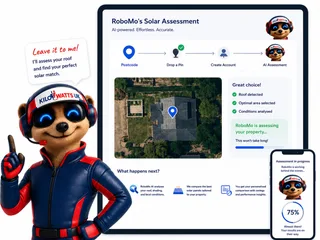
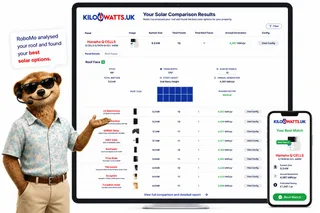
STEP 1
Choose Home, Business or Industrial
Enter your postcode to start your assessment.
STEP 2

Drop a pin on your roof
STEP 3

Create your free account
STEP 4

Sit back and watch RoboMo™ work
RoboMo™ analyses your roof and builds your personalised solar comparison.

Kilowatts UK is an authorised representative
Flower Turbines
Compact vertical-axis turbines built for real UK sites, not just open farmland.
They start in light wind, sit in a small footprint, and are bird-safe by design. Cluster them as a bouquet and the group performs better together than the same turbines standing alone. Enter your postcode for a location-based generation estimate. Figures use area weather data and will differ if buildings, trees or hills sit in the way.
Starts in light UK wind
Built to generate in typical UK wind, not only open farmland.
Small rooftop or ground footprint
Compact towers for roofs, yards and tight sites.
Bird-safe slow rotation
Slow vertical-axis spin, bird-safe by design.
Bouquet clusters raise output
Grouped turbines outperform the same units standing alone.
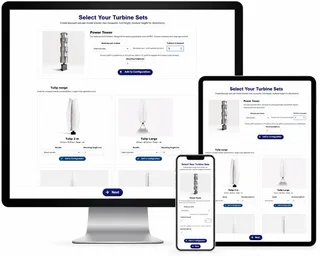
Step 1
Enter your postcode
Start designing your wind energy system in seconds.

STEP 2

Choose a location
STEP 3

Place your cluster
Tap the map where you want the turbine cluster to go.
STEP 4

Instant generation forecasts
Compare different turbine layouts and see annual generation forecasts instantly.
STEP 5

No commitment required
Explore different configurations before deciding whether to request a quotation.
Related articles
Mo's Mission Nominations
FAQ
Need Help? RoboMo's Got Answers
What is a commercial VAWT bouquet layout?
In the Flower Turbines product family, a bouquet is a tight cluster of small vertical-axis turbines used as on-site generation. It is not a wind farm and not a UK planning category. A vertical-axis machine spins on an upright shaft and does not yaw to face the wind, unlike a propeller-type horizontal-axis turbine. A layout drawn for one product family should not be treated as the design rules for another. A sales image is not planning consent, a connection offer or a measured annual yield.
Will close spacing make a bouquet produce more energy?
Turbines in a bouquet stand close enough for their airflow to interact, and that interaction can change output, sometimes raising it compared with the same machines standing alone. Published work on closely spaced vertical-axis arrays is background physics, not a measurement of annual energy for a named machine on a British business park. Any change depends on spacing, rotation direction, the wind rose and the turbine itself. Close spacing can also add fatigue, noise and visual bulk. Extra machines add swept area only if the wind is there; they do not multiply a resource the site lacks.
Why can a business-park bouquet produce less than its rated power suggests?
Rated power is output at a stated high wind speed, not the kilowatt-hours a sheltered commercial plot will produce over a year. Many UK business parks, towns and retail sites have lower mean wind speed at rotor height, and higher turbulence, than an open-country map suggests. Power in the wind scales with the cube of wind speed, so a modest drop in speed cuts energy sharply. Historical NOABL-style estimates have a record of over-reading sheltered UK sites. Independent public meter data for annual energy from these bouquets on UK commercial sites were not available for this guide.
Does a commercial bouquet need planning permission?
For a commercial installation in England, assume planning permission is needed. Domestic micro-wind permitted development does not carry across to a business bouquet. Scotland, Wales and Northern Ireland use separate consent systems, so a discussion about one nation is not an approval, or the same process, in another. Noise, heritage, ecology and aviation interests are assessed for the group at that location, not waived because each rotor is small. A visualisation is not a consent, and appeal decisions for this product class should be checked rather than assumed.
How does the distribution network treat several small turbines?
The distribution network operator decides the connection. Several small inverters can add up to a larger application even when each unit looks modest, especially if the site already has solar or standby generation. In Great Britain the usual frameworks are G98 notification and G99 application, but the route depends on the equipment list, generation already connected, any export limit and the host operator’s current process, not on rotor size alone. Do not assume domestic microgeneration paperwork covers a commercial cluster. A grid-tied group is on-site generation, not automatic backup, unless a separate storage and islanding design has been specified and accepted.
Should a bouquet be compared with one larger turbine or rooftop solar?
These are different site tests. Wind needs a credible resource at rotor height and creates moving visual and noise effects, while solar needs usable roof structure, orientation and daylight. A good solar case, or a comparison between solar and grid electricity, does not prove the wind resource. Wind-farm spacing habits for large horizontal-axis machines do not describe a bouquet, and a bouquet does not inherit the output of a multi-megawatt turbine. None of those options is a yield or a price unless measured or properly modelled energy, installed price, operating cost and the value of each unit are evidenced for that site.
When is a commercial VAWT bouquet the wrong project?
It is a poor fit on a crowded roof, in a courtyard between tall buildings, or in a screened car park with low wind and close neighbours. It is also a poor fit if the business needs a reliable offset to a large daytime load and has no evidence that the wind can supply a meaningful share of that load. Accepting wind from any direction avoids yaw error, but it does not replace missing wind speed or remove turbulence losses. The Encraft Warwick Wind Trials, reported in 2009, found that many building-mounted small turbines on UK urban and suburban sites produced far less than owners expected. That study is not a test of a modern ground-mounted Flower Turbines bouquet; it is a warning against treating urban small wind as already proven.
What should you ask for before treating a cluster drawing as a project?
Ask for rotor-height wind speed, the period covered, and whether the figure is measured or modelled, including turbulence. Also ask for the number of machines, spacing, rotation direction, whether that geometry is a warranty condition, and any energy or bouquet uplift stated with the same site context. Inverter evidence, noise data, foundation loads, the planning route for that nation, and the host operator’s view of the combined generation should come from current documents, not a render. Foundations, cable routes, lease constraints and erection access decide whether the group can be built, and a commercial client still has duties under the Construction (Design and Management) Regulations. If those documents are missing, yield, cost and consent outcome remain unknown.