


Combining rooftop solar and VAWT for UK businesses: UK
Published: 2026-09-29 04:40:28
Updated: 2026-10-02 15:51:32
Combining rooftop solar and a VAWT is a UK design question, not a ready-made bundle. Check hub-height wind, structure, consent and the DNO connection.
Combining rooftop solar and VAWT for UK businesses - UK business guide
UK business guide B Solar + Flower Turbines hybrid site
Combining rooftop solar and VAWT for UK businesses
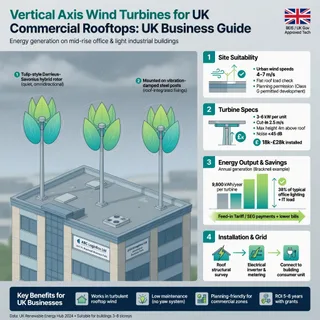
Rated power in kilowatts is not annual energy. Solar follows daylight and season. A VAWT follows wind speed at the rotor, which buildings often slow and make turbulent. No saving should be claimed until planning, structure, connection and metering have been designed for that site.
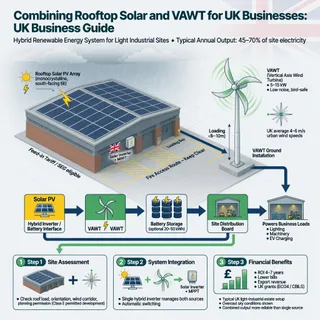
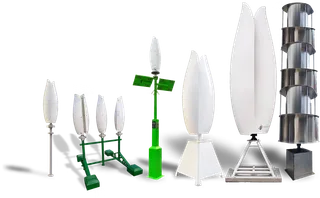
A pairing of a rooftop array with a tulip-form machine is a product combination to assess. That includes rotors sold as Flower Turbines, sometimes discussed alongside a B Solar installation. It is not a measured UK case study. Location, capacities, planning reference and twelve-month metered output are not stated here, because none were available to verify. A brochure image is not evidence.
What a hybrid site does and does not combine
Rooftop solar here means grid-connected modules on a commercial roof, used mainly to offset electricity the business would otherwise import. The turbine does not become part of that array because it stands on the same site. Wind resource, solar resource, foundation or roof fixing, planning and servicing stay separate, even when both machines use one switchboard and one network connection.
The electrical arrangement is alternating-current coupling. Each generator has its own inverter or generator interface, its own protection and its own meter, and both land on the site switchboard. Flower Turbines, as a brand in this class, are sold for relatively low mounting heights and built-up sites. That is a sales positioning until a site-specific yield and a structural pack say otherwise.
Assuming one small hybrid inverter will accept both the array and the turbine is a frequent error. The turbine’s generator type sets protection and power quality. If that schematic is not in the pack, the job is not ready to price as an install. Separate generation meters also stop a weak turbine result being hidden inside a healthy solar figure.
Does UK winter wind cover low solar months?
No. A seasonal tendency towards brighter months for solar, and often windier conditions in the darker months, does not prove hour-by-hour cover on a given estate. Useful output depends on mean wind speed and turbulence at rotor height. It does not follow from a regional label, or from the rotor accepting wind from any direction.
“Works in any direction” does not mean useful output in light wind, or in the lee of the building the business occupies. A rotor beside a large shed can sit in that building’s wake for long periods. Turbulence can increase fatigue and can reduce output against a smooth-flow power curve. Sheltered industrial estates, enclosed retail parks and city offices are often poor. Exposed coastal, hill or open sites are a different case, and even there the estimate has to be made at the hub.
Night-time wind only displaces imports where the site actually runs load overnight and the resource is real. Daytime offices, shops and many warehouses line up better with solar, because that is when they import. The site still needs a grid import and export arrangement. Neither machine is a backup for the other. Each can fail, be refused consent, or be limited at the connection.
Can the VAWT share the roof with the modules?
Do not assume the turbine can share the roof. Most commercial roofs are designed for static loads and for plant such as a photovoltaic array, not for the repeated loads of a rotor. A ground mast avoids putting that cyclic load into the frame, but it needs land, a foundation, lifting access, and clear vehicle and fire routes. If the only picture in the offer is a turbine among the modules, ask for the structural calculations before anything else.
A rotor on or near the array can shade modules, block cleaning access and pass vibration into the building. Roof works still have to preserve fire breaks, walkways and the membrane warranty. A roof photograph is not landlord consent, and it is not a letter from the membrane manufacturer. Listed buildings, tight visual settings and sites with no foundation or lifting access should be treated as unsuitable until evidence says otherwise.
Where the lease blocks alterations, or the roof cannot be certified for cyclic load, stop the hybrid and keep the solar design honest. Adding a turbine only to force a hybrid label does not make consent easier. It can lengthen both planning and the network application.
Does a second generator change the DNO application?
Yes, it can. The distribution network operator looks at the plant as a whole, not at the solar array in isolation. Adding wind can change aggregate capacity, export and protection, so a solar application that was already in train may have to be restated. Planning permission and the network agreement are separate approvals. One does not deliver the other.
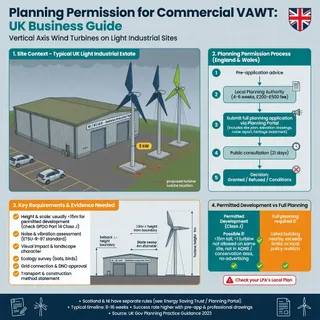
In some parts of the UK, certain rooftop solar work can be permitted development. The tests differ by nation and they change, so they must be checked for that building rather than copied from a previous job. A VAWT should not be treated as covered by solar permitted development. Planning and building control may ask for calculations to a named standard and for a noise report. Those come from the manufacturer and a structural engineer, not from a solar layout.
In Great Britain the connection is agreed with the distribution network operator. G98 and G99 are the engineering recommendations that usually frame that application. Which one applies depends on the plant and the documents in force. This guide does not state a kilowatt threshold. Those limits, and the way solar and wind capacity are added together, have to be taken from the current documents. A second generator can move the job across a boundary. Northern Ireland uses a different operator and a different process, so a Great Britain assumption should not be carried across. Commercial solar versus continued grid import is already a connection question: how much of the array the site can use, and how much it may export. Export limitation that was acceptable for solar alone can waste the turbine if the limit binds whenever both run. When the inverter, the turbine interface or the export limit changes, the operator may treat the proposal as a different plant. If the solar scope is still open, it helps to compare a commercial solar installation on its own before a turbine is allowed to reshape the connection.
How to test a quoted VAWT yield
A sales power curve is not a yield. Annual energy cannot be taken from rated power, and it cannot be equated to a solar array of the same kilowatt rating. The estimate needs wind speed at rotor height, measured for long enough to represent the site, and corrected for nearby obstacles. A short sensor on a parapet often records roof turbulence and can mislead in either direction.
Warranty length, service interval, availability, noise at a stated distance, start-up speed and the power curve are product data. They are not general UK ranges. No verified UK capacity factor for this VAWT class on business sites is used here, so none is implied. If those documents are missing, do not fill the gap with a percentage from a brochure. Commissioning should record noise, vibration and shut-down behaviour, not only the first day’s energy.
Installed cost for a commercial solar-plus-VAWT hybrid is not stated, because no verified UK price for this pairing was available. There is also no single commercial solar panel cost for UK warehouses. Roof repairs, access, electrical upgrades and region move the solar figure on their own, before a turbine is added. Payback against grid electricity is unknown until site load, the import tariff and a defensible yield are all on the table. Ask for the solar scope and the wind scope as separate lines, each with its exclusions.
Which business sites justify the extra design
Design time is justified where hub-height wind is credible, there is a mast position or a structure an engineer will certify, the roof suits solar, and demand can use generation the array does not already cover. The business also needs time for planning and a revised connection, and a budget for a yield study rather than a sales curve. More plausible plots are exposed, with space around the rotor and few close neighbours. It is a weak fit for sheltered warehouses, enclosed retail parks and urban offices with poor wind or sensitive neighbours. Commercial rooftop solar for UK offices is often the stronger project on its own, because office import is concentrated in daylight and city wind at a low mounting height is frequently disappointing. Solar for UK retail parks and shops has the same daytime logic, and an enclosed park can put a rotor in building wake for much of the year. A quiet sales line is not a noise assessment where homes or other units sit close by. The comparison below is a decision frame, not a performance ranking. It does not assign costs, yields or carbon savings. Where export limitation would waste the second generator, or the firm needs a more predictable solar-only project, stop at solar. That is a site judgement, not a verdict on either technology in the abstract.
What to have in hand before a saving is quoted
A combined headline kilowatt figure is not a design. Landlord consent, tenant interfaces and insurer notification belong before the order, not after it. Turbine maintenance is mechanical work on bearings, blades and brakes, often at height, and it is not a solar cleaning visit. If the named model has no structural pack, noise file and electrical schematic, the hybrid should not be described as ready to install.
The single-line diagram should show each generator, its protection, its meter and any export limit the network operator requires. Roof works should show how fire breaks, walkways and the membrane warranty survive both the array and any mast or fixing. If a supplier cannot separate those items from the sales curve, the quote is not yet a build price.
Before a price is treated as an offer to build, the pack should include the following.
If any of those are missing, the honest next step is a solar-only design, or a paid yield and structure study, not an order. Note when the building is actually occupied, and use half-hourly import data if you have it, so night wind is not credited for hours when the site is dark and shut. Ask the relevant network process how the combined plant will be assessed before anyone locks a layout. That sequence keeps an unproven turbine from displacing a solar project the roof and the daytime load can already support.
Plan, Compare & Buy Renewable Energy Solutions
AI does the thinking.
You get the perfect solar match.
Use RoboMo™ to assess your property, compare available technologies and connect with trusted UK installers, suppliers and manufacturers.
Simply enter your postcode, drop a pin on your roof, create your free account and let RoboMo™ analyse your property to find the best solar panels for your home.

You don't have to think
RoboMo™'s AI analyses your roof and does all the hard work.

Accurate & tailored
AI-powered assessment based on your roof, location, and conditions.

Best options, maximum savings
Compare top solar panels for the best performance and value.

Simple, fast & effortless
Provide a few details, sit back and watch your results unfold.
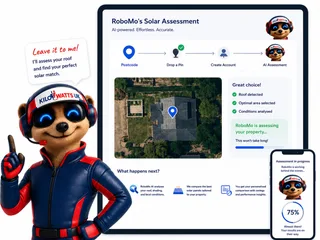

STEP 1
Choose Home, Business or Industrial
Enter your postcode to start your assessment.
STEP 2

Drop a pin on your roof
STEP 3

Create your free account
STEP 4

Sit back and watch RoboMo™ work
RoboMo™ analyses your roof and builds your personalised solar comparison.

Kilowatts UK is an authorised representative
Flower Turbines
Compact vertical-axis turbines built for real UK sites, not just open farmland.
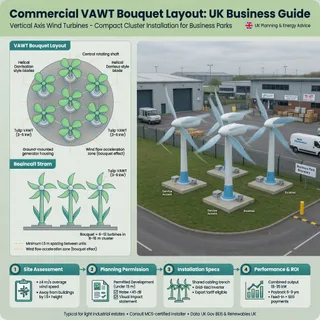
They start in light wind, sit in a small footprint, and are bird-safe by design. Cluster them as a bouquet and the group performs better together than the same turbines standing alone. Enter your postcode for a location-based generation estimate. Figures use area weather data and will differ if buildings, trees or hills sit in the way.
Starts in light UK wind
Built to generate in typical UK wind, not only open farmland.
Small rooftop or ground footprint
Compact towers for roofs, yards and tight sites.
Bird-safe slow rotation
Slow vertical-axis spin, bird-safe by design.
Bouquet clusters raise output
Grouped turbines outperform the same units standing alone.

Step 1
Enter your postcode
Start designing your wind energy system in seconds.

STEP 2

Choose a location
STEP 3

Place your cluster
Tap the map where you want the turbine cluster to go.
STEP 4

Instant generation forecasts
Compare different turbine layouts and see annual generation forecasts instantly.
STEP 5

No commitment required
Explore different configurations before deciding whether to request a quotation.
Related articles
Mo's Mission Nominations
FAQ
Need Help? RoboMo's Got Answers
Is rooftop solar plus a VAWT a ready-made package for a UK business?
No. Combining rooftop solar and a vertical-axis wind turbine is a site design question, not a standard bundle. The two remain separate generators, with different wind and solar resources, structures, consents and maintenance, even if they share one switchboard and one network connection. A brochure image, including pairings sold with tulip-form machines such as Flower Turbines, is not a measured UK case study. The hybrid is worth design time only where wind at rotor height is credible, an engineer can certify a mast or fixing, and the site can use the extra energy.
Does winter wind make up for months when solar output is low?
Not on its own. A tendency for brighter months to favour solar, and for darker months to be windier, does not prove hour-by-hour cover on a given estate. Useful output depends on mean wind speed and turbulence at rotor height, not on a regional label or on the rotor accepting wind from any direction. A machine beside a large building can sit in that building’s wake for long periods, and turbulence can cut output and increase fatigue. Night-time wind only displaces imports where the site actually runs load overnight and the resource is real.
Can a VAWT share the roof with the solar modules?
Do not assume it can. Most commercial roofs are designed for static loads and for plant such as a photovoltaic array, not for the repeated loads of a rotor. A turbine on or near the array can shade modules, block cleaning access and pass vibration into the building, and roof works still have to preserve fire breaks, walkways and the membrane warranty. A ground mast avoids putting that cyclic load into the frame, but it needs land, a foundation, lifting access and clear vehicle and fire routes. If the lease blocks alterations, or an engineer cannot certify the roof, stop the hybrid and keep the solar design honest.
Does adding a wind turbine change the network application?
Yes, it can. The distribution network operator looks at the plant as a whole, so adding wind can change aggregate capacity, export and protection, and a solar application already in train may have to be restated. Planning permission and the network agreement are separate approvals, and a VAWT should not be treated as covered by any permitted development that may apply to certain rooftop solar. In Great Britain, G98 and G99 usually frame the connection, but which one applies, and how solar and wind capacity are added together, must be taken from the documents in force rather than from a fixed figure in a general guide. Northern Ireland uses a different operator and process, and an export limit set for solar alone can waste turbine output if it binds whenever both machines run.
How should a quoted VAWT yield be checked?
A sales power curve is not a yield. Annual energy cannot be taken from rated kilowatts, and it cannot be equated to a solar array of the same rating. The estimate needs wind speed at rotor height, measured for long enough to represent the site and corrected for nearby obstacles, because a short sensor on a parapet often records roof turbulence and can mislead. Warranty length, service interval, noise, start-up speed and the power curve are product data, not general UK ranges, and no verified UK capacity factor for this class of machine on business sites should be assumed. If those documents are missing, do not fill the gap with a percentage from a brochure.
Which UK business sites justify the extra design?
Design time is more plausible where hub-height wind is credible, there is a mast position or a structure an engineer will certify, the roof suits solar, and demand can use generation the array does not already cover. Exposed sites with space around the rotor and few close neighbours are the clearer candidates. Sheltered warehouses, enclosed retail parks and urban offices are often a weak fit, because building wake, poor wind at a low mounting height, or sensitive neighbours can undermine the turbine. Where daytime import already lines up with solar, or an export limit would waste the second generator, a solar-only project is often the more predictable choice.
Can one hybrid inverter serve both the solar array and the turbine?
Do not assume so. The usual arrangement is alternating-current coupling: each generator has its own inverter or generator interface, its own protection and its own meter, and both land on the site switchboard. The turbine’s generator type sets protection and power quality, so if that schematic is not in the pack the job is not ready to price as an install. Separate generation meters also stop a weak turbine result being hidden inside a healthy solar figure.
What should be in hand before a saving from the hybrid is quoted?
A combined headline kilowatt figure is not a design, and this guide does not state an installed cost because no verified UK price for the pairing was available. Before a price is treated as an offer to build, ask for a hub-height wind study, structural calculations an engineer will certify, a single-line diagram showing each generator, its protection, its meter and any export limit, a noise assessment, and a checked consent route covering landlord approval, insurer notification and planning in that UK nation. Turbine maintenance is mechanical work on bearings, blades and brakes, often at height, and it is not a solar cleaning visit. If any of those items are missing, the honest next step is a solar-only design, or a paid yield and structure study, not an order.