


Planning permission for commercial VAWT: UK business guide
Published: 2026-09-29 05:04:33
Updated: 2026-10-02 19:51:15
Planning permission for a commercial VAWT in the UK should be treated as required until a planner checks that nation's rules for the site and turbine.
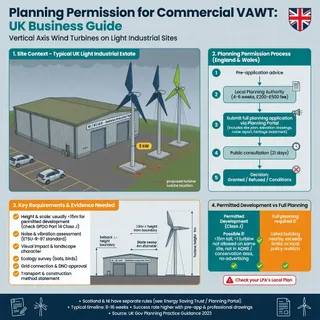
Planning permission for commercial VAWT - UK business guide
UK business guide Flower Turbines planning no invented PD rights
Does commercial VAWT planning permission apply in the UK?
Planning permission for commercial VAWT projects in the UK should be treated as required unless a planning professional has checked the current permitted development order for that nation against the exact site and turbine, in writing. A vertical-axis wind turbine on business land or a non-domestic building is normally development. Flower Turbines and other small VAWTs are products, not a planning use class and not an exemption. The local planning authority decides whether the proposal is acceptable in planning terms. That decision is separate from building regulations, the landlord’s consent, and any agreement to connect generation to the network.
The answer depends on the nation, the constraints on that site, and the hardware you propose. Height, colour, noise, roof fixings, and whether you mean one unit or a cluster all change what the authority will examine. England, Wales, Scotland and Northern Ireland each have their own planning legislation and policy. This guide does not describe a permitted development right for commercial VAWTs. It does not treat any model as already acceptable to a council.
A roof, a car park, or a proposed trial does not, by itself, remove the need for permission. Installing first and seeking permission later is a poor route. So is copying householder turbine rules, or the permitted development and prior-approval route used for some non-domestic solar.
What planning permission does and does not authorise
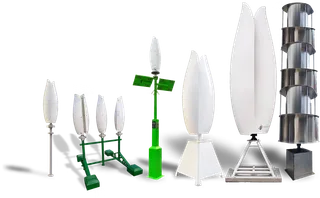
A grant of planning permission, if you receive one, authorises the development described in the approved drawings and conditions. It does not connect the turbine to the electricity network, certify that a roof can carry the load, or override a commercial lease. A connection offer from the distribution network operator, often called the DNO, does not authorise construction either. These regimes run beside each other. Any one of them can stop a project that looks acceptable on the others. A short, coloured or sculptural unit is not too minor to count as development merely because it is compact or decorative. Flower-type turbines make colour, siting and cumulative appearance more prominent than a plain mast would. Logos or promotional graphics on the units may also raise advertisement consent, which is a separate question for the authority. Listed building consent is likewise separate where works affect a listed building.
Why commercial solar rules do not transfer to a VAWT
Non-domestic solar has its own permitted development and prior-approval rules. Those rules are not a template for wind. A vertical-axis machine has a rotor, a different visual profile, and different noise and vibration questions. National planning policy that supports renewable energy is one material consideration. It is not a grant of permission. Amenity, heritage and safety can still justify refusal or conditions on a particular site.
This guide does not state a size limit, an exclusion, or an Article 4 interaction for non-domestic wind. Those points have to be read from the current order for the nation in question, against the exact site and turbine. Where a permitted development class exists for a different type of development, listed buildings, conservation areas and Article 4 directions can still remove or restrict rights. Do not assume a class written for solar, or for a householder turbine, applies to a commercial VAWT.
A certificate of lawfulness is the formal route if someone contends the work would be lawful without planning permission. It is not a shortcut. It is not something to assume from a product brochure. If an application is needed, the fee must be taken from the current fee schedule for that nation. Fees are not quoted here.
What the local planning authority will weigh
The authority can weigh design and appearance, noise and vibration, neighbour amenity, landscape or townscape, heritage, ecology, highway safety, and aviation or defence safeguarding. For sculptural and flower-type units, colour and cumulative visual impact carry more weight than they would for a plain mast. A manufacturer’s sound-pressure figure at a set distance is not automatically an acceptable noise assessment for the nearest dwelling or workplace. Environmental health usually expects a method agreed for that site, not a figure lifted from a brochure.
Effects on birds and bats are site-specific. A vertical axis does not take ecology out of the decision. Constraints are stronger near designated sites and where bats or birds are already a known issue. If that work is in scope, survey seasons can delay a valid application. The relevant nature body’s standing advice sets the season, not the project programme. Environmental impact assessment screening may also apply, depending on scale and location. Any threshold has to come from the current regulations for that nation.
Safeguarding zones around aerodromes and defence sites appear on local constraint maps. They may trigger consultation even for short turbines. Lighting or height triggers should be taken from a current Civil Aviation Authority or Ministry of Defence source before anyone treats a figure as a rule. In England, statutory determination targets differ for non-major, major and environmental impact assessment applications. Those targets are not a prediction of approval. They exclude time spent on surveys and pre-application advice. Whether a scheme is major development depends on legal tests, including site area and floorspace. Check those tests in the current regulations rather than guessing. Wales, Scotland and Northern Ireland use their own procedure periods.
How roof mounts, car parks and clusters change the proposal
A rooftop VAWT is not a ground turbine redrawn on a roof plan. The authority, and a structural adviser, will want to know how the unit is fixed, how vibration reaches occupied space, and how it will be maintained without unsafe access. A supplier’s generic base detail is not a structural design for that roof and those fixings. Building regulations, covering structure and electrical work, remain a separate decision from planning permission. A roof warranty and the insurer’s requirements are commercial constraints the planning officer will not resolve.
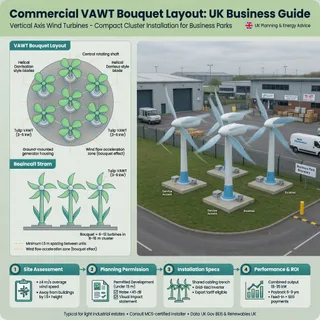
A car park or yard location raises different issues. These include highway safety, pedestrian routes, and how close the rotor comes to a boundary. Rotors should not oversail neighbouring land unless the title or a neighbour’s agreement allows it. That check sits with the title, not with the planning officer. A cluster needs a layout showing spacing, maintenance access, cable routes, and the relationship to public viewpoints. Describing one turbine when the proposal is several units understates cumulative appearance and noise.
In sensitive locations the authority may ask for photomontages. That is case by case. It is not a universal extra, and a marketing render is not a substitute. Pre-application advice is the usual way to learn whether aviation consultees, heritage officers or environmental health will be involved, and what noise method they expect. It is also where you learn whether the authority sees the job as a straightforward local application or something that needs a wider assessment.
What a usable application usually contains
Clients often instruct a supplier before the authority has seen a drawing. That order creates rework when height, colour or the number of units changes. A commercial VAWT application usually needs enough drawn information for someone who has not visited the site to understand overall height, rotor extent, finish, cable route, and how the units sit against neighbours and public views. The planning statement should address appearance and amenity, not only carbon saving. Height, colour, noise data, and base or roof-fix details have to come from the manufacturer for the stated model. Those details are not a certification. They are not evidence that an authority has already accepted the unit.
Noise and vibration should be scoped with the authority, usually through environmental health. A rooftop scheme needs a structural assessment from someone competent to assess that roof. Ecology scope, if any, should be agreed early. A seasonal survey cannot be compressed into the week before submission. Approval rates for commercial VAWTs, and for Flower Turbines specifically, are not stated here. A time-limited or conditional consent is sometimes used for renewable equipment, but there is no standard trial period to quote.
Those drawings are the minimum for a readable case. Photomontages, ecology reports and a formal noise assessment are added when pre-application advice or the site constraints show they are needed, not as a fixed pack for every car park.
When a commercial VAWT is a weak planning case
This topic suits UK organisations considering one or more small VAWTs on commercial, industrial, retail, campus or similar non-domestic land or buildings, including products marketed as Flower Turbines. It is a poor fit where the business does not control the land, the landlord will not allow alterations, or the organisation intends to install first and seek permission later. Householder turbine rules are a different regime and should not be used to build a commercial exemption. Utility-scale onshore wind, and larger schemes that fall into a national electricity or infrastructure consent route, also sit outside this guide. Those routes depend on scale and nation. They must be checked rather than assumed.
A site can still be a weak candidate after that filter. Safeguarded aviation or defence areas, sensitive heritage settings, designated nature sites, and roofs that cannot take the load are planning and site-constraint judgements. They are not a comment on a brand. Policy support for renewables does not cure a poor relationship to a listed building, a conservation area, or a neighbour’s windows. Claims that VAWTs are silent, risk-free for wildlife, or landscaping rather than development are not planning facts. A unit can produce aerodynamic and mechanical noise. A roof mount can carry vibration into occupied rooms.
If the occupier is a tenant, the lease often forbids alterations without the landlord. That conversation should happen before drawings are commissioned as if consent were a formality. Insurer notification and any roof warranty condition belong in the same early check. The authority will not negotiate those points for you. A site the business cannot alter, or a roof that cannot carry the fixings, is a reason to stop, not a reason to submit a thinner application.
Conditions you should expect and what to do next
Permission, if granted, is often conditional. Conditions can cover noise, colour, lighting, ecology measures, construction hours, and removal if the turbine is unused for a stated period. They are enforceable. A removal condition is not a suggestion. Read it against how the site actually operates, including seasons when the premises are quiet. Refusal is also a real outcome. Amenity, heritage and safety can outweigh the renewable energy benefit on that plot, even where national policy is supportive.
The practical sequence is to identify the local planning authority and the site owner, then fix the model details you will submit. That includes height, colour, base or roof fix, and whether the proposal is one unit or a group. Ask a planning professional to check the current permitted development position for that nation, in writing, before anyone treats the scheme as exempt. Use pre-application advice to agree the noise method, any viewpoint work, and which consultees matter. Run the structural, lease and boundary checks in parallel. Make the network connection application as its own process. It does not start, pause or replace the planning application.
Costs of turbines, installation, planning fees, consultant reports and grid connection are not stated here. They depend on the model, the nation and the site. Output, noise in decibels and service life are likewise unknown without the manufacturer’s data for that model and an assessment of that site. The useful next step is a measured brief: the site address, roof or ground location, the proposed number of units, and the constraints already visible on the authority’s map. That is what changes the programme and the scope of reports, not a generic small-wind claim.
Plan, Compare & Buy Renewable Energy Solutions
AI does the thinking.
You get the perfect solar match.
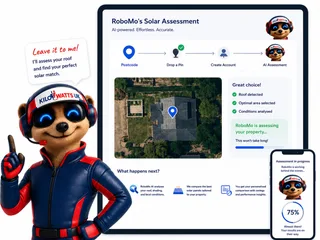
Use RoboMo™ to assess your property, compare available technologies and connect with trusted UK installers, suppliers and manufacturers.
Simply enter your postcode, drop a pin on your roof, create your free account and let RoboMo™ analyse your property to find the best solar panels for your home.

You don't have to think
RoboMo™'s AI analyses your roof and does all the hard work.

Accurate & tailored
AI-powered assessment based on your roof, location, and conditions.

Best options, maximum savings
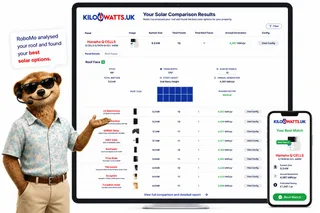
Compare top solar panels for the best performance and value.

Simple, fast & effortless
Provide a few details, sit back and watch your results unfold.
STEP 1
Choose Home, Business or Industrial
Enter your postcode to start your assessment.
STEP 2
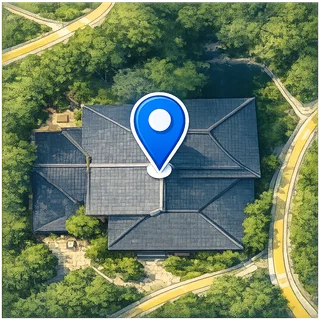
Drop a pin on your roof
STEP 3

Create your free account
STEP 4

Sit back and watch RoboMo™ work
RoboMo™ analyses your roof and builds your personalised solar comparison.

Kilowatts UK is an authorised representative
Flower Turbines
Compact vertical-axis turbines built for real UK sites, not just open farmland.
They start in light wind, sit in a small footprint, and are bird-safe by design. Cluster them as a bouquet and the group performs better together than the same turbines standing alone. Enter your postcode for a location-based generation estimate. Figures use area weather data and will differ if buildings, trees or hills sit in the way.
Starts in light UK wind
Built to generate in typical UK wind, not only open farmland.
Small rooftop or ground footprint
Compact towers for roofs, yards and tight sites.
Bird-safe slow rotation
Slow vertical-axis spin, bird-safe by design.
Bouquet clusters raise output
Grouped turbines outperform the same units standing alone.
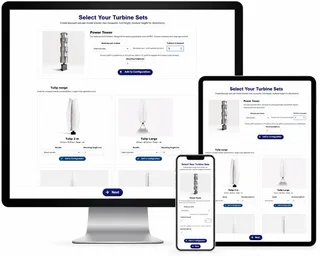
Step 1
Enter your postcode
Start designing your wind energy system in seconds.
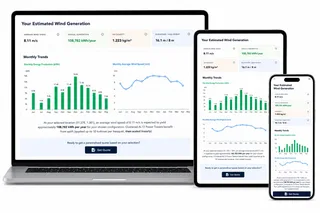
STEP 2

Choose a location
STEP 3

Place your cluster
Tap the map where you want the turbine cluster to go.
STEP 4

Instant generation forecasts
Compare different turbine layouts and see annual generation forecasts instantly.
STEP 5

No commitment required
Explore different configurations before deciding whether to request a quotation.
Related articles
Solar panels
Mo's Mission Nominations
FAQ
Need Help? RoboMo's Got Answers
Does a commercial VAWT need planning permission in the UK?
Treat planning permission as required unless a planning professional has checked the current permitted development order for that nation against the exact site and turbine, in writing. A vertical-axis wind turbine on business land or a non-domestic building is normally development. England, Wales, Scotland and Northern Ireland each have their own planning legislation, and this guide does not describe a permitted development right for commercial VAWTs. A roof, a car park or a proposed trial does not, by itself, remove the need for permission, and installing first is a poor route.
Are Flower Turbines or other small VAWTs exempt because they are compact or decorative?
No. Flower Turbines and other small VAWTs are products, not a planning use class and not an exemption. A short, coloured or sculptural unit is not too minor to count as development merely because it is compact or decorative. The local planning authority decides whether the proposal is acceptable in planning terms. Logos or promotional graphics on the units may also raise advertisement consent, which is a separate question.
What does planning permission authorise, and what does it leave untouched?
If granted, planning permission authorises the development described in the approved drawings and conditions. It does not connect the turbine to the electricity network, certify that a roof can carry the load, or override a commercial lease. A connection offer from the distribution network operator does not authorise construction either. Building regulations, landlord or freeholder consent, and listed building consent where works affect a listed building, are separate decisions.
Can non-domestic solar or householder wind rules be used for a commercial VAWT?
No. Non-domestic solar has its own permitted development and prior-approval rules, and those rules are not a template for wind. Householder turbine rules are a different regime and should not be used to build a commercial exemption. National policy that supports renewable energy is one material consideration, not a grant of permission. If someone contends the work would be lawful without planning permission, a certificate of lawfulness is the formal route, not an assumption drawn from a product brochure.
What will the local planning authority weigh?
The authority can weigh design and appearance, noise and vibration, neighbour amenity, landscape or townscape, heritage, ecology, highway safety, and aviation or defence safeguarding. For sculptural and flower-type units, colour and cumulative visual impact carry more weight than they would for a plain mast. A manufacturer’s sound-pressure figure is not automatically an acceptable noise assessment for the nearest dwelling or workplace. A vertical axis does not take birds or bats out of the decision, and environmental impact assessment screening may also apply depending on scale and location.
How do a roof mount, a car park or a cluster change the proposal?
A rooftop VAWT is not a ground turbine redrawn on a roof plan. The authority, and a structural adviser, will want to know how the unit is fixed, how vibration reaches occupied space, and how it will be maintained without unsafe access. A car park or yard raises highway safety, pedestrian routes, and whether the rotor would oversail neighbouring land. A cluster needs a layout showing spacing, maintenance access, cable routes and the relationship to public viewpoints, because describing one turbine when several are proposed understates cumulative appearance and noise.
What does a usable commercial VAWT application usually contain?
It usually needs a location plan, layout and elevations showing overall height, rotor extent, spacing and maintenance access, the actual colour and finish, and the cable route to the building electrical system. The planning statement should address appearance and amenity, not only carbon saving. Noise and vibration should be scoped with the authority, usually through environmental health, and a rooftop scheme needs a structural assessment from someone competent to assess that roof. Manufacturer details are not a certification and are not evidence that an authority has already accepted the unit.
When is a commercial VAWT a weak case, and what should happen before you apply?
It is a poor fit where the business does not control the land, the landlord will not allow alterations, or the organisation intends to install first and seek permission later. Safeguarded aviation or defence areas, sensitive heritage settings, designated nature sites, and roofs that cannot take the load can also make a site weak, and policy support for renewables does not cure those constraints. Fix the model details, ask a planning professional to check the current permitted development position in writing, and use pre-application advice to agree the noise method and consultees. Run structural, lease, insurer, warranty and boundary checks in parallel, and treat the network connection as its own process. Permission, if granted, is often conditional, and refusal remains a real outcome.